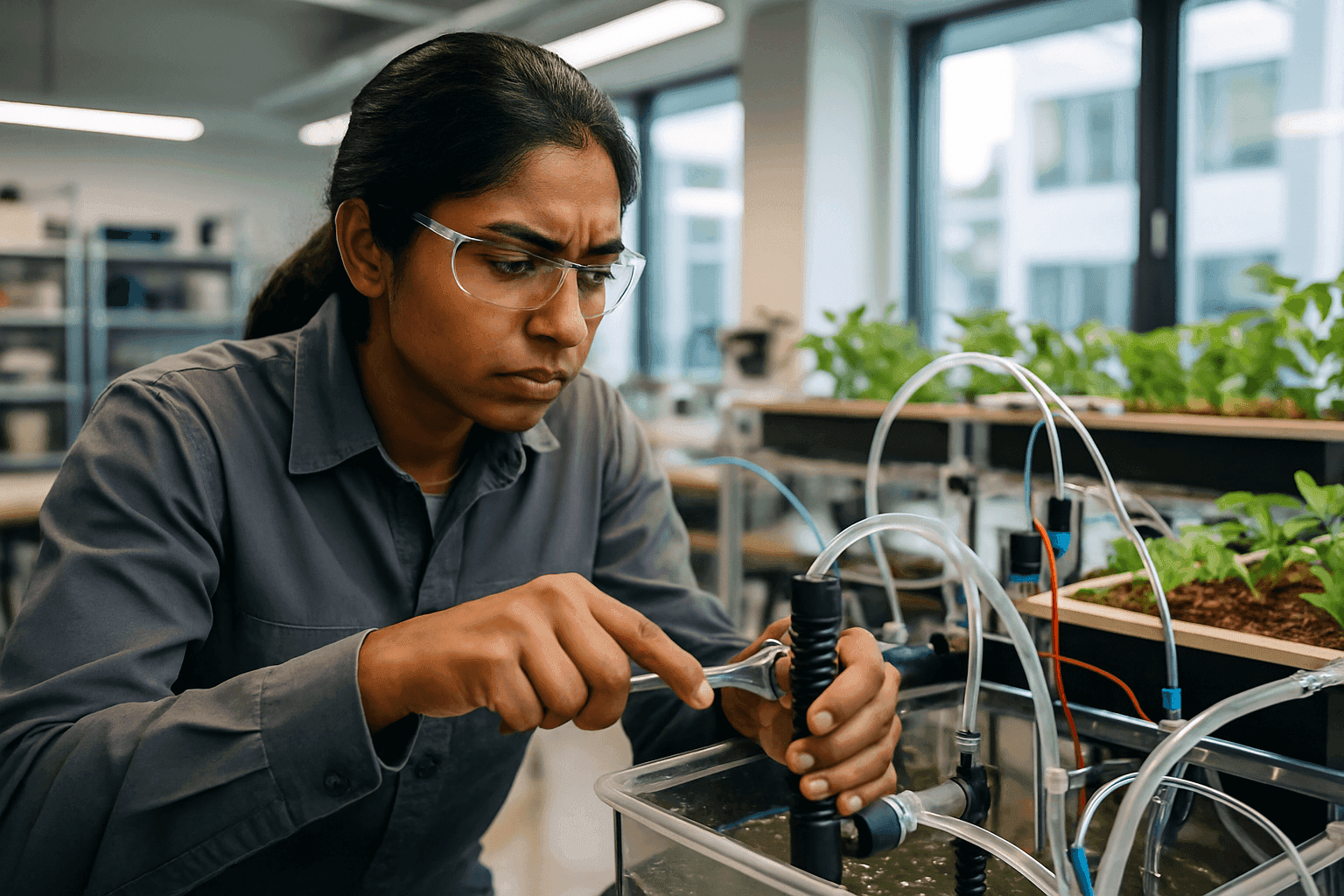
Navigating the Waters: Key Challenges in Prototyping Automated Aquaponics Systems
The promise of automated aquaponics systems – efficient, sustainable food production that conserves water and land – is compelling. By integrating aquaculture (fish farming) with hydroponics (soilless plant cultivation), these closed-loop ecosystems leverage the symbiotic relationship where fish waste nourishes plants, and plants filter water for fish. However, bringing these innovative systems from concept to a fully functional, automated prototype presents a unique set of engineering and biological challenges that demand meticulous design, precise hardware specification, and rigorous testing.
The Intricate Biological Balance: A Core Prototyping Hurdle
At the heart of any aquaponics system lies a delicate biological equilibrium between fish, plants, and beneficial nitrifying bacteria. Automating this living system requires precise monitoring and control over numerous environmental parameters, a task far more complex than in traditional hydroponics or aquaculture alone.
Maintaining Optimal Water Quality and Parameters
One of the most critical and challenging aspects of prototyping automated aquaponics is ensuring stable water quality. Fish, plants, and bacteria each thrive within specific, often differing, ranges for parameters such as pH, dissolved oxygen (DO), temperature, ammonia (NH3), nitrites (NO2−), and nitrates (NO3−).
- pH Stabilisation and Buffering: Fish like tilapia prefer slightly alkaline water (pH 7.0–9.0), while most plants, such as lettuce, flourish in slightly acidic conditions (pH 6.0–6.5). Nitrifying bacteria, essential for converting toxic ammonia into plant-usable nitrates, operate best at a pH of 7.8–8.3. Prototyping automated pH adjustment systems that can continuously monitor and respond to these conflicting needs without harming any component is a significant engineering feat. Engineers must also manage Carbonate Hardness (KH) to buffer the system against sudden, catastrophic pH drops caused by the naturally acidic nitrification process. Ammonia, Nitrite, and Nitrate Management: Fish waste introduces ammonia, which is highly toxic to fish. Nitrifying bacteria (Nitrosomonas and Nitrobacter*) convert this ammonia to less toxic nitrites, and subsequently to nitrates, which plants absorb as nutrients. Automated systems must accurately sense these compounds and adjust feeding, water flow, or filtration to prevent toxic buildups, particularly in the initial cycling phase of a new prototype. Dissolved Oxygen (DO) and Temperature Control: Both fish and bacteria require adequate dissolved oxygen (typically above 5.0 mg/L), while plants also have specific oxygenation needs for their roots to prevent root rot (Pythium*). Temperature also critically impacts fish metabolism, plant growth, and bacterial activity. Automated systems need reliable sensors and actuators (e.g., aerators, heaters, chillers) to maintain optimal ranges, as fluctuations can stress organisms and lead to rapid system failure.
Nutrient Management Beyond Nitrogen
While fish waste provides a primary source of nitrogen (as nitrates), it often lacks other essential micro and macronutrients required for optimal plant growth, such as iron, potassium, and calcium. Prototypes must incorporate automated nutrient dosing systems that can precisely supplement these deficiencies without negatively impacting fish health or bacterial colonies. Balancing nutrient supply from fish waste with plant demand is a complex dynamic. For example, dosing chelated iron (such as Fe-DTPA or Fe-EDDHA, depending on system pH) must be carefully automated to prevent toxic accumulations while meeting the requirements of heavy-feeding crops.
From initial concept sketching to functional prototypes — we bridge the gap between idea and production-ready design using 3D CAD, FEA, and rapid prototyping.
Technical Complexity and System Integration
Automated aquaponics systems are cyber-physical systems involving an intricate blend of fluid dynamics, hardware, software, and biological processes. Prototyping these systems involves overcoming substantial technical hurdles in component integration and reliability.
Sensor Selection, Accuracy, and Reliability
Accurate and reliable sensors are the bedrock of any automated system. However, selecting appropriate sensors for water quality (pH, DO, temperature, ammonia, nitrate, electrical conductivity (EC)), water level, humidity, and light intensity, and ensuring their long-term accuracy in a challenging aquatic environment, is difficult. Inconsistencies in sensor selection and a lack of publicly available, standardised data hinder comparative research and development. Prototypes must account for:
- Sensor Drift: Chemical sensors (especially glass-bulb pH electrodes) degrade and drift over time when submerged continuously.
- Biofouling: Algae and bacterial biofilms rapidly coat sensor interfaces, isolating them from the water column and causing highly inaccurate readings.
- Calibration Overhead: Designing automated calibration reservoirs or alert systems is crucial to keep the system running without constant manual intervention.
Control System Design and Actuator Integration
Developing robust control algorithms that can interpret sensor data and effectively manage actuators (e.g., automated feeders, water pumps, pH dosing pumps, aeration pumps, solenoid valves, grow lights) is complex. These systems must be capable of real-time adjustments and predictive maintenance, preventing issues before they escalate.
Integrating various actuators to work in concert without creating negative feedback loops or over-correcting (such as dosing too much acid in response to a temporary pH spike) is a significant control theory challenge. Prototypers must implement proportional-integral-derivative (PID) control loops or fuzzy logic systems rather than basic threshold-based (on/off) switches to prevent destructive oscillations in water chemistry.
Software Development and Data Analytics
Automated systems rely on sophisticated software for data acquisition, processing, analysis, and remote monitoring. Prototyping involves developing intuitive user interfaces, establishing robust communication protocols (e.g., MQTT, Modbus TCP/RTU, or LoRaWAN), and potentially integrating machine learning algorithms for predicting system behaviour, detecting anomalies, and recommending process optimisations. The lack of clean, standardised datasets for training models also poses a challenge for advanced automation, requiring engineers to build their own historical data-logging architectures from day one.
Selection Guide: Aquaponics Equipment for Engineers
When sourcing and specifying aquaponics equipment for engineers, choosing industrial-grade, chemically inert, and electrically isolated components is essential to transition a design from a hobbyist bench scale to a reliable automated prototype.
| Equipment Class | Preferred Specifications & Technologies | Purpose in Automated Systems | Key Selection Considerations |
|---|---|---|---|
| Industrial Controllers | PLCs (e.g., Siemens S7, Opto 22) or ruggedised microcontrollers (e.g., Kunbus Revolution Pi) | Central system automation, PID loop execution, and multi-sensor data acquisition | High electromagnetic interference (EMI) protection; native 4-20mA or Modbus interfaces. |
| Sensors (Water Quality) | Optical Dissolved Oxygen (DO) probes; double-junction glass or flat-surface pH sensors | Continuous, real-time monitoring of biological health parameters | Optical DO resists biofouling better than galvanic alternatives; flat-surface pH sensors are easier to clean. |
| Pumps (Fluid Dynamics) | Magnetic-drive submersible or external centrifugal pumps | Continuous water recirculation and head-pressure delivery | Ensure no copper or toxic metal parts contact the water; calculate Total Dynamic Head (TDH) accurately. |
| Mechanical Filtration | Radial Flow Separators (RFS) or automated micro-screen drum filters | Rapid separation and removal of heavy, suspended fish solids | Sizing must match the volumetric flow rate to allow gravity settling without hydraulic turbulence. |
| Biological Filtration | Moving Bed Biofilm Reactors (MBBR) using high-surface-area plastic media (e.g., Kaldnes K1) | High-rate nitrification (converting ammonia to nitrite, then nitrate) | Provide aggressive, continuous aeration to maintain high DO levels (>5.0 mg/L) and keep media fluidised. |
Economic Viability and Scalability
While automation promises reduced labour costs in commercial operations, the initial investment and ongoing operational expenses pose significant prototyping challenges, particularly when considering future scalability.
High Initial Investment Costs
The upfront cost of industrial-grade sensors, PLCs, automated dosing pumps, communication modules, and specialised backup power systems can be a significant barrier. For small-scale operations or initial prototypes, this investment can be prohibitively high. Engineers must design cost-effective, modular solutions that do not compromise reliability, using techniques like time-multiplexing sensors (routing water from multiple tanks past a single sensor array) to reduce capital expenditure.
Energy Consumption
Aquaponics systems, especially automated ones, are energy-intensive due to the continuous operation of water pumps, biological filtration aeration, air stones, inline heaters/chillers, and supplementary grow lights. Prototyping must focus on energy-efficient component selection and system design to minimise operating costs and ensure economic sustainability.
To optimise pump selection and calculate the theoretical hydraulic power requirement, engineers utilise the following equation:
P=ηρ⋅g⋅Q⋅HWhere:
- P is the hydraulic power requirement in watts (W)
- ρ is the density of the fluid in kilograms per cubic metre (approximately 1000 kg/m³ for water)
- g is the acceleration due to gravity (9.81 m/s²)
- Q is the volumetric flow rate in cubic metres per second (m³/s)
- H is the total dynamic head in metres (m)
- η is the pump efficiency (expressed as a decimal)
By utilising this relationship, engineers can precisely size variable-frequency drive (VFD) pumps to match system demands without wasting excess energy as heat, potentially integrating renewable energy sources like solar photovoltaic arrays coupled with battery backup systems.
Achieving Economic Scale
Designing a prototype that can be scaled economically for commercial viability is crucial. Scaling up can introduce fluid dynamic complexities (such as dead zones in large tanks where solid waste accumulates) and challenges in maintaining uniform dissolved oxygen profiles. Automated systems must be designed with modularity and scalability in mind, using decentralised control nodes (edge computing) to allow for expansion without requiring a complete redesign of the control architecture or a proportional increase in capital costs.
From initial concept sketching to functional prototypes — we bridge the gap between idea and production-ready design using 3D CAD, FEA, and rapid prototyping.
Interdisciplinary Knowledge Gap
Aquaponics itself is a multidisciplinary field, and adding automation further compounds the need for diverse engineering and scientific expertise.
Bridging Diverse Disciplines
Successful prototyping requires a deep understanding of aquaculture, hydroponics, microbiology, and automation engineering. The theoretical and practical knowledge across these fields is often siloed, making it challenging for a single team or individual to possess all the necessary expertise. Prototyping teams must foster strong interdisciplinary collaboration to ensure that mechanical or electrical designs do not inadvertently compromise biological processes (for example, choosing a pump material that leaches zinc or copper, which are highly toxic to fish).
Training and Technical Expertise
Operating and maintaining automated aquaponics systems requires specialised knowledge and skills. Prototyping efforts must consider the ease of use and maintenance for future operators, incorporating features like toolless sensor swapping, self-cleaning filters, and clear diagnostic dashboards that simplify troubleshooting and reduce the need for highly skilled control engineers on-site.
Reliability and Maintenance of Automated Components
Even with robust design, the practical application of automated components in a wet, warm, nutrient-rich environment introduces its own set of structural challenges.
Component Durability and Environmental Resilience
Electronic sensors and mechanical actuators must withstand constant exposure to high relative humidity, splashing water, dissolved salts, and fluctuating ambient temperatures. Prototyping needs to address issues of galvanic corrosion, biofouling on mechanical valve seats, and the long-term durability of IP-rated enclosures. Engineers should specify IP67 or IP68 enclosures for all electronics, use marine-grade stainless steel (316) or food-grade plastics (such as HDPE or PVC) for all wetted parts, and ensure optical isolation on all analogue sensor lines to prevent ground loops that corrupt sensor data and accelerate galvanic corrosion.
System Redundancy and Failure Prevention
A single point of failure in an automated aquaponics system – such as a primary pump failure, a stuck solenoid valve, or a sensor reading false low pH – can lead to catastrophic losses of fish crops or plants within hours. Prototyping must incorporate:
- Hardware Redundancy: Dual, parallel pumps with automated failover switches.
- Sensor Validation: Cross-checking readings between multiple sensors (e.g., dual pH probes) using voting algorithms to detect and ignore a failed or drifting probe.
- Emergency Protocols: Mechanical gravity-fed overflows, battery backups (UPS) for aeration systems, and automated GSM or Wi-Fi alerts to notify operators immediately during critical power or water-level events.
Conclusion
Prototyping automated aquaponics systems is an endeavour rich with challenges, demanding a holistic approach that seamlessly integrates biological understanding with cutting-edge engineering design. From maintaining the delicate biological harmony of fish, plants, and bacteria to overcoming the technical complexities of sensor integration, control systems, and software development, each step requires careful consideration.
Addressing high initial investment costs, managing energy consumption through precise hydraulic sizing, and bridge-building across disciplines are all paramount for creating systems that are not only functional but also economically viable and scalable. As the specification of specialised aquaponics equipment for engineers matures, continuous innovation in these areas will be key to unlocking the full potential of automated aquaponics for global sustainable food production.
