Why Pinch Analysis Cuts Pharmaceutical Energy Use
A pharmaceutical case study reported around 20% lower energy use and €310,000 savings.
Pinch analysis is a process-integration method that establishes the minimum heating and cooling utilities a defined pharmaceutical process requires by matching heat-releasing and heat-demanding streams. A published account of an anonymous medium-sized pharmaceutical manufacturer reported up to 20% lower energy use, about €310,000 in cost savings and a one- to two-year payback after an efficiency programme informed by pinch analysis.
The case, published by the European Cluster Collaboration Platform and attributed to Bayerisches Landesamt für Umwelt’s Wärme verbindet - Gezielte Analyse spart Energie, concerns batch pharmaceutical manufacture, with extraction identified as particularly heat-intensive. It covers chemical-reaction duties, steam-system modelling, boiler flue-gas recovery, refrigeration buffering and an existing cooling-water exchanger.
The account does not identify the manufacturer, site, product range, annual energy baseline, capital cost or the contribution of each measure to the reported saving. The figures reflect a wider efficiency programme, not a universal result from one exchanger retrofit. They nevertheless show the opportunity that can emerge when process heat, steam and refrigeration are assessed together.
For UK pharmaceutical plants, pinch analysis provides a disciplined way to identify recoverable heat without compromising product quality, cleanability or GMP controls.

Pinch analysis identifies the thermodynamic minimum energy requirement of your process — then designs the heat exchanger network to achieve it.
What Pinch Analysis Measures in Pharmaceutical Manufacturing
A pinch study starts with process streams, not a preferred technology. Engineers identify streams that release heat and streams that need heat within a defined operating case.
Hot streams can include reactor contents after a controlled reaction, condensate, distillate, solvent-recovery streams, hot wastewater, boiler flue gas and refrigeration-condenser heat. Cold streams can include process charges, water-treatment duties, cleaning solutions, make-up water and reactor heating stages.
The analysis requires dependable operating data. A value from a design drawing may differ sharply from a batch record or historian trend during normal production.
| Required input | Why it affects the pinch target |
|---|---|
| Supply and target temperatures | Establishes the usable temperature range |
| Flow rate, batch mass or batch volume | Determines heat available or required |
| Specific heat capacity and phase-change duty | Defines stream heat load |
| Batch timing and campaign schedule | Establishes whether source and demand occur together |
| Product and utility classification | Screens heat matches for GMP suitability |
| Pressure, fouling and cleaning constraints | Shapes exchanger selection and operating margin |
Composite Curves Set the Utility Target
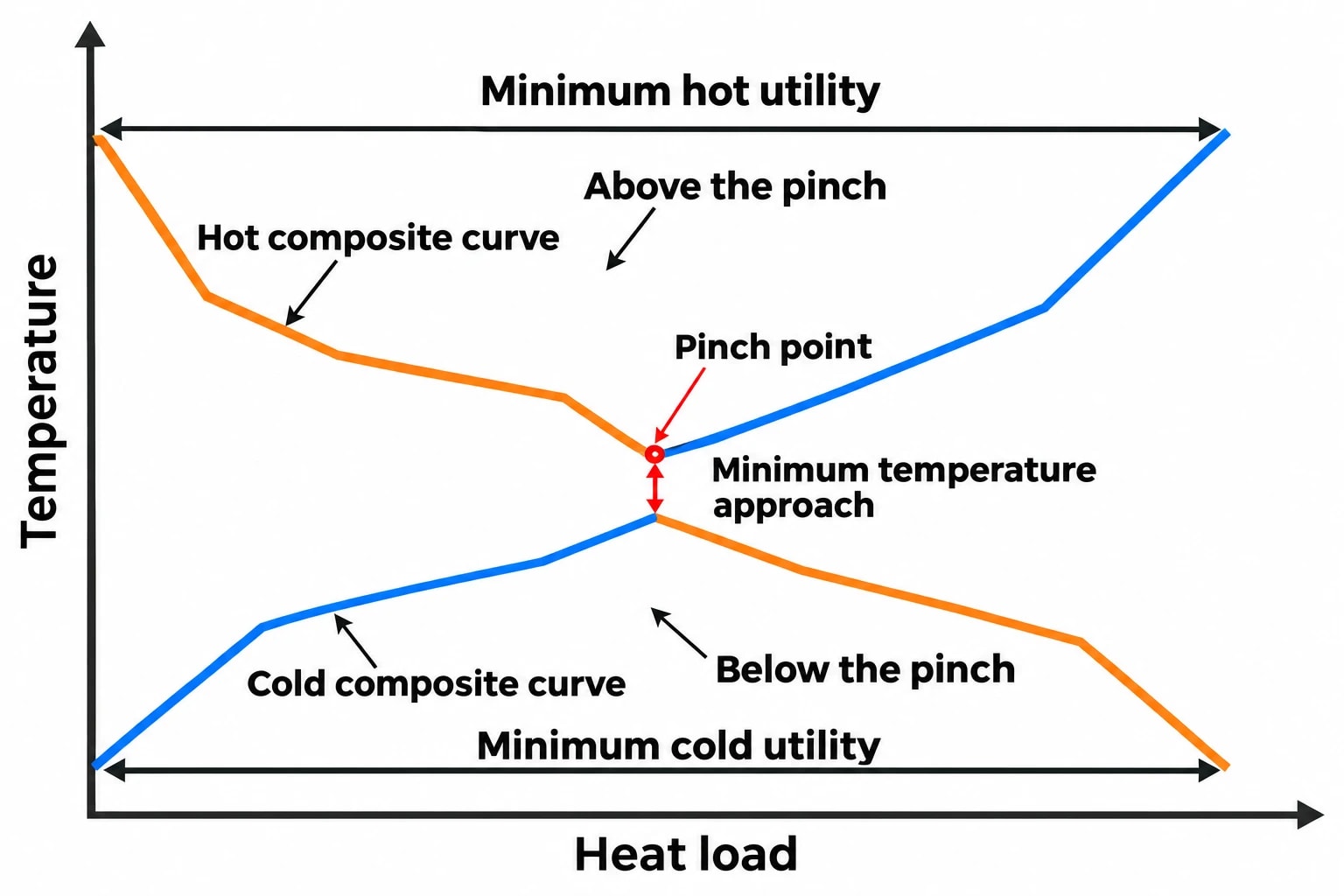
Engineers combine hot-stream data into a hot composite curve and cold-stream data into a cold composite curve. The curves show the aggregate heat available and required across the process temperature range.
Their closest permitted approach identifies the pinch point. Above the pinch, the process needs heat and requires careful use of high-temperature sources. Below it, the process rejects surplus heat and needs cooling. This establishes minimum hot- and cold-utility targets before a team commits to heat-exchanger matches, pipework or storage.
That sequence distinguishes pinch analysis from a search for a nearby warm pipe. A hot stream may contain significant energy but lack the temperature needed for a process duty. Another stream with lower-grade heat may displace boiler fuel by preheating suitable water or cleaning solution.
Why the Minimum Temperature Approach Matters
The minimum temperature approach is the smallest allowable temperature difference between hot and cold streams in a heat exchanger. It sets a central trade-off in pharmaceutical heat recovery.
A tighter approach raises theoretical heat recovery but can demand more heat-exchanger area, reduce control margin and increase the consequences of fouling. A wider approach reduces heat recovery but may improve operability and reduce capital cost.
The practical value should reflect the stream, not a generic target. A recoverable-water duty may tolerate a different approach from a reactor temperature-control duty. Design teams should evaluate fouling, cleaning method, response time, maintenance access and production consequences before fixing the approach temperature.
Why Batch Pharmaceutical Operations Need Time-Based Analysis
Batch operation makes pharmaceutical heat recovery attractive and difficult. A vessel may need steam during charge preparation, release reaction heat during temperature control, then need cooling before discharge. The same vessel can appear as a cold stream and a hot stream at different stages of a batch.
Annual utility totals hide this sequence. They cannot prove that heat released in one operation is available when another needs it.
Build Operating Cases From Real Production
A useful study maps representative batches, campaign patterns, cleaning cycles, product changeovers and seasonal utility conditions. It should include normal operation, start-up, shutdown and lower-throughput periods where these form part of the site’s operating envelope.
Time-sliced analysis can reveal several outcomes:
- A proposed heat match works only during a narrow part of a campaign.
- A process heat source exists, but the receiving vessel is occupied.
- Two batch demands overlap and create a steam peak.
- A cooling duty becomes a heat source during one production phase.
- A small buffer store shifts recovered heat to a later water-heating duty.
This work often exposes the most valuable retrofit decisions. A technically feasible match that relies on simultaneous batches may have limited delivered savings. A lower-duty project with a repeatable schedule can produce a more dependable result.
Thermal Storage Can Bridge Timing Gaps
Thermal storage can capture heat from a process stream or refrigeration system and release it later to a suitable duty. Its performance depends on usable temperature, tank volume, stratification, heat loss, demand timing and hygiene controls.
The pharmaceutical case study reported plans for an additional refrigeration buffer tank. It also considered a vertical baffle plate to support warm-water reuse. Storage adds value only where the stored heat remains warm enough for a real demand and the site can manage water quality, cleaning and microbiological controls.

Pinch analysis identifies the thermodynamic minimum energy requirement of your process — then designs the heat exchanger network to achieve it.
Where Pharmaceutical Pinch Analysis Finds Heat-Recovery Opportunities
The first opportunities often sit at the process-utilities boundary. They can avoid direct changes to product-contact equipment while reducing steam or refrigeration demand.
Potential measures include:
- Preheating suitable water duties with boiler flue-gas heat.
- Recovering refrigeration-condenser heat for warm-water services.
- Improving process-to-process heat exchange between compatible streams.
- Recovering condensate heat where water-quality controls permit.
- Adding buffer storage to align intermittent heat release with batch demand.
- Modifying existing heat exchangers where hydraulic capacity and cleanability allow.
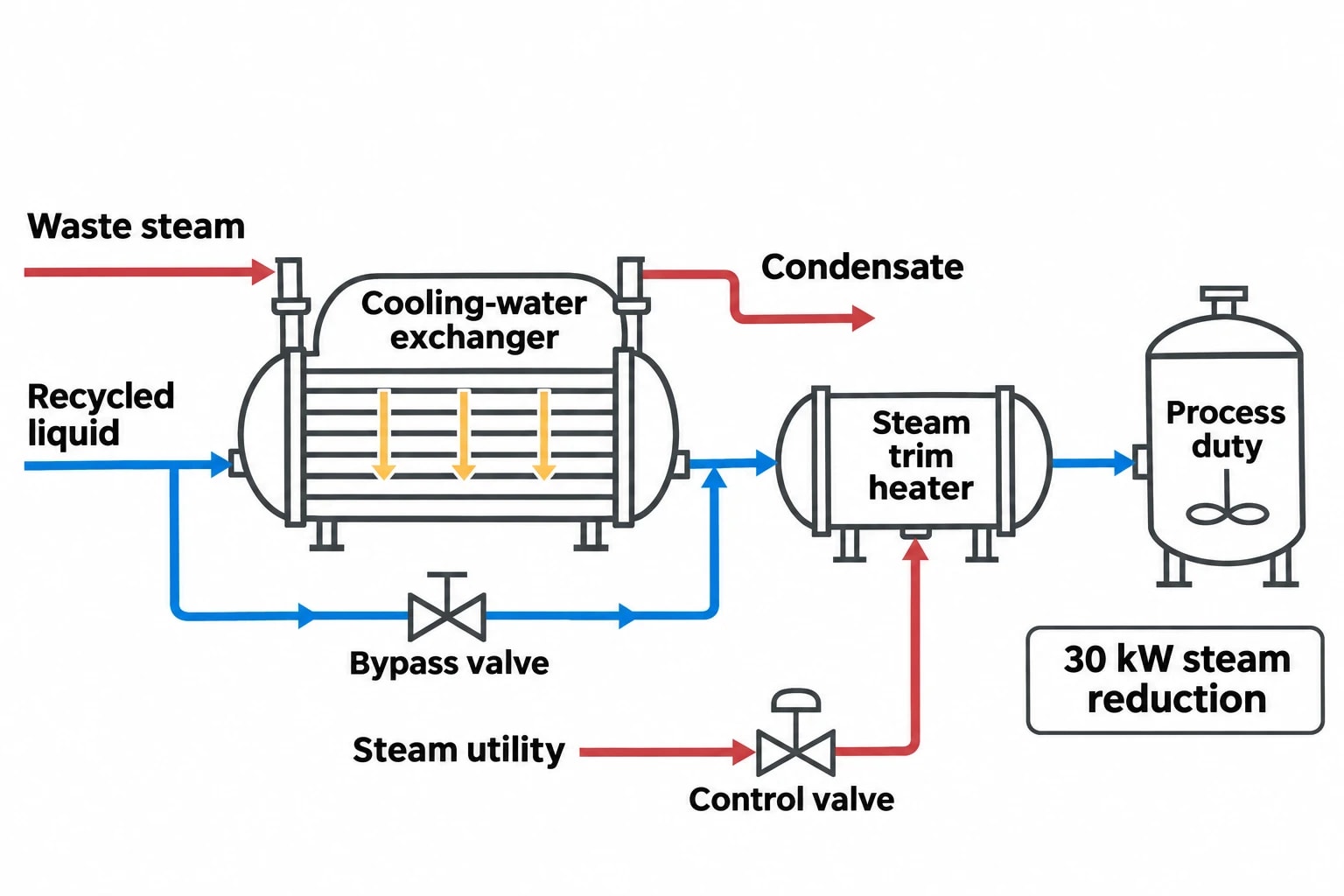
The published pharmaceutical case study provides a retrofit example. Engineers proposed using an existing cooling-water exchanger to transfer heat between recycled liquid and waste steam. The source reports that the modification retained existing cooling-water capacity while reducing steam demand by 30 kW.
The proposal assessed an existing heat exchanger within the wider thermal network rather than adding a separate recovery package. The 30 kW figure relates to that modification; it does not account for the site-wide saving reported for the efficiency programme.
Heat Quality Decides the Match
Heat recovery depends on temperature quality as well as heat quantity. Low-temperature condenser heat may suit a warm-water service but cannot replace clean steam or a high-temperature reactor-heating requirement. Equally, a high-temperature source can be wasted if it supplies a duty that lower-grade heat could cover.
A pinch study ranks heat by temperature range. This helps design teams reserve high-grade utility heat for duties that need it and direct lower-temperature recovery to preheating, wash-water and other suitable services.
Existing Equipment Requires Detailed Checks
An existing heat exchanger can lower capital cost, but it needs engineering verification. Teams should check available area, pressure drop, materials of construction, fouling history, design pressure, isolation, drains, venting, instrumentation and maintenance access.
Control arrangements also matter. A recovered-heat source may vary with batch activity or ambient conditions. A steam trim heater, control valve and bypass can preserve the required process-temperature range while allowing recovered heat to reduce utility demand when conditions permit.
How GMP Shapes Pharmaceutical Heat-Recovery Retrofits
A heat-recovery project in pharmaceutical manufacture is also a quality-system change. For sterile-product sites, EudraLex Volume 4, Annex 1, Manufacture of Sterile Medicinal Products, has been fully applicable since 25 August 2024.
Annex 1 places contamination-control strategy at the centre of sterile manufacture. That affects changes to utilities, equipment interfaces, cleaning arrangements and process control.
Define the Quality Boundary Before Modelling
The pinch model should record quality restrictions alongside temperatures and duties. Treating all warm liquids as interchangeable creates heat matches that may be thermodynamically valid but unsuitable for pharmaceutical operation.
The study team should identify:
- Product-contact and non-product-contact equipment.
- Clean steam, purified water and water-for-injection systems.
- Heating and cooling circuits serving critical process equipment.
- Sterilisation and cleaning stages.
- Validated process parameters and alarm functions.
- Potential contamination routes from a heat-exchanger failure.
- Equipment subject to qualification or requalification.
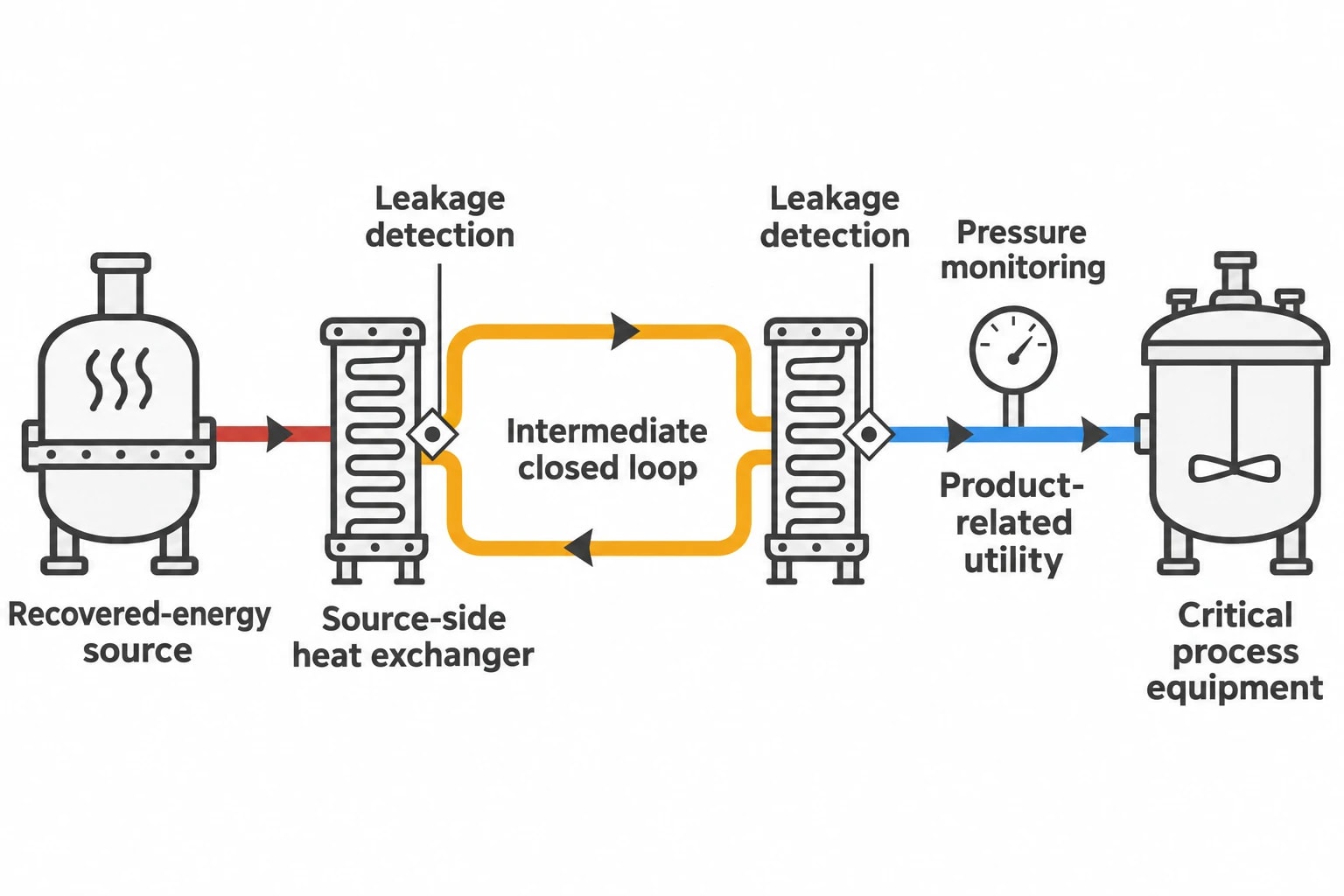
Indirect recovery through an intermediate closed loop may provide suitable separation between a product-related stream and a recovered-energy source. The risk assessment should address pressure relationships, leakage detection, material compatibility, cleaning, maintenance and the consequences of tube failure.
Change Control Determines the Evidence Needed
Each shortlisted project should enter GMP change control before detailed implementation. The assessment should define the equipment change, quality impact, contamination-control measures, utility specifications, commissioning plan and acceptance evidence.
The evidence required depends on the affected system. A change to a non-product utility can require focused engineering and quality assessment. A modification affecting a critical utility, sterilisation step or product-contact boundary may need wider qualification and validation.
The project should also establish how continued performance will be demonstrated after installation. Relevant evidence can include temperature trends, flow measurements, heat duty, utility consumption, control response, alarm testing and cleaning performance.
A Practical Pinch-Analysis Workflow for Pharmaceutical Sites
Pinch analysis produces an energy target. A successful retrofit requires a design that delivers that target through real batches, cleaning cycles and GMP controls.
Start With a Defined Study Basis
Select representative products, batch sizes, campaigns and cleaning cycles. Confirm utility conditions, including steam pressure levels, chilled-water temperatures and refrigeration loads. Reconcile historian data, batch records, site tests and process-flow diagrams before using them as design input.
Classify Streams Before Heat Matching
Separate product-related duties, critical utilities, non-product utilities and waste streams. Record temperature, heat duty, timing, pressure, corrosion risk, fouling risk, materials of construction and cleanability for each stream.
This creates an early screen for unsuitable matches. It prevents detailed design work on options that conflict with water quality, containment or validated process requirements.
Screen Retrofit Options on Delivered Value
A practical shortlist may include heat-exchanger modifications, new recovery heat exchangers, thermal storage and utility-side heat recovery. Each option should be assessed against capital cost, expected energy reduction, installation window, batch availability, maintenance burden, control response and GMP change-control effort.
The thermodynamic target remains valuable even when no single project reaches it. It shows the gap between present utility use and the practical heat-integration limit, helping engineers sequence projects and avoid a match that blocks a more valuable recovery opportunity later.
This article reflects the independent analysis and editorial opinion of EnerTherm Engineering. Product names, trademarks, and brands mentioned belong to their respective owners. EnerTherm Engineering is not affiliated with, endorsed by, or a licensee of any third-party software or product mentioned unless explicitly stated.

Managing Director — EnerTherm Engineering
Dr. François Pierrel is Managing Director of EnerTherm Engineering with over two decades of expertise in thermal design, heat transfer, and industrial energy optimisation. He holds a PhD in Heat Transfer from Cranfield University and a Post-Doctorate from Heriot-Watt University.
