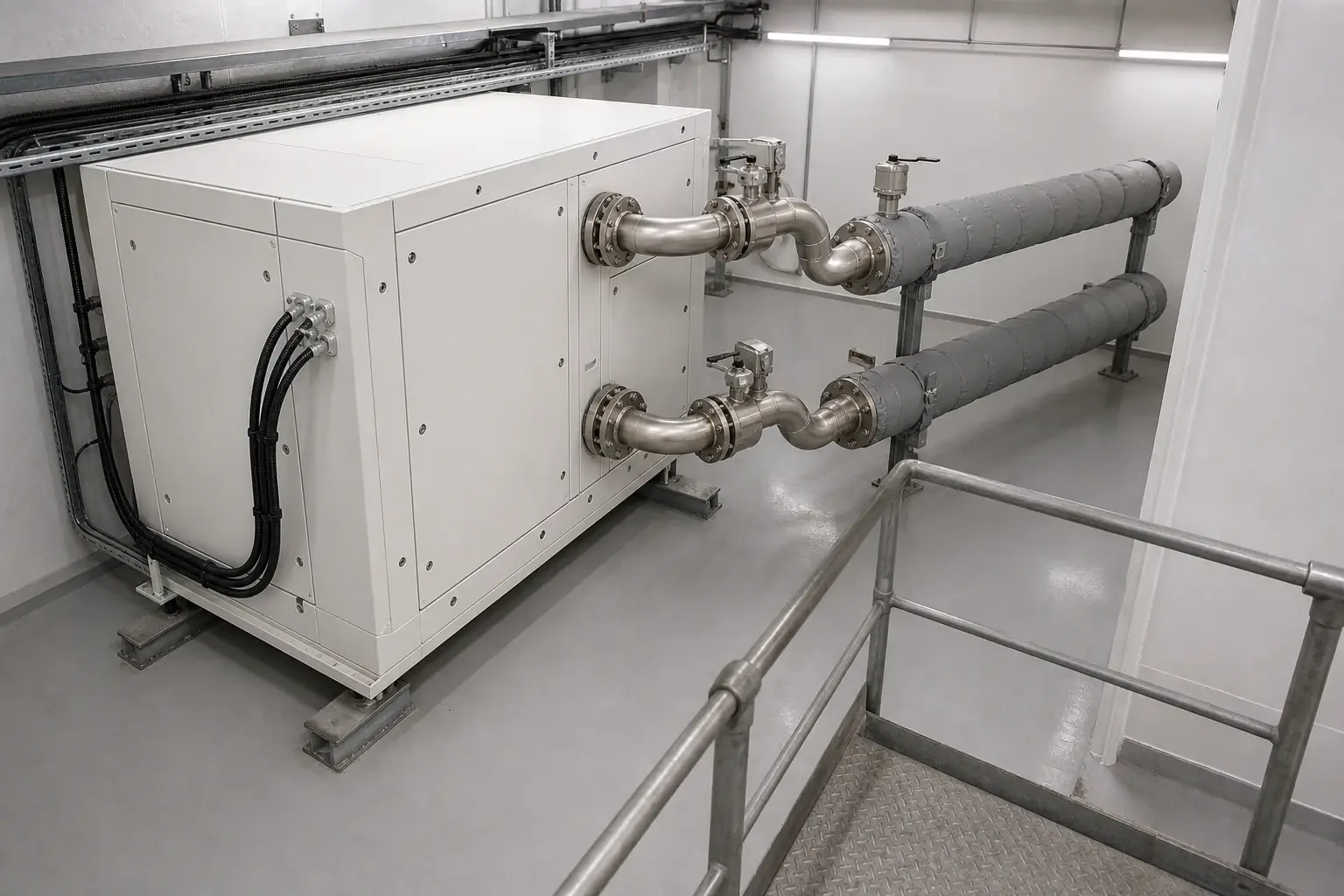
Heat Pumps in Pharmaceutical Manufacturing: 235 kWth
A UK feasibility case models 235 kWth delivering up to 120°C for 7,200 hours annually.
A high-temperature heat pump upgrades lower-temperature heat into process heat. A UK government-backed Futraheat feasibility case modelled a pharmaceutical application at 235 kWth, delivering 120°C continuously for 7,200 hours a year. This equates to 1.692 GWh of annual thermal output at the stated duty.
That scale matters to a utilities team while exposing the engineering questions that decide whether a heat-pump integration works at a GMP-regulated site: where the heat comes from, how it is delivered, what happens during process upsets, and how the utility change enters the pharmaceutical quality system.
For pharmaceutical manufacturers, attractive targets usually include long-running hot-water and low-pressure steam duties. Clean-in-place systems, vial and component washing, process vessel heating, drying support and HVAC reheat can create demand at temperatures increasingly within the range of high-temperature heat pumps. The technology does not remove the need for steam across a site, but it can reduce boiler firing on a defined, well-characterised utility load.
Why heat pumps in pharmaceutical manufacturing need a process-first design
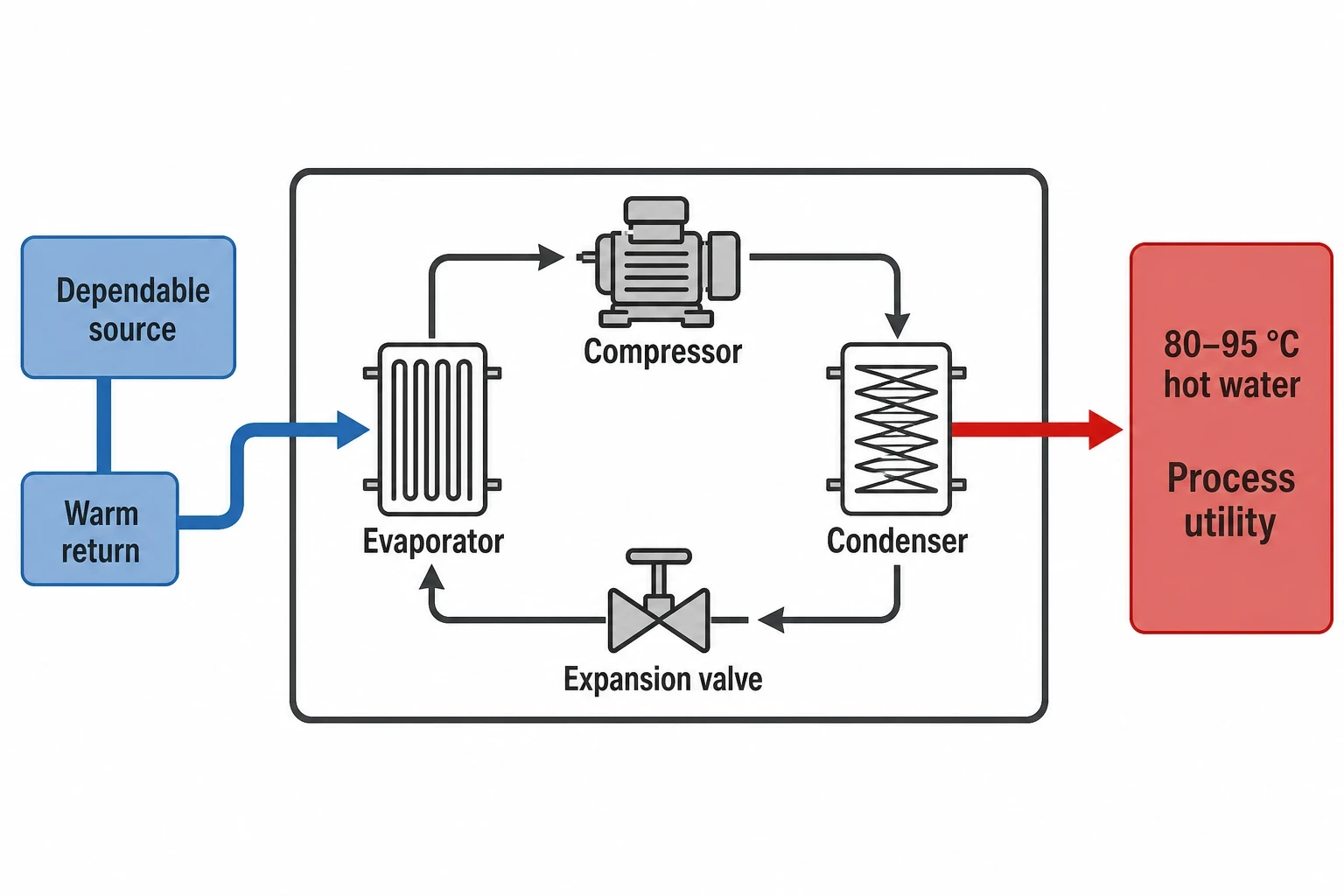
A heat pump moves heat. Its commercial and environmental case depends on the temperature and availability of both sides of that transfer.
The evaporator needs a dependable heat source. The condenser needs a heat sink that can accept heat at the required temperature. Pharmaceutical sites often contain both, but they are rarely connected in a way that suits direct installation.
The source side determines the opportunity
Potential heat sources include warm condenser-water return, cooling-water loops, refrigeration plant rejection, process-cooling return, warm wastewater and exhaust-air recovery where hygiene, corrosion and contamination controls permit it. The source must provide sufficient flow, temperature and operating hours.
An intermittent source may still support a heat pump, but it changes the design. Thermal storage, a parallel boiler connection or lower design capacity may be needed to protect the process utility.
The key site data are:
- Source temperature, flow and heat capacity across production states.
- Sink supply and return temperatures, including peak demand.
- Hourly coincidence between available waste heat and useful heat demand.
- Cleaning cycles, shutdowns, product campaigns and seasonal HVAC conditions.
- Water chemistry, fouling risk and the separation required between process-facing and refrigeration circuits.
Higher-temperature waste heat reduces the compressor lift and normally improves efficiency. A heat pump upgrading a warm return stream to 120°C is a different proposition from one raising ambient or chilled water to the same delivery temperature.
The sink side must match the duty
Pharmaceutical utilities should be separated by temperature requirement and product impact. A hot-water duty at 80°C to 95°C may be a strong heat-pump candidate. A process requiring clean steam, defined steam quality or a sterilisation cycle needs a more detailed interface assessment.
The heat pump should serve the lowest-temperature utility that satisfies the process requirement. Supplying 120°C water to a 75°C reheat coil wastes temperature potential and can reduce seasonal efficiency. A high-temperature heat pump may be appropriate where a continuous hot-water loop, thermal-oil circuit or steam-generating arrangement genuinely needs that temperature.

Pinch analysis identifies the thermodynamic minimum energy requirement of your process — then designs the heat exchanger network to achieve it.
The 235 kWth Futraheat pharmaceutical case
The Futraheat Industrial Fuel Switching feasibility report provides a useful reference point because it describes a pharmaceutical-scale duty rather than a generic industrial heat-pump claim. The case considered continuous delivery at 120°C for 7,200 hours a year.
The 1.692 GWh annual useful-heat output is a thermal quantity, not an electricity-consumption figure. Electricity use depends on the installed heat pump’s measured performance under the actual source temperature, sink temperature, part-load operation and auxiliary loads.
What the case size means in practice
A 235 kWth heat pump should be treated as one module within the wider utility system. It may cover a stable base load, with existing boilers retaining peak, standby and abnormal-condition duties. This can reduce fuel use while preserving the operational resilience expected of a pharmaceutical site.
The feasibility work should establish whether the heat pump operates against:
- A defined hot-water loop with an adequate temperature return.
- A low-pressure steam or steam-generating interface.
- A buffer vessel that separates variable process demand from compressor operation.
- A combination of heat-pump base load and boiler trimming.
Continuous duty is valuable because heat pumps generally benefit from sustained running and predictable loading. A short, high-temperature batch peak may require a large compressor, oversized electrical infrastructure and a heat source unavailable for much of the day.
Pinch Analysis should precede equipment selection
Pinch Analysis is the right starting point for heat pumps in pharmaceutical manufacturing. It identifies process heating and cooling targets before utility technology is selected.
The study should map stream temperatures, heat loads and timing. It should set a practical minimum approach temperature, identify direct heat-recovery opportunities, and show remaining heat demand by temperature level. A heat pump should upgrade heat that direct exchange cannot economically recover.
This avoids selecting a 120°C heat pump for a duty that direct recovery, lower-temperature hot water or a redesigned return loop could meet. It also exposes the opposite problem: a promising waste-heat source with no simultaneous sink.
A utility load profile should show base, normal and peak demand. The heat pump can then be sized against a dependable heat source and a load with sufficient annual operating hours.
Integrating high-temperature heat pumps with GMP utilities
Utilities engineers cannot treat a pharmaceutical heat-pump installation as a standard plant-room replacement. The heat pump may influence HVAC conditions, wash temperatures, water-system performance, pressure control or sterilisation-related utilities. Those effects must be assessed through the site’s quality and engineering governance.
Keep the refrigerant circuit outside the GMP utility boundary
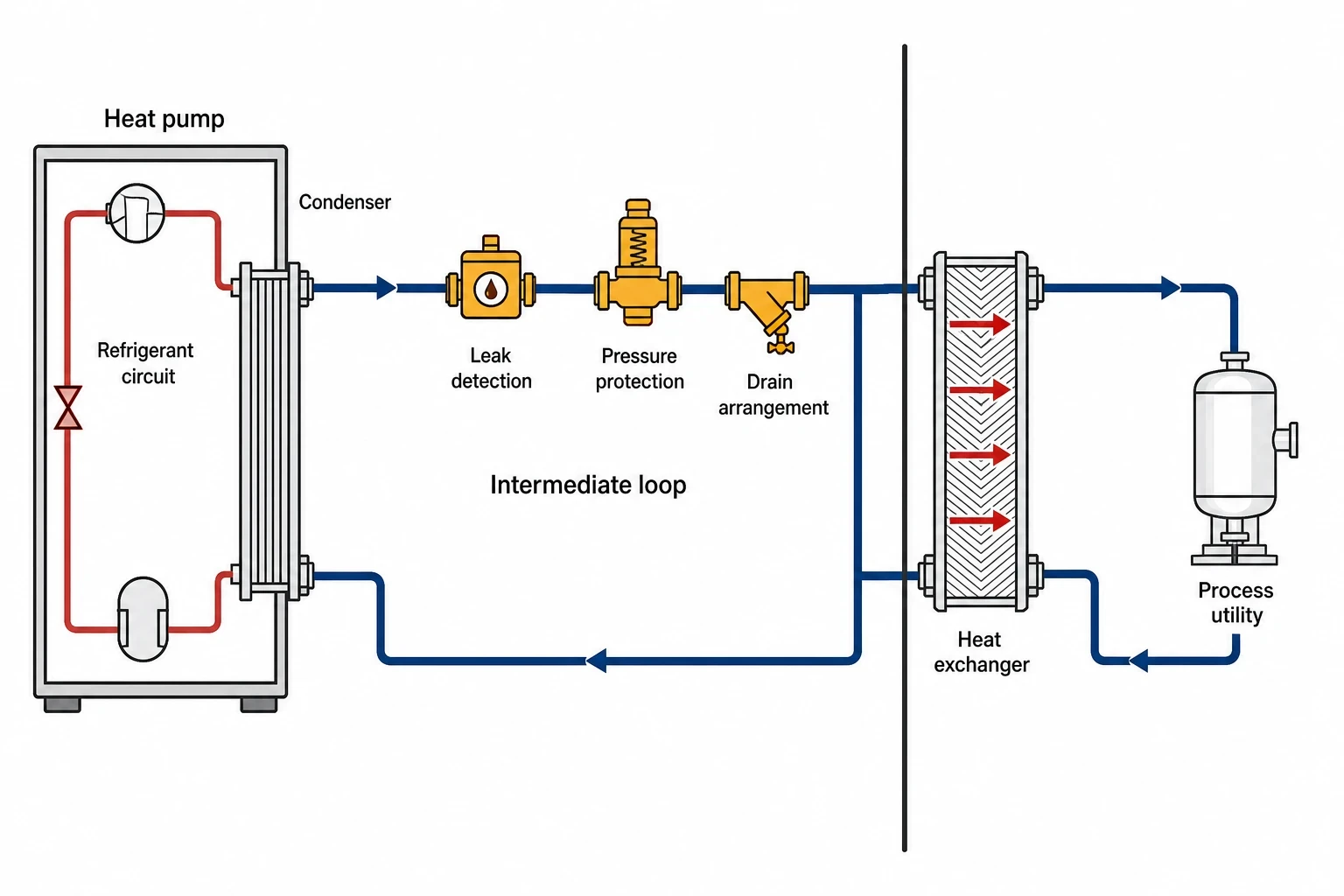
The refrigerant circuit should remain physically and functionally separate from process-facing utilities. Heat exchangers, intermediate circuits, leak detection, pressure protection and drain arrangements should reflect the consequence of a failure.
For a hot-water application, an intermediate loop can separate the heat-pump condenser from the process utility. The choice depends on contamination risk, fluid compatibility, temperature approach, maintainability and validation strategy. A direct connection may minimise losses but needs an evidence-based risk assessment.
The design should identify credible fault conditions, including refrigerant leakage, heat-exchanger tube failure, loss of circulation, compressor trip, sensor failure and loss of electrical supply. Each has a different effect on product quality, safety and plant availability.
HVAC reheat requires control discipline
HVAC systems may offer long operating hours and relatively modest supply temperatures, making reheat a potential heat-pump application. In sterile areas, however, a utility change can influence temperature, relative humidity, pressure cascades and recovery after door openings or process interventions.
The revised EU GMP Annex 1 for Manufacture of Sterile Medicinal Products applied from 25 August 2023, with section 8.123 applying from 25 August 2024. Annex 1 requires manufacturers to design, qualify, monitor and regularly review facilities, equipment and processes using personnel with suitable process, engineering and microbiological knowledge.
For HVAC reheat, qualification evidence should show that the revised thermal source maintains approved environmental conditions across normal, start-up, shutdown and fault scenarios. The critical question is whether the controlled area remains within its qualified state through the full range of operating conditions.
Clean steam is a separate engineering decision
A high-temperature heat pump may reduce the load on a boiler supplying clean-steam generation, but it does not automatically become a clean-steam source. Clean-steam quality, distribution materials, condensate management and sterilisation duties need their own specification and qualification route.
Process teams should distinguish between:
| Utility duty | Heat-pump integration question |
|---|---|
| CIP hot water | Can the heat pump maintain required supply temperature, flow and recovery time? |
| Parts and container washing | Does the revised heating arrangement preserve wash-cycle parameters and water quality? |
| HVAC reheat | Does the system maintain qualified temperature, humidity and pressure conditions? |
| Drying support | Is the heat demand continuous enough, and can heat recovery be used without cross-contamination risk? |
| Clean-steam generation | Can a heat pump reduce boiler firing upstream while retaining qualified steam generation and distribution? |

Pinch analysis identifies the thermodynamic minimum energy requirement of your process — then designs the heat exchanger network to achieve it.
Refrigerant selection under Regulation (EU) 2024/573
Refrigerant choice has direct serviceability and asset-life consequences. Regulation (EU) 2024/573 on fluorinated greenhouse gases restricts the use of high-global-warming-potential refrigerants in maintenance and servicing.
From 1 January 2026, the Regulation prohibits the use of F-gases with a global warming potential of 2,500 or more for maintenance or servicing of air-conditioning equipment and heat pumps. Limited exemptions remain until 1 January 2032 for correctly labelled reclaimed refrigerant and, under defined conditions, refrigerant recycled from the equipment concerned.
Selection must consider more than GWP
A pharmaceutical heat-pump specification should address:
- Required supply temperature and pressure envelope.
- Source temperature range and expected temperature lift.
- Refrigerant safety classification and plant-room implications.
- Charge size, containment and leak-detection arrangements.
- Availability of qualified service support.
- Future servicing restrictions and refrigerant recovery arrangements.
- Compatibility of compressors, seals, valves, lubricants and heat exchangers.
Lower-GWP refrigerant selection does not remove the need for a full hazard assessment. Flammability, toxicity, pressure, operating temperature, ventilation and emergency procedures remain central design issues. The selected refrigerant must suit the complete package and site conditions, rather than being chosen on GWP alone.
The regulation is an EU instrument. UK pharmaceutical manufacturers should confirm the applicable Great Britain or Northern Ireland legal requirements for the site, equipment and refrigerant service arrangements before procurement.
Validation, commissioning and change control
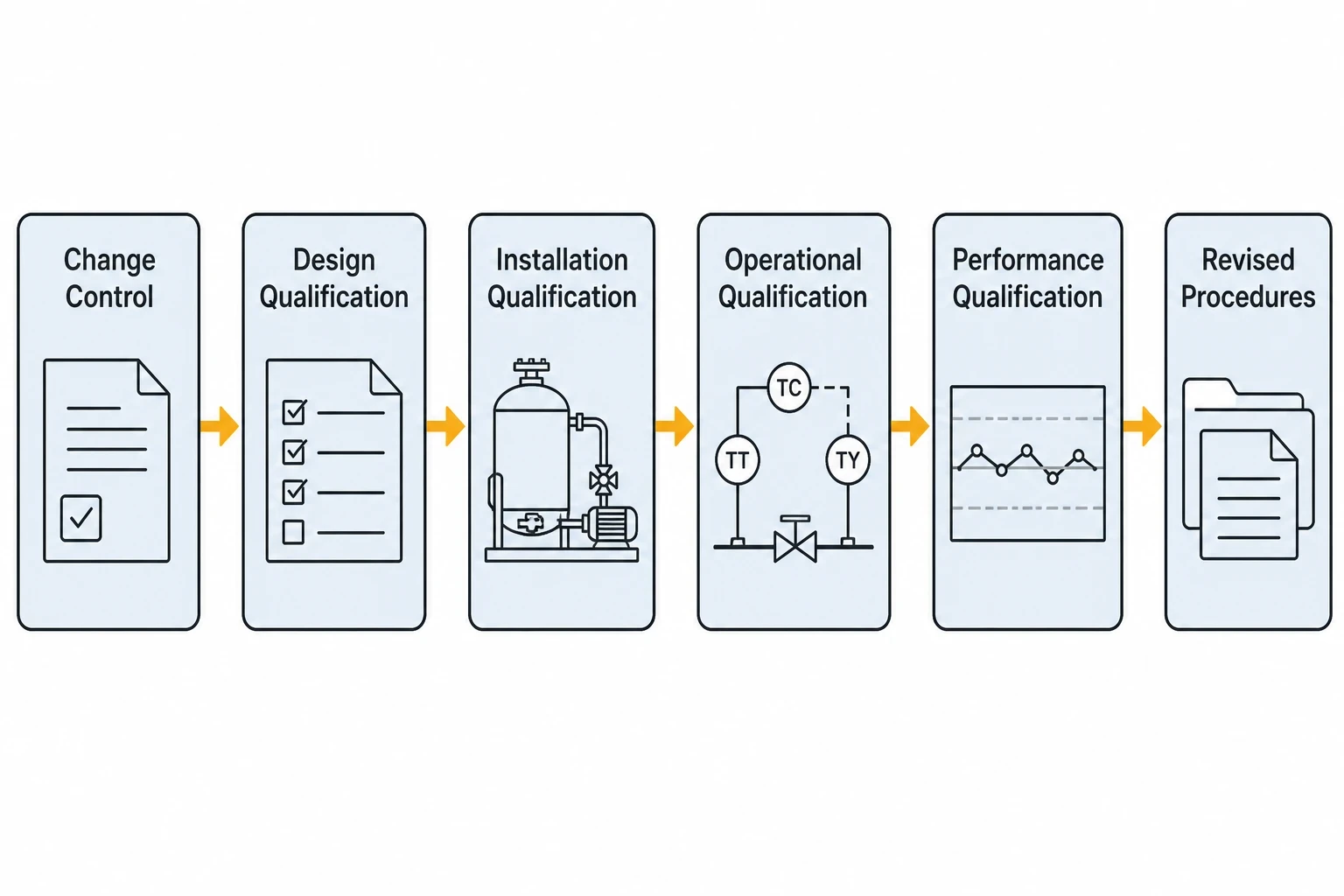
A heat-pump project should enter the quality system early. Late quality involvement creates a costly gap between mechanical completion and approved operational use.
Build the change package around the utility function
The change-control record should state the intended use, affected systems, quality risk assessment, acceptance criteria and rollback arrangements. It should also define the boundaries between the heat pump, thermal storage, existing boilers, building-management controls and process equipment.
For GMP-critical utilities, the commissioning plan normally needs evidence for:
- Design qualification against the approved user requirements.
- Installation qualification for installed equipment, instruments, materials, drawings and calibration status.
- Operational qualification across normal and credible upset conditions.
- Performance qualification demonstrating repeatable delivery under representative production demand.
- Revised maintenance, alarm-response, calibration and periodic-review procedures.
The design must preserve a clear record of source and sink temperatures, heat-pump output, buffer temperatures, flow, pressure and relevant utility-quality parameters. Engineers and quality teams should agree which measurements support product-impact decisions before installation.
Plan for boiler and heat-pump interaction
Existing boilers often remain part of the operating strategy. Their role should be explicit: peak cover, resilience, maintenance cover, steam generation or emergency response.
Control logic needs careful commissioning. A boiler firing while the heat pump rejects heat into a buffer vessel destroys the expected energy benefit. Equally, aggressive heat-pump control can cause unstable temperatures or inadequate reserve for a batch operation.
The plant should be tested through heat-pump start, boiler handover, heat-source interruption, demand spikes, loss of a circulation pump and recovery after a power event. These scenarios provide stronger assurance than steady-state performance alone.
A practical route from Pinch Analysis to pharmaceutical heat-pump deployment
The Futraheat case does not establish a universal heat-pump size, performance value or integration route. Each site has a different heat-source profile, process schedule and GMP boundary.
A disciplined project begins with measured data, identifies direct recovery before mechanical vapour compression or a high-temperature heat pump, sizes the heat pump to a reliable coincident load, retains suitable resilience, and treats the utility modification as a controlled GMP change.
This article reflects the independent analysis and editorial opinion of EnerTherm Engineering. Product names, trademarks, and brands mentioned belong to their respective owners. EnerTherm Engineering is not affiliated with, endorsed by, or a licensee of any third-party software or product mentioned unless explicitly stated.

Managing Director — EnerTherm Engineering
Dr. François Pierrel is Managing Director of EnerTherm Engineering with over two decades of expertise in thermal design, heat transfer, and industrial energy optimisation. He holds a PhD in Heat Transfer from Cranfield University and a Post-Doctorate from Heriot-Watt University.
