How Pinch Analysis Cuts Pharmaceutical HVAC Energy Use
Four-site modelling found 50%+ decarbonisation without higher annual cost.
Pinch analysis is a process-integration method that identifies the minimum heating and cooling utilities a site needs by matching heat sources with heat demands at feasible temperatures. A 2025 four-site pharmaceutical study found that HVAC can be the primary energy consumer in a facility and may offer energy-saving potential of up to 70%.
That makes pharmaceutical HVAC a major starting point for plant decarbonisation. Production environments cannot, however, be treated like conventional commercial buildings. Temperature, humidity, pressure cascades, air cleanliness, containment and recovery after failure all sit within Good Manufacturing Practice requirements. A heat-recovery proposal that disrupts any of them is a quality risk.
Pinch analysis helps engineering teams distinguish viable heat-recovery opportunities from ideas that look attractive on a utility bill but fail on temperature, hygiene or validation grounds. It can also identify where heat pumps, thermal storage and lower-temperature distribution systems can displace fossil-fuelled steam without weakening steam reliability for clean steam, sterilisation or other critical duties.
Why pharmaceutical HVAC is central to plant decarbonisation
HVAC operates continuously around the process
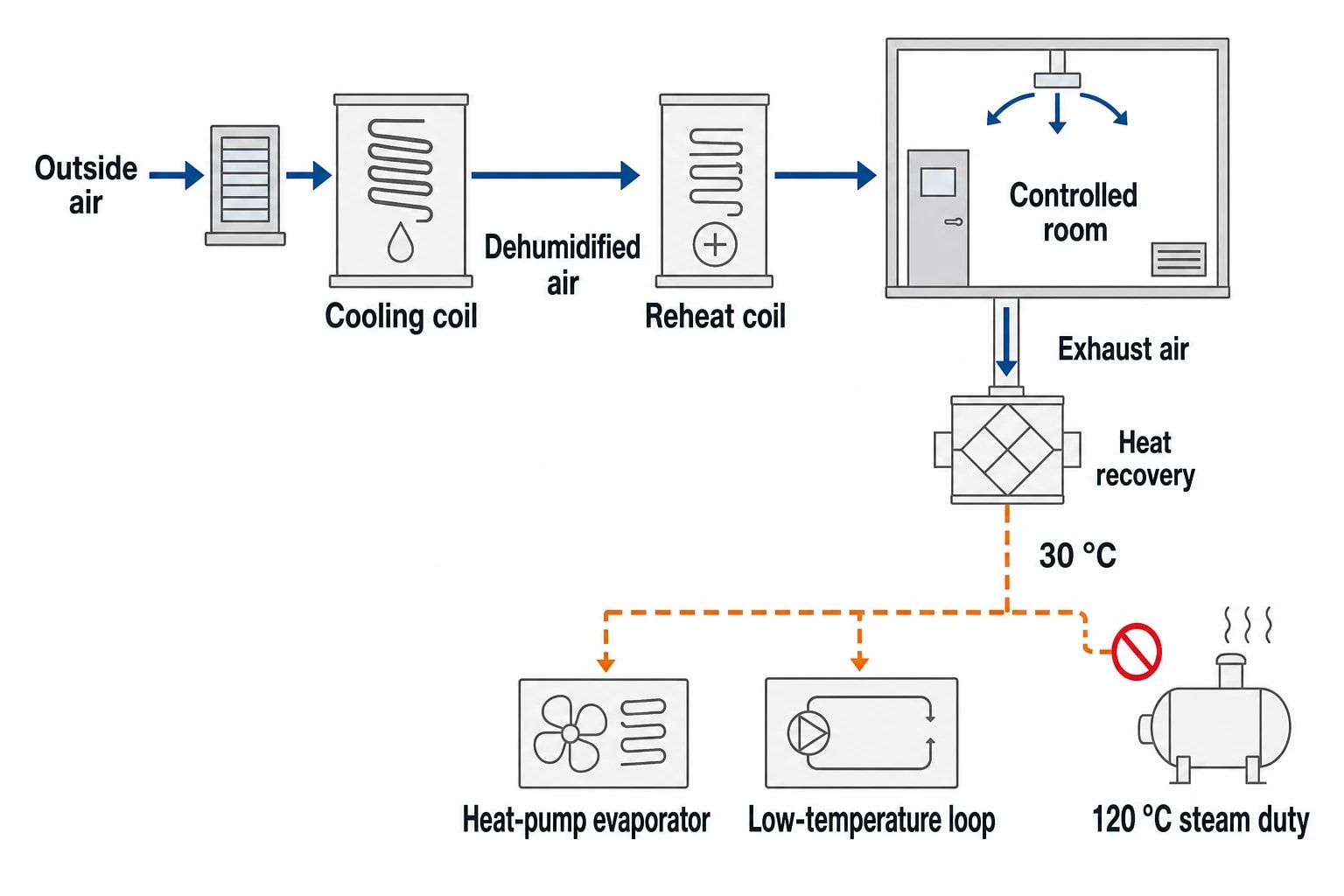
Pharmaceutical HVAC rarely follows a simple occupied-hours schedule. Air-handling units may condition outside air continuously, maintain room pressure differentials, control moisture through cooling and reheating, and support classified areas during manufacturing, cleaning and standby periods.
These systems create simultaneous heating and cooling loads. A cooling coil removes sensible and latent heat from supply air. A heating or reheat coil may then add thermal energy before the air enters a controlled room. Exhaust air, condenser heat, chilled-water return and warm process-water streams can all contain recoverable heat. Their temperatures, timing and cleanliness determine whether recovery is practical.
The 2025 Applied Thermal Engineering study modelled four pharmaceutical production sites and identified HVAC as the primary thermal-energy consumer. HVAC accounted for 65% and 70% of demand at two sites, while the other two recorded HVAC shares slightly below 40%. The study found that optimised HVAC systems reduced heating demand to 43% of the reference case and almost eliminated cooling demand in the modelled configuration.
Those results cannot be transferred directly into a business case for another site. Plant layouts, production schedules, room classifications, ambient conditions and utility networks differ. They do establish the scale of the opportunity and the value of site-specific analysis.
Steam demand can conceal low-temperature opportunities
Many pharmaceutical sites distribute steam because it is dependable, familiar and capable of serving a wide range of duties. Steam remains essential for some critical loads. Problems arise when high-grade steam heats low-temperature loads that could use recovered heat or hot water.
Examples include:
Preheating incoming air before a heating coil.
Reheating dehumidified supply air.
Heating glycol or water loops.
Preheating make-up water for suitable non-critical services.
Supporting cleaning-related hot-water demand where utility segregation and quality requirements permit.
Pinch analysis ranks these demands by temperature. This prevents engineering teams from treating all kilowatt-hours as interchangeable. Heat recovered at 30 °C may suit a heat-pump evaporator or low-temperature loop. It cannot directly replace a 120 °C steam duty. The distinction is central to reliable pharmaceutical heat decarbonisation.

Pinch analysis identifies the thermodynamic minimum energy requirement of your process — then designs the heat exchanger network to achieve it.
What Pinch Analysis reveals in pharmaceutical HVAC systems
Hot streams, cold streams and the pinch temperature
A pinch study starts by defining process streams. A hot stream needs cooling and can release heat. A cold stream needs heating and can receive heat. Each stream requires a supply temperature, target temperature, heat-capacity flowrate or duty, operating duration, and constraints on contact or heat exchange.
For HVAC, streams may include extract air, supply air, chilled-water return, condenser-water return, hot-water return and heat rejected by refrigeration plant. Process and utility streams may add boiler flue gas, clean-in-place return, warm wastewater, water-for-injection equipment and process-vessel cooling loads where permitted by the project boundary.
The analysis applies a selected minimum temperature approach, often written as ΔTmin. It reflects the practical temperature difference required across a heat exchanger, including exchanger size, pressure drop, fouling allowance and controllability. The resulting composite curves reveal the pinch: the point where the available temperature driving force is most constrained.
Above the pinch, the design should avoid external cooling where another process stream could absorb the heat. Below the pinch, it should avoid external heating where recoverable process heat can serve the load. Transferring heat across the pinch usually increases both heating and cooling utility demand.
Targets come before equipment selection
A pinch target is not a purchase order for a plate heat exchanger, thermal wheel or heat pump. It is a thermodynamic benchmark. It shows how far the site is from minimum utility demand before capital costs, cleanability, pressure drop, control strategy and GMP requirements determine the equipment.
That sequence matters in pharmaceutical HVAC. Teams can otherwise specify heat recovery within a single air-handling unit and overlook a better match elsewhere on site. A warm extract stream may offer limited direct recovery into outdoor air, yet provide a stable source for a water-to-water heat pump serving a low-temperature heating loop. Pinch analysis reveals the whole-site match.
The study should also distinguish three temperatures that are often confused:
Temperature basisWhat it informsPharmaceutical HVAC relevanceAir or fluid stream temperatureThe heat available or requiredEstablishes whether direct recovery is feasibleUtility supply and return temperatureThe distribution-system requirementShows where steam can give way to hot waterMinimum temperature approachExchanger size and achievable recoveryTests whether recovery remains practical after fouling and control margins
Building a GMP-relevant stream model
Start with measured operating data
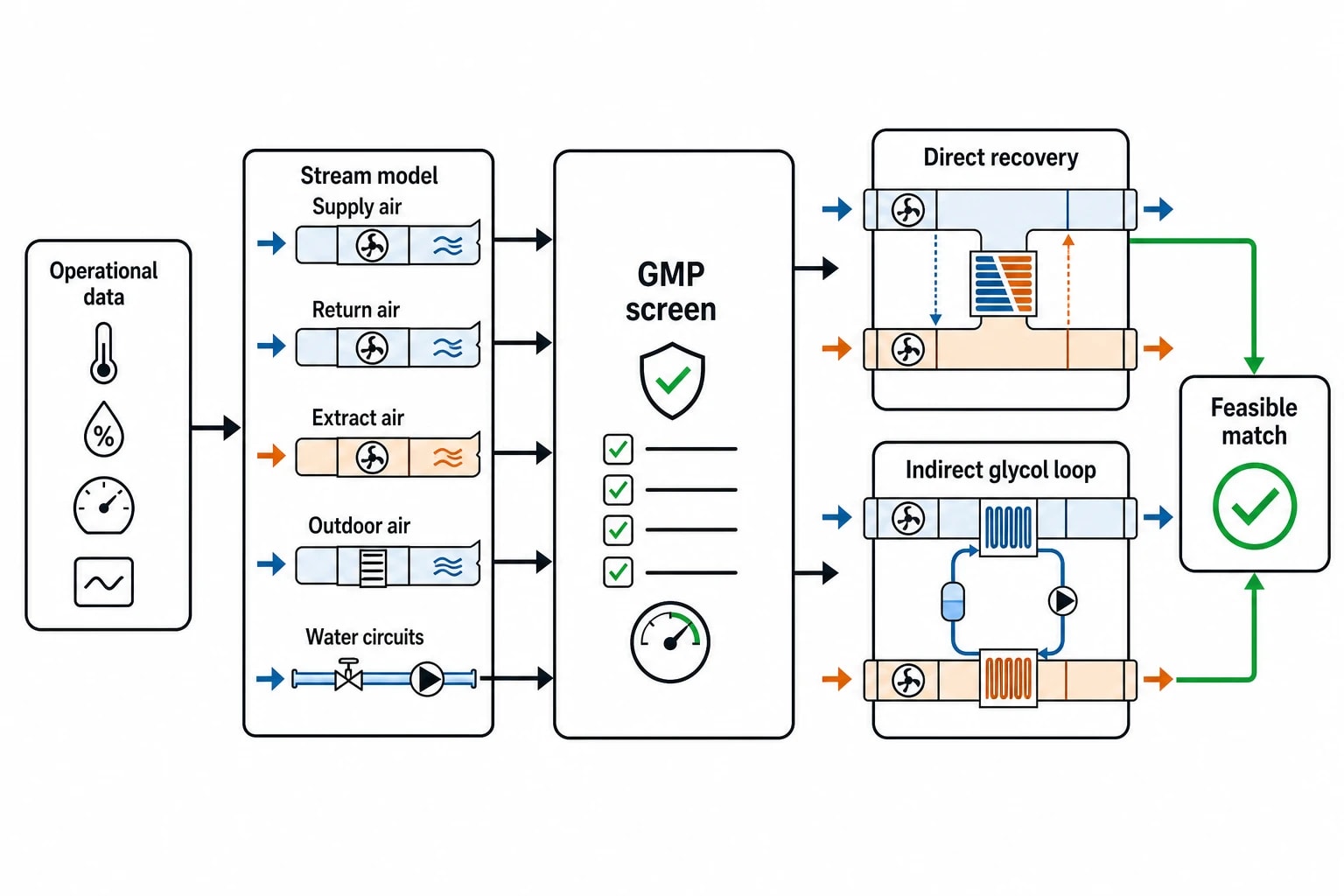
A credible study uses operational data rather than design assumptions alone. HVAC systems drift. Airflows change after room modifications. Coils foul. Dampers leak. Production campaigns alter internal gains and exhaust rates. A model based only on original drawings can miss the actual energy balance.
The initial data set should cover at least one representative production cycle and include seasonal conditions where outdoor-air treatment is material. Engineering teams typically collect:
Supply, return, extract and outdoor-air temperatures and humidity.
Airflow rates, fan speeds and static pressure.
Chilled-water, heating-water and condenser-water flow and temperatures.
Steam use by air-handling units, humidifiers and reheat coils.
Refrigeration and chiller load profiles.
Room pressure, temperature and relative-humidity set points.
Equipment operating states during production, cleaning, idle periods and shutdowns.
Batch and campaign schedules where HVAC or utility demand changes materially.
Humidity requires close attention. Cooling and dehumidification can create an apparent heat-recovery opportunity while increasing latent-load risk. The analysis must preserve the required supply-air condition, not merely an annual average air temperature. A room with a humidity specification, containment requirement or sensitive product may have far less operating flexibility than an unclassified warehouse.
Define boundaries before combining streams
GMP creates boundaries that a conventional pinch study might not have. Air from different pressure zones, potent-product suites, solvent-handling areas, microbiological areas and sterile operations cannot automatically exchange heat through a proposed device. The boundary may relate to contamination control, pressure integrity, cleanability, maintenance access or failure modes.
Indirect recovery through separate water or glycol circuits can reduce cross-contamination exposure, but introduces temperature losses, pumping energy, leakage considerations and additional controls. Direct air-to-air recovery can achieve closer temperature approaches, but the configuration must protect the required separation between exhaust and supply paths.
A feasibility review should record each proposed match alongside its quality and safety constraints.
Pinch-study outputEngineering decisionGMP and operational checkExtract-air heat availableDirect or indirect recovery routeCross-contamination, leakage path and cleanabilityChilled-water return heatHeat-pump source or process preheatTemperature stability and maintenance isolationReheat demandLow-temperature hot-water conversionRoom humidity, temperature and recovery responseHigh steam load at low temperatureSteam displacement opportunityCritical-duty segregation and standby arrangementsMismatched daily loadsThermal storage assessmentWater quality, space, controls and qualification scope

Pinch analysis identifies the thermodynamic minimum energy requirement of your process — then designs the heat exchanger network to achieve it.
HVAC heat-recovery projects Pinch Analysis can prioritise
Exhaust-air and condenser-heat recovery
Pharmaceutical exhaust air can provide a continuous heat source, particularly where high outdoor-air rates serve conditioned production areas. Its usefulness depends on temperature, moisture content, contamination classification and the relationship between exhaust and heating demand.
Direct heat recovery can precondition incoming air where air paths and risk assessment support it. Indirect systems transfer heat through an intermediate circuit and offer stronger separation. Pinch analysis assesses both routes against the wider energy system. It may show that a lower-temperature source has more value feeding a heat pump than directly preheating an air stream.
Condenser heat can also be valuable. Refrigeration plant removes heat from chilled-water systems when dehumidification or process cooling operates. Recovering that heat for reheat or hot-water duties can reduce simultaneous chiller rejection and boiler firing. Seasonal mismatch still requires assessment: condenser heat may be plentiful during high cooling periods and scarce during winter heating peaks.
Reduce reheat and lower heating-water temperatures
Reheat can become a large hidden steam load in tightly controlled air systems. Pinch targeting identifies whether the site can reduce that load through better sequencing, less simultaneous heating and cooling, recovered heat or lower-temperature hot-water circuits.
The objective is not to lower a temperature set point indiscriminately. It is to meet the specified room condition with the least high-grade utility input. A revised coil arrangement, improved valve control or low-temperature heating loop may reduce steam use while retaining humidity control.
Lower return temperatures can improve heat-pump performance and increase the useful heat recovered from low-grade sources. The feasibility assessment should include coil capacity at winter design conditions, valve authority, frost protection, pump capacity and response to rapid load changes.
Use heat pumps after reducing demand
Heat pumps can move recovered or ambient heat into useful hot-water circuits. Their role becomes stronger after pinch analysis has reduced avoidable heating demand and identified suitable source and sink temperatures. Installing a heat pump against an inflated reheat load can lock in excess electrical demand and plant capacity.
The 2025 study identified electricity-based systems, especially heat pumps combined with heat recovery, as an energy-efficient pathway for pharmaceutical decarbonisation. It also found that more than 50% decarbonisation could be achieved without increasing total annual costs in the modelled cases, with some scenarios reaching full decarbonisation. Those outcomes reflected site-specific assumptions on energy prices, technologies and demand reductions. A UK investment case needs its own tariff, connection-capacity, resilience and operating-profile assessment.
GMP change control determines whether savings can be realised
Risk assessment is part of engineering design
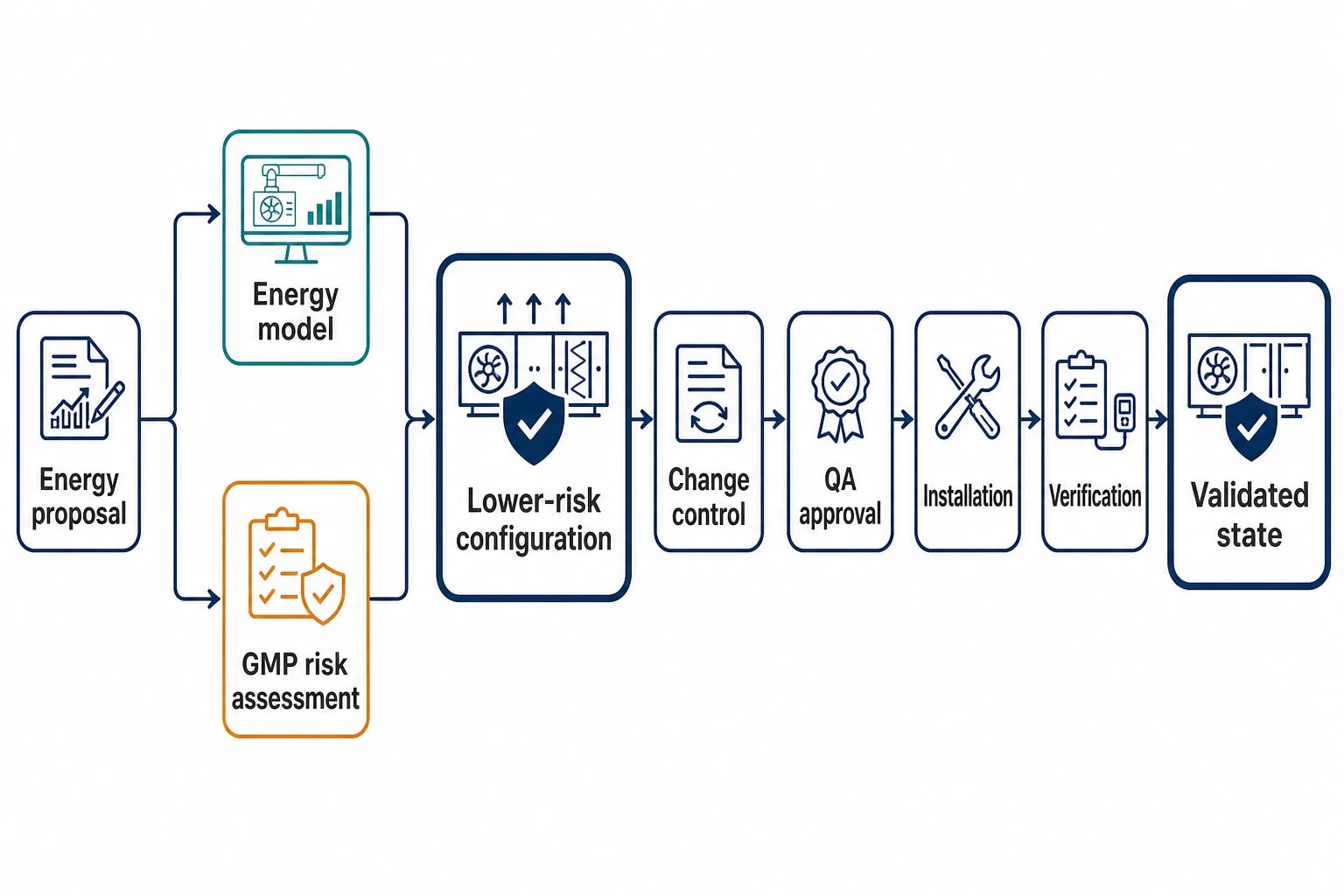
The International Society for Pharmaceutical Engineering states that every energy-efficiency proposal in a pharmaceutical production facility requires GMP hazard identification and risk assessment. That work should begin during pinch-study feasibility, not after engineering has fixed the preferred design.
For HVAC projects, the assessment should examine:
Room pressure differentials during normal operation, start-up, shutdown and fault conditions.
Temperature and relative-humidity control across the full operating envelope.
Containment and the potential for supply and exhaust air cross-leakage.
Effects on filtration, air-change rates and airflow patterns.
Access for inspection, cleaning, maintenance and calibration.
Utility failure response, alarms and return to the validated state.
Effects on adjacent rooms and shared utility systems.
The energy model and GMP assessment serve different purposes. The model quantifies utility reduction. The risk assessment establishes whether the change can operate within the approved control strategy.
QA approval, qualification and documentation
ISPE’s 2024 guidance states that planned changes require change control, and that the necessary scope of requalification or revalidation must be discussed and approved by quality assurance. The project team should therefore define verification activities before installation, including commissioning records, sensor calibration, functional testing and evidence that room conditions remain controlled.
A technically sound heat-recovery system can be delayed or rejected if its control logic, maintenance isolation, alarm response and qualification evidence were not designed into the project. A formal change-control package can instead identify a lower-risk configuration before capital is committed.
A practical route from energy target to implementation
Sequence measures by temperature and production risk
A pharmaceutical HVAC decarbonisation programme should follow a clear order:
Measure current heating, cooling, airflow, humidity and operating-state data.
Build the stream model and set utility targets through pinch analysis.
Identify heat matches, lower-temperature sinks and seasonal mismatches.
Screen each match for GMP, safety, maintainability and resilience.
Develop options for control changes, heat recovery, hot-water conversion, storage and heat pumps.
Compare annual energy, carbon, capital cost, operating cost and validation scope.
Take selected options through QA-approved change control, commissioning and qualification.
Verify utility performance after implementation and update the site energy model.
This sequence reduces demand for high-temperature utility before defining heat-pump and electrification duties.
EU regulatory context for applicable installations
For pharmaceutical operators with installations in the European Union that fall within the Industrial Emissions Directive scope, Directive (EU) 2024/1785, which amends Directive 2010/75/EU, strengthens the role of environmental management systems. These systems must include objectives and measures for improving resource and energy use, alongside performance indicators and other environmental controls.
The environmental management system must be audited at least every three years. A well-documented pinch study can provide a traceable baseline, identify energy-efficiency measures, record technical constraints and support tracking of utility performance after changes take effect.
This article reflects the independent analysis and editorial opinion of EnerTherm Engineering. Product names, trademarks, and brands mentioned belong to their respective owners. EnerTherm Engineering is not affiliated with, endorsed by, or a licensee of any third-party software or product mentioned unless explicitly stated.

Managing Director — EnerTherm Engineering
Dr. François Pierrel is Managing Director of EnerTherm Engineering with over two decades of expertise in thermal design, heat transfer, and industrial energy optimisation. He holds a PhD in Heat Transfer from Cranfield University and a Post-Doctorate from Heriot-Watt University.
