How Pinch Analysis Targets Pharmaceutical HVAC Energy
HVAC can consume up to 60% of pharmaceutical-production energy, with ESOS context.
Pinch analysis is a heat-integration method that sets the lowest practical heating and cooling demand for a defined group of process and utility streams before engineers design heat recovery. The European Medicines Agency reported in 2026 that HVAC systems may consume up to 60% of energy used in pharmaceutical production facilities. That makes air handling, chilled water, heating water, steam humidification and condenser heat central to energy efficiency in pharmaceutical manufacturing.
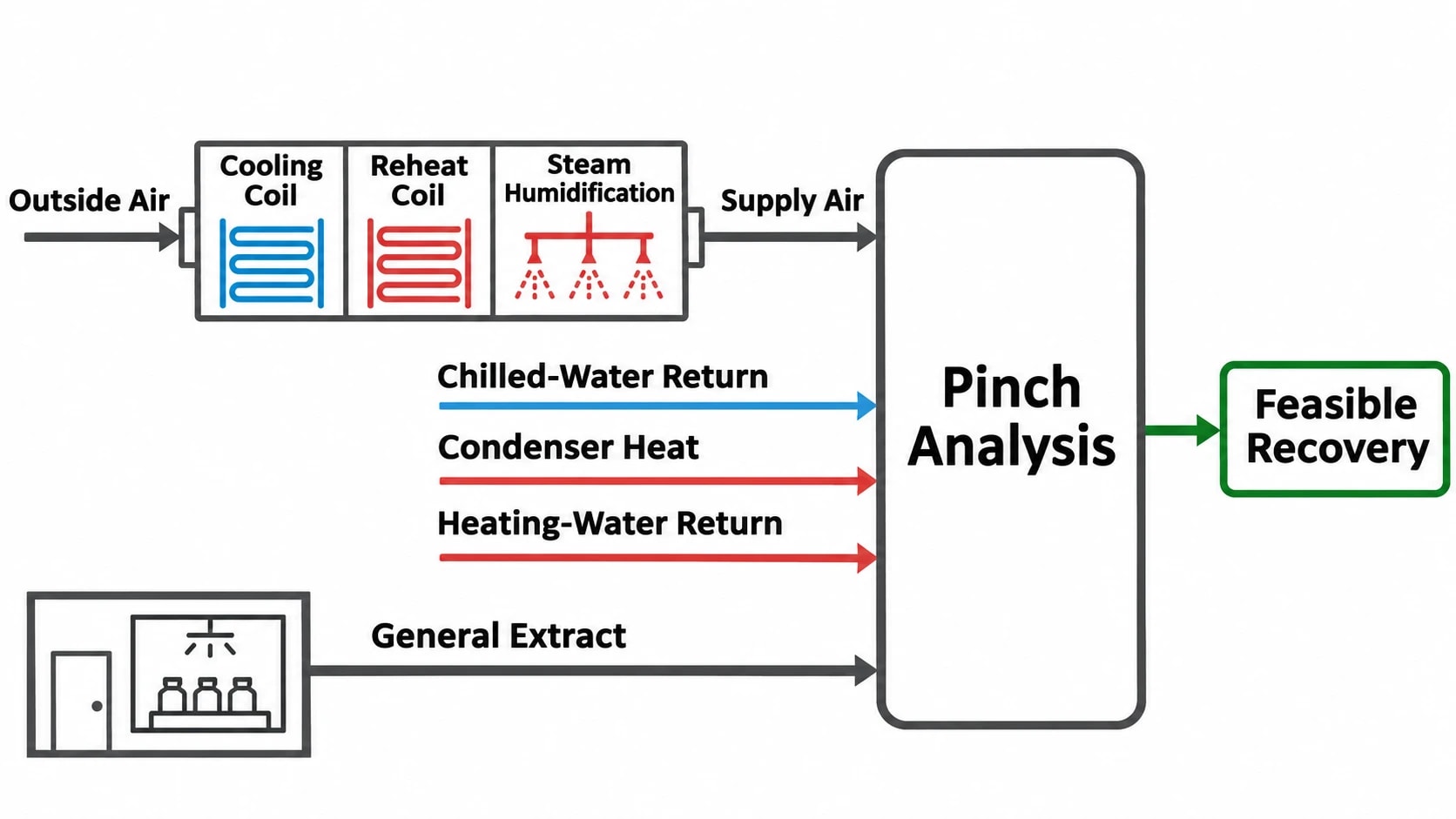
A GMP site can run steam coils, cooling coils, reheat coils, extract systems and refrigeration plant continuously, each with its own local control task. The result is often simultaneous heating and cooling at site level. Heat leaves in extract air, cooling-water return and refrigerant condensers while another part of the facility buys heat from boilers or electrical plant.
Pinch Analysis maps these interactions and establishes a thermodynamic target before capital equipment is selected. It does not override room pressure, humidity, particle control, product protection or validated operating conditions. It identifies heat-recovery options that can be developed within those constraints.
Why pharmaceutical HVAC is a Pinch Analysis priority
HVAC duties extend far beyond comfort conditioning
Pharmaceutical HVAC systems must sustain specified environmental conditions across suites with different functions and classifications. Air-handling units condition outside air, offset internal gains, control moisture, maintain pressure relationships and support required airflow patterns. Extract systems remove air from process equipment and rooms at rates that vary by operating state.
These duties create linked thermal loads:
- Outside air requires heating during cold weather and cooling during warm weather.
- Cooling coils remove sensible heat and, where required, moisture.
- Reheat coils raise supply-air temperature after dehumidification.
- Steam humidifiers impose a direct steam demand.
- Extract air carries sensible and latent heat away from the building.
- Chillers reject heat while heating systems create hot water or steam elsewhere.
A boiler-house review or chiller optimisation project can improve one part of this picture. Pinch Analysis evaluates the temperature levels and timing of all relevant loads together.
The Pinch-study boundary must reflect the production environment
A pharmaceutical HVAC study needs a wider boundary than a conventional process heat-recovery review. It should include air and liquid utility streams that affect manufacturing conditions, while excluding exchanges that cannot be justified on contamination-control, segregation, cleanability or validation grounds.
| Stream or system | Typical thermal role | Pinch Analysis question | Key constraint |
|---|---|---|---|
| AHU supply-air coil | Heating, cooling and dehumidification load | Can coil duty be reduced or met with recovered heat? | Qualified supply conditions must be maintained |
| General extract air | Low-temperature heat source | Can a sealed recovery system preheat water or incoming air? | No cross-contamination or loss of pressure control |
| Chilled-water return | Cooling load indicator | Which coil duties create the chilled-water demand? | Coil capacity and redundancy remain available |
| Condenser heat rejection | Low-grade heat source | Does a compatible low-temperature heating sink exist? | Source and sink must overlap in time |
| Heating-water return | Cold stream | Can recovered heat lift its temperature before the boiler? | Required flow temperature and control response |
| Steam humidification | Hot utility demand | What residual steam duty remains after feasible recovery? | Humidity control and steam quality requirements |
The boundary should separate sterile suites, non-sterile production, laboratories, warehouses and offices. A recovery route acceptable for a warehouse air-handling unit may be unsuitable for a higher-risk cleanroom.

Pinch analysis identifies the thermodynamic minimum energy requirement of your process — then designs the heat exchanger network to achieve it.
What composite curves reveal in pharmaceutical HVAC
Stream data converts plant operation into an energy target
A Pinch Analysis starts with hot streams that must be cooled and cold streams that require heating. For each stream, engineers need supply and target temperatures, heat-capacity flow or duty, operating hours, seasonal variation and the plant state in which the stream exists.
For HVAC work, source data usually comes from:
- Air-handling-unit schedules and coil selections.
- Building-management-system trends for airflow, temperatures, valve positions and room conditions.
- Chilled-water, heating-water and steam meters.
- Chiller condenser-water data and refrigeration-plant trends.
- Weather data matched to representative production conditions.
- Extract-flow records from process equipment.
Composite curves combine individual hot streams into one temperature-duty profile and do the same for cold streams. Their overlap indicates the maximum internal heat recovery at the chosen temperature approach. The unmatched portions identify the minimum external heating and cooling requirements.
A heat exchanger, run-around coil or heat pump can then be tested against a defined residual duty rather than a broad annual-consumption figure.
An illustrative HVAC stream table
The example below is a hypothetical screening case. It does not represent a design specification or prediction for a particular pharmaceutical facility. It assumes that extract-air recovery occurs through a sealed intermediate loop, with no air mixing between extract and supply streams.
| Stream | Stream type | Temperature change | Duty | Operating condition |
|---|---|---|---|---|
| Condenser-water return | Hot | 38°C to 28°C | 50 kW | Dehumidification plant running |
| Sealed extract-air recovery loop | Hot | 31°C to 21°C | 40 kW | General production extract available |
| AHU outside-air preheat coil | Cold | 8°C to 18°C | 35 kW | Winter production |
| Low-temperature heating-water return | Cold | 30°C to 40°C | 30 kW | Perimeter and AHU heating active |
The hot streams contain 90 kW of recoverable heat at their stated conditions. The cold streams require 65 kW. A composite-curve calculation using a 5°C minimum temperature approach could show that 50 kW is recoverable, leaving a minimum 15 kW hot-utility demand and 40 kW cold-utility demand for this operating case.
This is a theoretical target under the stated assumptions, not a case for immediate equipment purchase. The next stage tests hygiene separation, control behaviour, maintenance access, seasonal availability and qualification.
The pinch protects the utility target
The pinch is the closest permitted approach between the hot and cold composite curves. It divides the problem into zones with different heat balances.
Above the pinch, the site has a net heating requirement. Below it, it has a net cooling requirement. Heat transferred across the pinch in the wrong direction increases both utility requirements.
For example, medium-temperature condenser heat may be used for a low-temperature load that already has another suitable source. If that leaves a higher-temperature heating-water return dependent on boiler heat, the arrangement may miss the Pinch target. Composite curves expose this before pipework arrangements are fixed.
Choosing a realistic temperature approach
Small approaches increase recovery but add engineering demands
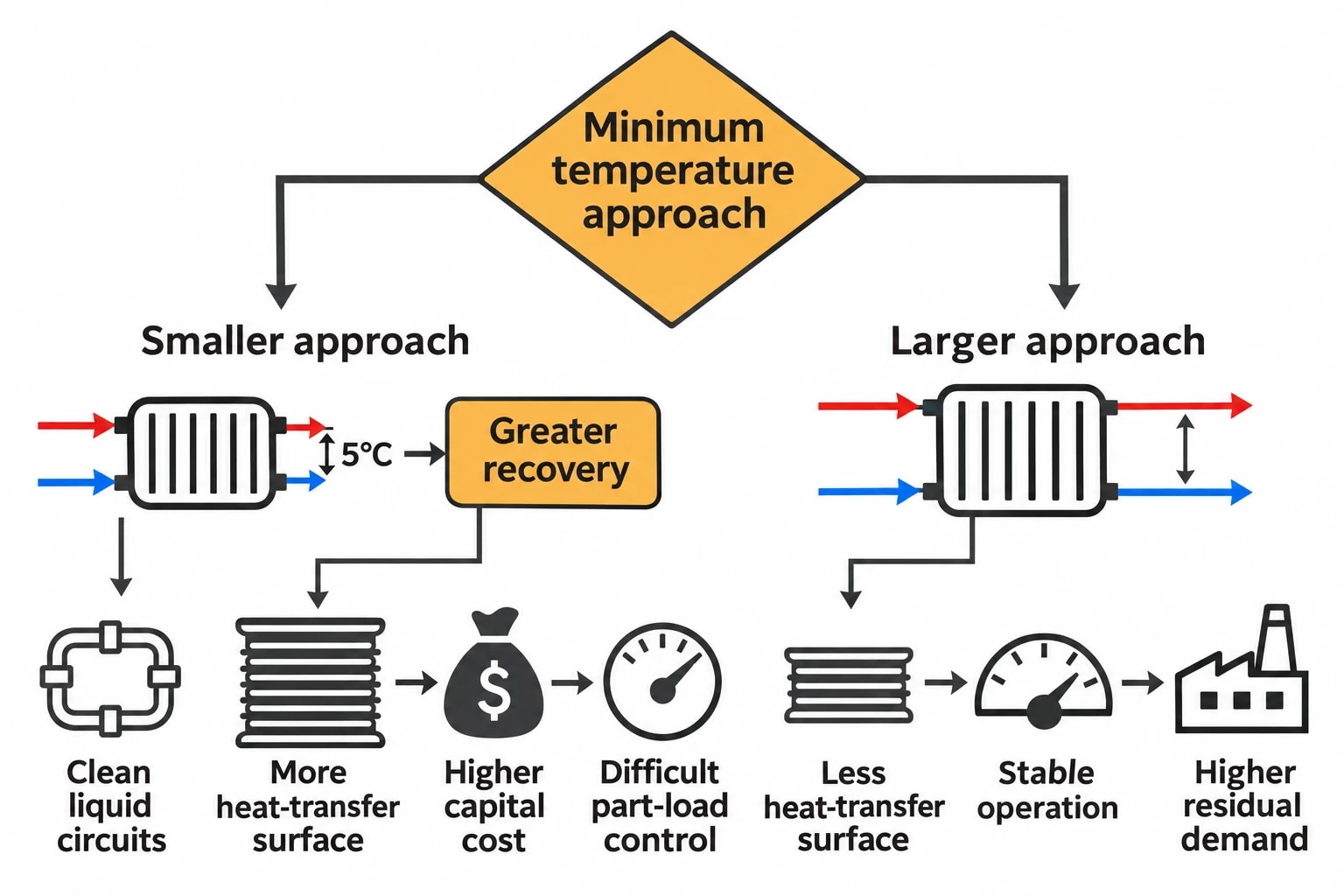
The minimum temperature approach is a project assumption, not a universal constant. A smaller approach increases apparent recovery because heat can transfer across a tighter temperature gap. It also requires more heat-transfer surface, raises capital cost and can create difficult part-load control.
A larger approach reduces heat-exchanger area and can give more stable operation, but increases residual heating and cooling demand. The selected approach should reflect the actual service, including:
- Fluid cleanliness and fouling risk.
- Heat-exchanger type and cleanability.
- Control-valve authority and response time.
- Operating turndown.
- Frost risk in air-side recovery systems.
- Maintenance access and bypass requirements.
- The consequences of a recovery-loop failure.
A 5°C approach may be a reasonable screening assumption for clean, well-controlled liquid circuits. It should not be transferred automatically to wet extract air, contaminated exhausts or duties with uncertain fouling behaviour.
Temperature quality determines project value
Annual energy totals can conceal a poor heat match. Heat rejected at 30°C has limited value for a high-temperature steam load, but may be valuable for heating-water return, domestic hot-water preheat or a heat-pump evaporator.
This distinction matters in pharmaceutical HVAC. Cooling coils and refrigeration equipment can reject substantial low-grade heat while hot-water systems need heat at a modest temperature. Pinch Analysis places both source and sink at their actual temperatures, showing whether direct recovery is possible or whether a heat pump has a credible role.
The method also tests timing. Condenser heat from summer dehumidification may peak when outside-air preheat demand is low. A valid project needs a compatible summer sink, thermal-storage strategy or reduced capital scope that reflects limited overlap.

Pinch analysis identifies the thermodynamic minimum energy requirement of your process — then designs the heat exchanger network to achieve it.
Heat-recovery options that fit pharmaceutical HVAC
Indirect recovery protects air segregation
Direct heat recovery between extract and supply air can create an unacceptable contamination-control challenge for many pharmaceutical applications. Indirect systems keep the airstreams separate.
A run-around coil system uses coils in the extract and supply airstreams linked by a pumped liquid circuit. Heat moves through the circuit rather than by direct air transfer. The system can preheat incoming air in winter or support other suitable low-temperature loads.
A sealed liquid loop can also recover heat from a general production extract system or condenser-water circuit to a segregated heating-water circuit. The design still requires a site-specific assessment of leakage paths, coil integrity, pressure relationships, freeze protection, drainability and maintenance controls.
Condenser heat can displace low-temperature boiler demand
Chillers and refrigeration systems reject heat during normal cooling operation. Pinch Analysis helps determine whether that heat can serve:
- Heating-water return.
- AHU preheat coils.
- Low-temperature perimeter heating.
- Domestic hot-water preheat.
- Reheat duties where temperature and operating overlap are suitable.
A heat pump may lift condenser heat or other low-temperature sources to a higher useful temperature. Its role should follow the Pinch target. The study must establish source temperature, sink temperature, simultaneous capacity and remaining heating duty before setting a heat-pump duty.
An oversized heat pump can spend much of the year bypassed because its source or sink is unavailable. A correctly sized heat pump addresses a defined residual gap in the composite curves.
Reheat needs a precise engineering review
Cooling, dehumidification and reheat can be necessary to deliver air at the required temperature and moisture content. Pinch Analysis does not classify this sequence as waste by default. It quantifies the heating and cooling duties and identifies the best source of reheat within the validated operating envelope.
The study may show that recovered condenser heat can supply part of a reheat duty. It may also show that reheat occurs only under particular outdoor conditions or production states. This prevents a project team from assigning annual savings to a recovery route available for only a limited number of hours.
Applying Pinch Analysis within GMP constraints
Contamination control sets the project rules
EU GMP Annex 1 is fully applicable and requires manufacturers of sterile medicinal products to establish a contamination-control strategy. HVAC modifications must preserve the environmental conditions and pressure relationships required for product protection.
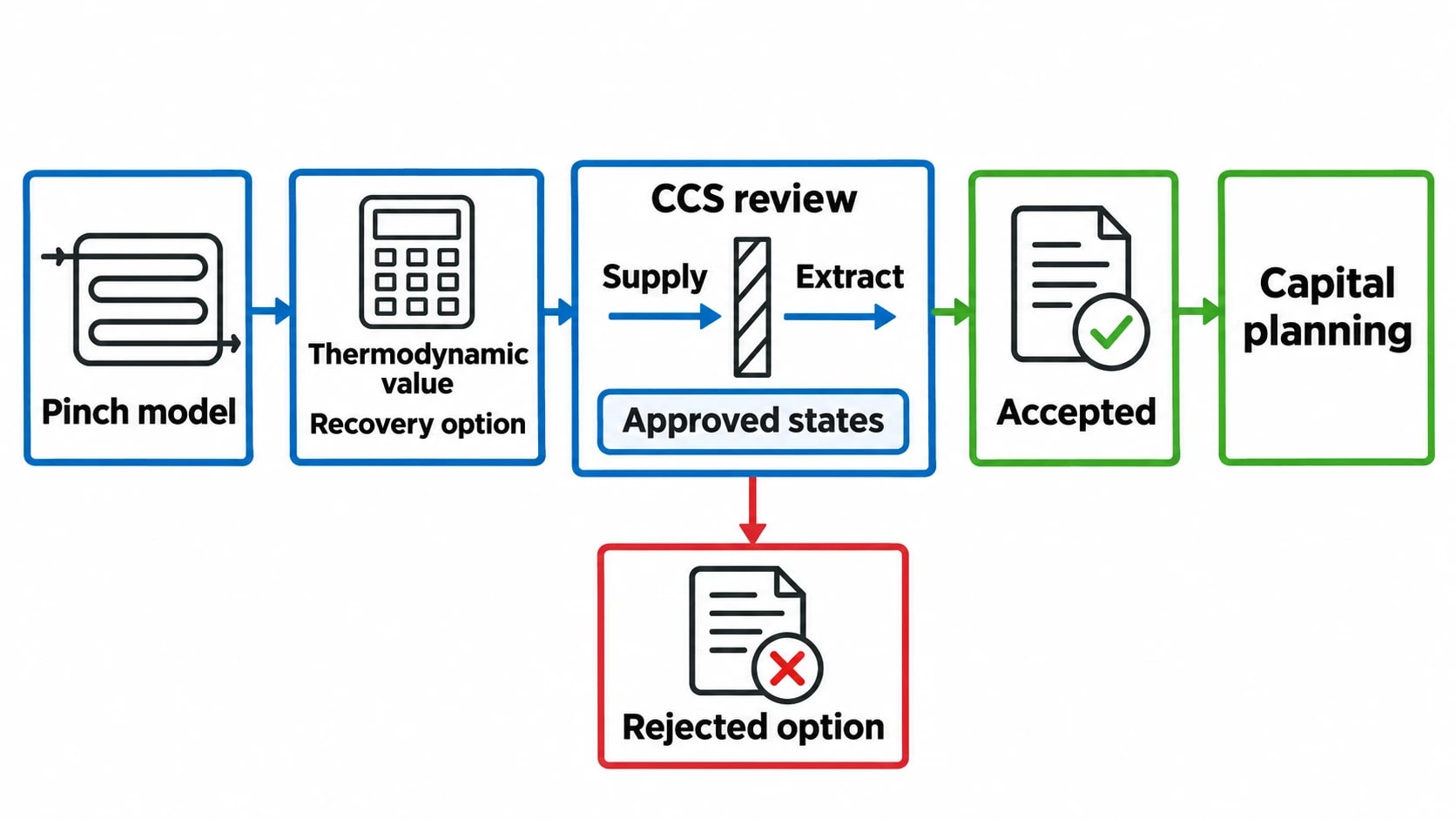
Pinch studies should screen potential measures in two stages: calculate their thermodynamic value, then determine whether they are acceptable within the site’s contamination-control strategy and pharmaceutical quality system.
A heat-recovery project should define:
- The physical boundary between extract, supply and utility circuits.
- Failure modes, including coil leakage, pump failure and sensor drift.
- Required bypass positions and safe operating states.
- Pressure-cascade performance during normal and upset conditions.
- Maintenance isolation, cleaning and inspection arrangements.
- Monitoring, alarms and acceptance criteria.
A high recovery target with an unacceptable hygiene case should be recorded as a rejected option rather than carried into capital planning.
Use validated operating profiles as model inputs
The Pinch model should represent approved operating states, not a single design-day snapshot. Winter and summer production, cleaning, shutdown, maximum extract demand and part-load operation can each produce a different heat-recovery target.
Where a site revises an operating profile through its pharmaceutical quality system, the updated validated airflow, temperature, humidity and pressure conditions must become Pinch-study inputs. This ensures heat-recovery equipment is sized against conditions the facility is authorised to run.
Qualification must test the whole control response
A recovery loop changes system dynamics. Preheating outside air alters heating-coil response. A heat pump can alter heating-water temperatures. A failed recovery circuit can affect supply-air conditions during cold weather.
Change control should cover design review, risk assessment, commissioning, qualification planning, alarm review and performance testing. The evidence package should demonstrate that the modified system holds approved conditions during normal operation, peak load and defined faults.
The strongest pharmaceutical HVAC energy projects establish the utility target through Pinch Analysis, protect it with appropriate separation and controls, then prove performance under the same disciplined conditions applied to the manufacturing environment.
A practical Pinch Analysis workflow for pharmaceutical HVAC
Build the study around operating cases
A useful study develops separate stream tables for representative operating cases rather than relying on an annual average. The following sequence keeps the work focused on heat recovery.
- Define the GMP, contamination-control and utility boundaries.
- Gather metered utility data and trend relevant HVAC conditions.
- Identify hot and cold streams, temperatures, duties and operating periods.
- Create composite curves for each representative operating case.
- Select and test realistic minimum temperature approaches.
- Identify recovery matches, residual utility targets and rejected hygiene-risk options.
- Develop concepts for indirect recovery, condenser-heat use or heat-pump integration.
- Validate the preferred concept through change control and qualification.
Prioritise measures by usable heat, not by source size
The largest heat source does not necessarily produce the best project. A smaller, steady source at a useful temperature can outperform a large intermittent source with no compatible sink.
For energy efficiency in pharmaceutical manufacturing, the most valuable result is a ranked set of heat-recovery opportunities stating available duty, source and sink temperatures, operating overlap, contamination-control boundary and residual utility effect. That gives utilities engineers a defensible basis for moving from energy data to a qualified project.
This article reflects the independent analysis and editorial opinion of EnerTherm Engineering. Product names, trademarks, and brands mentioned belong to their respective owners. EnerTherm Engineering is not affiliated with, endorsed by, or a licensee of any third-party software or product mentioned unless explicitly stated.

Managing Director — EnerTherm Engineering
Dr. François Pierrel is Managing Director of EnerTherm Engineering with over two decades of expertise in thermal design, heat transfer, and industrial energy optimisation. He holds a PhD in Heat Transfer from Cranfield University and a Post-Doctorate from Heriot-Watt University.
