
Why Pharma Energy Data Acquisition Uses Read-Only PLC Access
Modbus and OPC-UA provide audit-ready energy data without writing to validated GMP systems
Read-only PLC access extracts live energy and utility values from industrial control systems without granting the monitoring system permission to alter a process value, setpoint, programme or controller state.
For pharmaceutical manufacturers, that boundary protects far more than a network connection. A PLC may control cleanroom air handling, clean steam generation, chilled water, purified water, compressed air, autoclaves or process skids. These systems often sit within a validated GMP environment, where an unauthorised change can trigger a deviation investigation, affect product quality or require assessment of the validated state.
Energy monitoring still needs the operational data held near these assets. Electricity meters, gas meters and steam flowmeters provide much of the picture, but PLCs frequently hold the context needed to make consumption meaningful: equipment status, batch identifiers, production state, duty cycle, temperatures, pressures and alarm conditions. Read-only PLC access gives energy teams visibility without adding a control path into production.
For UK sites preparing for ESOS Phase 4 compliance by 5 December 2027, verified 12-month energy data and meaningful energy-intensity ratios are particularly relevant. A secure acquisition design can make this evidence available while respecting pharmaceutical change-control and validation practices.
Why secure pharma energy data acquisition starts at the PLC boundary
Energy data needs production context
A site can record total electricity consumption at an incomer meter and still struggle to explain a rise in energy intensity. A batch facility may use the same utility load for different products, batch sizes and production schedules. Cleanroom HVAC may consume substantial energy when no batch is active. Steam demand can reflect sterilisation, humidity control, clean-in-place operations or building heating.
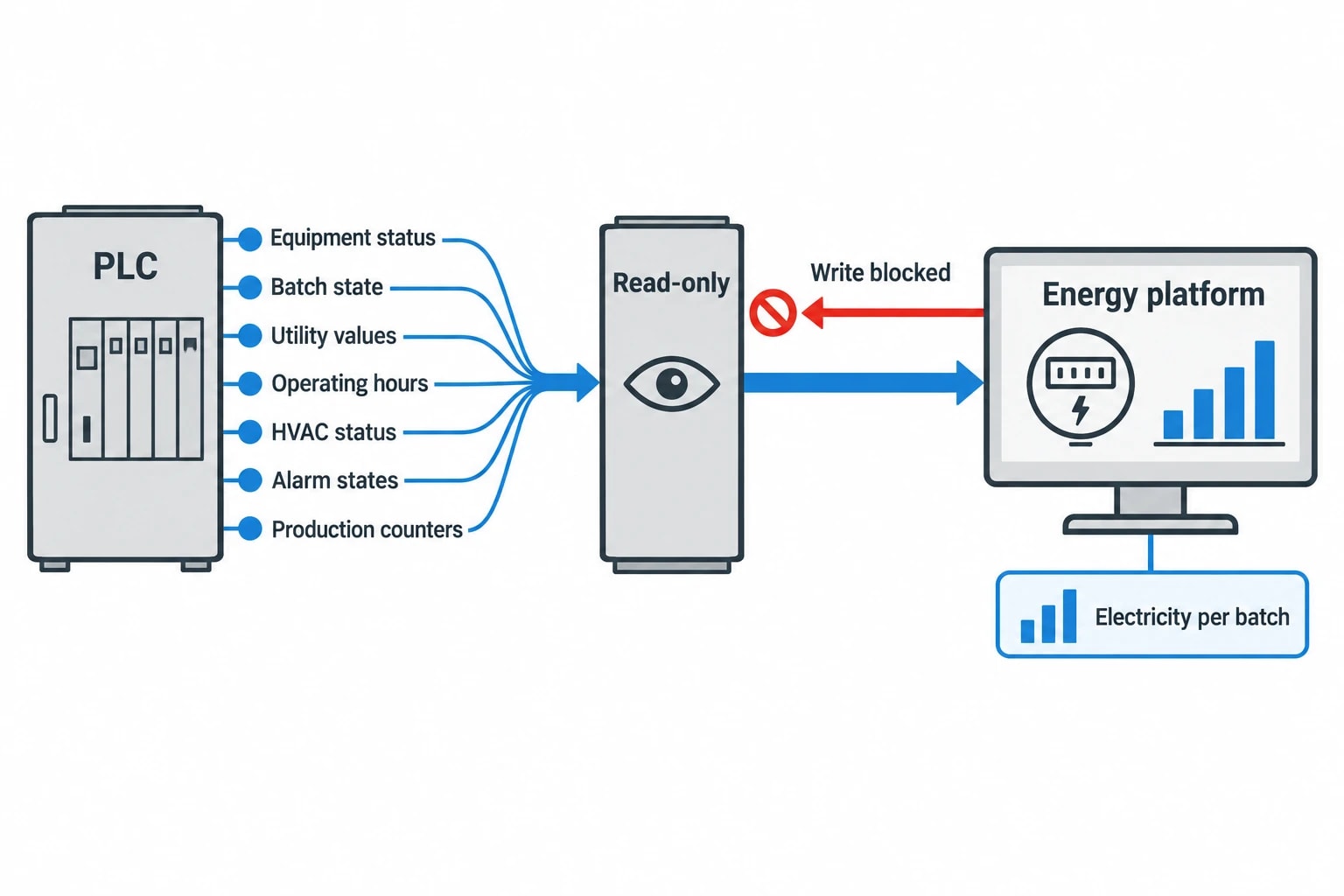
PLC data helps distinguish these conditions. An energy platform may collect selected, non-control values such as:
- Equipment running or stopped status
- Batch or campaign state where suitable for the intended use
- Utility flow, pressure and temperature values
- Pump and fan operating hours
- HVAC mode and occupancy schedule status
- Alarm states that explain unusual energy demand
- Production counters used to calculate energy per batch or unit output
This combination supports useful Energy Performance Indicators, or EnPIs. ISO 50001:2018 identifies EnPIs and energy baselines as tools for tracking energy performance and requires organisations to use data to understand energy use and make decisions.
For a pharmaceutical site, an EnPI such as electricity per batch can be more revealing than total monthly electricity. It can expose a sustained rise in cleanroom fan energy, a compressed-air leak during idle hours or a steam profile that no longer matches the normal sterilisation cycle. That insight depends on trustworthy source data and a controlled acquisition method.
Read-only access contains the functional scope
A read-only connection has one defined purpose: it requests approved values and receives them. It does not issue commands, change parameters, acknowledge alarms, start or stop equipment, or alter recipes.
The protocol alone does not guarantee a safe implementation. Modbus can support both read and write function codes. OPC UA can expose both readable and writable nodes. Security depends on the access rights, network design, endpoint configuration and client behaviour selected for the installation.
Read-only status must therefore be demonstrated, not simply applied as a label to a connection.

Omni Vision delivers turnkey utility metering, CO2 tracking, and AI-powered production KPI intelligence — giving you real-time dashboards and actionable insights across your entire facility.
Read-only PLC access and GMP-compliant monitoring
The risk-based case under GAMP 5
ISPE GAMP 5, A Risk-Based Approach to Compliant GxP Computerized Systems, frames compliance around patient safety, product quality and data integrity. The guidance supports a lifecycle approach in which knowledgeable teams assess intended use, system interfaces, risks and controls.
An energy monitoring system does not automatically become part of the GMP control system because it reads a PLC value. Its intended use determines the level of assessment. A platform used for sustainability reporting and utility optimisation has a different impact profile from a system used to release a batch, control a critical process parameter or maintain an official manufacturing record.
The interface still needs documented assessment. Quality Assurance, automation and IT/OT teams should establish:
- Which PLCs, meters and servers provide data.
- Which tags, registers or objects are required.
- Whether any selected value supports a GxP decision or record.
- Whether the monitoring connection can affect availability, configuration, process control or data integrity.
- Which technical and procedural controls reduce those risks.
- How the installation, configuration and ongoing change process will be verified.
Read-only access reduces the direct risk of an energy acquisition client altering the source process. It does not remove the need for assessment. Excessive polling, a poorly configured gateway, duplicate network addresses or unmanaged changes can still affect availability or create confusion over data ownership.
Data integrity applies to energy evidence too
MHRA guidance on GxP data integrity addresses the governance expected across the pharmaceutical lifecycle. Where energy information supports regulated decisions, audit evidence or GMP-related investigations, teams should establish its source, time basis, access control and retention approach.
A useful monitoring record captures more than a dashboard value. It should retain the meter or PLC source, tag or register mapping, acquisition timestamp, engineering unit, scaling method, data-quality status and any transformation applied by the platform.
This supports traceability. An engineer investigating an unexpected peak in gas consumption can trace the displayed figure to its source and confirm whether the value was measured, calculated, unavailable or substituted. The same discipline is valuable for environmental reporting and energy audits.
How Modbus and OPC UA enforce read-only PLC connectivity
Modbus requires explicit write blocking
Modbus remains common in utility meters, packaged plant and PLC-connected systems. Its simplicity makes it practical for energy acquisition, but it demands disciplined configuration.
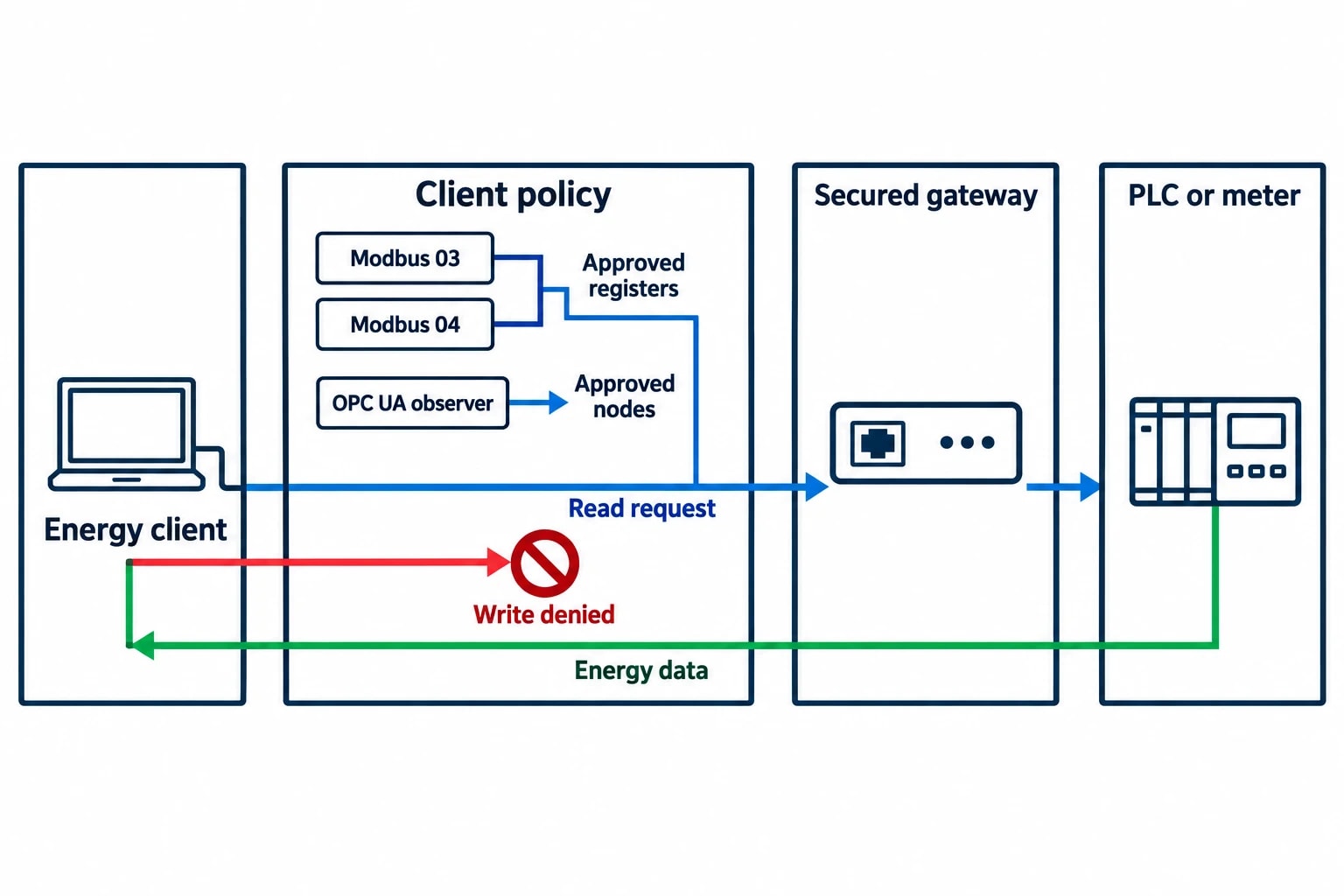
For read-only collection, a client normally uses Modbus function code 03 to read holding registers or function code 04 to read input registers. The appropriate choice depends on the device register map. A holding register is not automatically writable from the energy platform because of its Modbus data type. However, the interface must block write functions at the client, gateway and network boundary.
Write-capable Modbus functions must be explicitly denied. Engineers should also avoid generic polling configurations that permit users to enter arbitrary function codes or addresses after commissioning.
| Control point | Read-only requirement |
|---|---|
| Data scope | Whitelist only documented registers required for energy and operational context |
| Client configuration | Permit polling requests only, with no write or diagnostic command capability |
| Gateway or protocol converter | Deny write-capable Modbus functions and restrict permitted destinations |
| PLC or meter | Use device permissions where supported and preserve an approved register map |
| Network boundary | Permit only approved source and destination addresses, ports and paths |
| Change control | Review any new tag, register, poll rate, firmware change or network route |
Modbus TCP does not provide the same built-in security model as OPC UA. A site may apply segmentation, firewall rules and a secured gateway, or use Modbus Security where appropriate. The essential test is practical: a compromised or misconfigured energy client must not be able to issue an accepted write request to the production asset.
OPC UA supports read roles and node-level permissions
OPC UA can provide a structured model for exposing selected PLC or SCADA data. Its address space can identify variables, engineering units and metadata, while its security model supports authenticated sessions, certificates, encrypted secure channels and role-based permissions.
For energy data acquisition, the client should receive a dedicated observer or read-only role. The OPC UA server should expose only approved nodes and deny write access and method invocation. The platform account should not have engineering, supervisory or administrator privileges.
This follows the least-privilege principle and improves auditability because the connection has its own identity, certificate lifecycle and access record rather than sharing an engineering workstation account.
A read-only OPC UA session should still undergo operational testing. Teams should verify that intended values arrive at the expected interval, that an attempted write receives an access-denied response, and that loss of the monitoring connection leaves the controlled process unchanged.

Track energy consumption, emissions, and process parameters with seamless PLC/SCADA integration via Modbus, OPC-UA, and MQTT protocols.
Secure PLC connectivity must protect availability as well as write access
Polling frequency is an engineering decision
Energy data does not require millisecond-level acquisition from every source. Electricity, steam, gas and water meters may justify different collection intervals from equipment status or batch counters. The required resolution depends on the reporting period, utility dynamics, meter capability and intended analysis.
A polling design should account for PLC scan time, communications capacity, controller workload and the number of simultaneous requests. Automation engineers should approve the poll schedule before deployment. A staged site test can confirm that acquisition does not add unacceptable load or interfere with existing communications.
For example, a cumulative electricity meter total may need periodic collection, while a short sterilisation cycle may need a finer interval to relate steam demand to cycle state. The design should document why each interval is selected rather than applying one rate across all assets.
Segmentation and controlled pathways reduce exposure
Read-only permissions are necessary, but form only one layer of protection. The energy acquisition component should connect through an agreed OT network path, with only the ports and systems required for the defined data flow.
A typical arrangement separates the PLC network from the acquisition service through industrial network controls or a managed gateway. The monitoring platform receives selected data from that intermediary layer. Where remote or cloud analytics are used, the outbound connection, identity management, encryption and data-retention arrangements require review by the facility’s IT/OT and Quality teams.
The design documentation should identify the connection owner, asset owner, approved protocol, endpoint, certificate or credential arrangement, firewall rule, service account and recovery procedure. This makes later audits and change assessments faster and less dependent on individual memory.
ISO 50001, ESOS Phase 4 and SECR need reliable energy evidence
ISO 50001:2018 relies on meaningful EnPIs
ISO 50001:2018 is technology-neutral. It does not prescribe a PLC protocol or energy platform. It requires an energy management system that measures performance, uses data for decisions and improves energy performance over time.
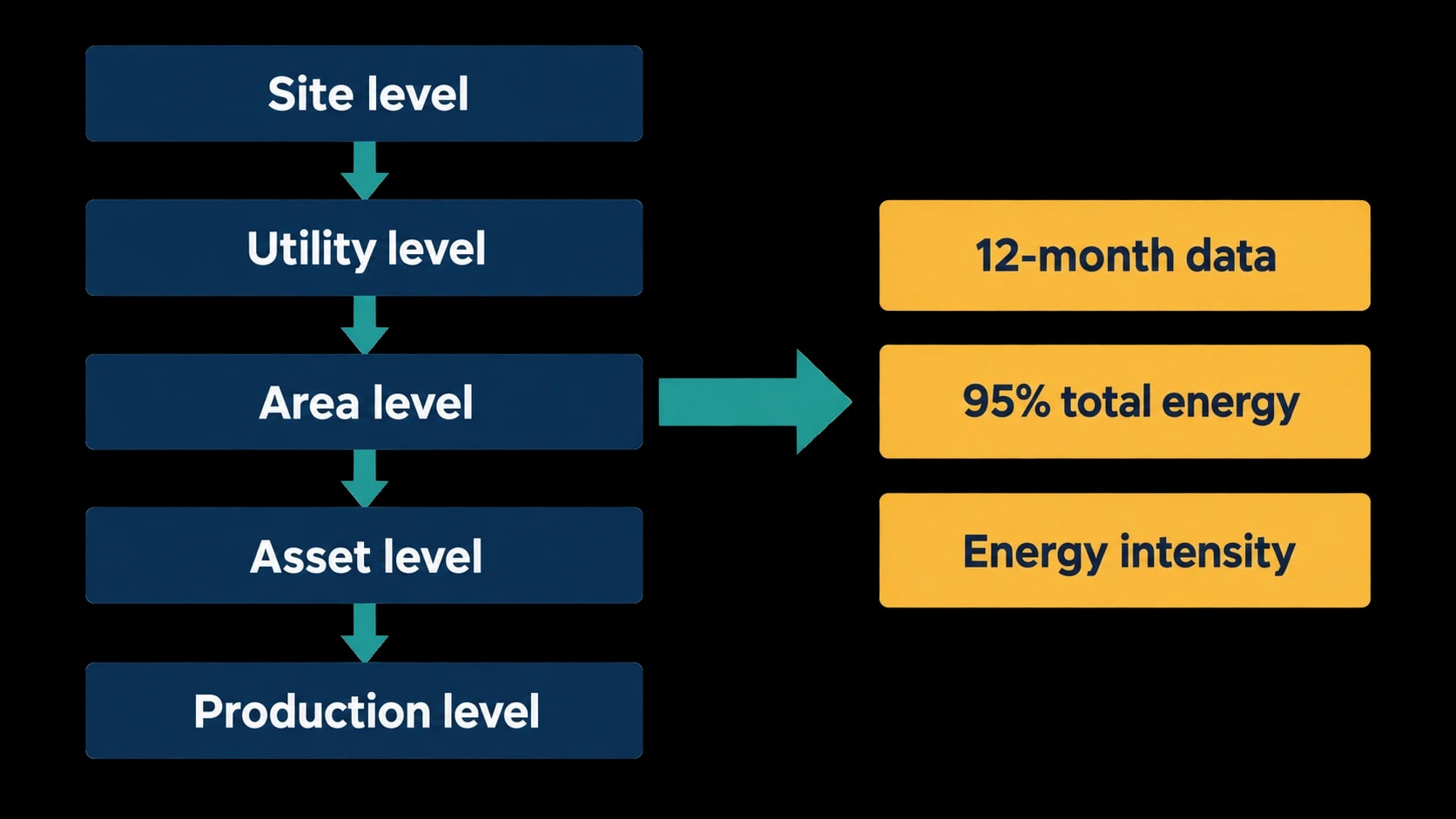
For pharmaceutical manufacturers, high-resolution utility data supports an EnPI hierarchy:
- Site level: total electricity, gas and associated cost
- Utility level: steam, compressed air, chilled water, purified water and cleanroom HVAC
- Area level: production suites, laboratories, warehouses and utilities plant
- Asset level: boilers, chillers, air handling units, compressors and autoclaves
- Production level: energy per batch, per campaign or per appropriate production unit
The production-level view requires care. A batch identifier or counter should be read only where approved for the defined energy purpose. The energy platform should not become the system of record for batch release or manufacturing execution. It correlates approved context with utility consumption and identifies operational questions for authorised teams to investigate.
ESOS Phase 4 raises the value of measured data
The Environment Agency states that ESOS Phase 4 audits must, so far as reasonably practicable, use verifiable energy-consumption data measured over a 12-month period. Participants must identify areas of significant energy consumption accounting for at least 95% of total energy consumption and calculate energy-intensity ratios for buildings, transport, industrial processes and other energy uses.
This fits the operating reality of pharmaceutical estates. Automated metering and controlled PLC-derived context can help separate process energy from building services and support evidence packs with a consistent audit trail. A central data model also helps teams retain the assumptions behind an energy-intensity ratio rather than reconstructing the calculation from spreadsheets after the reporting period closes.
SECR reporting needs a defensible source trail
SECR applies to quoted companies and to large unquoted companies and LLPs that meet the relevant threshold tests, subject to applicable exemptions. The reporting framework includes energy consumption and greenhouse gas emissions. Scope 1 covers direct emissions from sources owned or controlled by the organisation, such as onsite fuel combustion. Scope 2 covers indirect emissions from purchased energy, including electricity and, where relevant, purchased heat, steam or cooling.
An energy platform does not decide reporting scope or replace corporate accounting judgement. It can provide a controlled operational dataset: metered consumption, source identity, period totals, exception flags and retained calculation inputs. Finance and sustainability teams can then apply the applicable government conversion factors and reporting methodology consistently.
A practical deployment route for zero-write energy monitoring
Start with an interface inventory
The strongest projects begin with a survey, not a dashboard. The project team should identify utility meters, PLCs, SCADA servers, protocol gateways, existing historian links and network zones. It should then determine which sources provide primary measurement and which provide operational context.
The tag list should be concise. Collecting thousands of unneeded points creates validation work, cybersecurity exposure and long-term maintenance without improving energy insight. Each selected point should have a clear purpose, unit, source and owner.
Test the boundary before collecting production data
Commissioning should prove both the acquisition result and the absence of unauthorised control capability. A test protocol can include read validation against a known source, time-synchronisation checks, scaling checks, communication-loss behaviour, alarm handling and rejected-write testing.
The output should document that the monitoring platform neither writes to nor invokes control functions on the production PLC. It should also define the approved route for future changes, including new data points, altered polling rates and software updates.
Within the Omni Vision Energy Intelligence Platform, this approach supports centralised monitoring of electricity, gas, water, steam, compressed air and oil while maintaining zero-write access to approved production sources. Production-linked energy analysis can sit alongside audit-ready utility records without turning an energy system into a control system.
This article reflects the independent analysis and editorial opinion of EnerTherm Engineering. Product names, trademarks, and brands mentioned belong to their respective owners. EnerTherm Engineering is not affiliated with, endorsed by, or a licensee of any third-party software or product mentioned unless explicitly stated.

Managing Director — EnerTherm Engineering
Dr. François Pierrel is Managing Director of EnerTherm Engineering with over two decades of expertise in thermal design, heat transfer, and industrial energy optimisation. He holds a PhD in Heat Transfer from Cranfield University and a Post-Doctorate from Heriot-Watt University.
