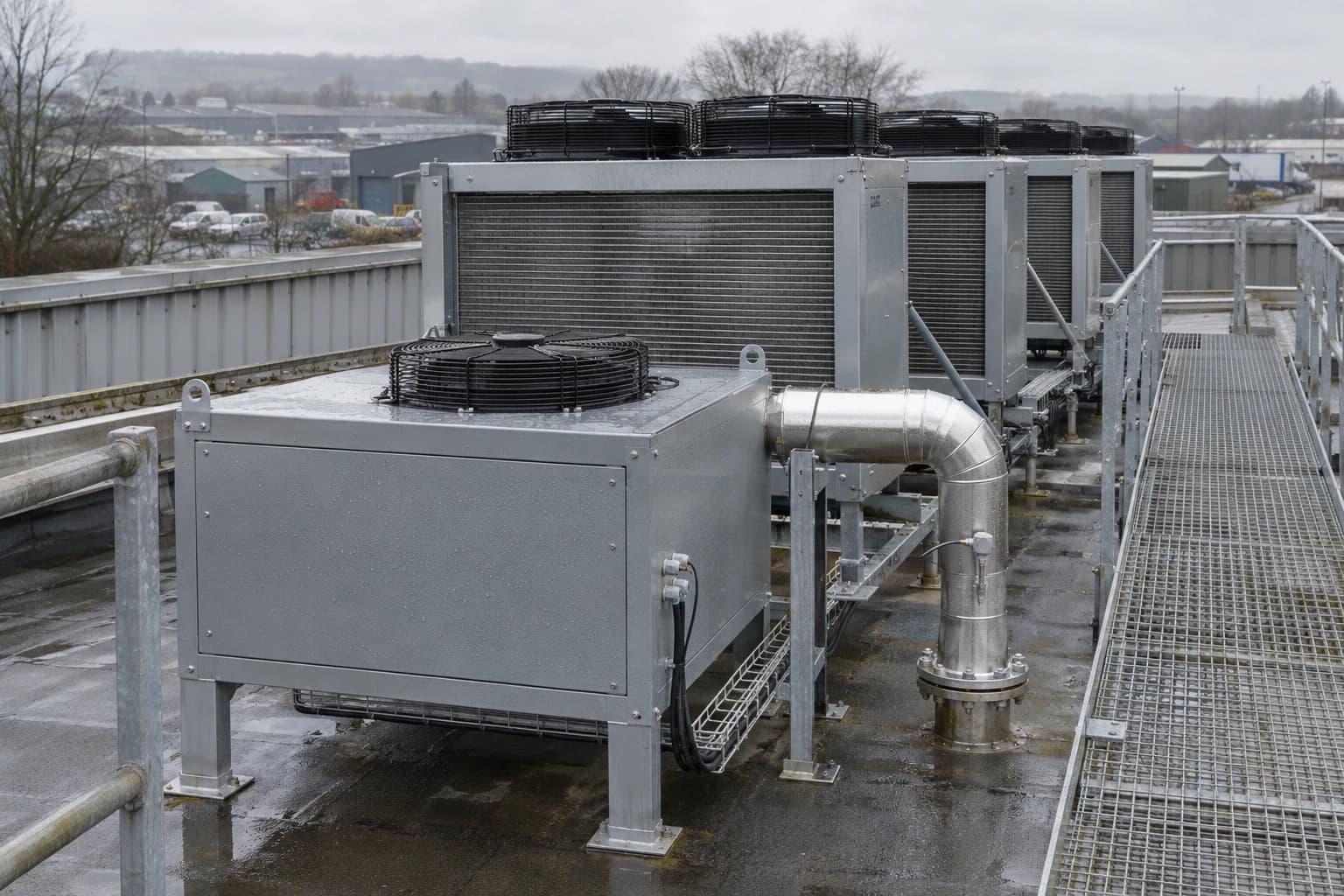
Can Industrial Waste Heat Recovery Cut Fuel Use by 20-50%?
UK food and drink sites could save 20-50% on fuel for heat, subject to hygiene controls.
DESNZ modelling published in 2026 estimates that food and drink sites could reduce fuel used for heat by 20–50% through a package of waste-heat recovery, combined heat and power, and reduced heat losses. That range needs careful reading. It is not a guaranteed saving from fitting one heat exchanger, nor a substitute for an investment-grade survey.
For UK food and beverage manufacturers, industrial waste-heat recovery can deliver material gas savings where a reliable heat source and a concurrent heat demand exist. Oven exhaust, boiler flues, condensate, refrigeration plant, compressed-air systems, pasteurisation and cooking operations can all release useful energy. The commercial result depends on temperature, operating hours, contamination risk, maintenance access and the value of displaced heat.
A sound business case starts with a heat and mass balance. It establishes where energy enters and leaves the process, which streams vary by shift or recipe, and whether recovery affects a HACCP critical control point or product specification.
What does the 20–50% fuel-saving figure mean?
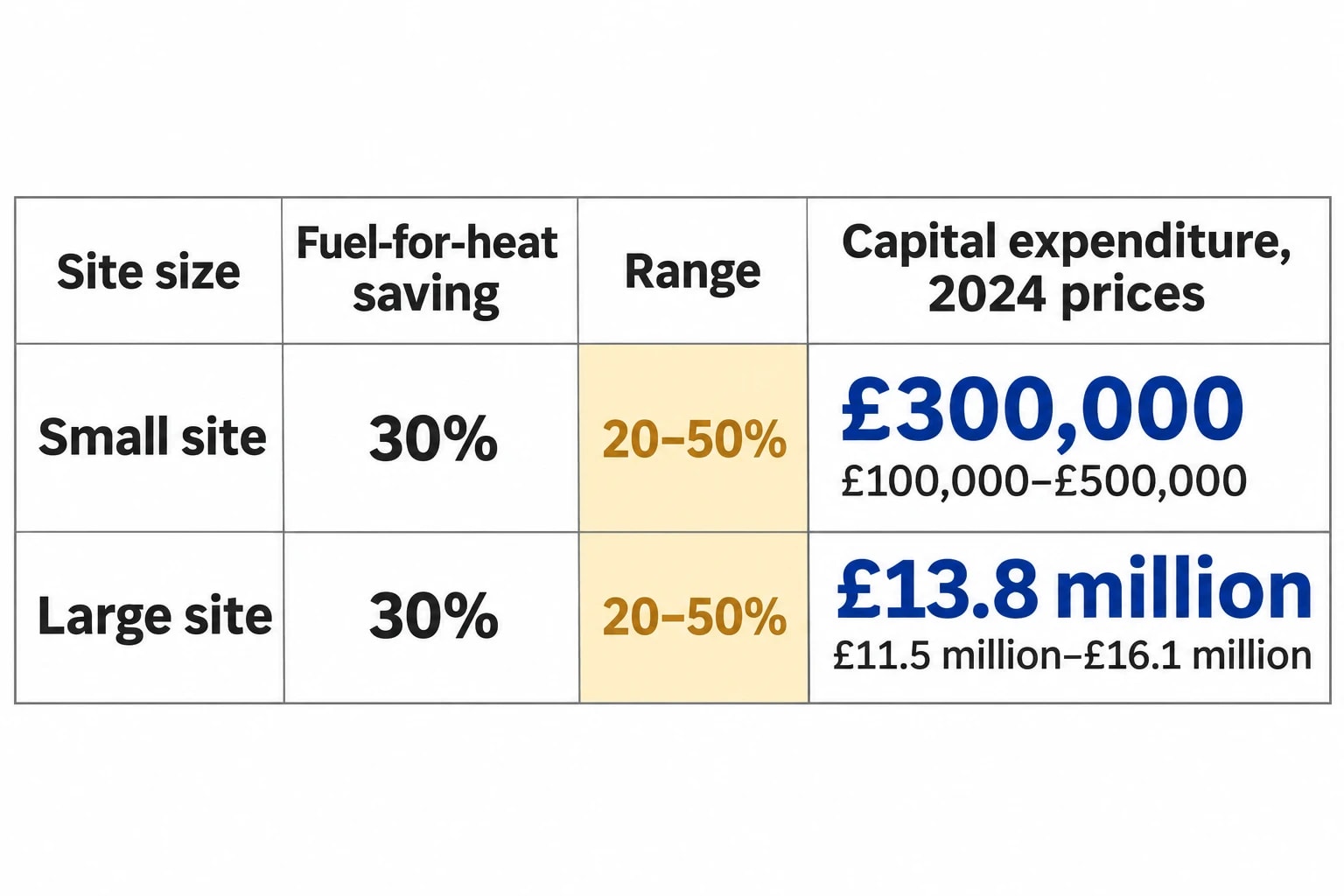
DESNZ’s “Updating evidence on energy efficiency potential for UK industry” modelled food and drink measures at average small and large sites. Its “waste heat recovery / CHP / no heat losses” category estimates average fuel-for-heat savings of 30%, with a 20–50% range for both site sizes.
The figure covers the package, not an individual item of equipment. A flue-gas economiser may serve only boiler feedwater. A heat-pump project may capture low-temperature refrigeration heat for hot-water duties. Both can be excellent projects, yet neither should carry a 50% fuel-saving claim without site evidence.
The modelled capital range is wide
DESNZ gives indicative average-site capital expenditure of £300,000 for a small food and drink site, within a £100,000–£500,000 range, and £13.8 million for a large site, within an £11.5 million–£16.1 million range. All figures are in 2024 prices.
The report gives the fuel-saving range amber confidence and capital costs red confidence. Food and beverage plants differ sharply in process temperatures, production patterns, factory layout, utility condition and available shutdown windows. A large bakery with continuous ovens has a different recovery profile from a seasonal cannery or a dairy with several cleaning cycles each day.
| DESNZ food and drink modelling category | Average fuel-for-heat saving | Range | Average-site capital expenditure, 2024 prices |
|---|---|---|---|
| Small site, waste heat recovery / CHP / no heat losses | 30% | 20–50% | £300,000 |
| Large site, waste heat recovery / CHP / no heat losses | 30% | 20–50% | £13.8 million |
Use sector modelling to identify the scale of the opportunity, then replace generic assumptions with metered site data before sanctioning expenditure.
Savings must be measured against production
A fall in monthly gas consumption may reflect lower throughput, product mix, weather or a changed production schedule. Energy managers need a normalised baseline, such as kWh per tonne, kWh per hectolitre or kWh per batch, with the relevant operating conditions recorded alongside it.
Commission Implementing Decision (EU) 2019/2031, retained in UK food, drink and milk BAT material, calls for an energy-efficiency plan that calculates specific energy consumption, sets annual KPIs and plans periodic improvement targets. ISO 50001:2018 offers a compatible framework for assigning responsibility, monitoring performance and reviewing improvement action.

Map every energy and material flow in your process with detailed heat and mass balance calculations — the foundation for any optimisation or design project.
Where industrial waste heat recovery produces the strongest returns
The strongest opportunities match a heat source with a nearby, steady lower-temperature demand. Temperature difference matters, but so do mass flow, coincident operating hours, fouling risk and the cost of production interruption.
Boiler flue gas and condensate
Food and drink boiler exhaust is commonly in the 120–150°C range, according to the Scottish Government’s waste-heat guide. This makes economisers a familiar starting point where feedwater or process-water preheating is available.
A conventional economiser transfers sensible heat from flue gas to water. Condensing arrangements can recover further heat where return-water temperature permits, but require attention to condensate handling, corrosion-resistant materials and combustion control. Assess boiler operating conditions, fuel type, stack arrangement and plume-visibility risk before selection.
Steam condensate is often attractive because it is clean on the process side and already carries valuable sensible heat. Recovery can reduce make-up-water demand, chemical treatment and boiler firing. The site must still confirm pressure, flash-steam behaviour, contamination pathways and the condition of condensate-return equipment.
Oven, fryer and dryer exhaust
Bakeries, snack lines and roasting processes can discharge large volumes of humid exhaust. The energy is available, but the engineering complications are substantial. Grease, flour, particulates, volatile compounds and condensation can foul heat-transfer surfaces or create demanding cleaning regimes.
Indirect recovery keeps exhaust separate from incoming air or water through a heat exchanger. This helps protect product-contact and hygienic zones. The design review should identify:
- Exhaust temperature, flow and moisture content across product range and line speed.
- Fouling mechanisms and cleaning access.
- Pressure-drop limits and their effect on extraction fans.
- Fire, odour and grease-management requirements.
- A safe bypass for start-up, shutdown and abnormal conditions.
A heat-recovery system that increases oven back-pressure, reduces extraction performance or cannot be cleaned during planned downtime will struggle to achieve its projected saving.
Refrigeration and compressed-air heat
Refrigeration condensers reject heat continuously in many chilled-food, dairy and beverage facilities. The temperature may be too low to replace steam directly, yet it can suit hot-water preheating, wash-down water, space heating or a heat pump.
Compressed-air aftercoolers and oil coolers are another source. Their value depends on compressor load and the temperature required by the receiving process. A plant needing hot water throughout production may have a stronger case than one with intermittent low-temperature demand.
Pasteurisation and cooking lines
Regenerative heat exchange is well established in liquid-food processing. A pasteuriser can transfer heat from outgoing hot product to incoming cold product through a suitably designed heat exchanger, reducing heating and cooling load. The configuration must preserve the required temperature-time duty, separation controls and cleaning performance.
Cooking and blanching systems can also create hot effluent or vapour streams. Assess their recovery potential alongside the wider water balance. Reduced water use can change flow rates, temperatures and cleaning arrangements, affecting available heat.
Heat pumps extend the value of low-temperature heat
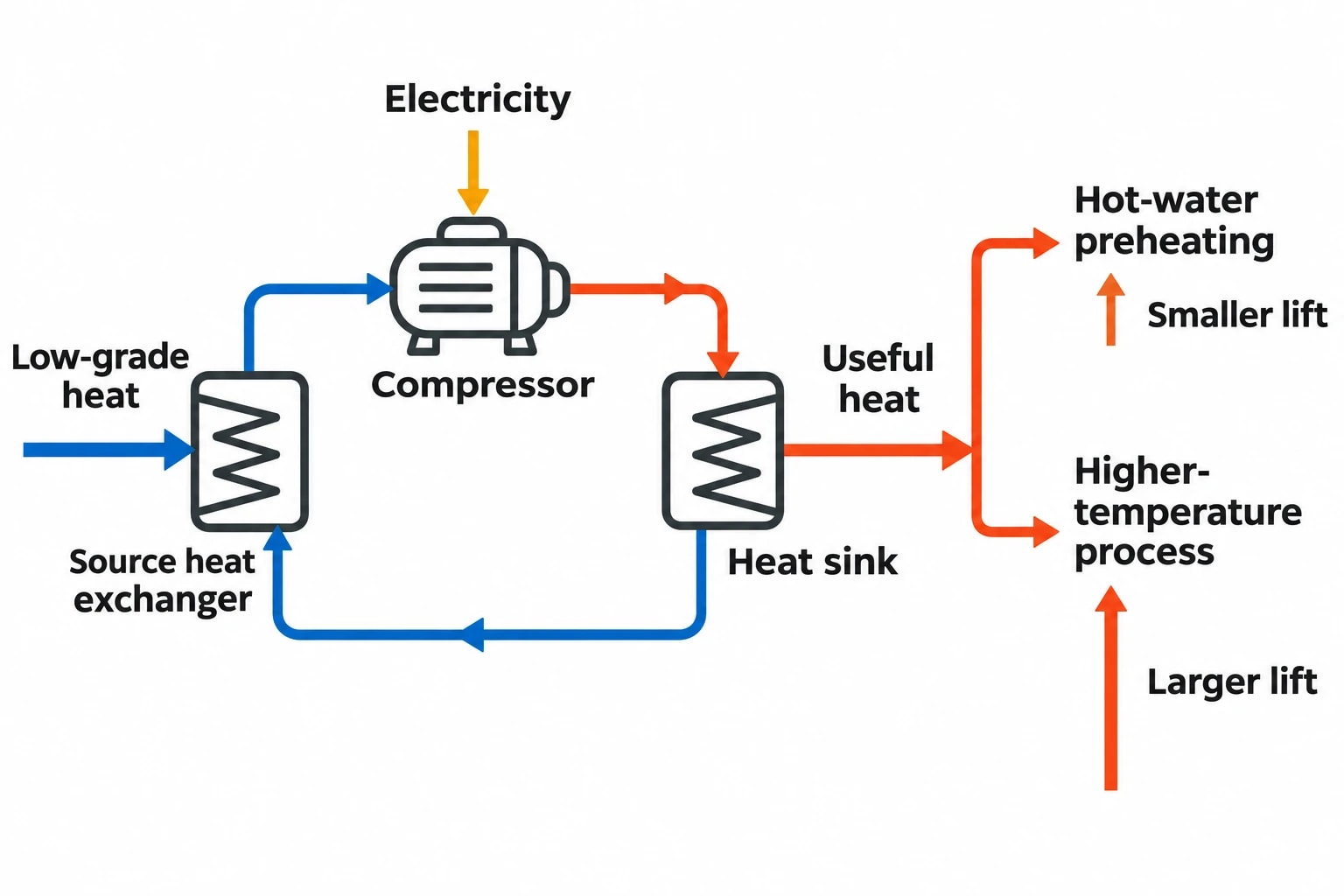
Industrial heat pumps can raise low-grade waste heat to a useful hot-water or process-heat level. They add electricity demand, so the decision requires a whole-system comparison rather than a heat-recovery calculation alone.
Commission Implementing Decision (EU) 2019/2031 lists heat recovery with heat exchangers and heat pumps, including mechanical vapour recompression, among common energy-efficiency techniques for food, drink and milk installations.
Match the heat pump to the duty
A heat pump performs best where source and sink temperatures, load profile and delivery temperature align with the process. Refrigeration heat used to preheat water may require a smaller temperature lift than heat supplied to a high-temperature cooking process. As the lift rises, performance becomes more demanding.
The project team should establish required supply and return temperatures from measured operating data. Nameplate values and design P&IDs are useful, but may not reflect current valve positions, bypasses, part-load operation or product mix.
Mechanical vapour recompression has a specific role
Mechanical vapour recompression compresses vapour so it condenses at a higher temperature, allowing its latent heat to be reused. It can be relevant to evaporation and concentration duties, including dairy and beverage processing.
Its business case depends on stable vapour flow, required pressure lift, electricity price and the degree to which recovered heat displaces steam. Vapour quality and carryover also matter. The design must account for separation and cleaning requirements before relying on recovered duty.

Map every energy and material flow in your process with detailed heat and mass balance calculations — the foundation for any optimisation or design project.
How a heat and mass balance protects food safety and production
Industrial waste-heat recovery should sit outside the food-safety plan only where the physical arrangement and risk assessment support that position. It cannot weaken validated controls for cooking, pasteurisation, chilling or cleaning.
The Food Standards Agency defines a critical control point as a step where control is essential to prevent, eliminate or reduce a food-safety hazard to an acceptable level. Critical limits can include required temperature and time. Any recovery project affecting a thermal process must therefore involve the HACCP team from feasibility onward.
Separate streams where contamination risk exists
Indirect heat recovery normally provides the clearest route to hygienic separation. The exhaust or utility stream transfers energy across a heat-transfer surface, while recovered heat enters a separate closed water loop or air system.
Design reviews should examine:
- The risk of leakage across a heat-transfer surface.
- Whether a pressure differential favours the clean side.
- Materials compatibility with cleaning chemicals and food-process conditions.
- Drainage, dead legs and access for inspection.
- Instrumentation, alarms and response procedures.
- Bypass operation during CIP, defrost, line cleaning and maintenance.
Project documentation should state whether the recovered loop can contact product, product-contact surfaces or ingredients. If it can, the scope increases substantially and requires appropriate hygiene design, validation and change control.
Protect validated process temperatures
A heat-recovery system can preheat water or air while the existing final heater retains control of the validated setpoint. This can reduce fuel demand without changing the critical heating step.
For pasteurisation, cooking and thermal disinfection, utilities engineers should check temperature profiles at the point of use, not only at the boiler house or heat-recovery skid. Pump changes, heat-exchanger fouling and control-valve behaviour can alter delivered conditions even when utility supply temperature appears stable.
Plan for operation, cleaning and failure
Production teams need a clear response when a pump trips, a heat exchanger fouls or the source stream is unavailable. The plant should revert safely to the original heat source without compromising production conditions.
Availability has financial value. The appraisal should include planned cleaning, inspection intervals, spare parts, controls support and realistic shutdown requirements. Low-cost heat-recovery equipment with poor maintainability can cost more over its service life than a better-designed installation with accessible isolation and bypasses.
Building the cost-benefit case
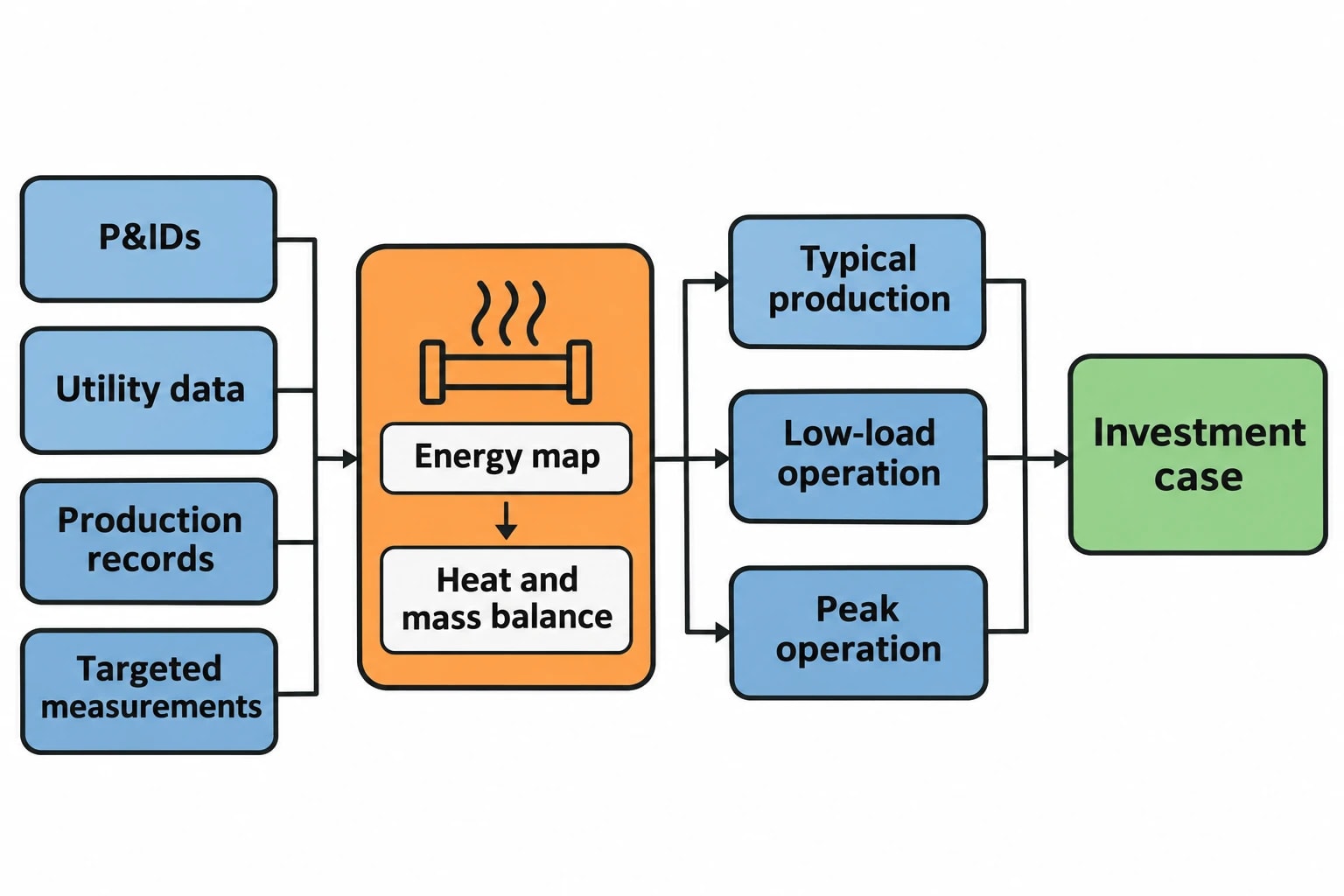
A credible investment case needs more than estimated annual kWh. It should link recovered heat to a defined displaced-fuel duty, account for added electricity and pumping, and test the economics against operating variability.
Start with measured streams
A practical assessment begins with an energy map built from P&IDs, utility data, production records and targeted measurements. For each candidate source and demand, record temperature, flow, pressure, composition or contamination risk, operating hours and location.
The resulting heat and mass balance can identify mismatches easily missed in a walk-round. A hot source may operate only when the intended heat user is idle. A promising refrigeration source may sit far from the wash-water system. Pipework, insulation, pumps and controls can form a large part of installed cost.
Include the full installed scope
The capital estimate should include equipment, civils, structural supports, pipework, electrical works, controls, insulation, commissioning, validation activity and contingency. It should also identify whether the project requires a production shutdown and how long that shutdown can be accommodated.
Operating costs need equal discipline. Consider electricity for heat pumps and fans, water treatment, cleaning chemicals, replacement parts, maintenance labour and any increase in pressure drop. Where recovered heat reduces boiler load, check whether reduced firing changes boiler efficiency or operating flexibility.
Test real operating cases
The business case should be tested against at least three conditions:
- Typical production, with representative product mix and shift pattern.
- Low-load operation, where the heat source or sink may be limited.
- Peak operation, where heat demand and process constraints are most severe.
Sensitivity analysis should vary gas and electricity prices, annual operating hours, fouling allowance, production growth and expected availability. This gives plant engineering managers a clearer view of downside exposure than a single payback figure.
Evidence from brewing and the regulatory direction
Tennent’s Brewery in Glasgow provides an example of multiple recovery opportunities. The Scottish Government reports that heat exchangers upgraded heat from brewing-process effluent to heat incoming material to the anaerobic digestion plant, reducing associated emissions by about 400 tCO₂ per year. A boiler-flue economiser preheated boiler feedwater and cut a further 500 tCO₂ per year.
Those results should not be copied into another plant’s business case. They show why heat-source mapping matters: one site found recoverable heat in both effluent and boiler exhaust, each serving a defined demand.
BAT makes energy planning part of the operating case
The UK food, drink and milk BAT conclusions include heat recovery, heat pumps, steam-system optimisation, boiler-blowdown minimisation and feedwater preheating among energy-efficiency techniques. For permitted installations, the relevant regulator and permit conditions determine applicable requirements.
For permitted and non-permitted sites, the operating case is the same: quantify specific energy consumption, track it against production, and prioritise measures that reduce delivered energy without transferring risk to product quality or food safety.
Funding should not be assumed
The Industrial Energy Transformation Fund supported energy-efficiency and low-carbon industrial projects in England, Wales and Northern Ireland, but the government states that the fund closed in July 2025 and no successor is planned. Existing funded projects continue, but new waste-heat proposals should not assume grant support.
This article reflects the independent analysis and editorial opinion of EnerTherm Engineering. Product names, trademarks, and brands mentioned belong to their respective owners. EnerTherm Engineering is not affiliated with, endorsed by, or a licensee of any third-party software or product mentioned unless explicitly stated.

Managing Director — EnerTherm Engineering
Dr. François Pierrel is Managing Director of EnerTherm Engineering with over two decades of expertise in thermal design, heat transfer, and industrial energy optimisation. He holds a PhD in Heat Transfer from Cranfield University and a Post-Doctorate from Heriot-Watt University.
