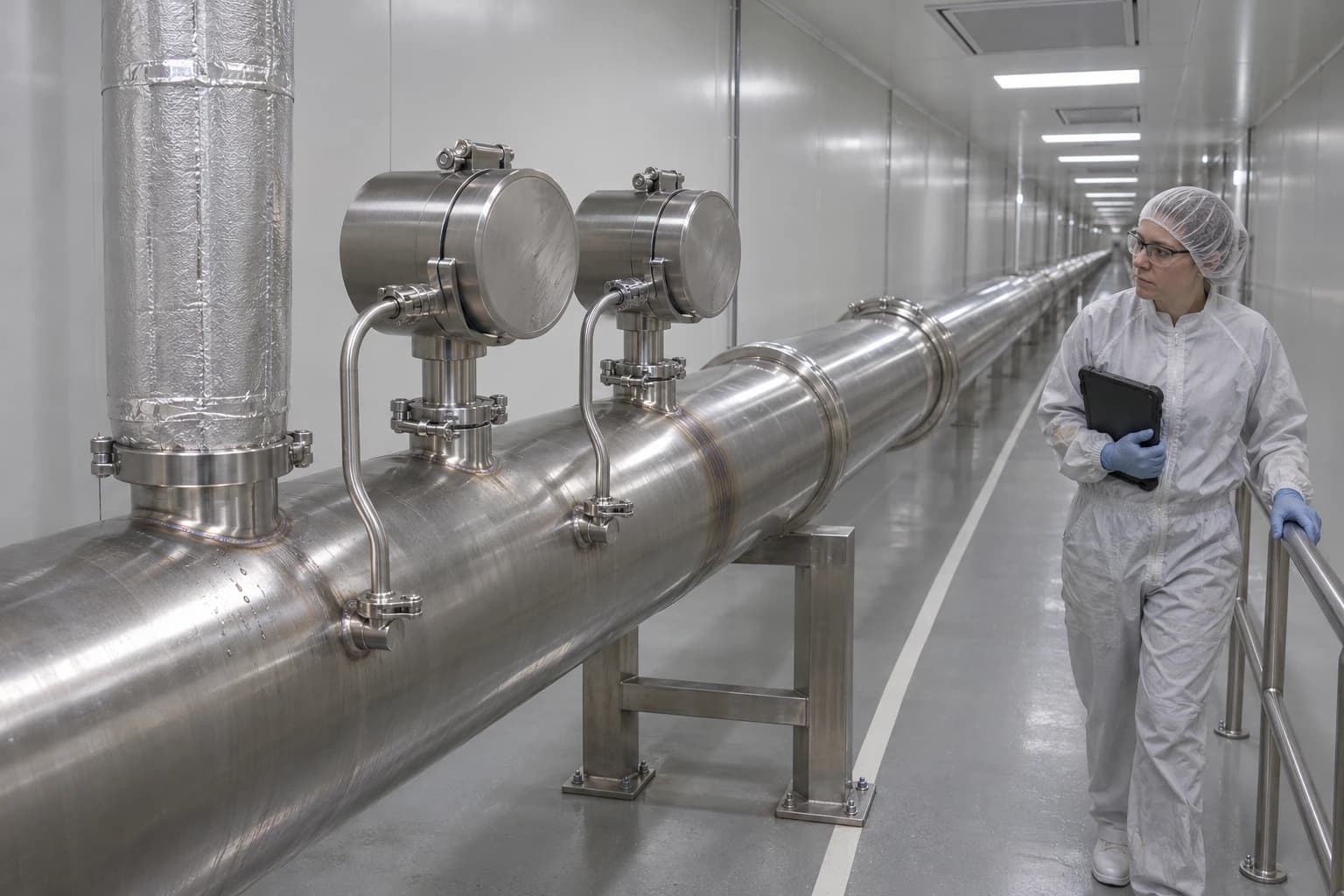
Critical Utility Monitoring for GMP Facilities and ALCOA+
How read-only utility data supports Annex 1 controls and ALCOA+ audit trails.
Critical utility monitoring for GMP facilities is the controlled collection, review and retention of data from utility systems whose performance can affect medicinal product quality, patient safety or validated manufacturing conditions. EudraLex Volume 4, Annex 1 states that Water for Injection systems should include continuous monitoring for total organic carbon and conductivity, with monitoring locations selected according to risk.
For pharmaceutical facility managers, QA officers and operations directors, this extends beyond installing meters. A WFI loop, clean steam generator or cleanroom HVAC system operates within a qualified state. Any monitoring addition must support that state, preserve the original record, maintain traceability and avoid uncontrolled changes to the plant control system.
The objective is to provide reliable evidence that critical utilities remain within approved operating and quality parameters, while creating useful operational intelligence without introducing revalidation risk.
Why critical utility monitoring matters in GMP facilities
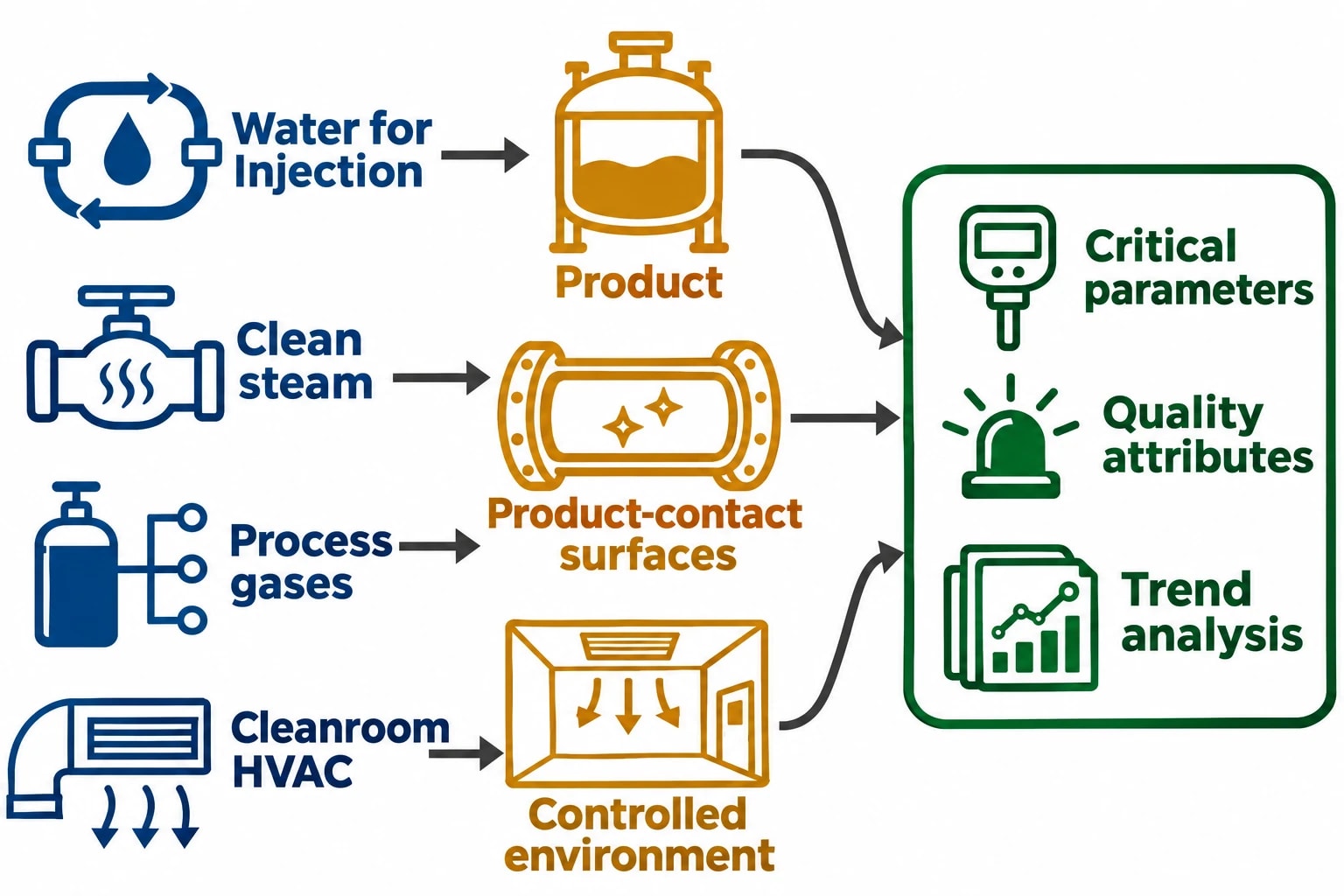
Utilities can affect a sterile product directly, indirectly or through the manufacturing environment. Annex 1 requires the nature and extent of controls to match a utility’s risk to product quality, as documented in the contamination control strategy.
A criticality assessment should start with the route by which a utility could affect product, product-contact surfaces, equipment or the controlled environment. High-risk utilities typically include:
- Water for Injection and other pharmaceutical water systems
- Clean steam used for direct sterilisation
- Process gases that contact product or primary container surfaces
- HVAC and cleanroom systems supporting classified areas
- Compressed air where its use creates a defined quality risk
- Electrical supplies supporting critical environmental-control equipment
Energy data is not automatically GMP data. It becomes GMP-relevant when it helps demonstrate the performance, availability or excursion history of a critical utility or its controls. A steam flow meter on a boiler header may support energy management. A measurement associated with a clean steam generator serving sterilisation equipment may also inform quality investigations, maintenance decisions and trend review.
Risk determines monitoring depth
Annex 1 identifies water, gases and steam used for sterilisation as higher-risk utilities when they directly contact product, materials or product-contact surfaces. It also requires regular trend analysis of critical parameters and critical quality attributes for high-risk utilities.
Useful monitoring differs from critical monitoring. Facility teams should identify:
- The utility and the points at which it affects product quality.
- The critical parameters and quality attributes established during qualification.
- Existing instruments, alarms, historian records and manual checks.
- Data gaps that could prevent timely detection of deterioration.
- The records needed to support investigation, batch disposition and inspection.
The resulting monitoring plan should form part of the site’s contamination control strategy and quality risk-management process, rather than an isolated energy project.
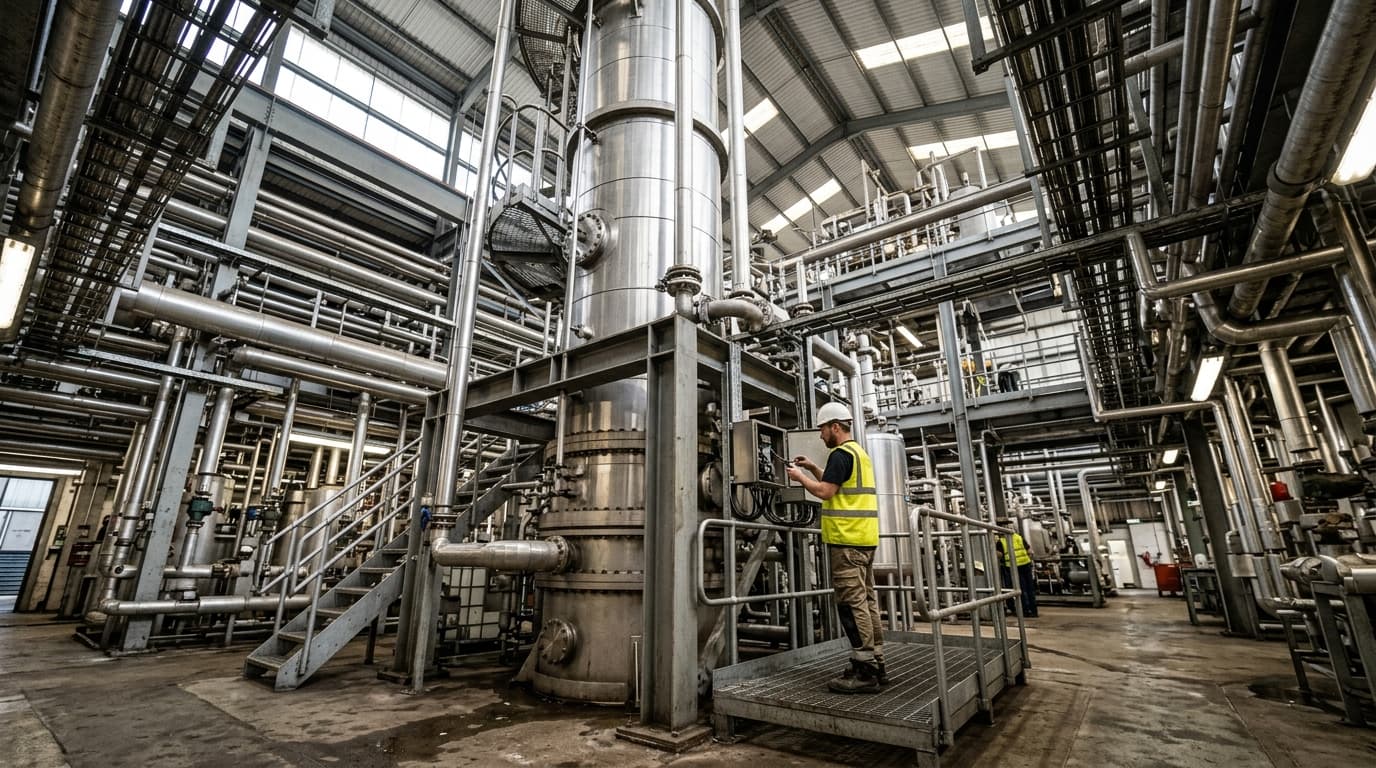
Omni Vision delivers turnkey utility metering, CO2 tracking, and AI-powered production KPI intelligence — giving you real-time dashboards and actionable insights across your entire facility.
WFI monitoring and the evidence required by Annex 1
WFI systems present a direct product-quality risk. Annex 1 requires pharmaceutical water systems to be designed, commissioned, qualified, monitored and maintained to prevent microbiological contamination and deliver water of appropriate quality.
Continuous WFI monitoring is not a replacement for sampling
Annex 1 states that WFI systems should include continuous monitoring, such as total organic carbon and conductivity, because these indicators may provide a better view of overall system performance than discrete sampling. This does not remove the requirement for routine chemical and microbiological monitoring.
A compliant monitoring strategy combines continuous instruments with representative sampling. Continuous signals can show a developing change between scheduled samples. Laboratory and microbiological results confirm whether water continues to meet applicable compendial expectations.
The site’s risk assessment should justify sensor placement. Useful locations may include the WFI generation outlet, storage tank, return loop and points of use most likely to reveal deterioration. The arrangement depends on the validated system design, distribution loop, user demand and contamination control strategy.
Trend the condition of the system, not only alarm events
Annex 1 requires routine monitoring data to be reviewed for adverse trends. QA teams should be able to review data with timestamps alongside maintenance work, sanitisation, regeneration, temperature history, flow conditions and laboratory results.
For example, a progressive conductivity change, altered return temperature or recurring flow deviation may warrant assessment before a formal action limit is exceeded. A dashboard can make this information visible, but the site must define who reviews the trend, what constitutes an alert, and how the assessment is recorded and closed.
Water-flow monitoring also has a defined GMP basis. Annex 1 states that water should remain turbulent in distribution pipework to reduce microbial adhesion and biofilm risk, and that the qualified flow rate should be routinely monitored. A flow measurement therefore needs a documented relationship to the qualified operating range, not an arbitrary energy-management target.
WFI monitoring points for QA review
| Monitoring area | GMP purpose | Data review consideration |
|---|---|---|
| Total organic carbon | Continuous indication of organic contamination risk | Examine excursions, drift and correlation with samples |
| Conductivity | Continuous indication of ionic contamination | Review against the approved operating and quality limits |
| Flow rate | Evidence that qualified circulation conditions are maintained | Trend against the qualified range and demand pattern |
| Temperature | Supports control of microbial-growth risk in hot WFI loops | Review with sanitisation, maintenance and return-loop performance |
| Laboratory samples | Chemical, microbial and endotoxin confirmation | Retain results with location, date, method and investigation records |
Clean steam monitoring must protect sterilisation assurance
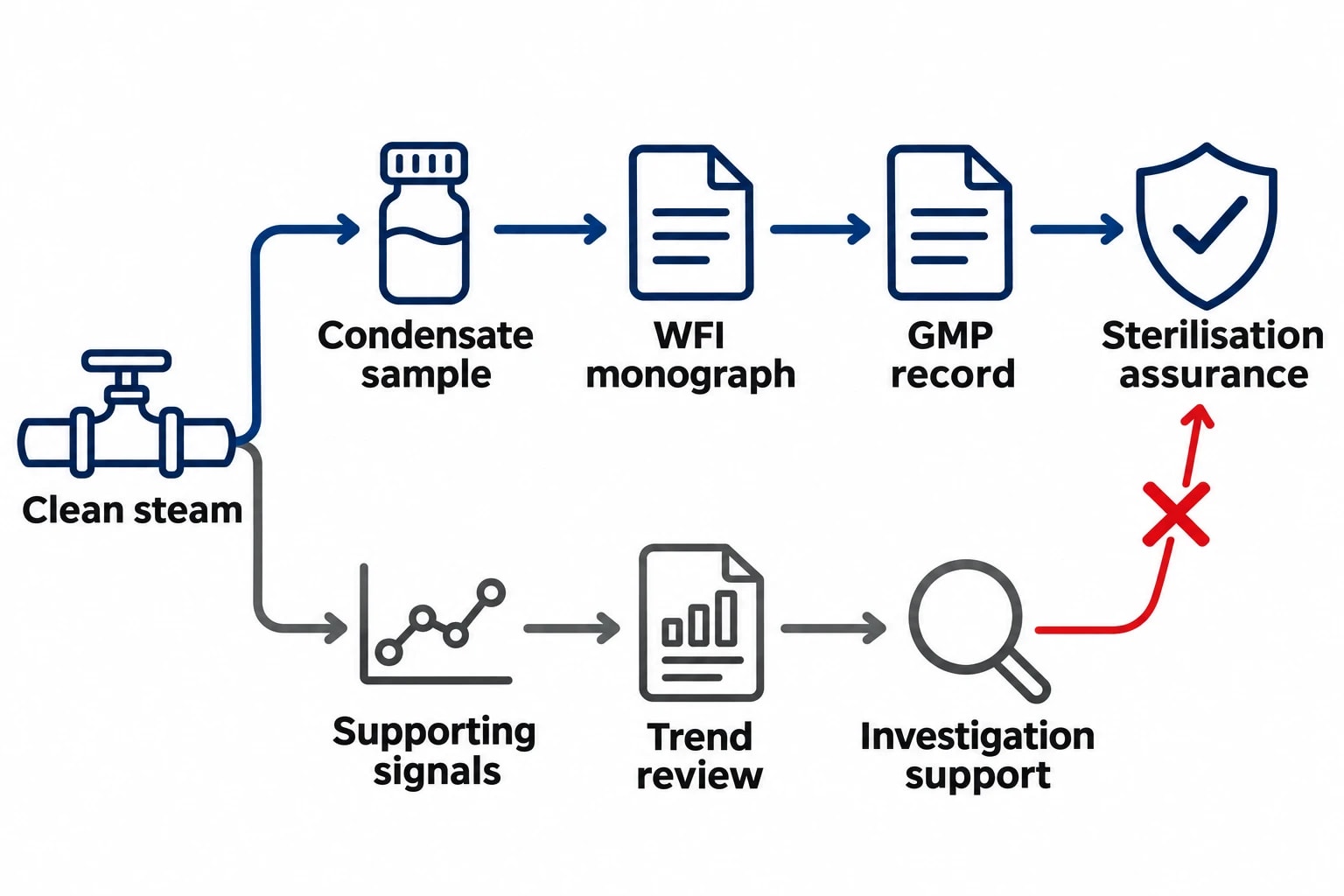
Clean steam used as a direct sterilising agent requires monitoring tied to its intended use. Annex 1 states that feed water to a pure steam generator should be appropriately purified and that the generator should be designed, qualified and operated to meet defined chemical and endotoxin levels.
For clean steam used to sterilise materials or product-contact surfaces, Annex 1 requires condensate to meet the relevant Pharmacopoeia’s WFI monograph, apart from the stated position on microbial testing of steam condensate. It also requires a suitable sampling schedule that produces representative samples for regular analysis.
Link utility monitoring to the qualified steam system
A monitoring platform can capture supporting indicators such as feedwater demand, generation load, steam pressure, temperature, condensate return and utility consumption. These are useful for operational investigation and energy performance. They do not replace the qualified measures, records and acceptance criteria that establish clean-steam quality.
The monitoring design should preserve this boundary. A facility should identify which signals are process-supporting data and which are GMP records, then define controls suitable for each category. Where a new signal influences quality decisions or becomes part of a validated process assessment, change control should establish intended use, data ownership, accuracy, review expectations and record retention.
Investigate context, not isolated values
An elevated clean-steam energy intensity may reflect an efficiency issue, a change in production demand, steam-trap failure, insulation damage, a generator operating pattern or a sterilisation programme change. The monitoring platform should allow users to compare the utility signal with batch activity, autoclave demand, maintenance events and validated operating conditions.
This supports structured investigation without relaxing sterilisation-cycle controls. Annex 1 requires critical sterilisation parameters to be controlled, monitored and recorded, with deviations from validated parameters investigated.
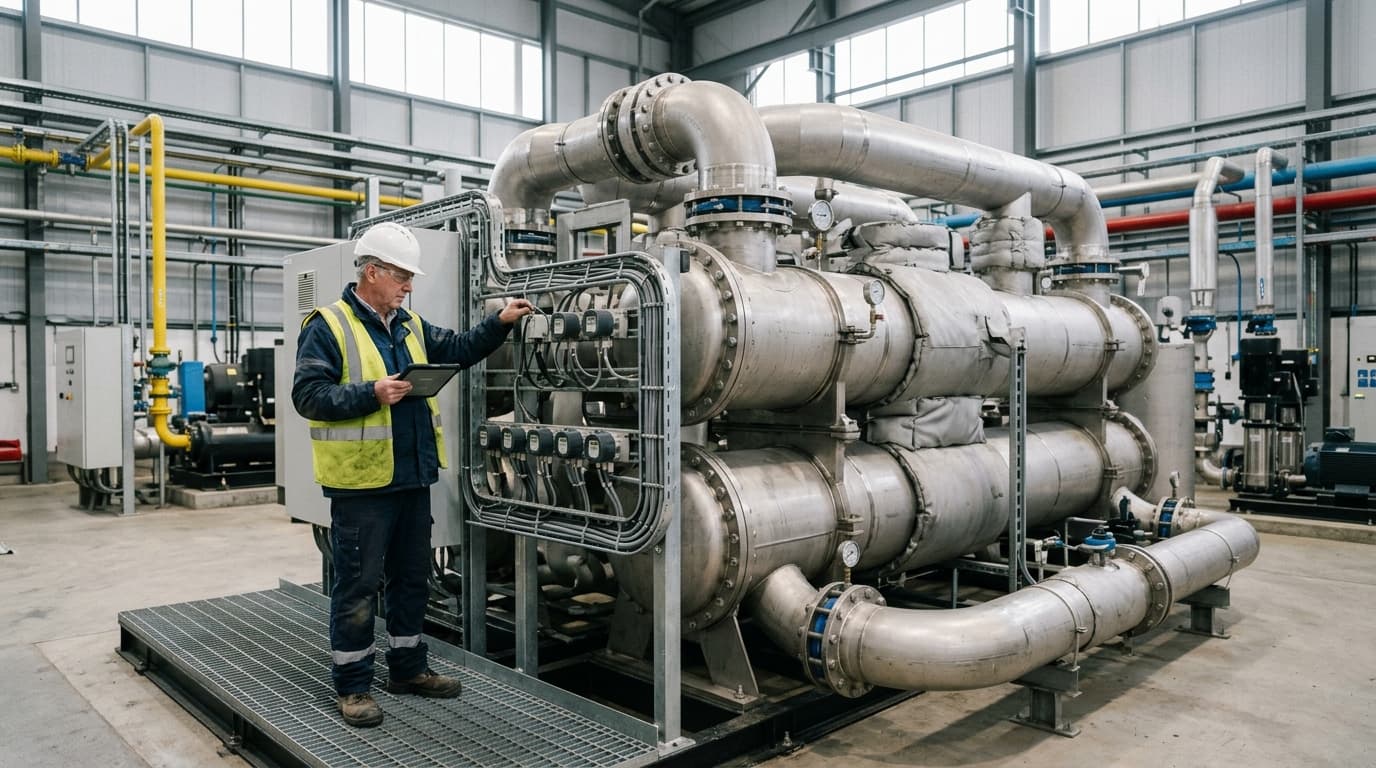
Track energy consumption, emissions, and process parameters with seamless PLC/SCADA integration via Modbus, OPC-UA, and MQTT protocols.
HVAC monitoring in classified areas without disturbing validation
Cleanroom HVAC creates and maintains the conditions in which sterile manufacturing takes place. It supports particle control, airflow patterns, pressure cascades, temperature and humidity requirements established by facility design and qualification.
ISO 14644-1:2015 specifies the classification of air cleanliness by airborne particle concentration in cleanrooms and clean zones. It does not assess viable, chemical or physical contamination. Pharmaceutical facilities must therefore combine cleanroom classification with the wider environmental and process controls required by GMP.
Protect pressure differentials and airflow control
Annex 1 requires a warning system to indicate failures in air supply or reductions in critical air-pressure differences below defined limits. It also requires cleanrooms and clean-air equipment used for sterile manufacture to be qualified, and distinguishes cleanroom qualification from routine environmental monitoring.
A monitoring project must not create an uncontrolled path into the HVAC control system. Direct changes to setpoints, fan speed, damper position, pressure controls or alarm logic can alter qualified conditions and may require formal assessment, testing and requalification.
Read-only data collection provides a safer starting point. It can collect selected values from a building management system, air-handling unit or PLC without writing commands back to the control layer. The change assessment still matters. Teams should assess data interfaces, instrument loading, cybersecurity controls, access management, validation impact and maintenance of monitoring hardware.
Measure energy without confusing energy performance with cleanroom performance
HVAC energy monitoring can identify unusual fan, heating or cooling demand. It can help operations teams identify operation outside scheduled hours, simultaneous heating and cooling, signs of filter loading, unstable control behaviour or unexplained increases in air-handling energy.
Energy reduction must remain subordinate to validated cleanroom conditions. Pressure differentials, airflow direction, recovery performance and particle-control requirements cannot be traded for a lower electricity figure.
QA should retain authority over quality-impacting limits and changes, while engineering uses approved data to identify investigation priorities. Any proposed control adjustment should pass through formal change control and demonstrate that the facility remains within its qualified and validated state.
ALCOA+ turns utility data into inspection-ready evidence
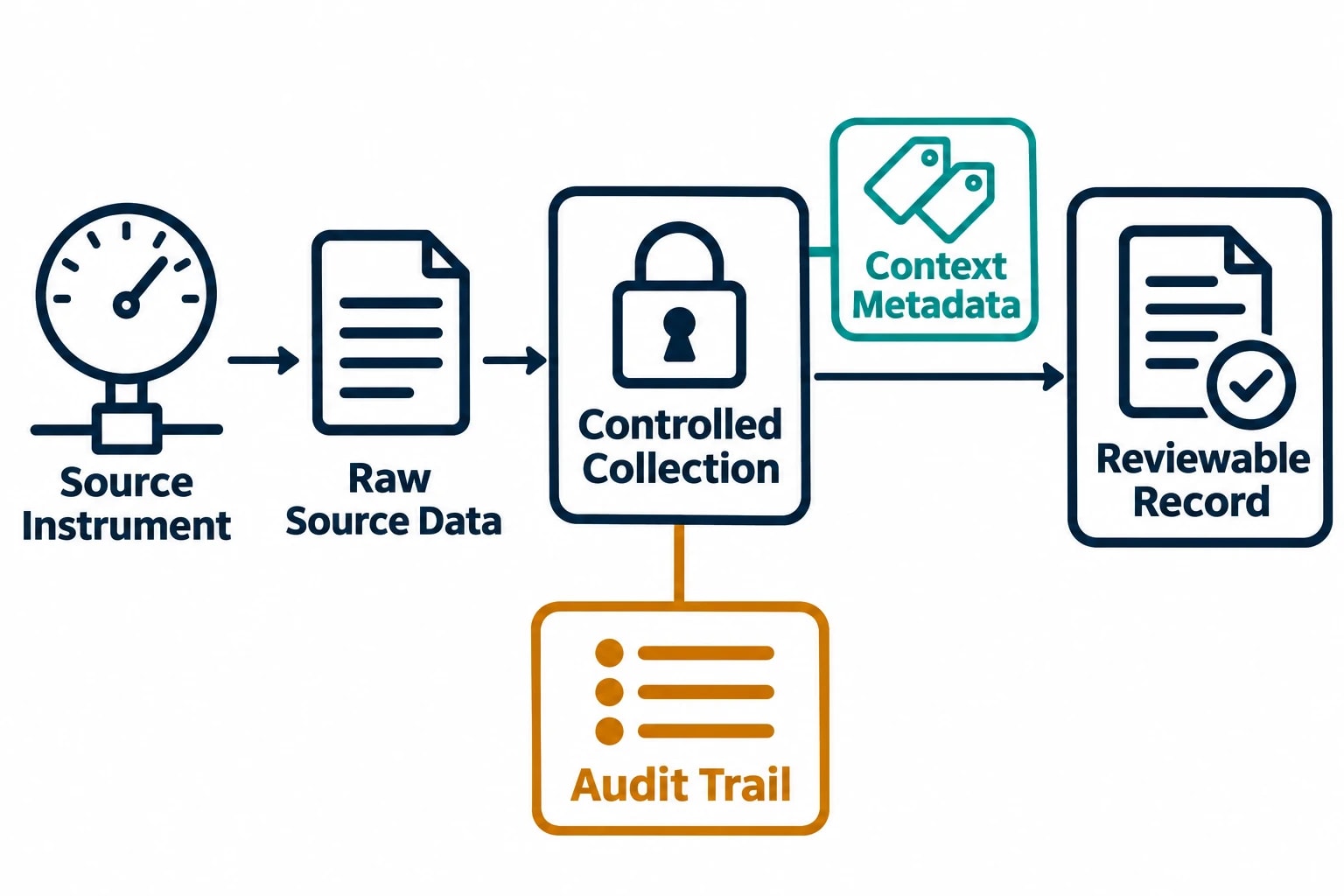
The MHRA GXP Data Integrity Guidance and Definitions describes ALCOA as attributable, legible, contemporaneous, original and accurate. The “+” expectations are complete, consistent, enduring and available. MHRA also states that no difference exists in regulatory expectation between referring to ALCOA and ALCOA+.
For critical utility monitoring, a chart alone is insufficient. Inspectors and internal reviewers need to reconstruct what happened, identify the source of the information and understand whether a record has changed.
What an ALCOA+ utility record should show
Each GMP-relevant data set should retain context as well as value. That includes the asset or point name, source system, unit, timestamp, time zone where relevant, collection status, quality flags and any transformation applied before display.
Audit trails are central. MHRA states that computerised systems used to capture, process, report, store or archive electronic raw data should retain audit trails. Data transfer must be validated, protected against alteration and supported by an audit trail. If an interface disconnects, creates duplicate values or applies a calculation, the system should make the event detectable and reviewable.
| ALCOA+ expectation | Application to critical utility monitoring |
|---|---|
| Attributable | Identify the source instrument, system and authorised user making a change |
| Contemporaneous | Capture event times as the measurement or action occurs |
| Original | Retain raw source data and relevant metadata, not only exported reports |
| Accurate | Maintain calibrated instruments and justified data-processing rules |
| Complete and consistent | Retain exceptions, failed transmissions, corrections and all relevant records |
| Enduring and available | Protect data for the required retention period and make it retrievable for review |
Validation follows intended use
MHRA explains that complex computerised systems require validation for their intended purpose, with the extent of validation increasing according to complexity and risk. A vendor’s generic validation documentation cannot, on its own, demonstrate suitability for a site’s configured use.
A GMP facility should define the monitoring system’s intended use before deployment. The user requirements specification should state the utilities, tags, data frequency, expected availability, alarm treatment, audit-trail requirements, user roles, reports, archive arrangements and interfaces in scope. The risk assessment should identify failures that could affect data integrity or quality decisions.
The facility then needs evidence that the installed configuration meets those requirements. This commonly includes documented testing of acquisition, calculations, time synchronisation, missing-data handling, user access, audit trails, data retrieval, backup and restoration.
Implementing critical utility monitoring without compromising operational integrity
A phased programme limits risk and helps QA retain control. The first phase should establish the current qualified state and existing records before adding hardware, gateways or analytics.
A practical GMP deployment sequence
- Map critical utilities, quality impacts and existing data sources with engineering, QA, automation and validation representatives.
- Define intended use and distinguish energy-management information from data that supports GMP decisions.
- Complete a documented quality risk assessment and change-control plan.
- Select read-only collection methods where suitable, so the monitoring layer does not issue commands to validated plant systems.
- Qualify or validate the monitoring arrangement to the degree justified by its intended use and risk.
- Set ownership for alarms, trend review, investigations, calibration, access control and periodic review.
- Commission dashboards only after confirming that data, metadata and audit trails are complete and retrievable.
The Omni Vision Energy Intelligence Platform is intended to provide granular utility metering and non-invasive connectivity for industrial sites. In a pharmaceutical context, its value depends on implementation discipline. Read-only connections through established interfaces such as Modbus, OPC UA and BACnet can separate observation from control, but the facility must still assess the specific architecture, configuration and GMP data role.
This article reflects the independent analysis and editorial opinion of EnerTherm Engineering. Product names, trademarks, and brands mentioned belong to their respective owners. EnerTherm Engineering is not affiliated with, endorsed by, or a licensee of any third-party software or product mentioned unless explicitly stated.

Technical Manager — EnerTherm Engineering
John Naranjo is Technical Manager at EnerTherm Engineering, bringing specialist expertise in chemical and environmental engineering. He recently led the implementation of Omni Vision, EnerTherm's real-time energy and utility monitoring platform. He holds an MSc in Environmental Engineering from the University of Huelva and a BSc in Chemical Engineering, with memberships in both the Energy Institute and IChemE.
