
How Read-Only PLC Data Protects GMP Energy Efficiency
Batch-level utility data supports SECR reporting without writing to validated systems.
UK organisations in scope of Streamlined Energy and Carbon Reporting must disclose energy use in kWh and associated greenhouse gas emissions. Pharmaceutical manufacturers must also protect validated systems, product quality and data integrity. That makes pharmaceutical manufacturing energy efficiency a Quality Assurance concern as much as a facilities task.
Read-only PLC data provides a controlled way to collect operational and utility information without allowing an energy platform to change setpoints, alarms, logic or equipment commands. It gives engineering teams evidence to investigate waste in steam, compressed air, chilled water and cleanroom HVAC, while the validated control environment retains sole authority over plant operation.
An energy project can create avoidable compliance risk if it adds an uncontrolled interface to process or building controls. Read-only architecture does not remove the need for GMP assessment, qualification or change control, but it separates observation of energy performance from control of manufacturing conditions.
Why pharmaceutical manufacturing energy efficiency needs GMP controls
Pharmaceutical sites consume energy across cleanroom air handling, boilers, chillers, compressed-air networks, water systems, steam generation and production equipment. Many operate within qualified conditions or support processes with direct quality consequences.
Monthly utility bills cannot establish whether higher consumption arose from a specific batch, a prolonged equipment clean-down, an air-handling unit running beyond its approved schedule, a compressed-air leak or poor chiller part-load performance. Metered data can answer those questions, but the collection route must suit a GMP environment.
An unauthorised connection may create change-control obligations. A connection capable of altering a variable, controller state, alarm setting or programme logic may affect an established qualified condition. Quality teams must assess its effect on process control, data governance, product quality and patient safety.
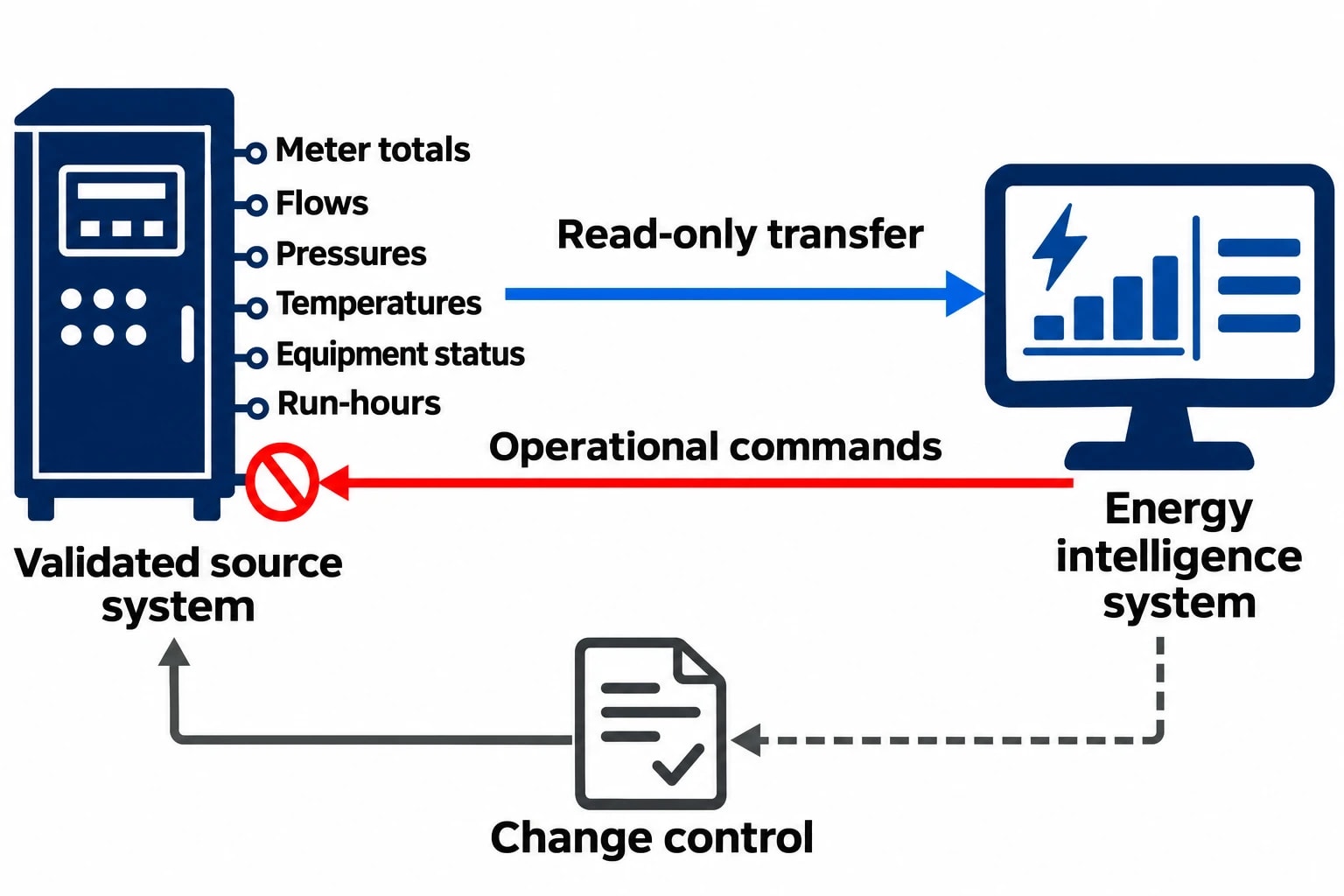
Read-only PLC data collects selected values, including meter totals, flows, pressures, temperatures, equipment status and run-hours, without allowing the energy platform to issue operational commands.
The practical boundary is straightforward:
- The plant control system remains responsible for operation.
- The validated source system remains the authoritative record for its controlled process.
- The energy intelligence system receives approved information for analysis.
- Change control governs any operational adjustment identified through that analysis.

Omni Vision delivers turnkey utility metering, CO2 tracking, and AI-powered production KPI intelligence — giving you real-time dashboards and actionable insights across your entire facility.
GMP data integrity and the intended use of energy data
What the Orange Guide and Annex 11 mean for energy projects
The MHRA’s Orange Guide, formally Rules and Guidance for Pharmaceutical Manufacturers and Distributors, brings together expectations that UK medicines manufacturers must consider within their pharmaceutical quality systems. Its GMP framework requires controlled processes, documented arrangements and reliable records.
EU GMP Annex 11, Computerised Systems, applies to computerised systems used in GMP-regulated activities. It requires a lifecycle approach based on documented risk management, considering patient safety, product quality and data integrity when defining validation and control requirements.
The energy platform’s intended use determines its GMP significance. A dashboard used to identify a steam loss or compare electricity per batch may have a different risk profile from a system used to support environmental-control decisions, formal deviation investigations or batch-release evidence.
That distinction must be documented before implementation. An organisation should define:
- what data the platform receives;
- how personnel will use the data;
- whether any report becomes part of a GMP record;
- the data owner and system owner;
- the retention period and retrieval expectations;
- the controls required if data are unavailable, delayed or implausible.
Read-only status is a valuable control measure, not a blanket validation exemption. GMP status follows intended use and risk, rather than the software label.
Data integrity must preserve meaning as well as values
MHRA GxP data integrity guidance sets out ALCOA+ expectations. Records should be attributable, legible, contemporaneous, original and accurate. They should also remain complete, consistent, enduring and available.
For energy information, those principles affect more than the meter value. A recorded figure needs context: source tag, engineering unit, timestamp, time zone, scaling, collection interval and communications status at collection.
A 4,000 kWh reading loses value if users cannot establish whether it is a cumulative meter total, interval consumption value, shared utility feed or batch-specific allocation. The same problem arises when a dashboard silently carries forward a stale value after a communications failure.
An audit-ready energy record should retain enough metadata to explain its meaning. This supports engineering investigation and allows Quality Assurance to assess whether the data can support a GMP-related decision.
Read-only PLC data keeps observation separate from control
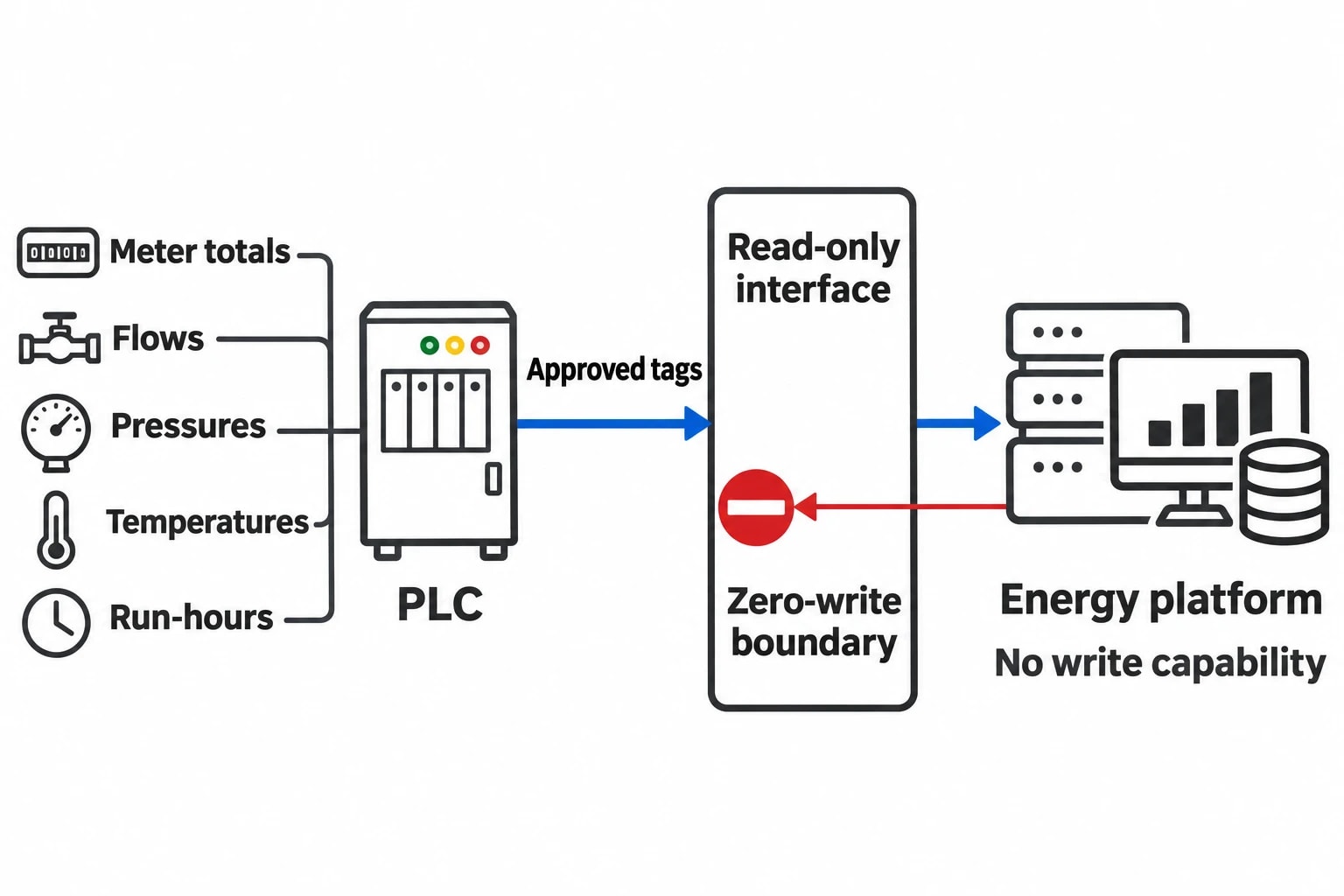
Modbus and OPC UA can support collection from approved source points, but protocol names do not make an interface read-only. The controlled state depends on the approved specification, configuration, access arrangements and verification evidence.
The energy system should receive only agreed values and have no approved capability to write to PLCs, building management systems or process control systems. A site should verify that boundary during commissioning and reassess it through GMP change control when the interface, source system or software changes.
Evidence Quality Assurance should expect
A controlled integration needs records that make the boundary explicit. Documentation should include the approved data-point list, source system, ownership, unit, scaling and intended analytical use for each tag.
Testing should demonstrate that the energy platform collects expected readings correctly, preserves timestamps and identifies communications problems. Verification should also demonstrate the zero-write boundary in the operating configuration.
A useful evidence pack includes:
| Evidence item | Why it matters |
|---|---|
| Intended-use statement | Defines whether the data supports utility analysis only or a GMP-relevant activity |
| GMP risk assessment | Establishes the proportionate qualification and validation approach |
| Approved tag list | Prevents unreviewed collection of process or quality data |
| Data mapping record | Links source values, units, timestamps and scaling to the analytical record |
| Test protocol and results | Demonstrates data collection, error handling and read-only behaviour |
| Change-control record | Preserves review of later interface, software or reporting changes |
| User-access record | Clarifies who may view, configure or approve reports |
This evidence provides a traceable account of the energy data lifecycle without creating a parallel process-control system.
Batch-level energy tracking improves pharmaceutical manufacturing energy efficiency
Use production context without duplicating batch records
Batch-level energy tracking links utility use to a defined manufacturing period, campaign, recipe stage or line. It can expose rising electricity demand during tablet compression, high steam use during cleaning or a compressed-air baseload persisting between scheduled production periods.
The batch record, manufacturing execution system and validated production controls should remain the authoritative sources for GMP batch status. An energy platform can receive an approved batch identifier or time boundary to organise utility information, but it should not become the master record for batch disposition.
This avoids duplicate records with competing values while allowing facilities and operations teams to investigate energy performance in context.
Define the allocation boundary before comparing batches
Energy per batch becomes meaningful only when teams apply the same scope to each comparison. One product may require longer preconditioning, cleaning, sterilisation or environmental control than another. A site-wide electricity total offers little insight unless relevant shared loads are understood.
The allocation method should state whether the measure includes:
- pre-batch room conditioning;
- clean-in-place or sterilisation activities;
- shared HVAC operation;
- purified-water or clean-steam demand;
- post-batch cleaning;
- standby consumption between campaigns.
A clear boundary prevents false conclusions. An apparent rise in kWh per batch may reflect a different product mix or a longer approved hold time rather than declining asset efficiency.
Useful indicators include electricity per batch, steam per clean-in-place cycle, compressed-air baseload outside production hours, air-handling-unit fan energy by zone, and chilled-water use against occupancy and outdoor conditions. These indicators identify priorities for engineering investigation; they do not authorise operational changes.

Track energy consumption, emissions, and process parameters with seamless PLC/SCADA integration via Modbus, OPC-UA, and MQTT protocols.
Cleanroom HVAC efficiency must retain qualified conditions
HVAC often provides the largest controllable energy load in a pharmaceutical facility. Fan operation, heating and cooling overlap, filter pressure drop, inappropriate operating schedules and inefficient chilled-water operation can raise energy demand substantially.
Cleanroom energy work must preserve environmental control. ISO 14644-1:2015 classifies cleanroom air cleanliness by airborne particle concentration. It does not characterise viable, chemical, radiological or other particle properties, and it does not replace a site’s contamination-control strategy.
Pharmaceutical facilities must also maintain their approved environmental monitoring programme, room pressure relationships, temperature and humidity ranges, recovery performance and qualification evidence. An energy opportunity must be assessed against these controls before implementation.
The ISPE Good Practice Guide, Assessing the Particulate Containment Performance of Pharmaceutical Equipment, known as the SMEPAC guide, provides methodologies for assessing airborne emissions and surface deposition from containment systems under defined test conditions. Changes to local extraction, airflow patterns or room pressure relationships can affect containment as well as energy use.
A controlled sequence for HVAC improvement
Read-only data can identify waste without changing HVAC operation. Facilities engineers may compare fan energy with approved occupancy periods, detect extended simultaneous heating and cooling, or investigate an unusual rise in filter differential pressure.
Any identified change should pass through the site’s established engineering and quality process:
-
Collect approved read-only data from meters, equipment status and authorised environmental indicators.
-
Establish the cause of the energy pattern and rule out data-quality problems.
-
Assess the proposed action for effects on air cleanliness, pressure cascade, temperature, humidity, recovery and containment.
-
Obtain required engineering and Quality Assurance approval through change control.
-
Implement, test and document the change under the site’s qualification requirements.
-
Retain post-change evidence showing both energy performance and the approved environmental outcome.
ISO 50001 and SECR benefit from granular utility evidence
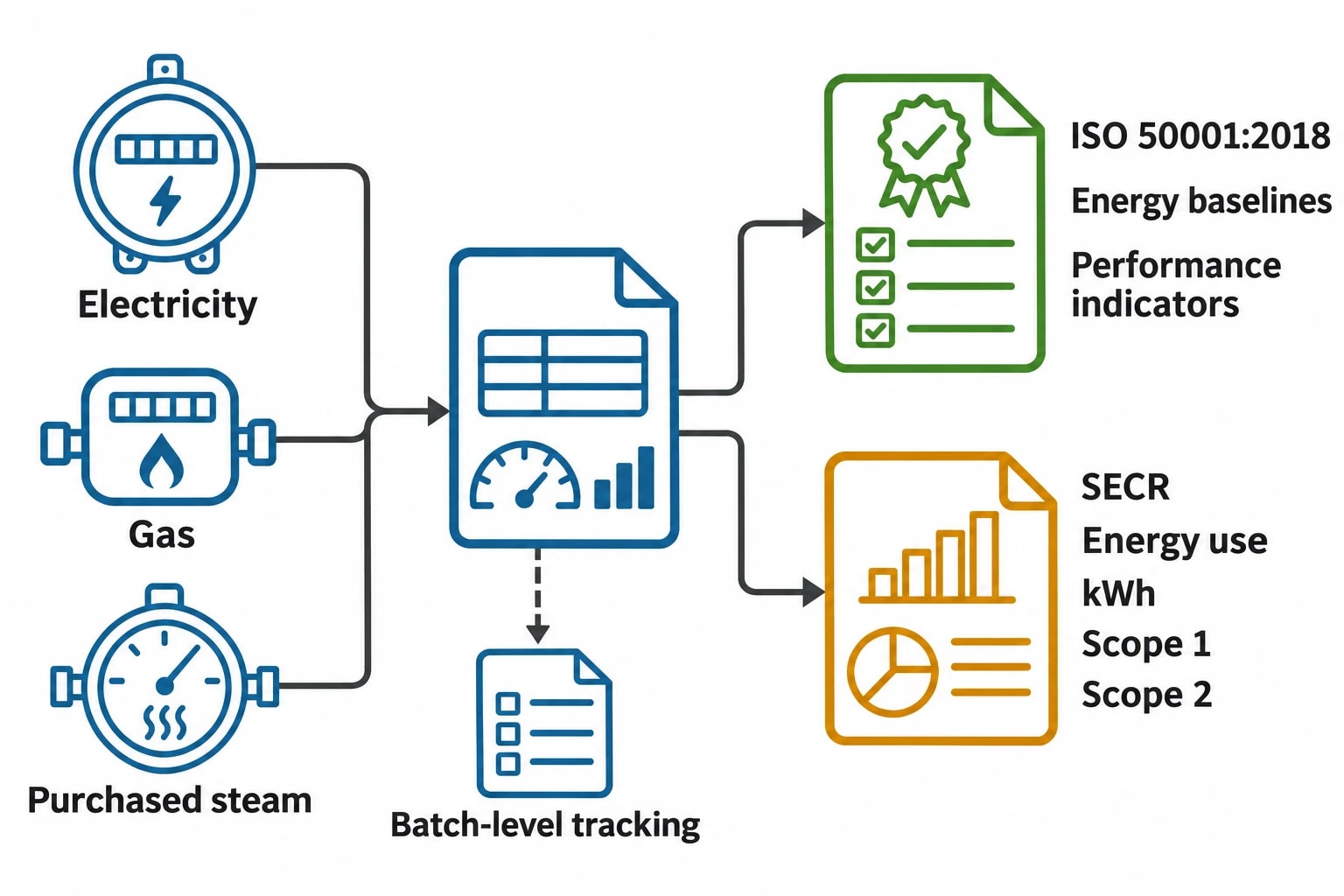
ISO 50001:2018 provides a framework for establishing and improving an energy management system. It focuses on energy performance, energy review, objectives, measurement and continual improvement. The standard remains current following confirmation in 2024.
For GMP manufacturers, ISO 50001:2018 aligns with controlled evidence. Energy baselines and performance indicators need defined boundaries, consistent collection methods and review by accountable teams. These practices also help distinguish an operational change from a metering fault or production-volume effect.
SECR requires qualifying UK companies and LLPs to report energy use and associated greenhouse gas emissions. Government guidance requires energy used to calculate emissions to be reported in kWh. Scope 1 includes direct emissions from sources owned or controlled by the reporting organisation, such as fuel combustion in a boiler. Scope 2 covers purchased electricity, heat, steam and cooling consumed by the organisation.
Granular utility data improves the explanation behind annual figures. Electricity, gas and purchased steam can be reconciled to source meters, while operational context can explain whether consumption changed because of output, altered operating hours, a plant fault or an efficiency measure.
Batch-level tracking is an internal management tool, not a mandatory SECR reporting format. It connects organisation-level reporting with the engineering evidence behind the result.
What a GMP-ready energy intelligence deployment should demonstrate
A pharmaceutical energy intelligence project should begin with intended use and data boundaries, not dashboard design. Facilities engineering, automation, production, IT or OT, Quality Assurance and sustainability teams should agree the scope before installation.
For Omni Vision, deployment evidence should show which utility streams are metered or received from approved systems, which production context is used for analysis, and whether the interface remains read-only in its commissioned state. Electricity, gas, water, steam, compressed air and oil can form the utility scope where site metering and approved source data support measurement.
The platform can provide a central analytical view of energy data and production-linked indicators. It does not replace the validated source control system, batch record, environmental monitoring system or formal change-control process. Its reports require governance appropriate to their intended use.
A GMP-ready deployment should be able to demonstrate:
- a defined utility and batch-allocation boundary;
- approved read-only data sources and point lists;
- traceable units, timestamps and source identifiers;
- handling of missing, stale or anomalous data;
- verified zero-write behaviour;
- controlled user access and report ownership;
- change assessment for later configuration or interface amendments.
This article reflects the independent analysis and editorial opinion of EnerTherm Engineering. Product names, trademarks, and brands mentioned belong to their respective owners. EnerTherm Engineering is not affiliated with, endorsed by, or a licensee of any third-party software or product mentioned unless explicitly stated.

Technical Manager — EnerTherm Engineering
John Naranjo is Technical Manager at EnerTherm Engineering, bringing specialist expertise in chemical and environmental engineering. He recently led the implementation of Omni Vision, EnerTherm's real-time energy and utility monitoring platform. He holds an MSc in Environmental Engineering from the University of Huelva and a BSc in Chemical Engineering, with memberships in both the Energy Institute and IChemE.
