Energy Reduction Strategies for Bakeries: Oven Heat Losses
EU BREF data puts bakery oven thermal use at 0.110-2.0 kWh/kg before loss modelling.
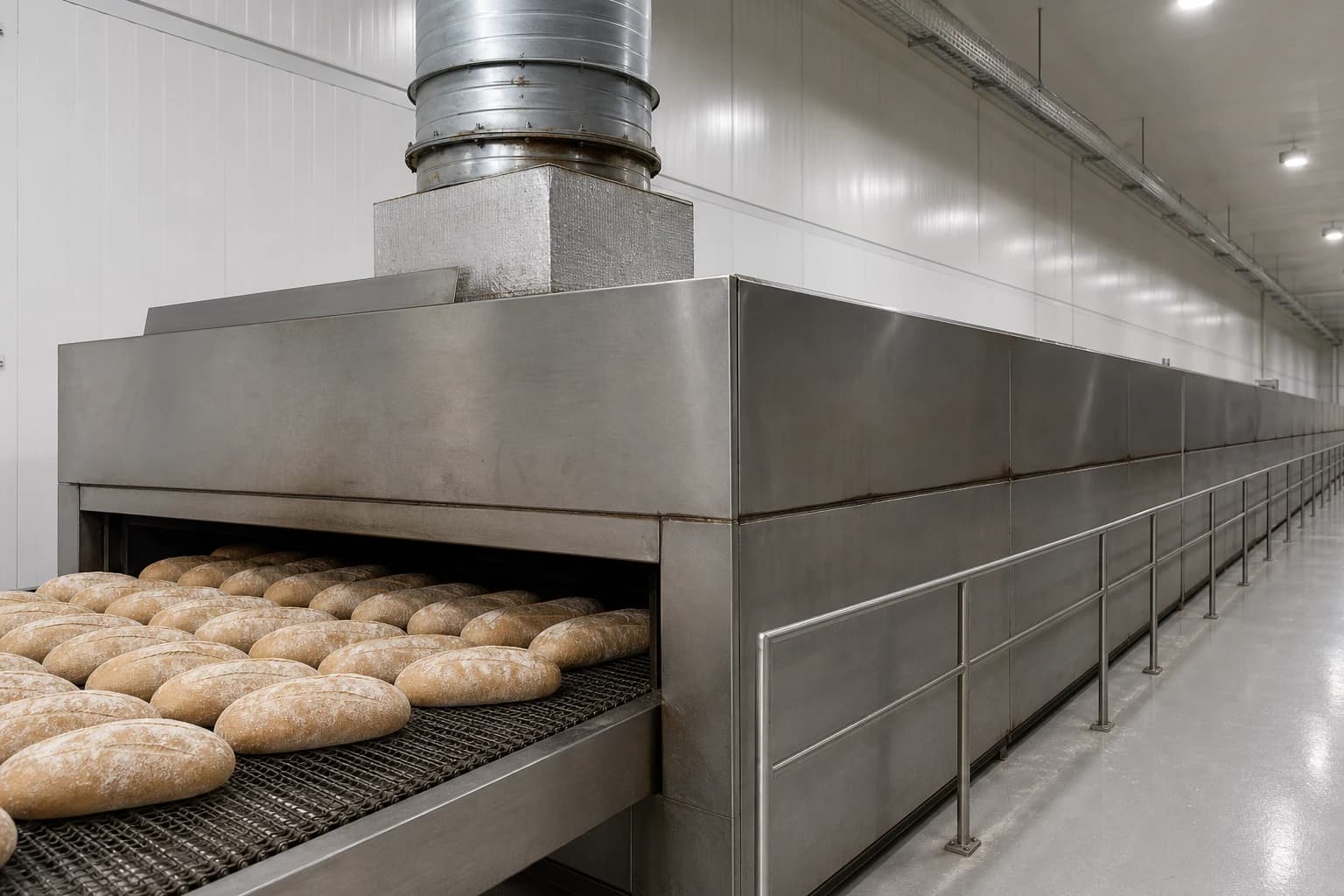
The EU Food, Drink and Milk Industries BREF reports bakery oven thermal consumption ranging from 0.110 to 2.0 kWh/kg of product, showing how strongly product type, oven design, loading and operating discipline affect energy use. For bread baking, it also reports a normal range of 0.125 to 0.167 kWh/kg. These figures give bakery operations managers a starting benchmark, not a performance verdict.
A tunnel oven producing a fully loaded run of standard loaves has a very different heat balance from a lightly loaded oven producing short runs of cakes, biscuits or speciality products. Heat must set the crumb structure, evaporate water, develop colour and maintain the required bake profile. Losses through exhaust stacks, oven casing, openings, leaks, hot pans and idle time add cost without improving the product.
The strongest energy-reduction strategies start with a measured heat and mass balance. This identifies where fuel, electricity, steam and recovered heat enter the process, where moisture leaves it, and which losses can be reduced without changing validated baking conditions.
Why oven heat losses dominate bakery energy reduction strategies
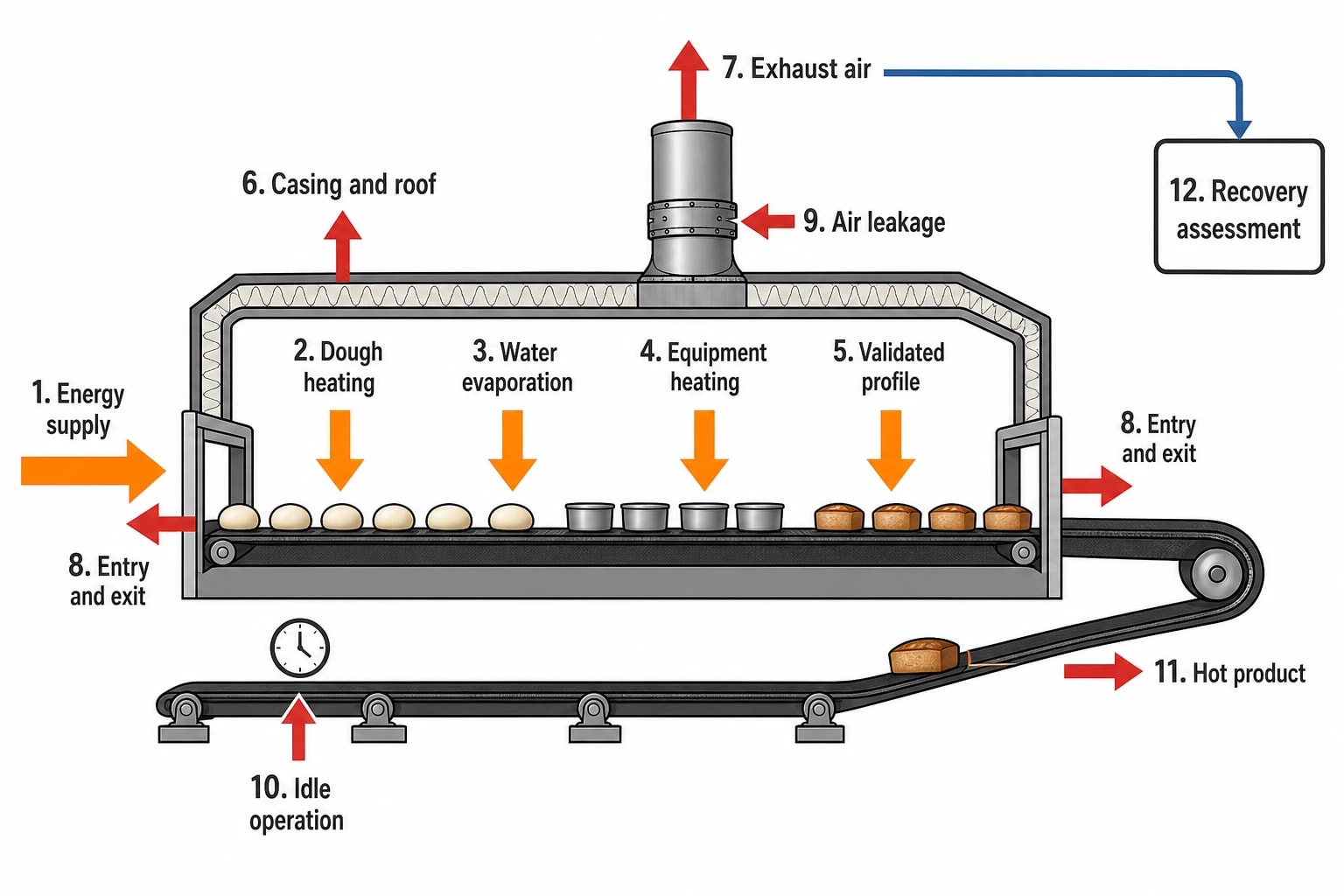
An industrial baking oven contains competing heat flows. Combustion or electric elements supply energy to the bake chamber. Radiation, convection and conduction transfer heat into the dough and baking surface. Water then evaporates from the product and leaves with the exhaust air.
The process must also heat tins, trays, belts, racks and the oven structure. These loads can be substantial during start-up, after cleaning and when production schedules leave the oven below its intended throughput.
The useful heat and the unavoidable process load
The useful portion of oven energy includes:
- Heating dough from its incoming temperature to the required baked condition.
- Providing latent heat for water evaporation.
- Heating tins, trays, belts or baking surfaces that travel with the product.
- Maintaining the validated temperature profile needed for structure, crust and colour.
A bakery cannot eliminate these duties. It can reduce the extra fuel or electricity consumed when the oven loses heat to the building, exhausts excessive hot air, operates underloaded or recovers too little usable energy.
Where heat leaves an industrial oven
The principal loss routes are usually visible in a heat balance:
| Heat-loss route | What it indicates | Operational consequence |
|---|---|---|
| Exhaust air | Sensible heat in hot air and latent heat in water vapour | High stack temperature or excessive exhaust flow increases fuel demand |
| Casing and roof | Conductive loss through insulation, panels and joints | Raises bakery ambient temperature and wastes heat continuously |
| Entry and exit apertures | Radiation and hot-air escape around product openings | Loss rises when curtains, seals or pressure balance deteriorate |
| Air leakage | Infiltration into the oven or fan ductwork | Extra air must be heated and often exhausted |
| Idle operation | Heat supplied while little or no product is baking | Specific energy consumption rises sharply during gaps and changeovers |
| Hot product and equipment | Energy carried out in baked goods, tins, trays and belts | Can be useful for controlled recovery or must be removed in cooling |
The exhaust stream often offers the clearest recovery opportunity, but it can also carry moisture, flour dust, grease aerosols and odorous compounds. A heat-recovery project needs process, hygiene, cleanability and maintenance assessment before capital approval.

Map every energy and material flow in your process with detailed heat and mass balance calculations — the foundation for any optimisation or design project.
Establish the bakery oven baseline before buying equipment
A cost-benefit case fails when it compares a proposed recovery system with an unreliable baseline. Production rate, recipe, moisture target and oven operating state all affect specific energy consumption. A monthly gas bill cannot separate these effects.
Commission Implementing Decision (EU) 2019/2031 sets out best available techniques for the food, drink and milk industries, including monitoring energy consumption and efficiency. It identifies heat recovery using heat exchangers or heat pumps, combustion control, insulation, boiler improvements and steam-distribution optimisation among the applicable techniques.
Use specific energy consumption by product family
Track oven energy as kWh per kg of saleable product, separately for major product families and oven lines. Record rejects and rework separately. A biscuit line, a high-moisture bread line and a cake oven should not share a single KPI.
A practical baseline should include:
- Metered fuel and electrical demand for the oven and its fans.
- Production mass, product type, line speed and oven occupancy.
- Start-up, shutdown, cleaning and changeover periods.
- Exhaust temperature, oxygen concentration where relevant, flow and humidity where measurement is feasible.
- Oven-zone temperatures, damper positions, fan speeds and burner firing patterns.
- Product incoming and outgoing moisture, supported by routine quality data.
- Ambient conditions around proofing, oven entry and cooling.
The resulting data set distinguishes a genuine reduction in oven energy from a shift in production mix or a temporary rise in throughput.
Build a heat and mass balance around moisture removal
Water removal is central to bakery energy use. The oven must supply the energy that changes product water into vapour, then exhaust air carries that vapour from the chamber. Product moisture loss also affects finished weight, texture, shelf-life behaviour and yield.
For each representative product, process engineers should reconcile dough input mass, finished-product mass, expected bake loss, rejects and moisture measurements. The thermal balance should allocate energy to product heating, evaporation, exhaust, shell losses and other measured loads.
This is more useful than treating stack temperature as the sole heat-loss metric. A lower exhaust temperature may indicate recovered heat, reduced excess air, lower production rate, condensation or a measurement problem. The mass balance provides the context.
Separate steady production from non-productive energy
Many bakeries can reduce energy without changing the bake by focusing on non-productive hours. Record energy use during warm-up, planned stops, breakdowns, sanitation, changeovers and waiting periods. The data can show whether the line needs improved scheduling, lower standby settings or a revised start-up sequence.
Production planners should use validated warm-up profiles. An oven started too early wastes energy; one started too late can create pressure to increase settings or reduce soak time, affecting bake consistency.
Reduce oven heat losses at the source
Heat recovery earns more when the oven first retains the heat it needs. Repairs and operating adjustments also tend to require less capital than major recovery projects.
Repair insulation, seals and oven openings
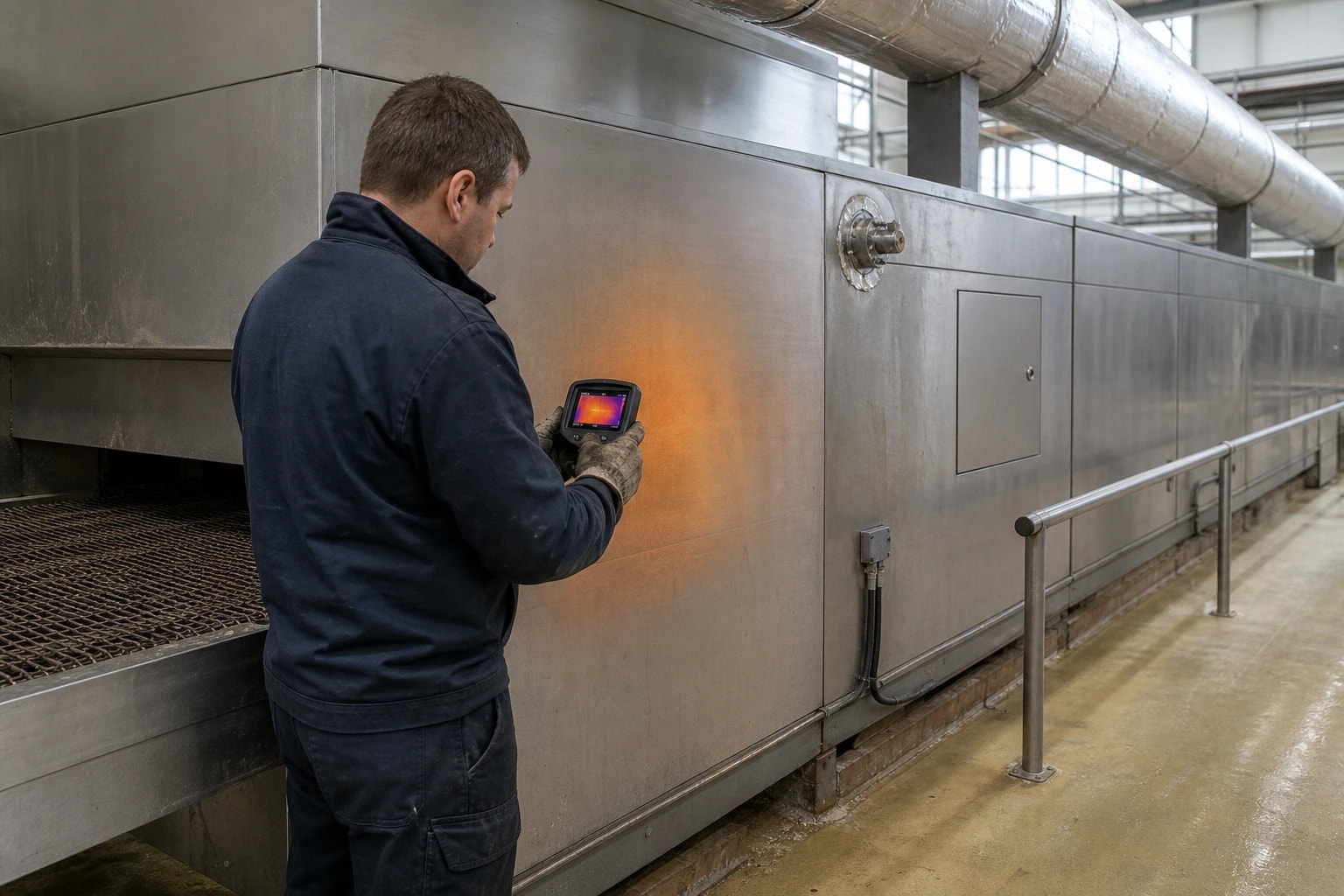
A casing survey should identify hot panels, damaged insulation, deteriorated door seals, poorly sealed service penetrations and leakage around inspection hatches. Thermal imaging can target the survey, followed by physical inspection and temperature measurement.
Entry and exit openings deserve particular attention. Curtains, baffles and pressure balance must allow product to pass without drawing excessive ambient air into the oven. A poorly adjusted opening increases the air volume that burners or electric elements must reheat.
These measures require product validation after adjustment. Altered pressure or airflow can change heat transfer at the product surface, particularly on sensitive biscuit and cake lines.
Control exhaust flow to the process requirement
Exhaust removes steam and combustion products, but excessive extraction wastes hot air. Dampers left fully open after a product change, poorly calibrated controls and fans running at fixed maximum speed can create a persistent loss.
The correct exhaust setting depends on the oven, fuel, recipe, baking stage and required chamber conditions. A controlled trial should monitor finished moisture, colour, dimensions, internal structure and bake safety alongside energy data. The aim is a stable minimum effective exhaust rate, not the lowest possible flow.
Variable-speed drives on suitable exhaust and circulation fans can reduce electrical use while improving airflow control. They must be commissioned against the oven’s pressure, burner and extraction requirements.
Improve burner and zone control
Direct-fired gas ovens need stable combustion and well-controlled zone temperatures. Burner inspection should cover ignition, flame detection, air-to-fuel control, burner condition and temperature-sensor accuracy. A drifting sensor can cause unnecessary firing or an unstable temperature profile.
Zone control should match the product’s actual bake requirement. Excess energy in an early zone can set the surface too quickly. Excess heat late in the bake can increase moisture loss and product-weight variation. Both create quality and yield risks as well as energy waste.
For electric ovens, the same principle applies to element control, zone setpoints, fan performance and product loading. Analyse energy data against the delivered heat profile, not only the oven’s rated connected load.
Map every energy and material flow in your process with detailed heat and mass balance calculations — the foundation for any optimisation or design project.
Recover heat from oven exhaust where it has a verified use
An oven exhaust project is economically credible only when it connects a reliable heat source to a simultaneous, suitable heat demand.
Match recovered heat to a lower-temperature demand
Recovered heat can support several bakery duties, subject to hygiene and engineering assessment:
- Preheating fresh air for suitable process or building ventilation duties.
- Preheating boiler feedwater or other permitted water services through an appropriate heat-exchanger arrangement.
- Supporting proofing-room heating where temperature and humidity control remain validated.
- Providing a source for a heat pump where direct-use temperature is insufficient.
- Reducing the load on downstream cooling or hot-water systems where a compatible duty exists.
The economics depend on annual operating hours, exhaust temperature and flow, fouling risk, the temperature required by the receiving process, and the price of displaced fuel or electricity. A high-temperature exhaust stream has limited value if the receiving process operates on a different shift.
Prevent fouling, corrosion and cross-contamination
Bakery exhaust can contain water vapour and product-derived material. Cooling it can cause condensate formation, increasing fouling and corrosion risk. The recovery system must define materials of construction, access for cleaning, drainage, inspection intervals and the treatment or disposal route for condensate.
Food-safety controls matter equally. UK food businesses must operate a food-safety management system based on Hazard Analysis and Critical Control Point principles. A heat-recovery installation that changes airflow or connects to process-air systems requires a documented hazard review, physical separation where appropriate, validation and records.
The project team should assess air quality, cleanability, access, drainage, microbial risk, allergen segregation and any effect on the validated bake or proofing process. A recovered-energy project must not compromise food-safety controls.
Consider heat pumps after reducing losses
A heat pump can raise the value of a low-grade recovered stream, although its performance depends on source temperature, sink temperature, operating hours and electrical demand. It suits a defined low-temperature heat sink better than an undefined future use.
The business case should compare annual delivered heat with the electricity required, maintenance needs, standby requirements and any effect on production continuity. It should also account for the boiler or heating system displaced by the heat pump.
Protect proofing, steam and cooling performance
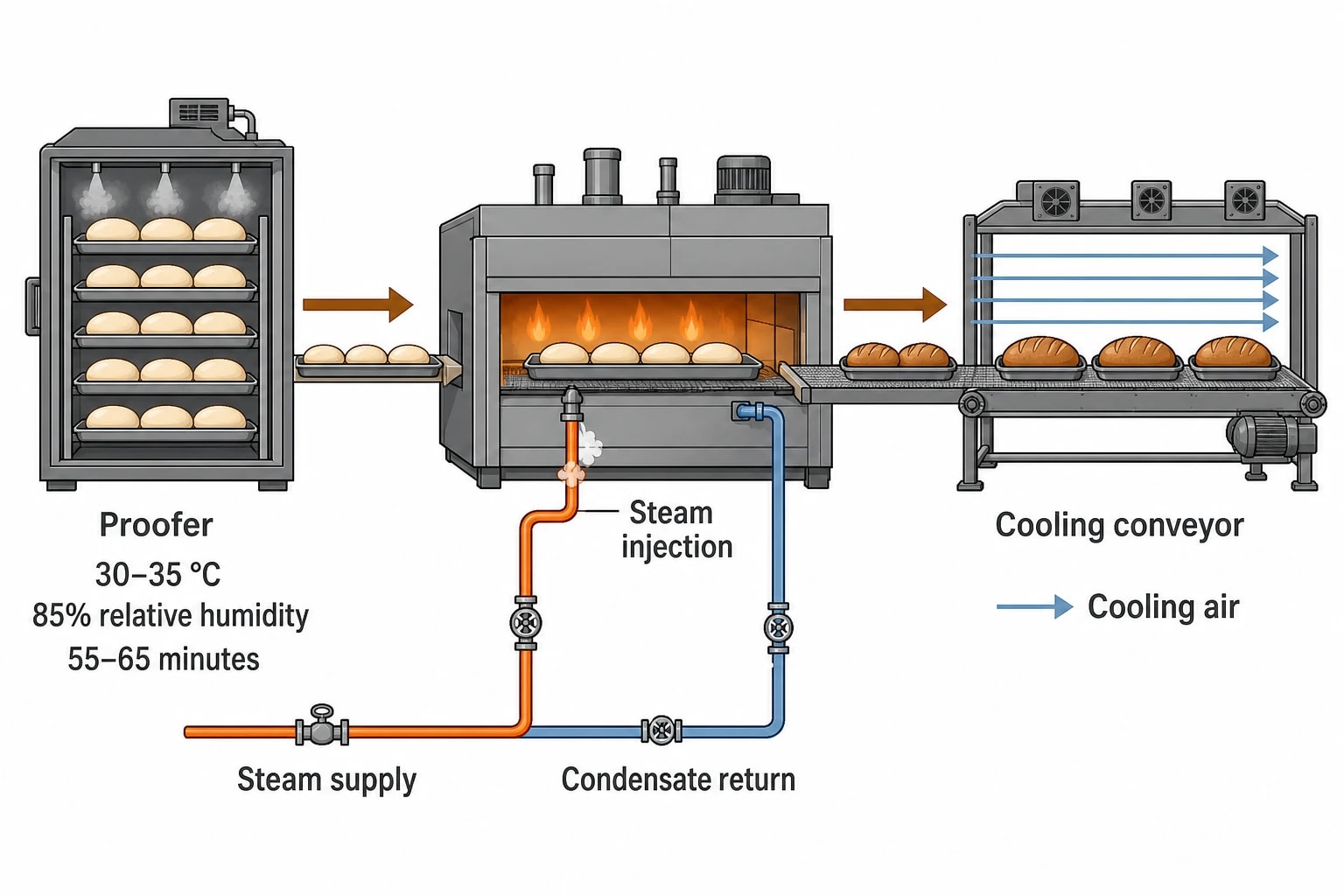
Oven energy reduction cannot be managed in isolation. Proofing, steam addition and cooling determine the incoming and outgoing moisture conditions around the oven.
Hold proofing conditions within the validated process window
The FDM BREF describes typical bread proofing conditions of 30 to 35 °C, about 85% relative humidity and roughly 55 to 65 minutes. Actual conditions must be set by the bakery’s recipe, plant, product specification and validation evidence.
Changes to recovered heat serving a proofer should be assessed against dough skin condition, proof height, dough strength, product volume and bake loss. Low humidity can dry the surface; excess humidity can create condensation and handling problems. Energy optimisation should preserve the chosen proofing window.
Account for steam and condensate
Steam used for oven injection or other bakery duties has an energy cost beyond boiler fuel. Distribution losses, failed steam traps, leaking valves, poor condensate return and unnecessary blowdown all increase demand.
A steam-system audit should map supply pressure, usage points, condensate return, trap condition and losses. Returned condensate can retain useful heat, but its quality and routing must meet site operating and food-safety requirements.
Recover product cooling energy carefully
Baked goods and hot trays leave the oven carrying energy that the cooling system must reject. Cooling-air control, fan operation and equipment cleanliness affect product quality and electrical demand.
The first priority is to meet the required cooling profile before slicing or packaging. Any use of product-cooling heat must remain physically separate from food where necessary and must not raise product temperature, moisture or condensation risk.
Prioritise bakery energy projects by evidence and value
A staged programme gives operations teams faster evidence and lower project risk than a single large intervention. The first phase should improve measurement and correct visible losses. The second should prove control changes against product quality. Major heat recovery should follow once the source and sink have been measured during representative production.
A practical investment sequence
- Establish product-specific energy, mass and moisture baselines.
- Repair insulation, seals, dampers, doors and obvious air leaks.
- Optimise start-up, shutdown, burner control, exhaust settings and fan operation through validated trials.
- Audit steam distribution, condensate return and proofing controls.
- Measure exhaust heat availability and concurrent site heat demand.
- Develop heat-exchanger or heat-pump options that include hygiene, drainage, maintenance and production constraints.
- Verify savings against the original specific-energy KPI after implementation.
Evaluate cost-benefit on annual production, not a single shift
For each proposal, calculate annual avoided energy from metered baseline data and expected operating hours. Apply the site’s actual fuel or electricity cost, then include maintenance, cleaning, downtime, spare parts, controls work and product-validation costs. A proposal with modest recovered heat but high availability may outperform a larger system that operates only intermittently.
The decision should also include yield. A small reduction in unnecessary bake loss can have material commercial value, but the bakery must validate that finished moisture, weight, colour, texture and shelf-life remain within specification.
A disciplined heat and mass balance shows which heat belongs in the product, which leaves through the stack and which losses can be removed without disturbing throughput, moisture control or HACCP evidence.
This article reflects the independent analysis and editorial opinion of EnerTherm Engineering. Product names, trademarks, and brands mentioned belong to their respective owners. EnerTherm Engineering is not affiliated with, endorsed by, or a licensee of any third-party software or product mentioned unless explicitly stated.

Managing Director — EnerTherm Engineering
Dr. François Pierrel is Managing Director of EnerTherm Engineering with over two decades of expertise in thermal design, heat transfer, and industrial energy optimisation. He holds a PhD in Heat Transfer from Cranfield University and a Post-Doctorate from Heriot-Watt University.
