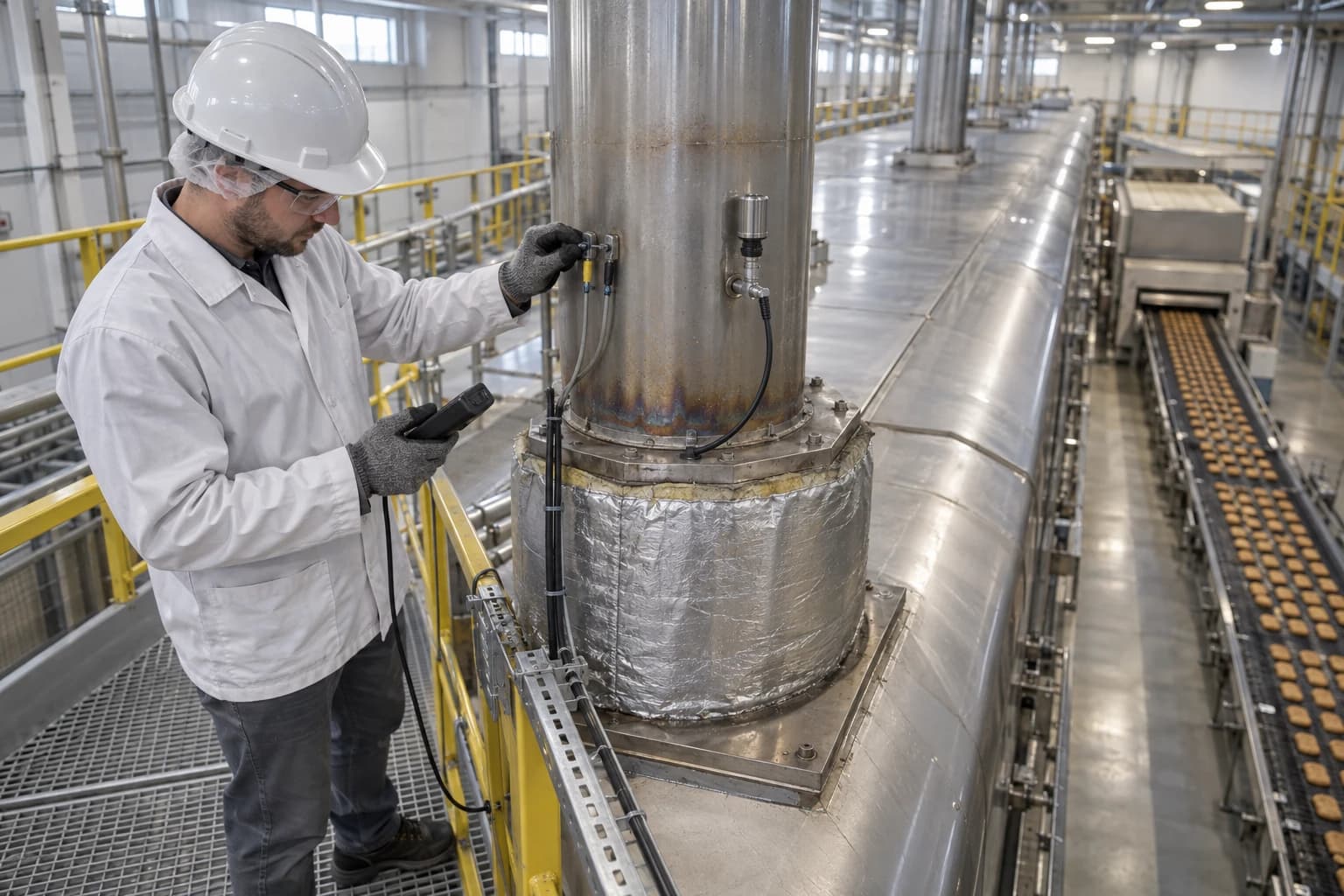
How Heat and Mass Balance Supports HACCP in Food Processing
Models quantify steam, moisture loss and heat use while HACCP limits remain validated.
A heat and mass balance in food processing is an engineering account of product, water, vapour, heat and utility streams through a process. It confirms that thermal operations remain within validated HACCP and product-quality conditions.
A dairy pasteuriser may show the correct outlet temperature while throughput, fouling or regeneration performance changes its thermal margin. A bakery oven may produce biscuits at the intended colour while moisture loss moves outside the weight-control target. A fryer may maintain oil temperature while wetter potatoes increase vapour load and change final moisture.
These are process-control and utility issues. The Department for Energy Security and Net Zero reports that UK food and drink manufacturing used 1,530.58 ktoe of natural gas and 938.28 ktoe of electricity in 2023. Steam generation, ovens, fryers, evaporators, refrigeration and cleaning systems all require careful accounting.
Heat and mass balance work gives engineering, production and quality teams one evidence base. It quantifies what enters and leaves a defined process boundary, identifies unexplained losses and tests whether an efficiency change remains within the conditions on which HACCP controls rely.
Why heat and mass balance food processing matters to HACCP
HACCP plans identify hazards, establish critical control points, define critical limits, set monitoring arrangements and specify corrective actions. Heat and mass balance engineering provides the process understanding needed to support those activities.
The Food Standards Agency states that a critical limit must be measurable or observable in real time and adequate to prevent, eliminate or reduce the relevant hazard to an acceptable level. A food plant may therefore monitor time, temperature, moisture, pH, pressure or water activity, depending on the process and hazard.
A balance adds context to those individual readings.
Temperature readings need process context
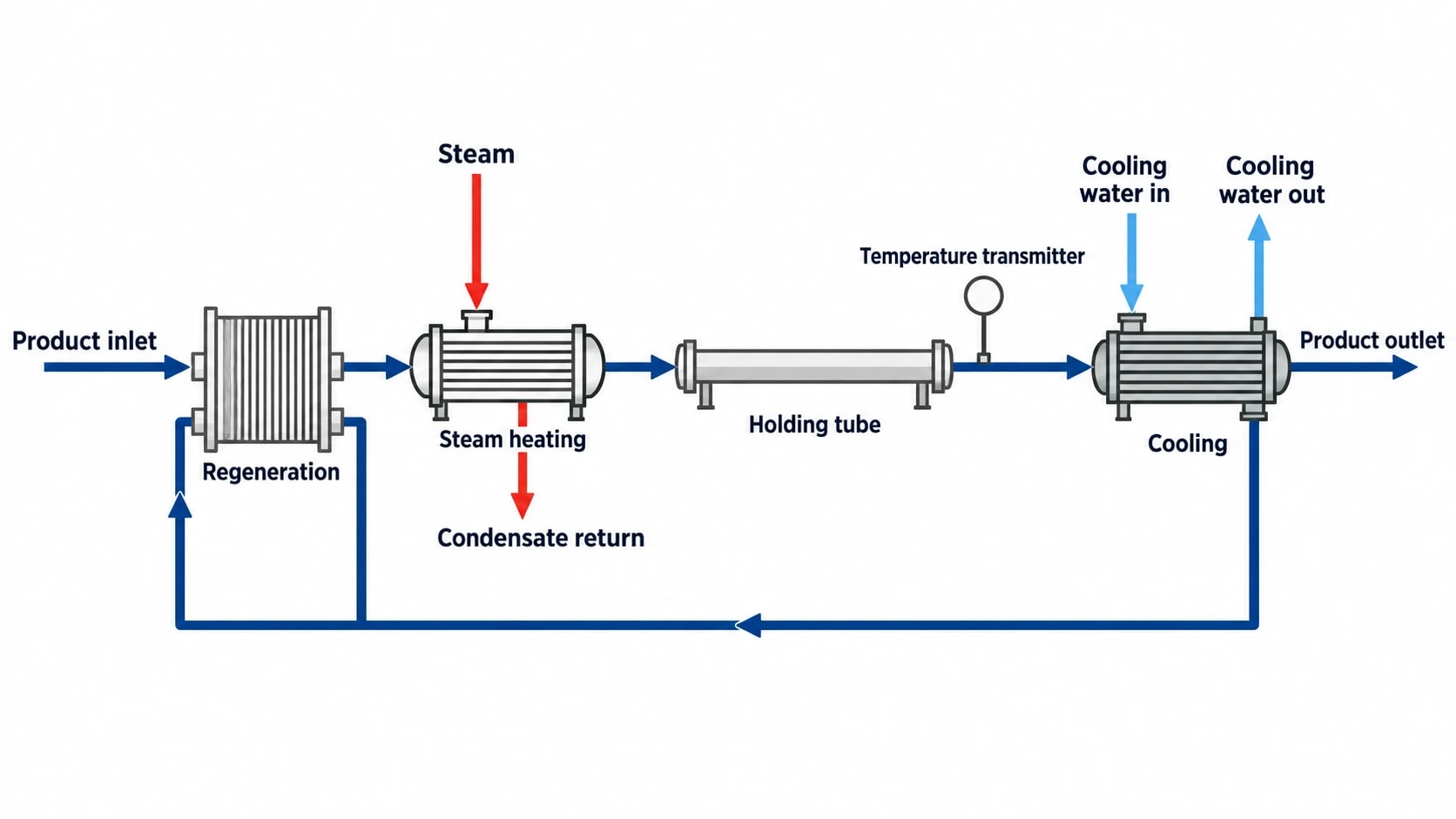
A temperature transmitter records conditions at one location. Product safety depends on the treatment received by the relevant product for the required time under validated operating conditions.
For a continuous thermal process, engineers normally examine:
- Product mass flow and density
- Product inlet and outlet temperatures
- Heating-medium flow, temperature and pressure
- Holding-section volume and residence time
- Heat-exchanger regeneration duty
- Cooling duty and cooling-water demand
- Steam condensate generation and return
- Product composition, viscosity and solids content
- Start-up, shutdown and product-changeover conditions
A throughput increase can shorten residence time in a holding section. Higher solids can change viscosity and heat-transfer behaviour. Fouling can reduce heat-exchanger duty, increasing steam demand while narrowing the thermal operating margin.
The HACCP critical limit remains the governing requirement. The balance helps engineers identify physical changes that may threaten repeatable delivery of that requirement.
Moisture is a safety, quality and yield variable
Water often represents the largest moving component in a food process. Its removal, addition or redistribution affects shelf life, texture, weight, concentration and heat transfer.
In bakery production, excessive evaporation can reduce finished weight and alter crumb structure. Insufficient evaporation can leave a product above its specified moisture content. In snack processing, incoming raw-material moisture affects fryer vapour load and final product moisture. In dairy evaporation, concentration changes viscosity, heat-transfer coefficients and the duty required downstream.
A useful mass balance separates ingredients, product, water, vapour, condensate, rejects, purge streams and measured losses. This prevents an apparent energy improvement from masking reduced output, increased product loss or a moisture shift outside specification.

Map every energy and material flow in your process with detailed heat and mass balance calculations — the foundation for any optimisation or design project.
HACCP limits constrain balance-led changes
A heat and mass balance supports HACCP verification and management of change. It does not establish a new critical limit or substitute for validated monitoring.
The Food Standards Agency notes that some critical limits are set in legislation, including milk pasteurisation requirements. Other limits may derive from scientific evidence, recognised guidance, industry guidance or peer-reviewed research. Food businesses must document how they established the critical limit and review it when relevant process changes occur.
Treat validated conditions as fixed constraints
Before considering an energy or capacity change, the engineering team should identify conditions requiring formal food-safety review. These may include:
- Time and temperature requirements for a thermal step
- Maximum or minimum product moisture
- Product flow rate through a holding section
- Pressure, sealing or cooling conditions for sealed products
- Cleaning conditions and hygienic separation requirements
- Product-core temperature or cooling limits
A proposed reduction in oven exhaust may retain heat in the oven and lower fuel demand. It may also reduce vapour removal and alter the product moisture profile. The balance quantifies that change; the HACCP and quality process determines whether the revised operating condition remains acceptable.
Balance work improves change-control evidence
A documented balance gives the HACCP team a practical record of the operating case behind an engineering recommendation. It should state the product, recipe, line configuration, production rate, sampling method, instrument status and production date.
That record matters after recipe reformulation, packaging changes, line-speed changes, heat-exchanger replacement or utility modifications. It also distinguishes a sustained process shift from a one-off abnormal operating condition.
Building a reliable food-processing balance
The quality of a balance depends on boundary selection and data quality. A well-structured study begins with a specific decision.
“Why has gas use risen?” is too broad. “Can the biscuit oven operate at its proposed belt speed while retaining the established final moisture and bake profile?” provides a usable engineering question.
Define the boundary around the decision
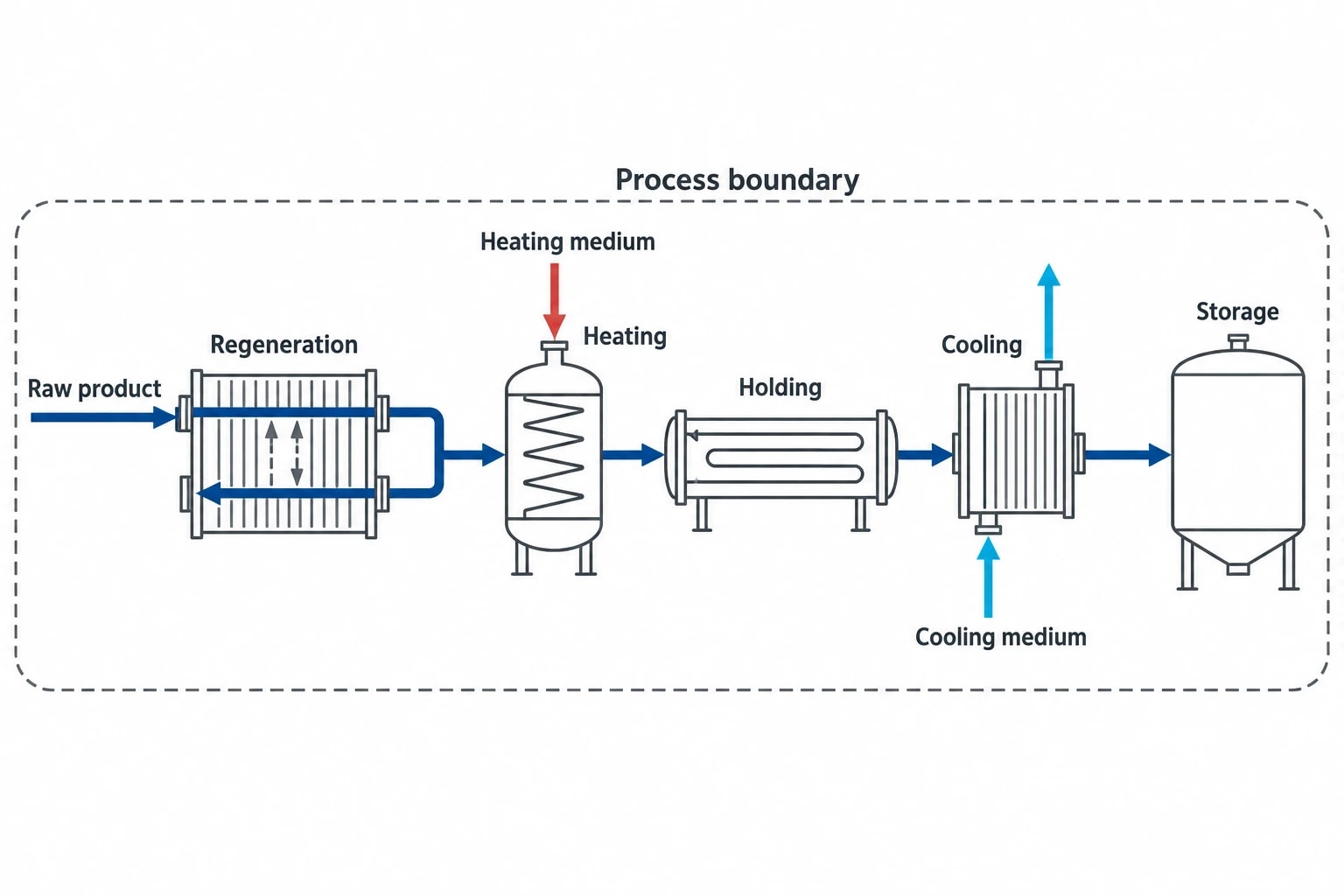
For a pasteurised dairy line, the boundary may run from raw-product inlet through regeneration, heating, holding, cooling and transfer to storage. For a bakery oven, it may include dough feed, oven zones, extraction air, burner fuel, product discharge and cooling.
The boundary should capture streams that materially change the answer. A steam study that excludes condensate return may overlook a major cause of boiler make-up demand. An oven study that excludes exhaust air may miss a substantial heat and moisture outlet.
Representative operating cases often include normal production, the highest validated line speed, low-throughput production, start-up and product changeover.
Collect measurements that close the balance
A balance usually needs more than historical utility totals. Field work may include timed product-weight checks, moisture sampling, gas-meter readings, steam-flow measurement, condensate measurement, exhaust temperature and humidity measurements, and utility pressure checks.
Plant teams should record measurements over a stable production period. A single reading during a line-speed adjustment, burner modulation event or cleaning sequence rarely represents the process.
The core measurements vary by application:
| Process | Mass-balance measurements | Heat-balance measurements |
|---|---|---|
| Tunnel oven | Dough rate, inlet moisture, final moisture, reject rate | Fuel use, zone temperatures, exhaust temperature and flow |
| Pasteuriser | Product rate, product solids, diversion flow, losses | Heating-medium flow, inlet and outlet temperatures, cooling duty |
| Fryer | Raw-product rate, inlet moisture, final moisture, oil uptake | Fuel or steam input, oil temperature, exhaust vapour conditions |
| Evaporator | Feed rate, feed solids, concentrate solids, condensate | Steam flow, condensate temperature, vapour conditions |
| Beverage line | Product flow, syrup, dilution water, losses, cleaning volumes | Pasteuriser duty, refrigeration duty, hot-water demand |
Reconcile differences rather than hiding them
Balances seldom close exactly. Moisture tests vary with sampling method. Flow meters have uncertainty. Steam blowdown, leakage, intermittent drains and unmetered water use can sit outside the initial boundary.
The remaining difference is an engineering finding. A material mass-balance error may indicate unmeasured product losses, incorrect moisture data or a bypassed stream. A large heat-balance gap may indicate unmeasured exhaust losses, a fuel-meter issue, heat storage during an unstable run or missing utility streams.
Engineers should document the error and investigate it before using the balance to approve a major operating change.
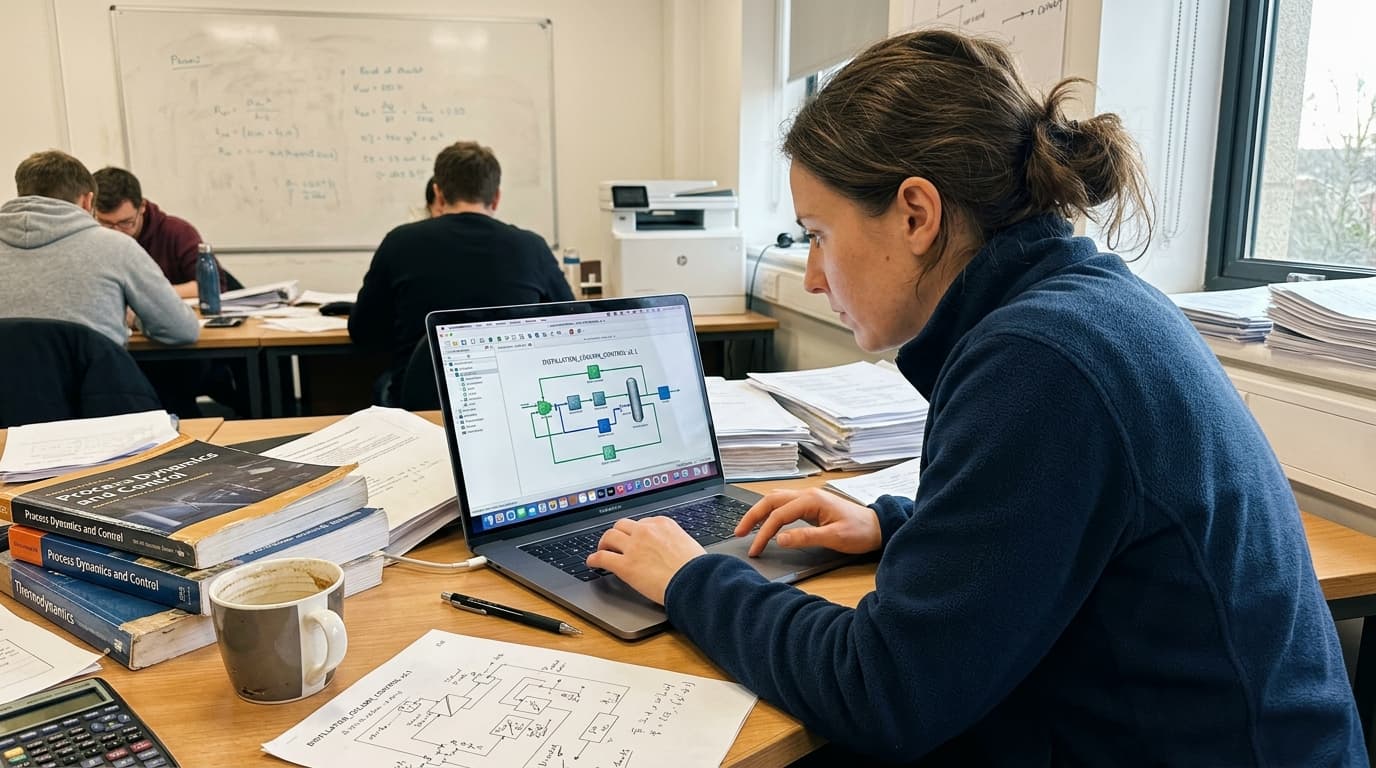
Map every energy and material flow in your process with detailed heat and mass balance calculations — the foundation for any optimisation or design project.
Worked tunnel-oven example: evaporation drives the minimum duty
A published continuous biscuit-oven example illustrates the relationship between moisture loss and heat duty. The example assumes steady operation, with dough entering at 2,000 kg/h, 18% wet-basis moisture and 25 °C. Biscuits leave at 2% wet-basis moisture and 130 °C.
The calculation uses dry solids as the mass-balance anchor.
Mass balance result
The dough contains 1,640 kg/h of dry solids. With 2% moisture in the finished biscuits, those solids leave in 1,673.47 kg/h of product.
The difference between inlet dough and finished product is evaporated water:
| Balance item | Result |
|---|---|
| Dough feed | 2,000.00 kg/h |
| Dry solids entering | 1,640.00 kg/h |
| Finished biscuit output | 1,673.47 kg/h |
| Water evaporated | 326.53 kg/h |
| Mass-balance closure error | 0.00 kg/h |
The zero closure error reflects the fact that the example calculates finished-product flow from conserved dry solids. A plant balance should report the difference between independently measured inlet, product and vapour streams rather than rely on a calculated closure alone.
Minimum thermal duty
The example calculates three product-side energy demands:
| Duty component | Result |
|---|---|
| Heating finished biscuits from 25 °C to 130 °C | 268,370 kJ/h |
| Heating evaporated water from 25 °C to 100 °C | 102,370 kJ/h |
| Latent heat for evaporation | 736,960 kJ/h |
| Total minimum product-side heat duty | 1,107,700 kJ/h |
| Equivalent duty | 307.69 kW |
The latent load accounts for about two-thirds of the calculated minimum duty. A meaningful increase in dough moisture, final-moisture target or production rate should therefore increase the evaporation load and minimum product-side duty.
Actual burner input will exceed this minimum because ovens also heat air, conveyor components and equipment surfaces while losing heat through exhaust and the oven enclosure. The published calculation identifies a thermal efficiency range of 50% to 80% for actual oven operation, although site measurement is required to establish the result for a specific oven.
What the example means for HACCP
The example does not establish a bakery HACCP critical limit. It shows why moisture and throughput require the same engineering attention as temperature set-points.
If a plant increases dough rate by 10% while moisture values remain unchanged, the calculated evaporation requirement also increases by 32.65 kg/h. The latent component rises by roughly 73,696 kJ/h before extra sensible heating and oven losses. The plant should then verify final moisture, product temperature, bake profile and relevant HACCP controls under the revised condition.
Applications across food and beverage plants
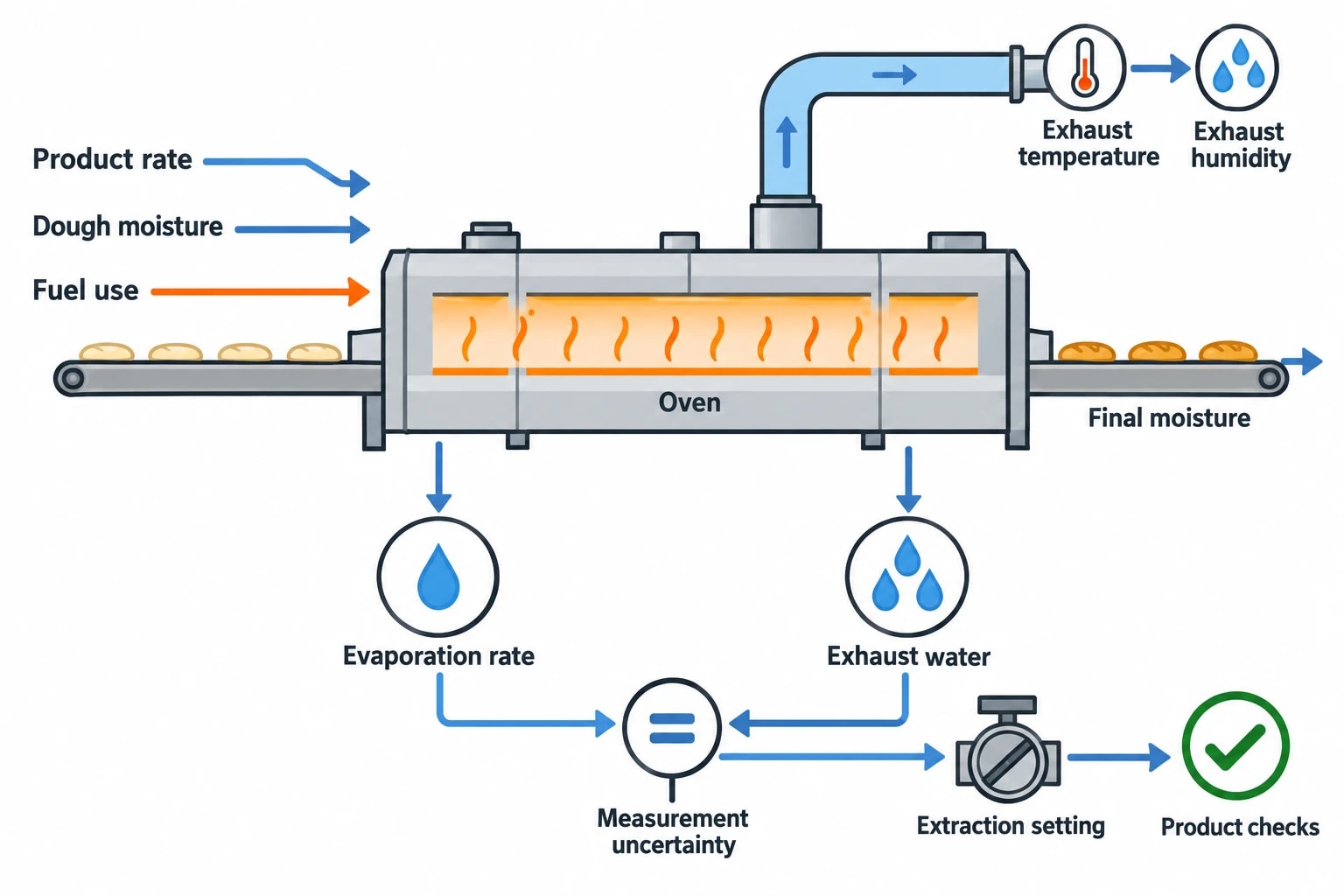
Bakeries: measure evaporation before adjusting exhaust
Oven exhaust removes humid air and combustion products. Excess exhaust carries heated air out of the oven. Insufficient exhaust can alter humidity, product drying and bake characteristics.
A practical test compares product rate, dough moisture, final moisture, fuel use, exhaust temperature and exhaust humidity across stable operating periods. The calculated evaporation rate should align with the water carried away by the exhaust stream within measurement uncertainty.
If the balance identifies excess exhaust heat, the team can test a reduced extraction setting in controlled increments. Product moisture, weight, colour, bake profile and relevant HACCP controls need verification at each condition. Report any fuel reduction as measured gas use per tonne of saleable product rather than as a theoretical percentage.
Dairies: quantify regeneration before changing thermal loading
Regeneration in a plate heat exchanger transfers heat from pasteurised product to incoming cold product. The heat recovered reduces external heating duty and usually reduces cooling duty.
A dairy balance should compare product flow, inlet and outlet temperatures, heating-medium flow, cooling-water or glycol demand, and condensate flow. A falling regenerated duty at unchanged throughput may indicate fouling, altered product solids, a control issue or a bypass arrangement.
The result can be expressed as extra steam demand per tonne of product or as the difference between measured and expected heating duty. Any response, including cleaning, temperature changes or throughput changes, must retain validated pasteurisation conditions and the site’s established monitoring arrangements.
Snack plants: distinguish raw-material moisture from fryer losses
Frying removes water and changes product oil content. A mass balance based on raw-product rate, incoming moisture, finished moisture and oil uptake shows whether a higher fuel load follows the raw material or fryer performance.
For example, if measured incoming moisture rises while final moisture remains fixed, the fryer must evaporate more water per tonne of finished product. Exhaust flow, vapour handling and fuel use should rise accordingly. A balance can identify whether the increased demand matches the expected evaporation load or suggests a further loss, such as excess exhaust, degraded insulation or poor burner performance.
Beverage facilities: separate production heat from cleaning demand
Beverage plants often combine pasteurisation, refrigeration, hot-water generation and clean-in-place activity on shared utilities. Daily energy totals can therefore obscure the demand created by production and cleaning.
A utility balance should allocate steam, hot water, chilled water and electricity to production periods, clean-in-place cycles, start-up and changeover. It can also quantify product losses during line flushing and identify the associated cooling or heating load.
A reduction in hot-water demand during cleaning, for instance, needs assessment against the validated cleaning process rather than treatment as an unrestricted utility target.
Turning balance results into controlled improvement
A completed study should provide a process flow diagram, stream table, mass and energy balance, data-quality assessment and register of operating constraints. These outputs give production, engineering, quality and utilities teams a common reference.
Convert discrepancies into specific site tests
Balance findings should lead to a measured action with a clear verification method.
-
A low condensate-return rate can be tested by measuring condensate flow at the process outlet and at the boiler-house return. The difference identifies the recoverable mass before capital or maintenance work begins.
-
A high oven exhaust loss can be tested through fuel use per tonne of saleable product, exhaust temperature, exhaust humidity and final moisture before and after a controlled damper adjustment.
-
Reduced plate-heat-exchanger performance can be tested by calculating heating duty from measured product flow and temperature change before and after cleaning.
-
Excess product loss during beverage changeover can be measured by comparing ingredient and packaged-product mass, then assigning the associated heating and cooling demand to the loss.
-
A suspected steam-trap failure can be investigated through a trap survey and by comparing measured steam generation, condensate return and process demand during a stable production period.
Keep the result tied to saleable product
Utilities performance should be normalised against saleable output and product specification. Gas use per tonne of dough processed can improve while finished weight falls. Steam use per litre can improve while product losses increase during changeover. Electricity use can decline while refrigeration temperatures move outside the approved operating range.
A heat and mass balance connects utility consumption to the physical movement of product and water, making those trade-offs visible against the thermal, moisture and hygiene conditions that keep the process under control.
This article reflects the independent analysis and editorial opinion of EnerTherm Engineering. Product names, trademarks, and brands mentioned belong to their respective owners. EnerTherm Engineering is not affiliated with, endorsed by, or a licensee of any third-party software or product mentioned unless explicitly stated.

Managing Director — EnerTherm Engineering
Dr. François Pierrel is Managing Director of EnerTherm Engineering with over two decades of expertise in thermal design, heat transfer, and industrial energy optimisation. He holds a PhD in Heat Transfer from Cranfield University and a Post-Doctorate from Heriot-Watt University.
