How Food Plants Use Steady-State and Dynamic Models
Aspen HYSYS models thermal processes, moisture removal and production changes
A steady-state model is a heat and mass-balance representation of a food process in which material and energy do not accumulate over the selected operating period. A dynamic model represents how that process changes over time. Regulation (EC) No 852/2004 requires food business operators to maintain HACCP-based procedures, monitor critical control points and review those procedures when a product or process changes.
For a bakery, dairy, snack factory or beverage plant, that regulatory context changes the role of process simulation. A model cannot be treated as an energy-saving exercise detached from food safety. It must represent the production conditions that determine product moisture, pasteurisation performance, cooling duty, steam demand, line capacity and critical operating limits.
Steady-state and dynamic modelling in food plants require different inputs and answer different questions. The first establishes normal heat and material flows through a line. The second tests what happens during disturbances, start-ups, recipe changes, line stoppages and utility constraints.
Used together, they give process engineers a defensible basis for equipment sizing, utilities planning, debottlenecking and heat-recovery projects.
What steady-state and dynamic modelling means in food plants
Steady-state modelling fixes a defined operating condition
A steady-state model assumes the process has settled. Over the period examined, the flow entering each unit operation equals the flow leaving it, adjusted for known reactions, evaporation, purge streams, product uptake and losses. Energy entering the process also balances energy leaving it.
The model represents a production snapshot. It may describe a bakery oven running a defined product at 6,000 kg/h, a dairy pasteuriser processing a specified milk flow or a beverage line operating at its planned filling rate.
Process engineers use this model to establish:
- Product, water, air, steam and condensate flows
- Heating and cooling duties
- Utility consumption per tonne of product
- Heat-exchanger area requirements
- Moisture removal across ovens and dryers
- Boiler load and condensate-return potential
- Waste-heat quantity, temperature and possible users
- Constraints that limit throughput
For food operations, input-data quality decides whether the result is useful. A mass balance that treats wet dough, milk concentrate or potato slices as a single generic stream may miss the property driving the operating problem: water content.
A credible model separates relevant components. It identifies product solids, water, steam, combustion gases, process air, cleaning media, refrigerant-side duties and condensate where appropriate. The level of detail should match the decision. Early project screening needs fewer assumptions than a detailed heat-exchanger replacement or dryer rebuild.
Dynamic modelling adds time, inventory and control behaviour
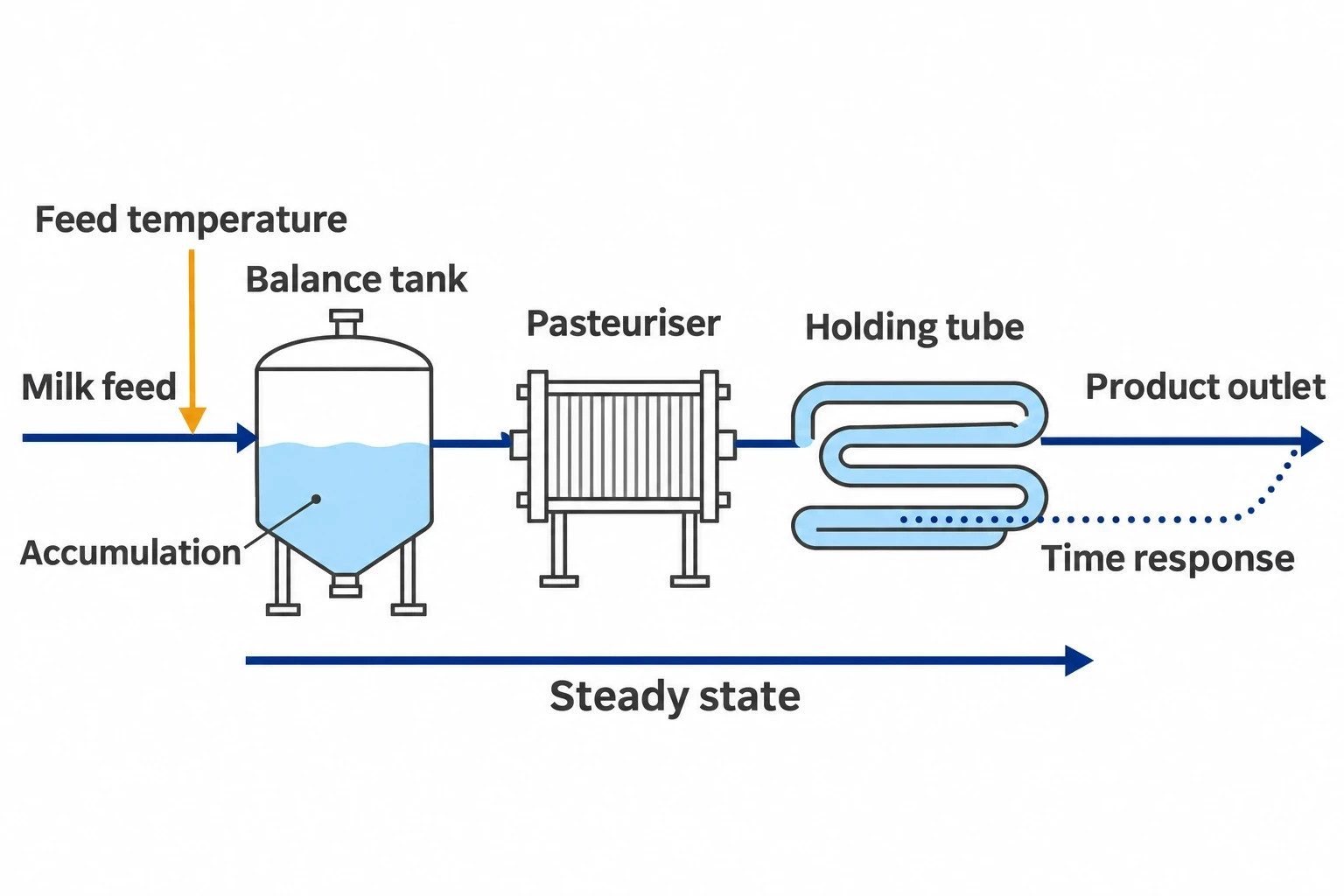
Dynamic models include accumulation. Product fills a holding tube. Liquid level rises in a balance tank. Metalwork stores heat in an oven. Steam pressure changes after another line opens a control valve. These effects matter because food plants do not operate at one perfectly stable point for an entire shift.
A dynamic model tracks the process response after a change. It can examine the time taken for a pasteuriser outlet temperature to recover after a feed-temperature disturbance, the pressure response in a steam header after a batch cooker starts, or the moisture effect of a conveyor-speed change through an oven.
Aspen HYSYS documentation makes the same distinction: steady-state models exclude material and energy accumulation and support design, sizing and energy calculations; dynamic models include accumulation and support control, safety and operability studies.
For food plants, the practical question is simple: can the plant remain within validated process and quality limits while conditions move from one operating point to another?

Map every energy and material flow in your process with detailed heat and mass balance calculations — the foundation for any optimisation or design project.
Why food manufacturers need both model types
Product quality sits inside the heat and mass balance
Food production contains tightly coupled thermal and moisture effects. A change intended to save gas or steam can alter product quality before it affects the utility meter.
In a bakery, reduced oven air temperature may cut fuel input but increase final moisture, change crust formation or extend baking time. A higher exhaust-air rate may remove moisture more quickly, but it can also increase fan power and carry more sensible heat out of the stack.
In snack production, fryer temperature, residence time, product load and water removal interact. In dairy processing, feed temperature, regeneration performance, holding conditions and cooling load shape energy use and process control. In beverage production, hot-water demand, bottle or can temperature and line interruptions can affect pasteurisation duties.
A steady-state model establishes the normal relationship between these variables. A dynamic model tests whether that relationship holds when production changes.
HACCP demands controlled operating conditions
In Great Britain, food-safety legislation derived from Regulation (EC) No 852/2004 is treated as assimilated law. Article 5 requires permanent HACCP-based procedures. The Food Standards Agency states that these procedures must identify hazards, define critical control points, establish limits, monitor controls, take corrective action and maintain records.
Heat treatment and chilling regularly form part of those controls. The Food Standards Agency identifies time and temperature as typical critical limits for microbiological hazards, including pasteurisation. Annex II to Regulation (EC) No 852/2004 requires suitable arrangements for maintaining and monitoring food-temperature conditions.
A process model does not replace validation, verification, instrumentation or HACCP records. It gives the HACCP team a structured way to assess changes before they affect the line.
For example, a model can help assess whether lower steam-header pressure might reduce the available temperature driving force in a heat exchanger. The food-safety team must still determine whether the proposed operating range protects the validated process, critical limits and corrective-action procedures.
Production changes expose weak assumptions
Many food plants run several recipes, formats and shift patterns on the same assets. The stated design capacity of an oven, pasteuriser or boiler may bear little resemblance to the utility load observed during a high-output product campaign.
Steady-state cases should represent the operating envelope, not a single average day. Useful cases may include:
- Maximum production rate
- Lowest and highest incoming product temperature
- Wettest and driest permitted feed condition
- Each major recipe family
- Summer and winter ambient conditions where ventilation or cooling duty changes
- Reduced-capacity operating periods
- Planned future line expansion
Dynamic studies should then focus on transitions between those cases. This prevents a project team from approving an efficient design point that creates poor control during grade changes or demand peaks.
Steady-state models for ovens, dryers and thermal processing
Multi-zone ovens require a moisture balance
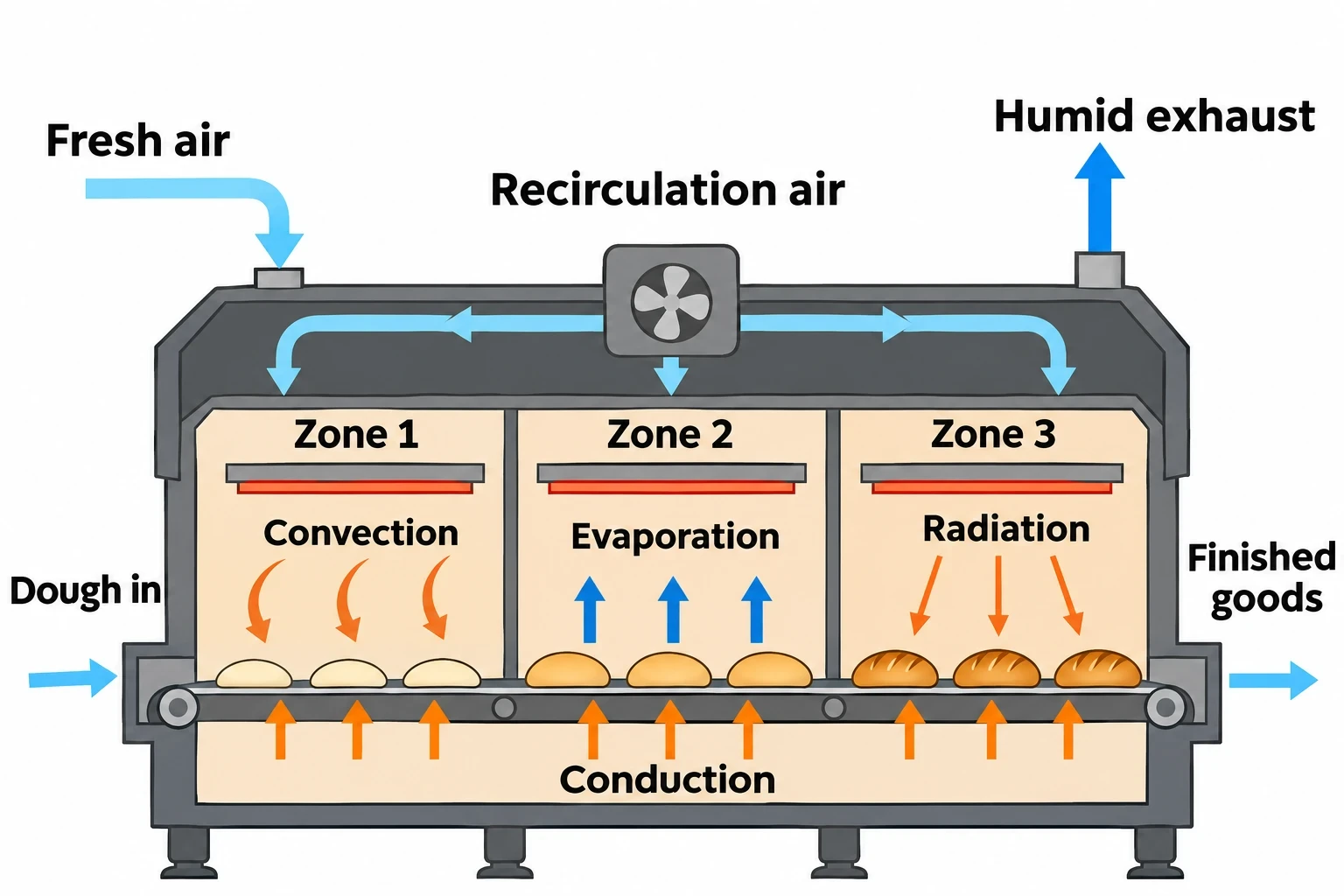
A bakery oven transfers heat through convection, radiation and conduction. It also removes water from the product. The balance must account for water entering with dough, water retained in finished goods, evaporation, moisture carried in the exhaust and any added steam.
A model can divide a tunnel oven into zones where operating conditions differ. It can then examine burner or electric duty, recirculation air, fresh-air input, exhaust volume, belt loading and product residence time.
This supports practical decisions such as whether an exhaust reduction will affect moisture removal, whether a heat-recovery exchanger has a stable heat source, or whether a higher line speed requires additional thermal capacity.
The model should be checked against measured product moisture, oven temperatures, exhaust conditions, gas consumption and production mass. A gas meter alone cannot confirm that the model represents the baking process.
Dairy models distinguish regeneration from utility demand
Dairy systems often contain large internal heat-recovery duties. Regenerative pasteurisation exchanges heat between outgoing hot product and incoming cold product. A steady-state model can show how changes in flow, feed temperature or heat-exchanger performance alter the remaining heating and cooling duties.
The model should include the real operating arrangement: product-side temperatures, hot-water or steam supply, chilled-water or glycol return, heat-exchanger pressure drops, holding equipment and relevant diversion conditions.
Fouling matters. As thermal resistance rises, the same process may require more utility input or lose temperature margin. Comparing a clean case with measured late-run conditions can help engineers distinguish a capacity issue from a cleaning-frequency, heat-exchanger-area or control issue.
Steam-system models make losses visible
A food plant’s steam model should trace steam generation, distribution, pressure reduction, process users, condensate return, flash steam and make-up water. This is particularly useful where several departments share one boiler house.
A steam-system balance can reveal:
- High condensate temperatures discharged to drain
- Steam pressure reductions that generate flash steam without a recovery route
- Mismatches between boiler production and recorded process use
- Large swings in demand between batch and continuous operations
- Potential effects of poor steam-trap performance
- Available heat for feedwater preheating or process-water heating
The Scottish Government’s 2024 waste-heat guide identifies condensate from evaporation, distillation and cooking, plus boiler exhaust gases typically at 120–150°C, as common food-and-drink heat sources. The guide reports that Tennent’s Brewery in Glasgow reduced emissions by about 400 tCO₂ per year through effluent heat recovery for its anaerobic digestion plant, with a further 500 tCO₂ per year attributed to a boiler economiser.
Those figures describe one site rather than a universal business case. A plant-specific model must establish flow, temperature, operating hours, fouling risk, cleaning requirements and the heat sink before capital is committed.
Map every energy and material flow in your process with detailed heat and mass balance calculations — the foundation for any optimisation or design project.
Dynamic models for process changes and disturbances
Pasteurisation and holding systems need transient analysis
A steady-state model can show the expected outlet temperature and utility duty at a defined flow. It cannot show the response after a cold-product slug, steam-pressure dip, pump-speed change or diversion event.
Dynamic modelling represents the thermal mass of heating surfaces, pipework and product. It also represents inventories in balance tanks and holding sections. That allows engineers to examine temperature response, controller settings, delays and interactions between control loops.
The study should use actual control logic and available instrument data where possible. The objective is to determine whether the process response stays within validated operating constraints and whether the control arrangement gives operators enough time to act.
Batch systems need time-resolved energy demand
Batch cookers, kettles, retorts and cleaning systems produce utility peaks. A steady-state model may estimate the total energy required for a batch. It cannot predict the timing of steam demand when several batches start together.
Dynamic models can assess:
- Boiler-header pressure during simultaneous batch starts
- Warm-up time after planned shutdown
- Jacket-temperature response
- Tank-level behaviour during transfers
- Cooling-water demand after cooking
- Interaction between cleaning-in-place activity and production utilities
This is useful for utilities managers facing recurring pressure dips, poor batch repeatability or a planned capacity increase. The solution may involve sequencing, buffer capacity, control changes or pipework modifications rather than a larger boiler.
Line stoppages affect thermal processes
A short conveyor stoppage can expose bakery and snack products to additional heat. In a beverage plant, a filler interruption may alter upstream pasteuriser flow and cooling demand. A downstream blockage can change tank levels, pump operation and heat-exchanger flow rates.
Dynamic simulation helps teams test these events against real plant constraints. It should include the expected action of interlocks, pumps, control valves and operator procedures. A model that assumes uninterrupted production will miss the event most likely to create waste, quality variation or a safety concern.
Building a dependable food-process model
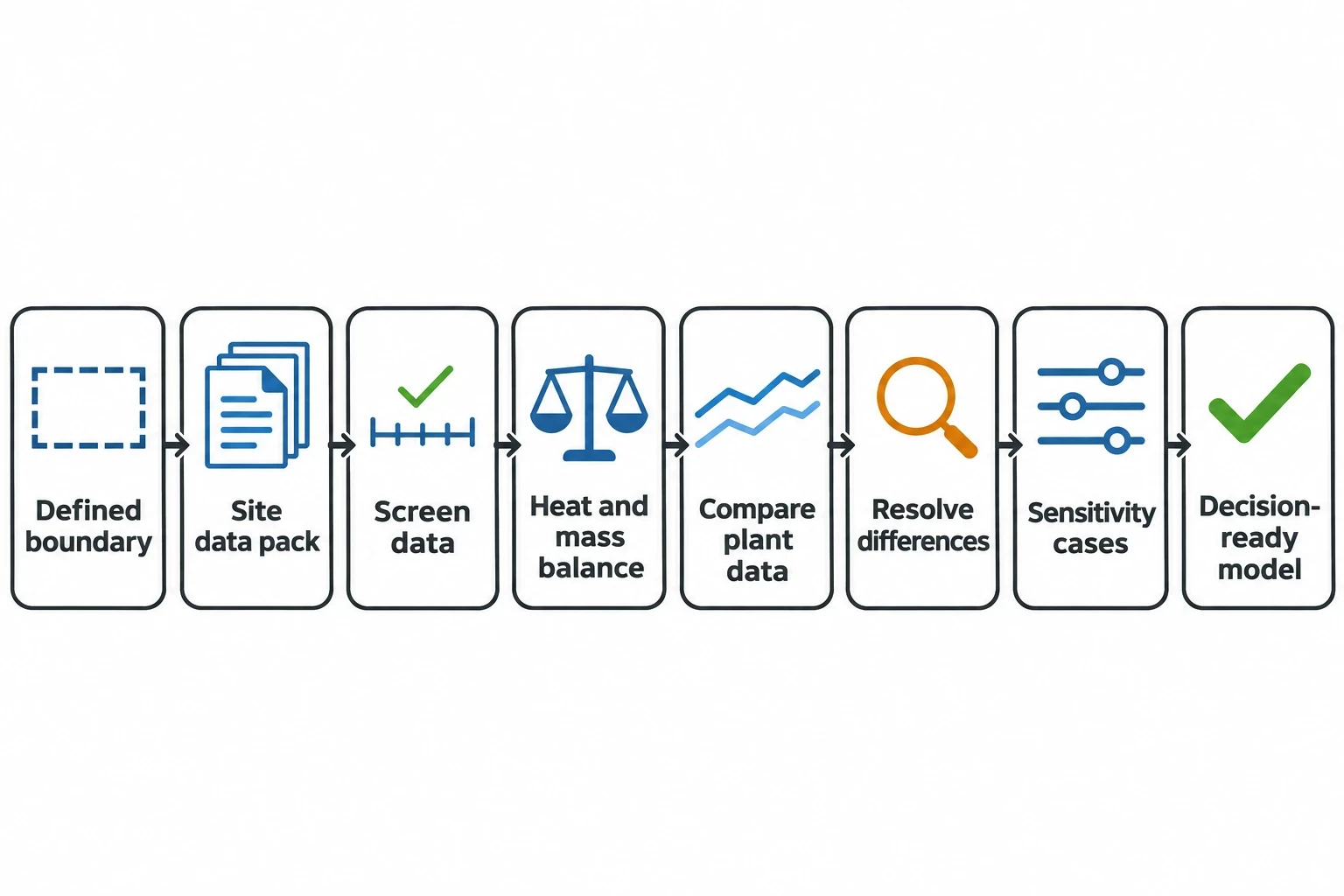
Start with an engineering data pack
A model should begin with a defined boundary and data pack, rather than software selection. The key records are often already held by the site:
- Current P&IDs and utility drawings
- Equipment data sheets and operating manuals
- Production records by product and line speed
- Laboratory moisture, solids and yield data
- Historian trends for temperature, pressure, flow and level
- Gas, electricity, steam, water and refrigeration-meter data
- Boiler logs, condensate records and water-treatment information
- HACCP plans, critical limits and change-control requirements
Historical data needs screening. Meter periods must align with production data. Instrument ranges, calibration status and sampling intervals require checking. A balance cannot close reliably if the plant has mixed monthly gas consumption with one hour of process temperatures.
Validate before optimising
Model validation compares calculated results with independently measured plant data. It should cover more than one variable. A dryer model that matches gas use but misses final moisture may be compensating for an incorrect airflow, product-water or loss assumption.
Useful validation checks include product flow, solids or moisture, measured temperatures, steam flow, condensate flow, fuel use, cooling duty and stack conditions. Differences should be documented, investigated and resolved where they matter to the decision.
Once the base case reflects production, engineers can run controlled sensitivity cases. Each case should state the proposed change, the assumptions held constant, the quality and HACCP constraints, and the outcome measures.
Select the simplest model that answers the decision
A full dynamic model is not required for every project. A steady-state heat and mass balance is often the right starting point for a heat-recovery screening study, oven energy audit or initial equipment-sizing exercise.
Dynamic modelling becomes proportionate where time-dependent behaviour creates material risk or uncertainty. Common triggers include:
- Thermal processes with defined time-temperature controls
- Repeated utility-pressure excursions
- Frequent product or throughput changes
- Significant tanks, holding sections or thermal inertia
- Batch sequencing conflicts
- New control strategies
- Plant modifications that affect established HACCP controls
Process simulation platforms such as Aspen Plus, Aspen HYSYS and DWSIM can support this work where their property methods, unit-operation representations and dynamic capabilities suit the duty. The engineering specification, data quality and validation plan remain more important than the software name.
A practical modelling route for food and beverage plants
EnerTherm Engineering’s heat and mass-balance methodology can structure the work from site evidence to an actionable design basis. The sequence should retain food safety and product requirements as design constraints throughout.
Define the operating question
The first task is to state the decision in measurable terms. Examples include reducing oven gas consumption while holding final moisture within specification, determining whether an existing steam header can support a new cooker, or testing whether a heat-recovery scheme affects process-water temperature.
The project team should define the product, throughput, quality parameters, utility boundaries and HACCP-related constraints before building the model.
Develop the single source of truth
The core deliverable is a Process Flow Diagram with consistent stream data. It should show material and utility streams, temperatures, pressures, flow rates, energy duties and known losses. Sankey energy mapping can then show where thermal input reaches the product, leaves in exhaust or condensate, or dissipates through equipment and distribution systems.
This gives production, engineering, quality and utilities teams a common reference. It also prevents project proposals from relying on incompatible numbers from different reports.
Test changes and protect the operating envelope
Each proposal should be assessed against the validated model, then reviewed against product specification, HACCP controls, operability and maintenance requirements. The resulting decision may be a capital project, a control adjustment, a revised operating procedure or a further measurement campaign.
This article reflects the independent analysis and editorial opinion of EnerTherm Engineering. Product names, trademarks, and brands mentioned belong to their respective owners. EnerTherm Engineering is not affiliated with, endorsed by, or a licensee of any third-party software or product mentioned unless explicitly stated.

Managing Director — EnerTherm Engineering
Dr. François Pierrel is Managing Director of EnerTherm Engineering with over two decades of expertise in thermal design, heat transfer, and industrial energy optimisation. He holds a PhD in Heat Transfer from Cranfield University and a Post-Doctorate from Heriot-Watt University.
