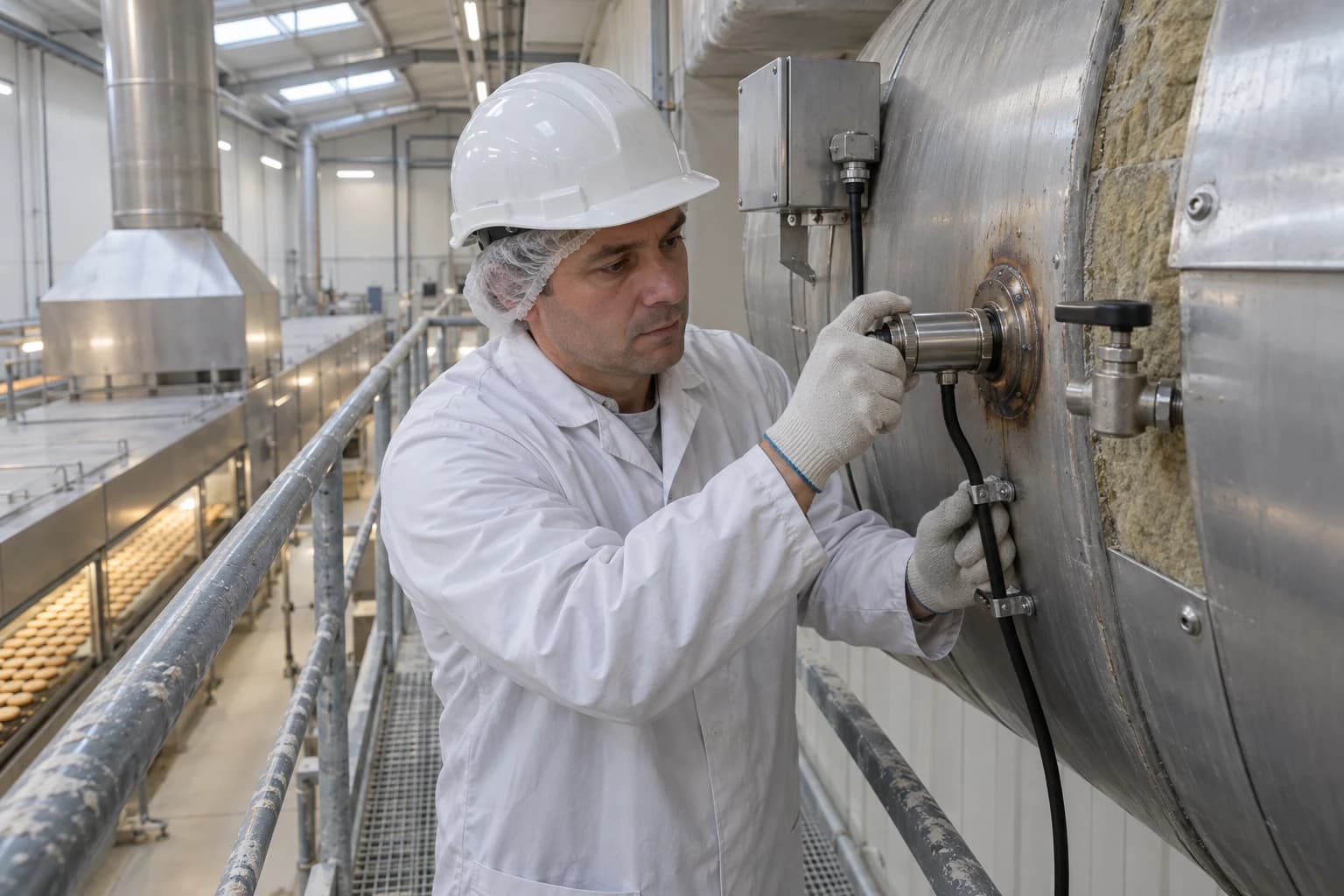
Moisture Balance Calculations Industrial Dryer Control
A dry-solids balance reconciles feed moisture, water removal and exhaust-air data.
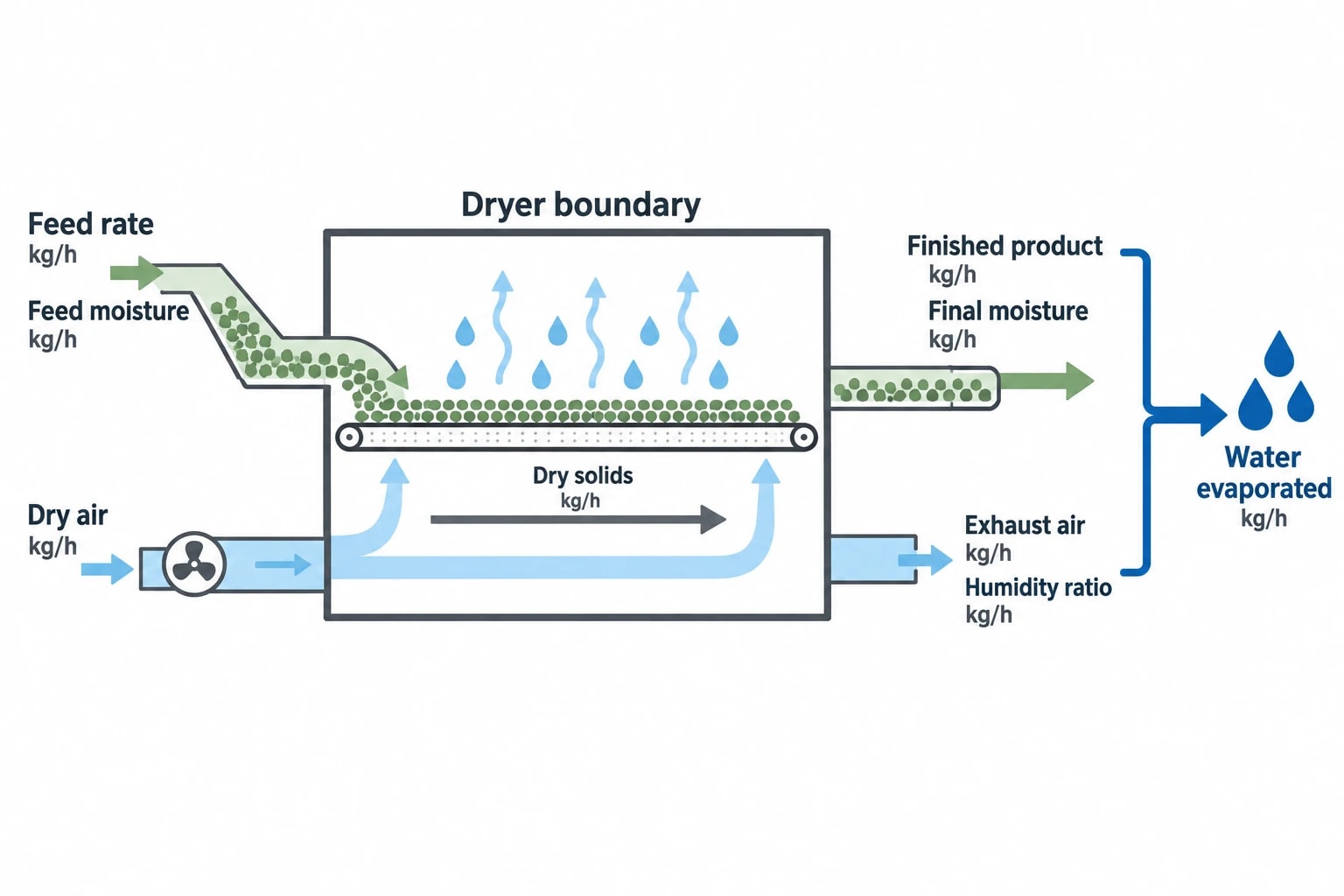
A moisture balance calculation for an industrial dryer is a conservation-of-mass calculation that quantifies water entering with feed, leaving in finished product and leaving in exhaust air.
It gives bakery, snack and dairy plants a defensible water-removal rate in kg/h. This provides the reference needed to diagnose excess fuel use, variable final moisture and restricted throughput before changing oven temperature, belt speed, fan speed or residence time.
A biscuit line can process the same nominal recipe while inlet dough moisture shifts with flour, fat or ambient conditions. A snack dryer can receive uneven belt loading after an upstream change. A dairy spray dryer can see powder moisture drift while burner duty appears stable. In each case, a moisture balance separates the water load from the operating response.
The most useful balances use dry solids as the reference basis. Product water changes through the dryer, while dry solids should remain constant across a properly defined boundary, apart from measured losses, fines recovery and material deliberately added or removed. This makes the calculation suitable for routine production data and detailed engineering studies.
Why moisture balance calculations matter in industrial dryers
Water removal defines the drying duty
Evaporation is usually the largest useful thermal load in a food dryer. Higher feed moisture and throughput both increase the water that must leave the product. A dryer can therefore require more heat and air-side moisture capacity even when temperature setpoints, fan speed and fuel firing rate remain unchanged.
Final moisture gives a quality result, but does not quantify how it was achieved. A product can meet specification while excess exhaust flow, leakage or over-ventilation wastes heated air. Equally, stable exhaust temperature can hide a rising water load until final moisture exceeds target.
The moisture balance expresses the task as kg of water evaporated per hour. Engineers can compare that value directly with:
- Feed rate and feed moisture
- Finished-product rate and moisture
- Exhaust-air flow and humidity ratio
- Fuel, steam and electrical consumption
- Zone temperatures and residence time
- Fines captured by cyclones, filters or extraction systems
It gives different teams one operating reference
Production teams generally work from tonnes per hour and line availability. Quality teams monitor moisture, texture, colour, water activity or powder characteristics. Maintenance teams see damper position, fan speed, burner behaviour and filter condition. Utility teams see gas, steam and electricity totals.
A moisture balance joins these datasets around a single physical duty. Its value increases when the calculation records the process boundary, recipe, measurement period, product-moisture method and operating mode. This avoids comparing a laboratory wet-basis moisture result with a dry-basis calculation, or a steady production run with a shift that includes warm-up and cleaning.
It identifies the real throughput constraint
A dryer reaches its limit when one or more constraints restrict water removal. The limiting factor may be available heat input, dry-air flow, exhaust-air moisture pickup, product distribution, air velocity, residence time or a product-quality boundary.
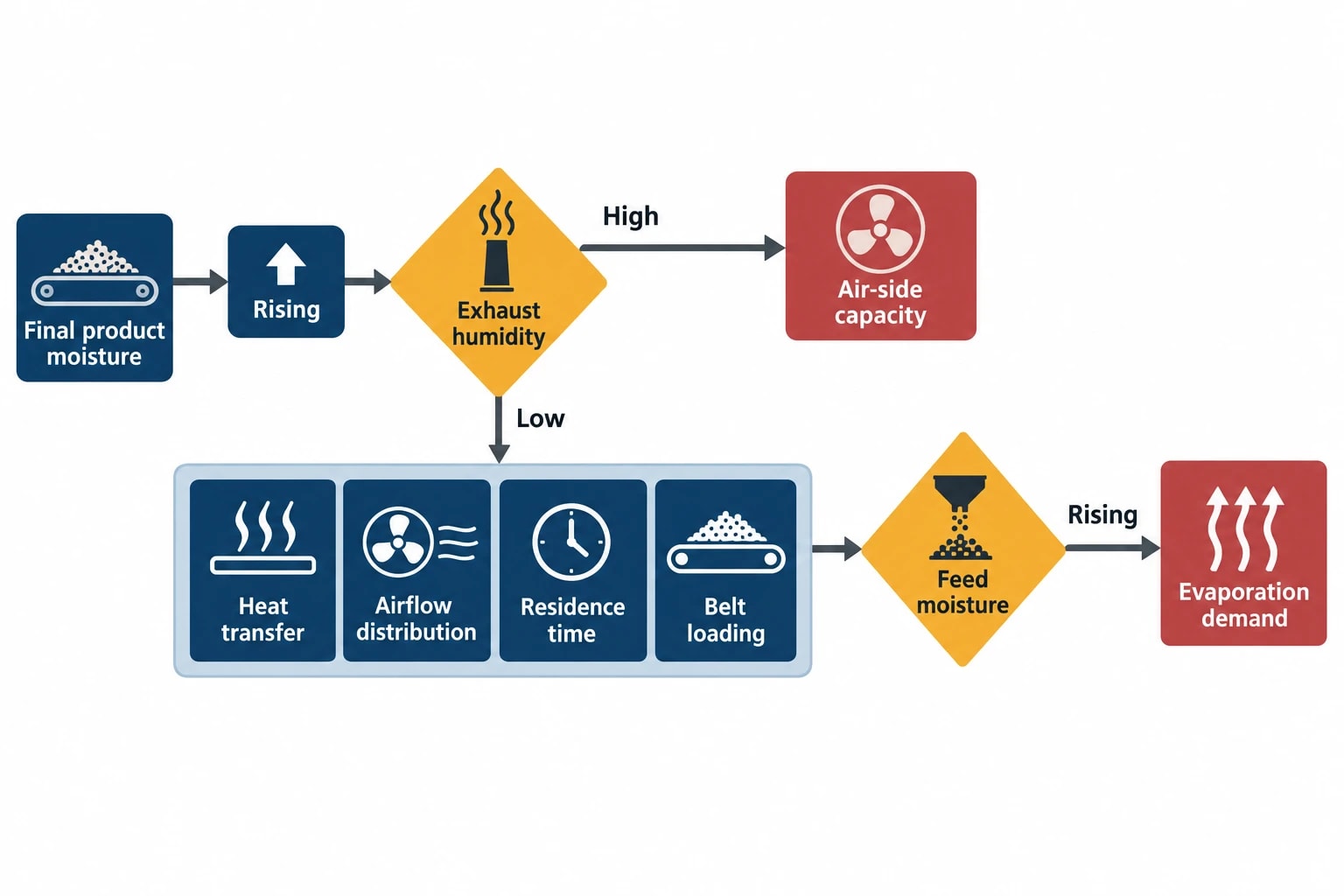
The calculation narrows the investigation. A rising feed-water load paired with high exhaust humidity can point to limited air-side capacity. Low exhaust humidity and rising final product moisture can indicate insufficient heat transfer, poor air-product contact, short residence time or uneven loading. These problems need different corrective actions.

Map every energy and material flow in your process with detailed heat and mass balance calculations — the foundation for any optimisation or design project.
Build an industrial dryer moisture balance on a dry-solids basis
State wet-basis and dry-basis moisture clearly
Food specifications commonly report wet-basis moisture: the mass of water divided by total wet product mass.
Dry-basis moisture is the mass of water divided by dry-solids mass. It is useful for drying calculations because dry solids provide a stable reference through the dryer. Very wet feeds can have dry-basis moisture above 100%, which remains a valid expression of water mass relative to dry solids.
For a continuous dryer at steady state, dry-solids flow is calculated from feed and product measurements:
S˙=F˙(1−MF)=P˙(1−MP)Here, S˙ is dry-solids flow in kg/h, F˙ is wet feed flow in kg/h, P˙ is finished-product flow in kg/h, and MF and MP are inlet and outlet moisture fractions on a wet basis.
This mass balance assumes no dry-solids losses across the selected boundary. Where crumbs, powder or fines leave the main product stream, their measured solids must appear as additional outlet streams.
Convert moisture results before calculating evaporation
The dry-basis moisture content is:
X=1−MMHere, X is dry-basis moisture in kg water per kg dry solids, and M is wet-basis moisture fraction.
The product-side evaporation rate then follows from dry-solids flow and the change in dry-basis moisture:
W˙evap=S˙(XF−XP)Here, W˙evap is evaporated water in kg/h, while XF and XP are inlet and outlet dry-basis moisture contents.
Consider an illustrative snack line receiving 1,000 kg/h of feed at 28% wet-basis moisture and producing finished product at 5% wet-basis moisture.
| Item | Value |
|---|---|
| Feed rate | 1,000 kg/h |
| Water in feed | 280 kg/h |
| Dry solids in feed | 720 kg/h |
| Finished-product rate | 757.9 kg/h |
| Water in finished product | 37.9 kg/h |
| Calculated water evaporated | 242.1 kg/h |
The dryer must remove approximately 242 kg/h of water under these conditions. If feed rate rises by 10% without a change in inlet or outlet moisture, required evaporation also rises by 10%.
Define a process boundary that matches the equipment
The process boundary should include every material stream that crosses it. For a continuous oven or belt dryer, this commonly covers product feed, finished-product discharge, supply air, exhaust air and dust collection. A spray-dryer study may also include atomiser feed, powder discharge, cyclones, bag filters and fines return.
A practical boundary record should identify:
| Inlets | Outlets |
|---|---|
| Wet feed | Finished product |
| Makeup air | Exhaust air |
| Recycled fines or powder | Captured fines or powder |
| Direct-fired combustion products, where relevant | Condensate or drainage, where relevant |
| Washdown water where it affects the test period | Purge streams |
Fines matter. Powder loss through an extraction system changes the dry-solids balance and can make a correct moisture result appear incorrect. Condensation in exhaust ducting or accumulated water in a filter can also distort a short test if it crosses, or is temporarily stored within, the selected boundary.
Reconcile calculated evaporation with exhaust-air moisture pickup
Use humidity ratio for the air-side balance
Relative humidity depends on temperature. It is useful for judging proximity to saturation, but does not quantify the mass of water carried by an air stream.
The air-side calculation uses humidity ratio, expressed as kg water vapour per kg dry air. Industrial-drying guidance from ASHRAE describes moisture pickup as the difference between inlet and exhaust humidity ratio, related to dry-air flow and the rate of water evaporated from the material.
For a once-through system, or a balance based on net dry-air flow leaving the dryer:
W˙evap=m˙da(ωex−ωin)Here, W˙evap is evaporated water in kg/h, m˙da is dry-air flow in kg dry air/h, and ωex and ωin are exhaust and inlet humidity ratios.
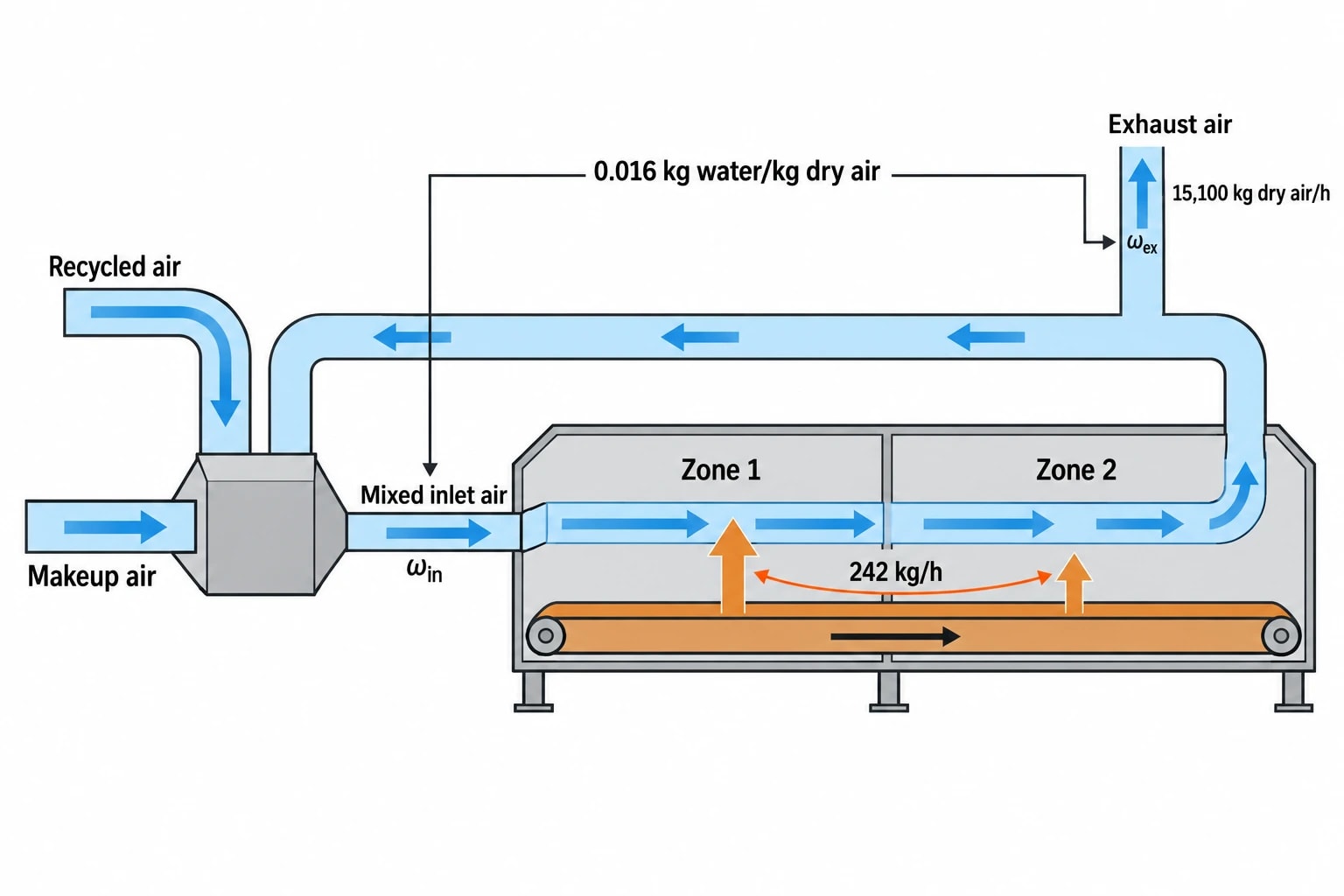
If the product-side balance calculates 242 kg/h of evaporation and measured exhaust dry-air flow is 15,100 kg dry air/h, the expected net humidity-ratio increase is approximately 0.016 kg water per kg dry air. Exhaust-air measurements should be plausible against that result.
Treat recycle air as a separate stream
Recirculation improves thermal efficiency by returning heated air to the dryer, but changes the inlet condition seen by the product. The relevant inlet humidity ratio is the mixed-air condition after makeup air and recycled air combine.
A simple air-side calculation that compares exhaust humidity with outdoor-air humidity can overstate available moisture pickup in a recirculated dryer. Engineers should record recycle-flow rate where available, or calculate it from fan and damper data, then establish the supply-air state entering the drying zones.
This matters in multi-zone ovens. A zone may receive air that has already collected moisture from product upstream. Zone temperature can remain on setpoint while the zone has less capacity to remove additional water.
Measure representative air conditions
Exhaust-air validation depends on measurement quality. Sensors should sit where the gas stream is sufficiently mixed and where condensation, dust deposition and fan swirl do not dominate the reading. A single point in a stratified duct may produce a misleading average.
A field test should capture synchronised values for:
- Wet feed rate and finished-product rate
- Inlet and final product moisture, with the laboratory method stated
- Dryer inlet-air temperature, humidity and pressure
- Exhaust-air temperature, humidity, pressure and flow
- Makeup-air temperature and humidity
- Fan speed, damper position and recirculation setting
- Burner duty, steam flow or other heat input
- Fines, powder, condensate and drainage streams crossing the boundary
The European Commission's ENTHALPY dairy project used measured mass and energy balance data from standard products to calibrate drying-tower simulation work. The same discipline applies at plant level: model results gain value only after measured streams reconcile within understood uncertainty.
Map every energy and material flow in your process with detailed heat and mass balance calculations — the foundation for any optimisation or design project.
Diagnose a moisture-balance gap before altering dryer settings
Reconcile solids before reconciling exhaust air
A gap between product-side evaporation and air-side moisture pickup does not prove poor dryer performance. It commonly indicates a measurement problem, an unrecorded stream or a boundary that does not match the process.
Start with dry solids. Confirm feed-rate calibration, finished-product mass, samples, fines capture and rejects. Then reconcile water entering and leaving with the product before comparing calculated evaporation with exhaust-air moisture pickup.
This order prevents air-flow changes from concealing a feed-rate or sampling error.
Check common sources of disagreement
The following issues frequently create an apparent imbalance:
- Moisture results reported on different bases
- Laboratory samples that miss variation across belt width or through a powder batch
- Load-cell drift or inconsistent production-rate timestamps
- Exhaust humidity instruments affected by condensation or dust
- Inaccurate duct-area, velocity or pressure measurements
- Air leakage into the dryer or downstream ductwork
- Unmeasured fines, crumbs or powder losses
- Water temporarily retained in ducts, filters or equipment during a short test
- Changes in recycle ratio during the measurement period
A stable measurement window is more valuable than a long production dataset containing recipe changes, line stoppages, warm-up, washdown or product transitions. For continuous equipment, select a period with consistent feed rate, steady fan operation and enough product samples to represent the process.
Report uncertainty honestly
Food plants often use moisture results, flow estimates and production records collected for different purposes. A balance should report methods and tolerances rather than imply false precision.
For example, a calculated evaporation rate of 242.1 kg/h may be presented operationally as approximately 242 kg/h if feed-meter accuracy, moisture repeatability and exhaust-flow estimates cannot support decimal precision. The objective is a dependable decision boundary, not a spreadsheet result with excessive digits.
Use moisture balance calculations for industrial dryer control
Control against water load and product outcome
Exhaust temperature is a useful operating indicator, but cannot define final product moisture by itself. Feed moisture, belt depth, air velocity, product distribution and residence time may change while exhaust temperature remains within a narrow range.
A stronger control approach uses final product moisture as the outcome, with calculated water load and exhaust moisture pickup as context. Operators can then distinguish between a feed change and a dryer limitation.
If feed moisture rises, the balance should show higher evaporation demand. If final moisture rises while exhaust humidity remains low, the line may need more heat transfer, better airflow distribution, more residence time or a change in belt loading. If final moisture rises with high exhaust humidity, air-side moisture-carrying capacity may be limiting.
Compare energy against evaporated water
Gas, steam or electricity per tonne of finished product can move because feed moisture changes. A line can appear more efficient per tonne of saleable product while consuming more energy per kg of water removed.
Specific energy consumption expressed against evaporated water provides a more relevant comparison:
- Fuel or steam per kg of water evaporated
- Electricity per kg of water evaporated
- Total thermal energy per kg of water evaporated
Use the same period for utilities and moisture data. Meter totals that include idling, cleaning, upstream cooking or adjacent equipment require allocation before comparison with dryer evaporation.
The moisture balance anchors the energy balance, separating latent heat for evaporation from sensible heating of product and air, exhaust losses, surface losses and unburned or untransferred heat.
Protect product consistency while testing changes
A dryer adjustment can reduce utility consumption while damaging product consistency. Bakeries may see changes in texture, colour, breakage or shelf-life performance. Snack plants may find that average moisture meets target while product varies across belt width. Dairy operations may need to consider powder moisture alongside bulk density, particle condition and downstream storage behaviour.
Each trial should retain product sampling that represents belt position, process time, recipe and production rate. The moisture-balance result should sit alongside the site’s validated quality and food-safety controls, rather than replace them.
Turn the calculation into an engineering decision
Establish a repeatable baseline
A useful moisture-balance campaign begins with a current process flow diagram, a line walkdown and an agreed boundary. Teams then gather synchronised data during stable operation, record material and air streams, and reconcile product-side evaporation with air-side moisture pickup.
The final report should show dry-solids flow, feed-water flow, product-water flow, calculated evaporation, exhaust moisture pickup, reconciliation difference and the uncertainty associated with each significant measurement. An embedded stream table makes the calculation auditable during later trials.
Test targeted operational changes
Once the baseline is credible, teams can assess revised exhaust flow, recirculation settings, improved sealing, adjusted zone temperatures, altered belt loading, feed conditioning and exhaust-heat recovery.
Each change should be assessed against required evaporation rate, final product moisture, quality checks and available utility capacity. The calculation turns an operational idea into a measurable test: whether the dryer removes the required water at the required product condition and energy input.
This article reflects the independent analysis and editorial opinion of EnerTherm Engineering. Product names, trademarks, and brands mentioned belong to their respective owners. EnerTherm Engineering is not affiliated with, endorsed by, or a licensee of any third-party software or product mentioned unless explicitly stated.

Managing Director — EnerTherm Engineering
Dr. François Pierrel is Managing Director of EnerTherm Engineering with over two decades of expertise in thermal design, heat transfer, and industrial energy optimisation. He holds a PhD in Heat Transfer from Cranfield University and a Post-Doctorate from Heriot-Watt University.
