Why Compressed Air Leaks Cost Food Plants Up to 30%
Carbon Trust findings support leak checks every three months with food-air controls.
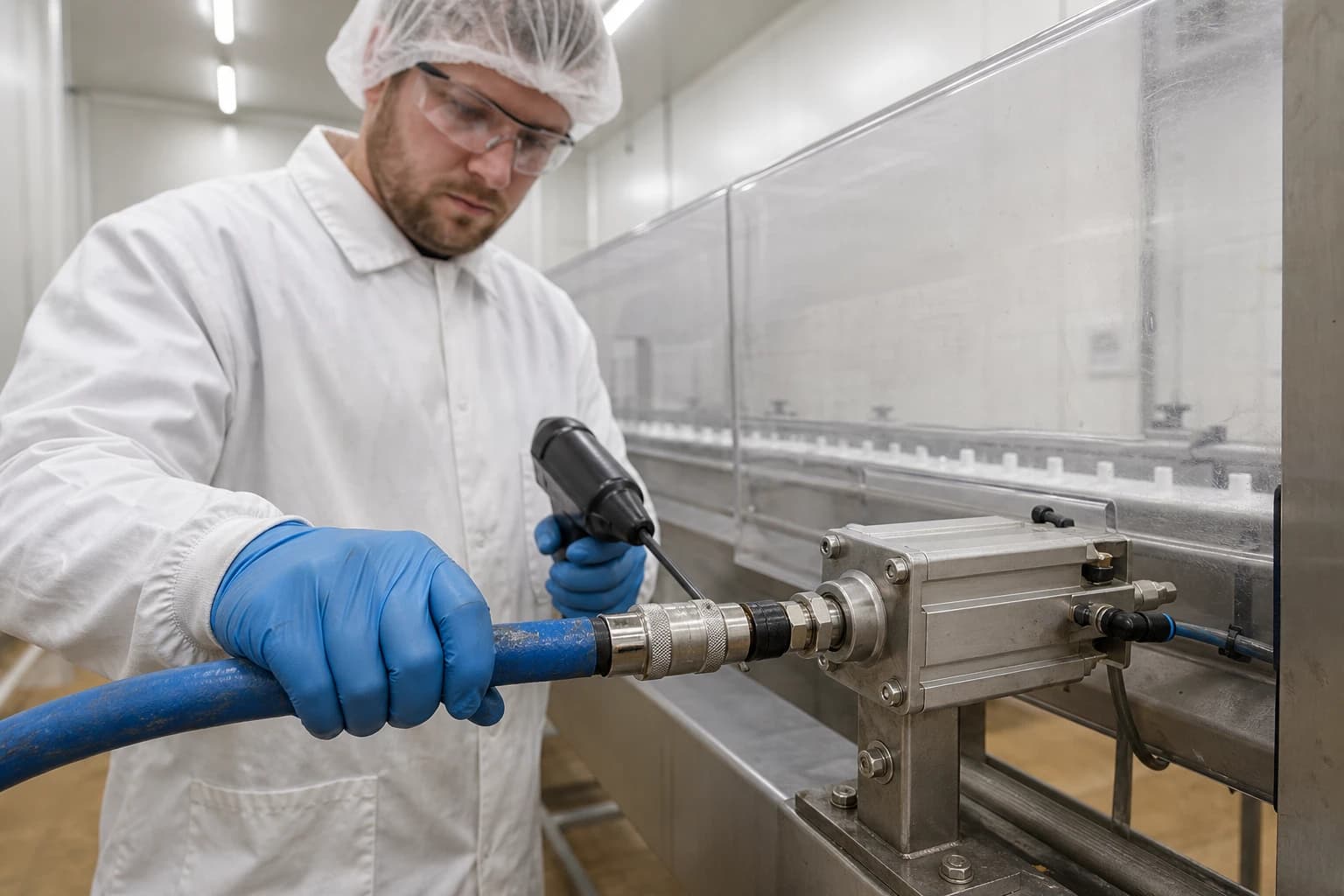
Compressed air efficiency in food plants means delivering the required volume, pressure and air purity to each process with the least practicable electrical energy. Carbon Trust guidance reports that industrial sites can lose up to 30% of compressed air through leakage. For a food factory running compressors across long shifts, that loss adds electricity costs, compressor wear and avoidable pressure instability.
Leaks are easy to dismiss. A faint hiss at a quick coupling, a worn actuator seal or a damaged flexible hose may not stop a bakery oven, filler or packing line. Yet leaks run continuously while production is live and can continue through breaks, sanitation windows and overnight standby. The compressor must replace air that performs no useful process work.
Food and beverage manufacturers face an added constraint. Compressed air may power actuators in hygienic zones, blow containers, move product, operate valves or contact packaging and food. Any leak-reduction programme must preserve production reliability and air-quality controls. The strongest projects treat leakage, pressure and purity as one engineering problem.
Why compressed air efficiency in food plants matters
Compressed air is a high-cost utility because electricity drives compression, cooling, drying and distribution. Its flexibility explains its widespread use on filling, conveying, packing and process-control equipment.
That flexibility can hide waste. An open blow-off, permanent leak or excessive header pressure can appear as normal background demand in the compressor room. Maintenance teams may respond to poor pressure at a remote machine by raising the compressor setpoint. This increases energy consumption and sends more air through the same leaks.
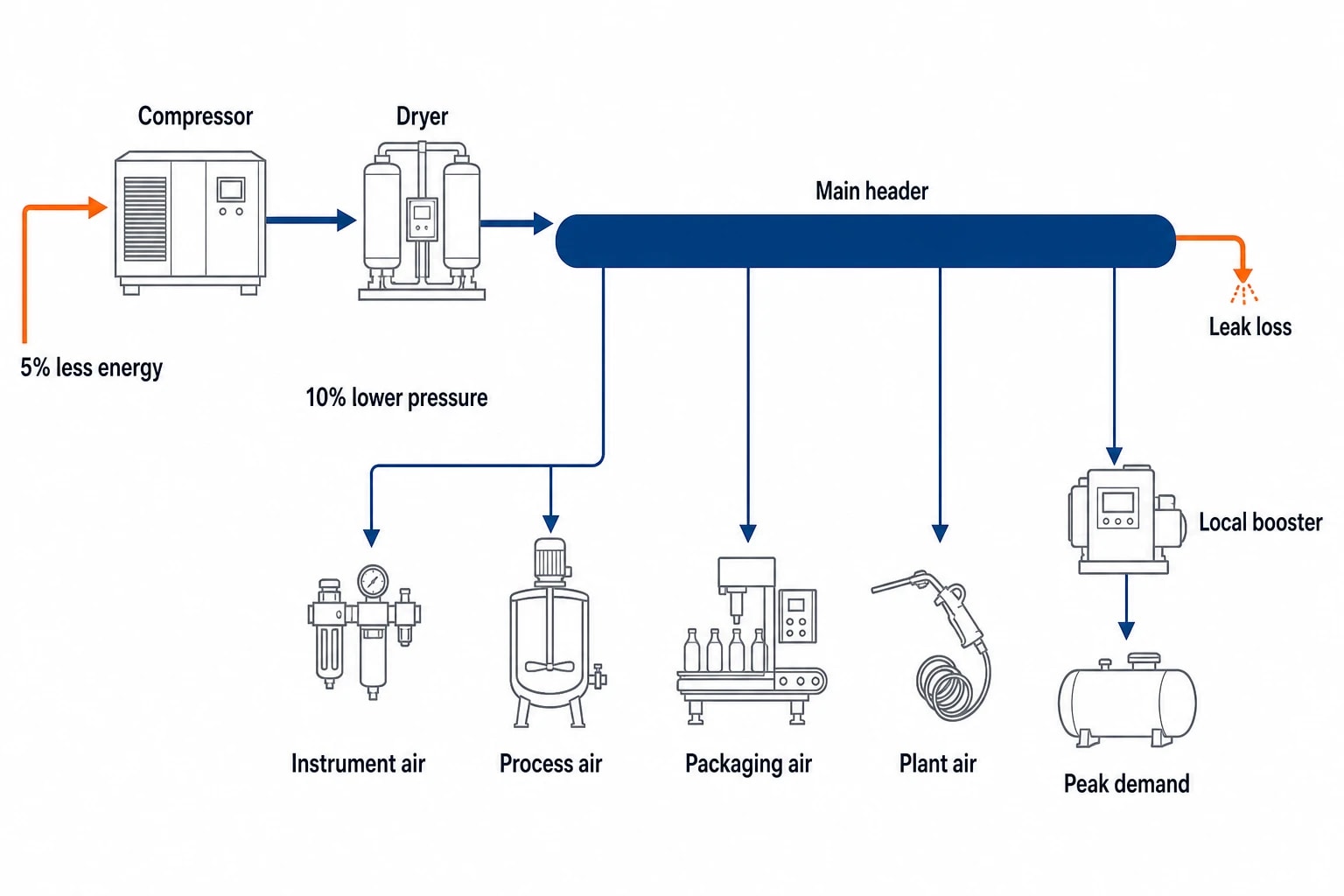
Carbon Trust guidance states that a 10% reduction in compressor discharge pressure can cut energy use by 5%. Engineers must first establish the minimum pressure required at each point of use. Lowering a header setpoint without understanding remote pressure loss can create nuisance trips, slow cylinder movements and reduced line performance.
Food plants often have several distinct compressed-air demands:
- Instrument air for control valves and actuators.
- Process air used to move, dry, aerate or protect product.
- Air for bottle blowing, packaging and pneumatic handling.
- General plant air for maintenance tasks.
- Short-duration, high-flow demand from cleaning or blow-off points.
Each demand needs a clear pressure and purity specification. A single high-pressure or high-purity application should not dictate the condition of the whole distribution network where a local solution would be more suitable.
The cost is larger than the leak itself
A leak creates a volume loss, but its effects can spread across the compressed-air system. As pressure falls during peak demand, a compressor may load more frequently or a standby compressor may start. In fixed-speed systems, this can leave a large compressor running at low useful demand.
Leakage also contributes to unstable pressure at production equipment. Teams sometimes compensate by increasing regulator settings, widening pressure bands or installing a larger compressor. These measures can conceal the root cause while increasing energy consumption.
Carbon Trust guidance states that a well-maintained compressor can be 10% more efficient than a poorly maintained one. Leak repair, filter maintenance, condensate management and compressor controls therefore belong in the same utility strategy.
Identify where your plant is losing energy and quantify the savings potential — our audits map every heat source, sink, and waste stream in your facility.
Where food plants lose compressed air
Leaks occur at joints, fittings and moving components. Food factories add washdown exposure, frequent format changes, vibration and equipment cleaning, all of which can accelerate deterioration.
Common leak points in bakeries, dairies and bottling halls
Typical survey findings include:
- Quick-release couplings and hose tails.
- Damaged flexible hoses on mobile equipment.
- Worn pneumatic cylinder seals.
- Solenoid valve manifolds and valve stems.
- Threaded joints, regulators and gauges.
- Filter housings, drains and condensate traps.
- Isolation valves that no longer seal fully.
- Redundant pipework left pressurised after line changes.
- Blow-off nozzles left continuously open.
In bakeries, flour dust can obscure fittings and make minor leaks difficult to hear. Dairies and meat plants may expose equipment to regular washdown and temperature swings. Beverage sites often have long distribution networks serving fillers, labellers and palletising equipment. These conditions make a repeatable survey more valuable than an occasional walk-round.
Inappropriate air use adds to the base load
A compressed-air audit should distinguish genuine leakage from deliberate but unnecessary consumption. Open blowing for cooling, product movement or cleaning can consume substantial air even where no pipework defect exists.
The Health and Safety Executive advises food businesses to avoid compressed-air cleaning except for non-dusty activities. In dusty food processes, the HSE recommends a fully earthed, centralised piped vacuum-cleaning system and identifies the Dangerous Substances and Explosive Atmospheres Regulations 2002 as the framework for assessing and controlling fire and explosion hazards.
This guidance is relevant to flour handling, sugar, starch and powdered ingredients. Compressed air can create dust clouds, disperse residues and increase cross-contamination risk. The Food Standards Agency also notes that compressed air can spread allergenic proteins and recontaminate equipment or adjacent clean areas. A process review should establish whether a vacuum, mechanical removal or enclosed cleaning method can replace air blowing.
How to detect compressed air leaks without disrupting hygiene
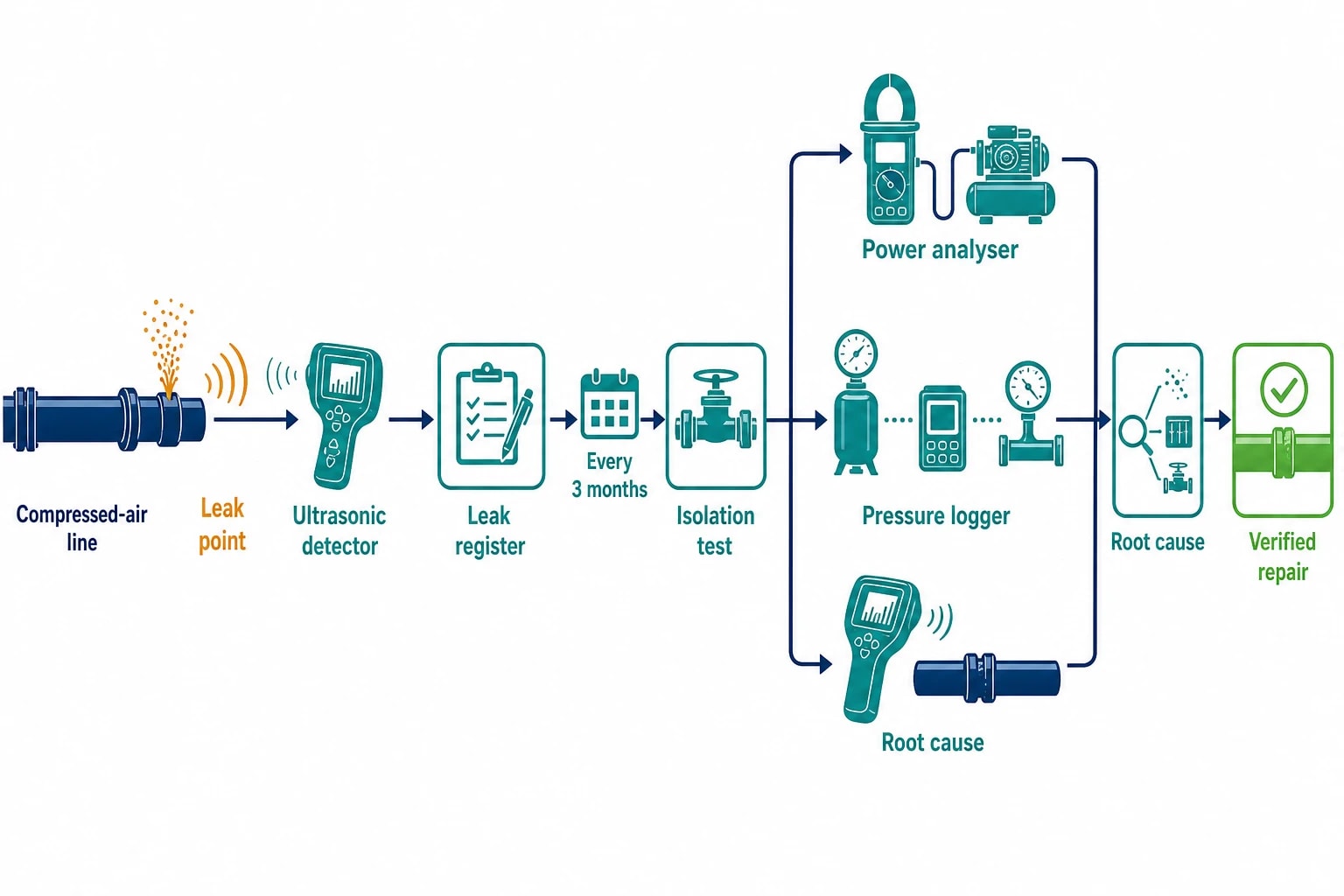
Leak detection need not wait for a shutdown. Carbon Trust guidance recommends a systematic, regular programme and suggests that a leak-detection exercise every three months may be appropriate. The interval should reflect site conditions, leak recurrence, production patterns and maintenance access.
Use ultrasonic detection during normal production
Ultrasonic leak detectors identify the high-frequency sound generated as air escapes through a restriction. They help teams find leaks in noisy compressor rooms, packing halls and production areas where machinery masks an audible hiss.
An effective survey records more than location. For each leak, the surveyor should capture:
- Asset and line identification.
- Exact component and fault type.
- Pressure at the local connection.
- Ultrasonic signal or estimated severity.
- Food-zone or hygiene classification.
- Access requirements and repair owner.
- Safe repair window and verification status.
Tagging leaks creates a visible maintenance backlog. A digital register makes the programme measurable, particularly where shift teams find defects between formal surveys.
Soapy water remains useful for accessible, isolated joints, but it is unsuitable as the sole method in a hygienic manufacturing environment. It can introduce liquid and residues near equipment, and it does not offer a practical way to survey extensive elevated pipework during operation. Teams should follow site hygiene rules and use approved methods in production areas.
Measure the system when it is quiet
A no-production or low-production test can reveal the scale of leakage. After confirming that legitimate compressed-air users are isolated, engineers can observe compressor loading, electrical power and pressure decay. This establishes a baseline for loss that persists when process demand has stopped.
The test must be planned with production, engineering and food-safety teams. Automatic drains, frost protection, control systems and safety-related actuators may need to remain supplied. The objective is to identify avoidable demand without affecting plant safety or product protection.
Portable power analysers can measure compressor electrical demand. Pressure loggers show control-band behaviour, receiver pressure and pressure at remote users. Ultrasonic measurements locate individual leaks. Together, these measurements prevent teams from fixing obvious leaks while missing a controls issue or pressure restriction that drives most energy use.
Pressure losses can erase leak-repair savings
Leak repair reduces demand, but pressure loss determines how much useful air reaches the line. A compressed-air system can have healthy compressor discharge pressure and still starve an actuator or filler because undersized pipework, loaded filters, poorly selected regulators or restrictive fittings reduce downstream pressure.
Establish the true minimum point-of-use pressure
The correct pressure target starts at the machine, not the compressor. Engineers should obtain the equipment manufacturer’s stated requirement, then measure pressure at the machine during its highest realistic demand. The result should include the pressure needed for reliable operation and an allowance for distribution loss that remains after repairs.
A pressure survey should compare:
| Location | What to measure | What the result can indicate |
|---|---|---|
| Compressor outlet | Pressure and control band | Excessive setpoint or poor control stability |
| After dryer and filters | Differential pressure | Treatment equipment restriction or maintenance need |
| Main header | Pressure during peak demand | Distribution capacity and compressor response |
| Remote production point | Minimum operating pressure | Pipe loss, regulator performance or local demand issue |
| Local receiver | Pressure recovery | Whether stored air supports short peak events |
Filter differential pressure deserves attention. Filters protect air quality, but poorly maintained elements create a permanent pressure penalty. A site should use the treatment required for its air quality, monitor the restriction it introduces and replace elements according to condition and manufacturer requirements.
Segregate high-pressure and high-purity demand
One demanding user can cause a plant to operate the whole distribution network at a higher pressure or purity than most users need. Options include local boosting, local storage, point-of-use filtration or a dedicated clean-air branch. Selection depends on validated process requirements, contamination risk and maintenance capability.
The principle also applies to redundant lines. Isolating unused pipework reduces the area where new leaks can develop. Zone valves allow maintenance teams to shut down part of a distribution network during a line stop while keeping the rest of the factory supplied.

Identify where your plant is losing energy and quantify the savings potential — our audits map every heat source, sink, and waste stream in your facility.
Food safety controls shape compressed-air optimisation
Energy reduction must not compromise the air specification needed for food, product-contact equipment or packaging. British Compressed Air Society guidance, BPG 102/1, revised in June 2022, addresses the safe and efficient use of food and beverage grade compressed air. It covers equipment, installation, maintenance, audit practice, prerequisite programmes and HACCP considerations for systems operating above 0.5 bar.
Specify air purity by risk and use
ISO 8573-1:2010 classifies compressed-air purity for particles, water and oil. The classification provides a common language, but it is not a blanket food-safety specification. Food manufacturers should determine the required quality from the air’s intended use, the likelihood of direct or indirect contact, process risk and their HACCP plan.
Air used solely to power an actuator outside a product zone may need a different specification from air that contacts food, product-contact surfaces or the internal surface of primary packaging. The same distinction affects sampling points, filtration, dryer selection and maintenance records.
A sound audit maps air users by function and hygiene risk before recommending changes to treatment equipment or pressure. This prevents overspecifying the whole distribution network while protecting applications that need more stringent control.
Retain statutory controls during system changes
The Pressure Systems Safety Regulations 2000 apply to compressed or liquefied gas, including air, at more than 0.5 bar above atmospheric pressure. The HSE states that qualifying pressure equipment needs a written scheme of examination before use and examination in accordance with that scheme.
Any project involving receivers, protective devices, compressor controls or distribution pipework must consider the written scheme, inspection duties and the competent person’s requirements. A leak programme can cause little disruption, but repairs still require isolation, depressurisation and safe reinstatement.
Food-safety and engineering records should meet at the same point. A changed filter, new regulator setting or altered air branch can affect energy performance and contamination control. Recording the change, its reason, its verification and its effect on the HACCP assessment makes later investigation easier.
A practical energy-audit programme for compressed air
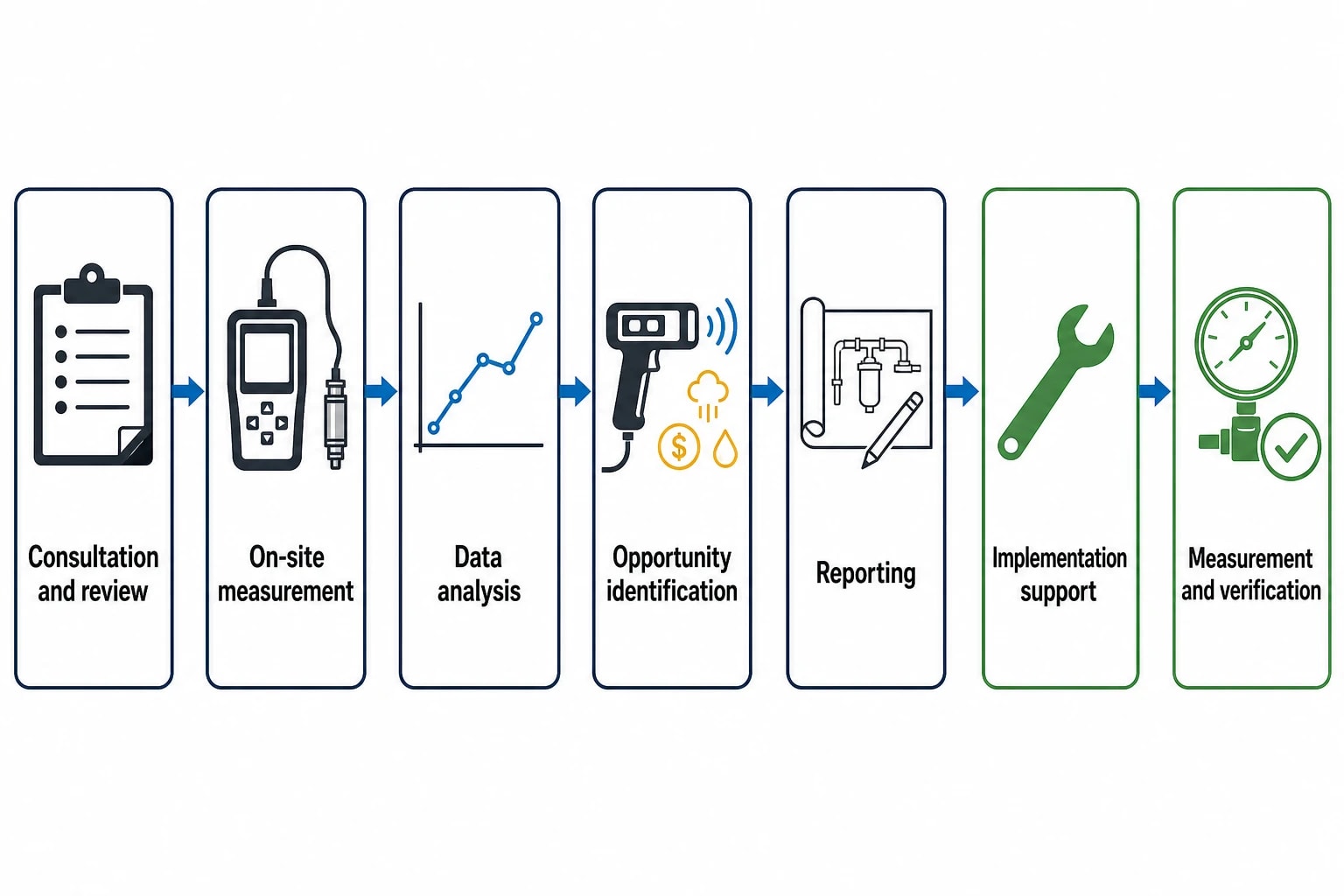
A useful audit turns field observations into an ordered repair and investment plan. EnerTherm Engineering’s seven-step audit methodology begins with consultation and site review, then combines on-site measurement, data analysis, opportunity identification, reporting, implementation support and ongoing measurement and verification.
Start with a production-aware survey plan
The survey scope should identify the compressor room, dryers, receivers, headers, ring mains, drops and end users. It should also include shift patterns, planned sanitation, changeovers, seasonal production changes and known pressure complaints.
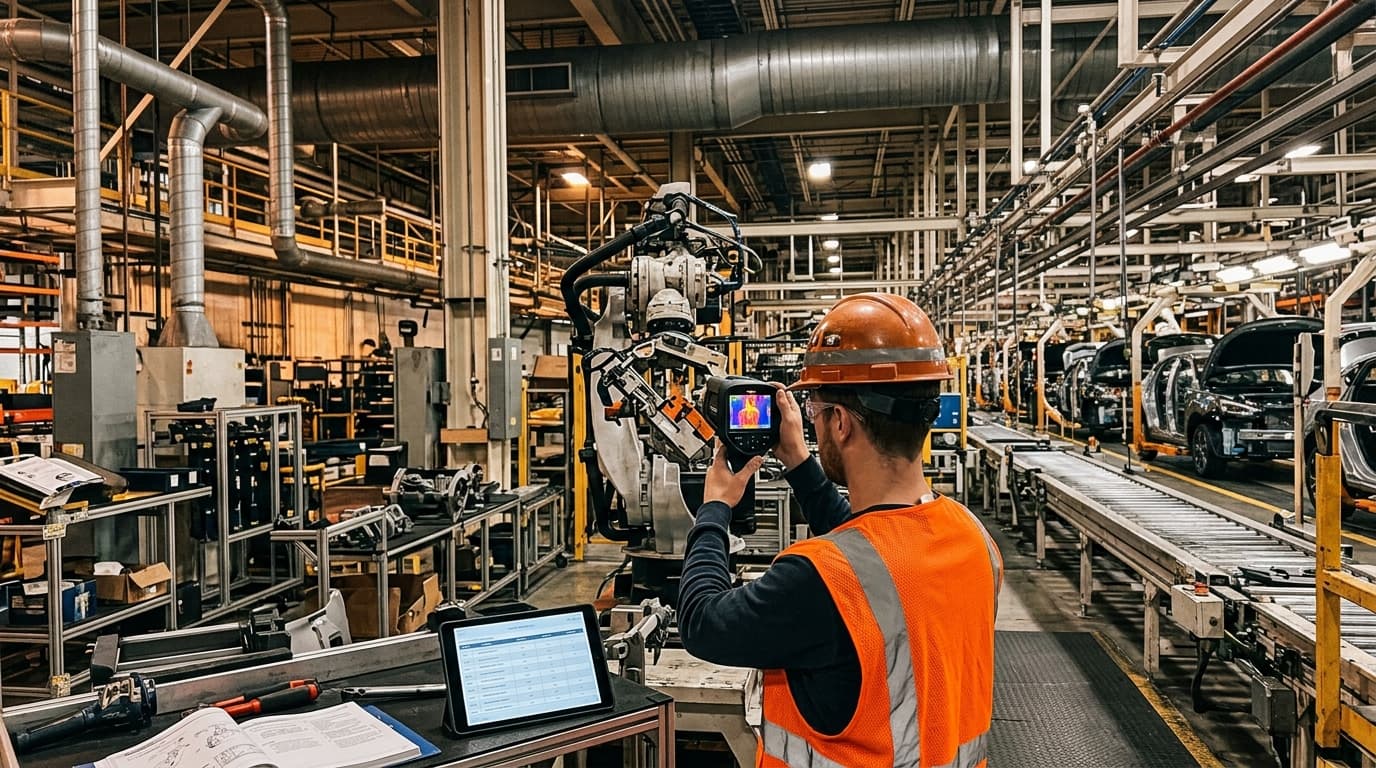
Portable instrumentation can capture electrical demand and pressure behaviour without intrusive work. Ultrasonic detection identifies leaks while lines run. Thermal imaging can support broader utility checks, including electrical connections and heat loss around adjacent thermal assets. The audit team should agree access rules with hygiene, operations and maintenance staff before entering production areas.
Prioritise actions by value and production risk
The first report should separate immediate repairs from projects that need engineering design. Typical priorities are:
- Repair confirmed leaks at couplings, hoses, valves and cylinders.
- Isolate unused pipework and out-of-hours zones.
- Remove inappropriate blow-off uses where a safer or lower-energy method is suitable.
- Replace restricted filters and correct faulty drains.
- Reduce header pressure in controlled steps after verifying point-of-use demand.
- Improve compressor sequencing and storage where logged demand supports the case.
- Create separate local solutions for exceptional pressure or purity requirements.
Each action should state its expected energy effect, production risk, hygiene implications, capital requirement and method of verification. This gives engineering managers a credible basis for maintenance planning and board-level investment decisions.
Maintaining savings after the leak survey
A one-off leak survey rarely holds its value unless the site assigns ownership for the next inspection cycle. New leaks emerge as seals wear, hoses move and equipment is modified. The maintenance system should treat compressed air as a measured utility, not an unlimited service.
Monthly review of compressor kWh, run hours, pressure profile and maintenance records can highlight a rising base load. Scheduled ultrasonic surveys provide a structured route to find and repair recurring defects. Production teams can report audible leaks, unstable cylinders and unnecessary blowing, while trained maintenance personnel decide the safe repair method.
Measurement and verification should compare post-repair performance with an appropriate baseline, allowing for changes in production volume, operating hours and ambient conditions. The International Performance Measurement and Verification Protocol provides a recognised framework for documenting that process.
This article reflects the independent analysis and editorial opinion of EnerTherm Engineering. Product names, trademarks, and brands mentioned belong to their respective owners. EnerTherm Engineering is not affiliated with, endorsed by, or a licensee of any third-party software or product mentioned unless explicitly stated.

Technical Manager — EnerTherm Engineering
John Naranjo is Technical Manager at EnerTherm Engineering, bringing specialist expertise in chemical and environmental engineering. He recently led the implementation of Omni Vision, EnerTherm's real-time energy and utility monitoring platform. He holds an MSc in Environmental Engineering from the University of Huelva and a BSc in Chemical Engineering, with memberships in both the Energy Institute and IChemE.
