Optimising Industrial Baking Performance with Heat Flux Mapping
The Challenge of Transient Heat Transfer in Baking
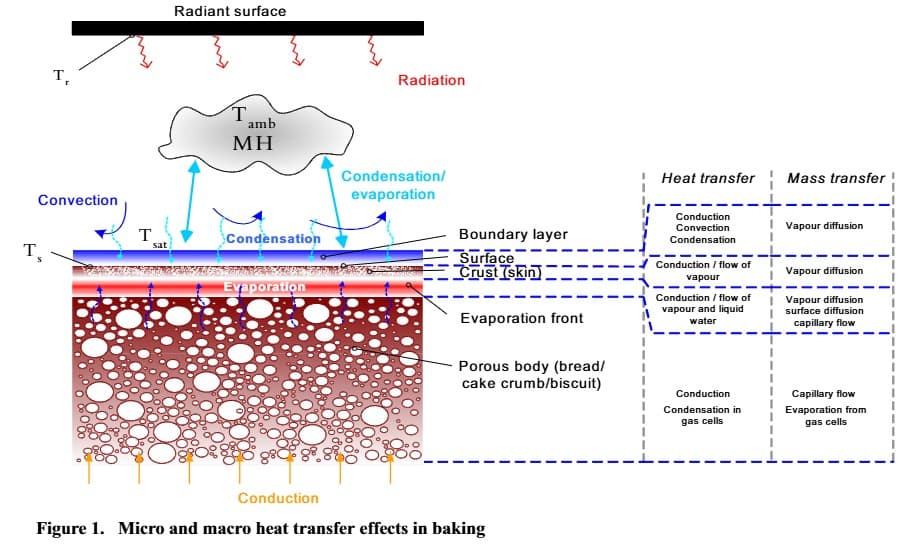
Achieving rapid throughput in industrial tunnel ovens often comes at the expense of product quality. Plant engineers frequently face the challenge of balancing excessive heat flux—which risks damaging product texture, colour, and moisture content—with the need for efficient production cycles. Conventional oven modelling often relies on steady-state assumptions, which fail to capture the complex, transient interactions between convection, radiation, conduction, and mass transfer that occur throughout the baking process.
This white paper presents a technical methodology for quantifying these interactions. By treating the baking process as a transient thermal problem, it is possible to define a "Baking Comfort Zone" (BCZ). This concept provides a visual and mathematical approach to mapping heat fluxes, allowing engineers to identify the optimal heating profiles that satisfy both product quality specifications and production efficiency targets.
What this white paper covers
The document provides a detailed examination of the physical mechanisms governing the baking process and the application of heat flux mapping, including:
- The physics of micro and macro heat transfer, covering the interplay between convective, radiative, and conductive fluxes, and the impact of latent heat during moisture evaporation.
- Methodologies for developing heat flux maps that account for the changing physical state of the product, including surface temperature and moisture content.
- An analysis of how specific oven settings, such as jet-impingement and infrared radiation (both near and far-wave), influence the boundary layer and thermal penetration.
- The theoretical basis for the Baking Comfort Zone, illustrating how to define the upper and lower limits of heat application for a consistent product output.
- Approaches for integrating real-time process monitoring into control systems to dynamically adjust oven conditions.


Key Research Findings
Using a high-performance research oven, the study demonstrates the feasibility of optimising heat application to significantly reduce process times without compromising quality.
- Research trials applying these mapping techniques to cake products achieved a 16.6 percent reduction in total bake time.
- The data illustrates how condensation flux dominates the initial phase of baking, typically accounting for the first 18 percent of the total process time.
- The study highlights the limitation of using simple energy balances, showing that radiation and convection are often secondary to the energy consumption required for water evaporation during the early stages of the bake.
Figure 5 in the paper displays the normalised heat flux distribution, demonstrating how various fluxes (conduction, convection, radiation, and condensation) evolve over the bake duration. This visual representation serves as a baseline for commissioning new ovens or diagnosing performance issues in existing production lines.
Who should read this
This paper is intended for process engineers, thermal design specialists, and R&D managers within the food manufacturing sector. It provides the technical foundation required to move beyond trial-and-error oven adjustments and implement data-driven control strategies for industrial baking operations.

Managing Director — EnerTherm Engineering
Dr. François Pierrel is Managing Director of EnerTherm Engineering with over two decades of expertise in thermal design, heat transfer, and industrial energy optimisation. He holds a PhD in Heat Transfer from Cranfield University and a Post-Doctorate from Heriot-Watt University.
