Redefining Safe Touch: Thermal Diffusivity in Personnel Protection Coatings
The Limitations of Current Surface Temperature Standards
In the oil, gas, and chemical sectors, the health and safety of personnel remain the primary operational priority. Current industry standards, specifically ASTM C1055-03, define burn hazards based on the relationship between surface temperature and contact time. These standards are widely used to establish a 60°C threshold for "safe to touch" surfaces.
However, this threshold is fundamentally derived from the thermal properties of bare metal. When applied to insulation coatings, this limit is often overly conservative. Insulation coatings possess distinct physical properties that alter heat transfer mechanics. Relying on simple surface temperature measurements fails to account for the actual risk of burn injury, frequently leading to unnecessary maintenance requirements or the premature rejection of viable coating systems.

What this white paper covers
This paper examines the physics of human burn hazards and redefines the "safe touch" criteria by incorporating the thermal diffusivity of materials. It provides an engineering framework to evaluate coating performance beyond simple surface temperature readings.
- The mechanics of human skin contact and the distinction between surface temperature and skin temperature.
- The role of thermal diffusivity (the ratio of thermal conductivity to volumetric heat capacity) in predicting heat transfer rates.
- A comparison of measurement methodologies, specifically the difference between standard thermocouple readings and the more accurate thermesthesiometer.
- The application of finite element modelling to predict the required coating thickness for safe operation at elevated substrate temperatures.
- Experimental validation comparing theoretical models against real-world test data for acrylic-based insulation coatings.
Key findings and data analysis
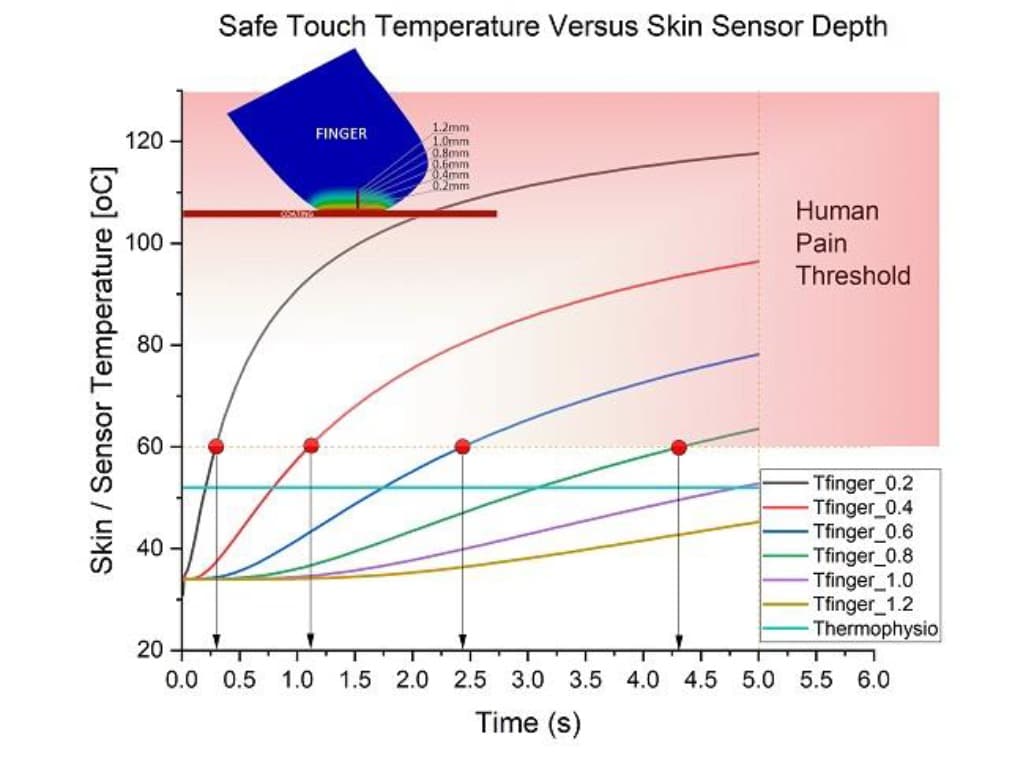
The research demonstrates that thermal diffusivity is the critical property for determining whether a surface is safe to touch. While bare metal reaches the pain threshold rapidly, insulation coatings with low thermal diffusivity significantly delay heat transfer. Figure 1 illustrates the established temperature-time relationship for burns, while Table 1 provides the thermal diffusivity constants for various common materials, highlighting why coatings perform differently than metal substrates.
The paper presents data from a 2mm insulation coating applied to steel. As shown in the study, variability in thermal properties—specifically the interplay between density, specific heat, and thermal conductivity—means that thermal diffusivity is not constant across all temperatures, as seen in Figure 4. The study reveals that a coating can exhibit a surface temperature higher than 60°C and still remain safe for contact.
Comparison testing highlights the discrepancy between measurement tools. In the analysis, while a thermocouple recorded surface temperatures exceeding 70°C on a coated substrate, the thermesthesiometer—which mimics human skin response—remained below the 60°C safety limit. Figure 6 details these results, validating that the coating effectively protects against burns even when surface temperatures suggest otherwise. Figure 7 further confirms that model predictions align with thermesthesiometer readings, allowing for accurate thickness specification to ensure safety at operating temperatures reaching 177°C.


Who should read this
This paper is intended for asset integrity managers, safety engineers, and insulation specialists responsible for specifying and maintaining personnel protection systems. It provides the technical justification required to move beyond simplified temperature limits and adopt science-based safety assessments for high-temperature process equipment.

Managing Director — EnerTherm Engineering
Dr. François Pierrel is Managing Director of EnerTherm Engineering with over two decades of expertise in thermal design, heat transfer, and industrial energy optimisation. He holds a PhD in Heat Transfer from Cranfield University and a Post-Doctorate from Heriot-Watt University.
