Optimising Lidded Bread Baking: Thermal Profiles and Process Efficiency
The Economic Imperative of Process Control
Baking is a mature industry, yet process variability remains a significant factor in operational efficiency. In high-volume production environments, even marginal improvements in weight loss and bake time yield substantial financial benefits. Traditional baking practices often rely on heuristic, experience-based settings. This white paper shifts the focus from empirical guesswork to data-driven process control, documenting a scientific investigation into the baking of 800g lidded bread.
The research utilises Design of Experiment (DOE) techniques to isolate and quantify the relationships between oven operating conditions and product outcomes. By moving beyond single-zone process settings, the study establishes a foundation for predictive modelling that enables bakers to optimise production yield and consistency.
What this white paper covers
The document provides an end-to-end overview of the methodology required to transition from traditional settings to an optimised, multi-zone baking profile. Key areas include:
- The establishment of a "gold standard" benchmark for lidded bread, defining precise tolerance bands for critical product responses.
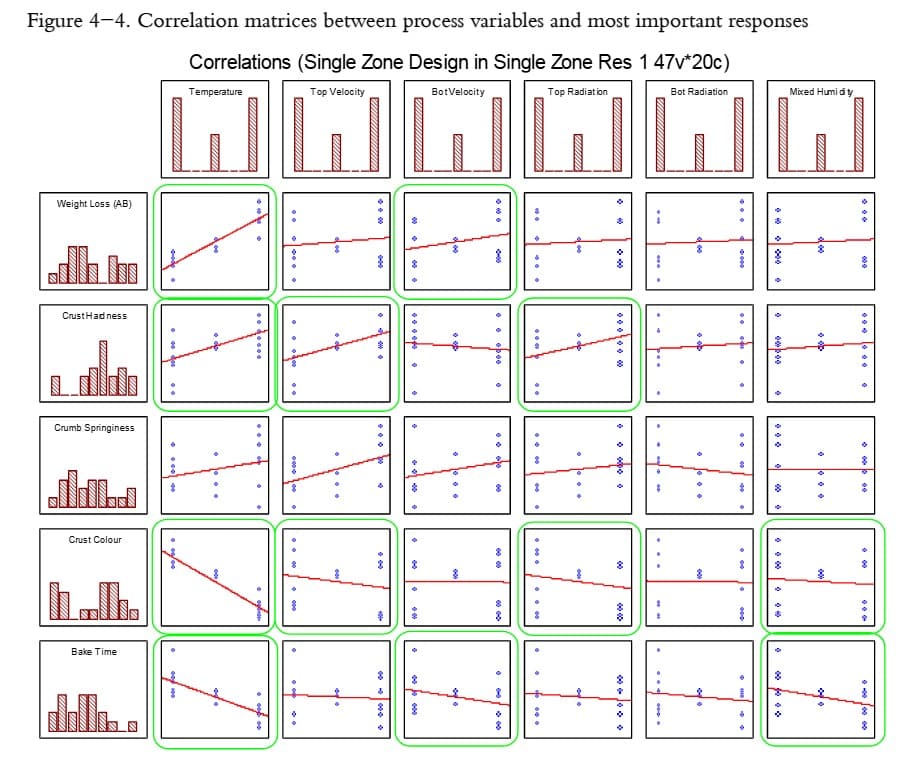
- A detailed analysis of six independent process variables, including air temperature, top and bottom air velocity, radiant temperature, and steam injection.
- A comparative evaluation of single-zone versus multi-zone baking configurations, focusing on the reduction of bake time while maintaining target weight loss.
- The development of validated predictive models that allow operators to estimate product responses based on specific oven variable inputs.
Key Findings and Economic Impact
The research confirms that precise control over thermal and mass transfer mechanisms provides a measurable path to improved plant economics. The study identifies specific correlations that allow for tighter control over product quality attributes such as crust hardness, volume, and moisture retention.
Significant findings from the trials include:
- Economic Sensitivity: The study quantifies that in a plant producing 6,000 loaves per hour, a reduction of just 1 gram in weight loss per loaf translates to an annual saving of approximately £10,000.
- Thermal Evolution: The analysis of the internal product temperature profile identifies a distinct 8th degree polynomial curve. This data provides a clear indicator for the end-of-bake point, allowing for greater consistency than time-based batching alone.
- Variable Interaction: The results demonstrate that increasing temperature and bottom airflow has a contradictory effect on bake time and weight loss, necessitating a multi-zone approach to reach an optimal equilibrium between throughput and yield.


Who should read this
This document is intended for process engineers, operations managers, and oven design specialists within the bakery sector. It is particularly relevant for those seeking to implement structured statistical analysis to reduce waste, optimise energy consumption, and increase throughput in automated bread production lines.

Managing Director — EnerTherm Engineering
Dr. François Pierrel is Managing Director of EnerTherm Engineering with over two decades of expertise in thermal design, heat transfer, and industrial energy optimisation. He holds a PhD in Heat Transfer from Cranfield University and a Post-Doctorate from Heriot-Watt University.
