Optimising Industrial Tunnel Ovens: Designing Feasibility for Heat Recovery Systems
The Challenge of Thermal Waste
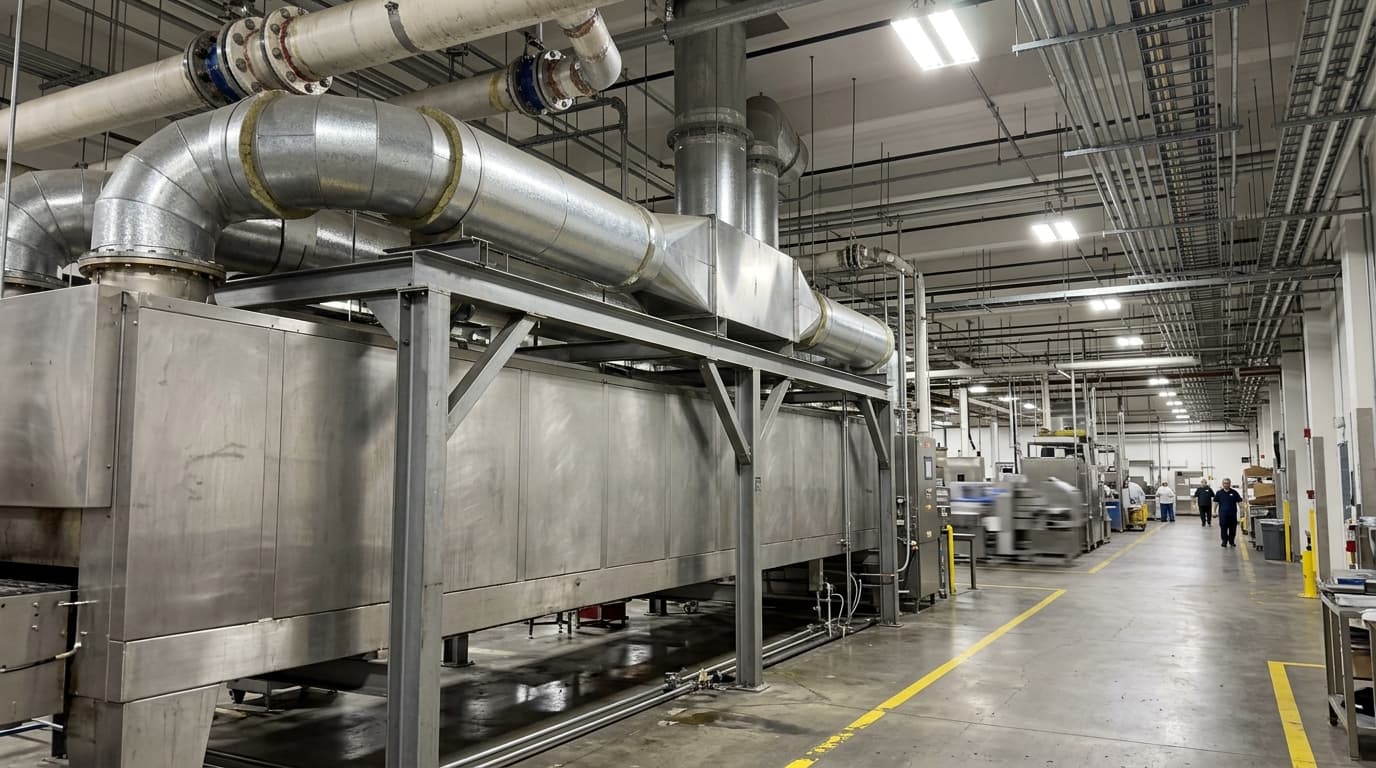
A manufacturing client operating high-volume tunnel ovens in the food production sector identified significant energy losses within its thermal processing line. The facility relied on conventional burner systems that exhausted high-temperature combustion gases directly to the atmosphere. This resulted in considerable waste, prompting the client to commission an engineering consultancy firm to investigate the technical and economic feasibility of integrating a heat recovery system to improve overall site energy efficiency.
The core of the issue was the lack of data regarding the potential energy capture versus the mechanical integration difficulties. Retrofitting heat recovery equipment into an existing, tightly-packed oven assembly presents significant challenges, particularly regarding available space, gas train location, and maintaining the structural integrity of the exhaust system.
Phase 1: Validating Theoretical Feasibility
The engagement began with a comprehensive feasibility study, requiring 40 hours of engineering analysis. The objective was to validate the potential for energy recovery based on existing burner specifications and operational data. The team performed detailed heat and mass balance calculations, which were critical to determining the theoretical maximum energy recovery possible from the oven stacks.
This phase required the client to provide precise operational parameters, including:
- Burner rating and detailed model specifications.
- Combustion air and stack exhaust flow rates at steady-state operation.
- Recirculation airflow rates.
- Current oven operating temperatures and exhaust gas discharge temperatures.
By analysing these variables, the engineering consultancy firm established the projected heat recovery in kilowatts (kW) and estimated the preheated air temperatures achievable. This provided the client with a clear view of the potential efficiency gains before committing to capital expenditure.
Phase 2: 3D Design and Simulation
Upon confirmation of feasibility, the project transitioned into design integration. This stage was critical for moving from theoretical models to physical reality. The team developed a detailed 3D CAD model of the proposed heat exchanger, designed specifically to fit within the restrictive physical constraints of the existing oven assembly.
| Project Phase | Engineering Hours | Primary Objective |
|---|---|---|
| Feasibility Study | 40.00 | Heat and mass balance validation |
| 3D Design & CFD Simulation | 90.00 | Physical integration and performance validation |
| Cost Estimation | 20.00 | Budgetary planning and material selection |
Crucially, the team employed CFD to ensure the design was not only physically compatible but thermally effective. The simulation process visualised airflow patterns and temperature distribution within the exchanger and the connecting ductwork. This was essential for identifying potential hot spots, cold spots, and areas of high thermal stress that could compromise the longevity of the equipment.
The simulation results provided the client with high confidence in the design. By validating pressure drop predictions for both air and exhaust streams before manufacturing, the consultancy team mitigated the risk of design failure in the field. The final deliverable included full integration drawings, demonstrating exactly how the unit would interface with the existing flue connections and combustion air inlets.
Phase 3: Economic Viability and Material Selection
The final stage of the project focused on budgetary control and material specification. The manufacturing client required a robust estimate to facilitate an investment decision. The engineering team developed a detailed cost breakdown, factoring in material take-offs, fabrication labour, and specific requirements for food-grade components.
Material selection was a primary consideration, particularly the specification of high-grade stainless steel to ensure compliance with food safety standards. The team also evaluated insulation requirements to minimise ambient heat loss and ensure the safety of maintenance personnel working near the oven assembly. This structured, phased approach ensured that the client could proceed with the physical installation of the thermal recovery project knowing exactly how the system would perform, how it would integrate with existing plant architecture, and the precise investment required.
Outcome
The project, formally referenced as the thermal recovery project, demonstrated the critical importance of upfront engineering analysis in industrial efficiency programmes. By investing 150 total engineering hours across feasibility, design, and cost analysis, the client eliminated the guesswork typically associated with retrofitting energy systems into legacy production lines. The final deliverable provided a bankable design specification, allowing the manufacturer to proceed to procurement with verified thermal performance expectations.

Managing Director — EnerTherm Engineering
Dr. François Pierrel is Managing Director of EnerTherm Engineering with over two decades of expertise in thermal design, heat transfer, and industrial energy optimisation. He holds a PhD in Heat Transfer from Cranfield University and a Post-Doctorate from Heriot-Watt University.
