Predictive Maintenance in Food Manufacturing: AI Alerts
Non-invasive IoT monitoring protects HACCP integrity, with downtime reductions of 20-30%
Predictive maintenance for food and beverage manufacturing is a condition-monitoring method that uses equipment and utility data to identify developing faults before they cause failure.
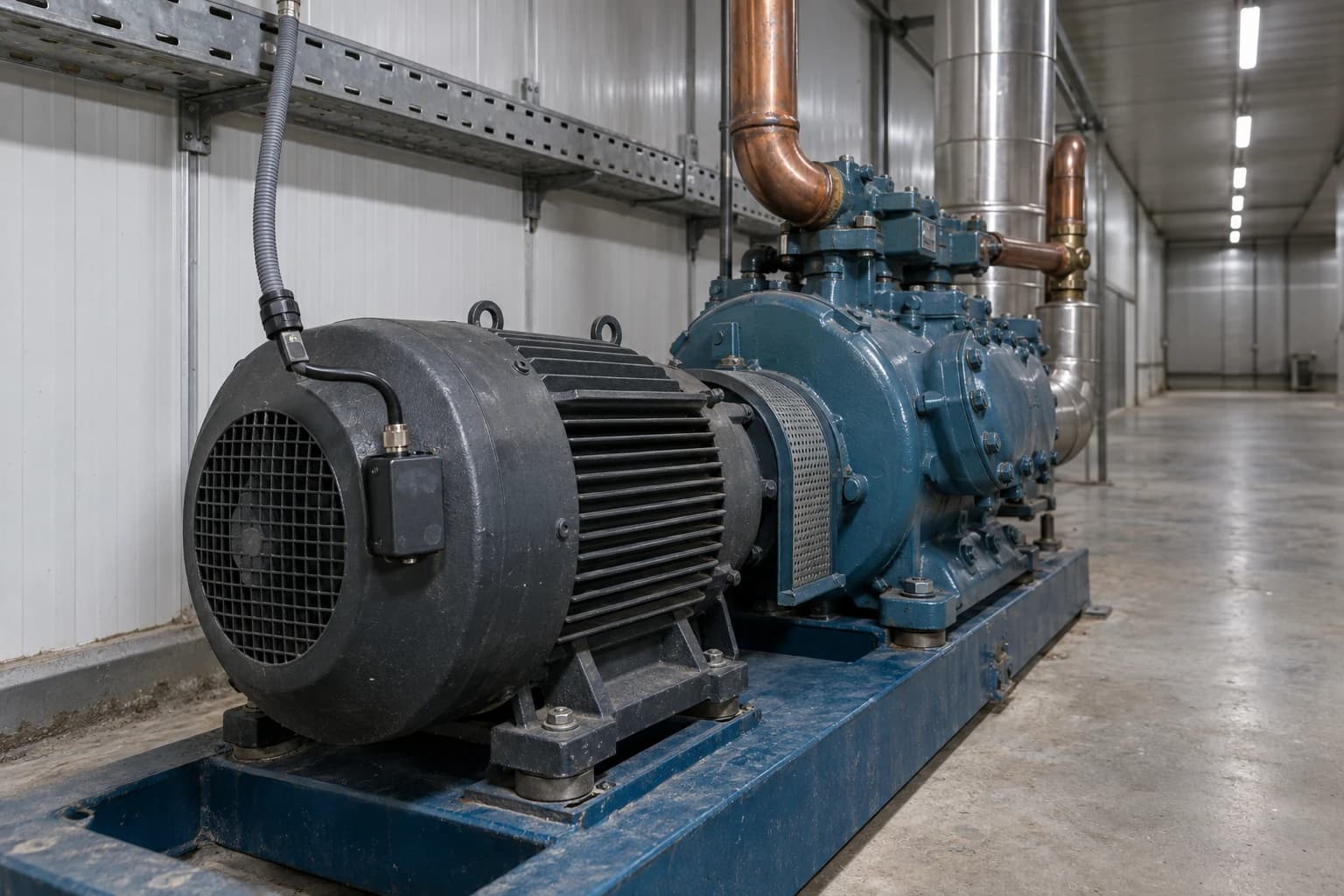
A cold-store compressor can run for hours with a deteriorating bearing, increased electrical demand and a changing thermal response. Production may continue without a visible problem. Then the compressor trips during a busy shift, putting temperature-controlled stock, dispatch schedules and energy performance under immediate pressure.
AI alerts give maintenance teams earlier evidence that an asset is operating outside its expected pattern. That supports planned inspection and intervention before a developing condition becomes an unplanned outage.
For food and beverage sites, the consequences reach beyond the repair invoice. Refrigeration, steam generation, compressed air, pumps and motors support food-safety controls, throughput and utility consumption. A mechanical fault can interrupt a batch, raise electricity or gas use, create product-hold decisions and generate avoidable waste.
What Predictive Maintenance Means in Food and Beverage Manufacturing
Predictive maintenance sits between reactive repair and calendar-based preventative maintenance. It uses current and historical asset data to identify patterns associated with degradation or abnormal operation.
Reactive maintenance begins after an asset has failed. Preventative maintenance schedules work at set intervals, whether component condition warrants it or not. Predictive maintenance uses evidence from the operating asset to help maintenance teams decide when work should be planned.
It does not remove the need for statutory examinations, planned servicing, inspection routines or food-safety controls. It improves the evidence available when teams prioritise those activities.
AI anomaly detection is not fault diagnosis
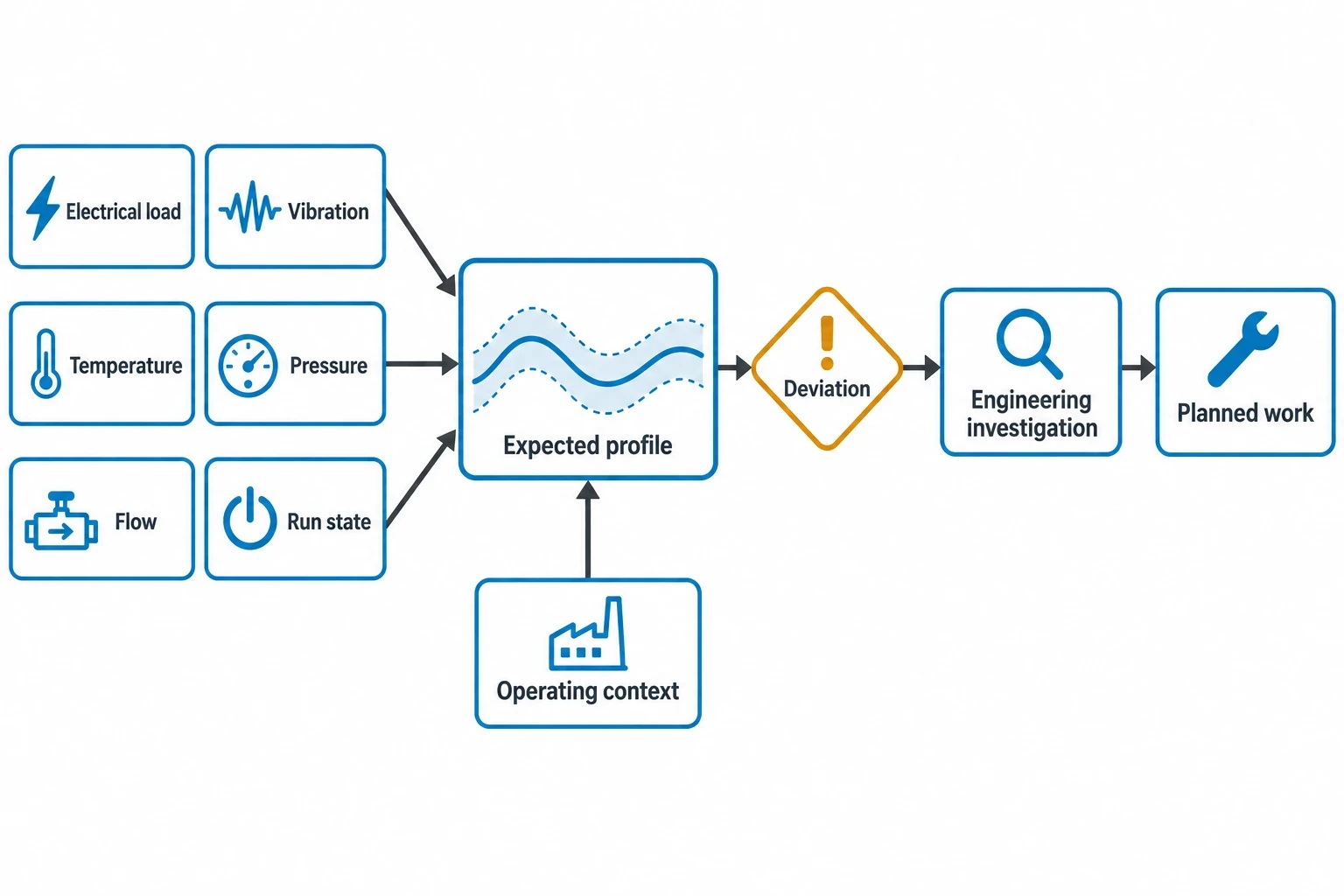
AI anomaly detection establishes an expected operating profile from measurements such as electrical load, vibration, temperature, pressure, flow and equipment run state. It flags a deviation from that profile.
The alert should begin an engineering investigation, not close one. Rising motor current and vibration could result from bearing wear, misalignment, a blocked filter, a process change, poor suction conditions or a faulty sensor. Engineers need to inspect the asset, assess its operating context and record the confirmed cause.
A useful alert contains practical detail:
- The affected asset and measurement point
- The size, duration and direction of the deviation
- Relevant conditions such as product load, batch, shift or ambient temperature
- The preceding trend
- A route into an inspection, maintenance and close-out workflow
This gives the planner enough information to rank the job against safety, product, production and energy risks.
Food plants need operating context
Food manufacturing has operating modes that can confuse a generic alarm system. A blast chiller changes duty as product enters and leaves. A boiler’s gas consumption and steam demand move with cooking, cleaning and production schedules. Clean-in-place activity creates sharp but expected changes in water and steam use.
AI models need these states as context. Comparing a compressor during a heavy production run with the same compressor at night can generate misleading alerts. Linking condition data to production state, defrost activity, cleaning cycles and weather conditions makes anomaly detection more relevant to the engineer receiving it.
Omni Vision delivers turnkey utility metering, CO2 tracking, and AI-powered production KPI intelligence — giving you real-time dashboards and actionable insights across your entire facility.
Which Food-Manufacturing Assets Benefit Most from AI Alerts?
The first predictive-maintenance deployment should focus on assets where failure threatens product integrity, food safety, continuity of production or utility consumption. Refrigeration and steam systems often meet all four criteria.
Refrigeration systems and cold stores
Industrial refrigeration can increase electricity use before a temperature excursion becomes visible. Useful signals include compressor electrical demand, suction and discharge pressure, evaporator and condenser temperatures, run time, defrost activity, room temperature and vibration.
A developing fault often appears in the relationship between several measurements rather than in one breached threshold. Engineers may investigate:
- Increasing compressor power for comparable refrigeration duty
- Rising condensing temperature under similar ambient conditions
- Longer run time after defrost
- Repeated short cycling
- A widening difference between redundant temperature measurements
- Vibration that worsens at a particular load condition
Matteo Sala, Roberto Zanetti, Matteo Pirotta, Marco Rossoni and Giorgio Colombo examined this approach in their ASME IMECE paper, Real-Time Monitoring Platform for Commercial Refrigerators Using Digital Twin Aggregates. Published online in February 2026, the work used a Long Short-Term Memory encoder-decoder model trained on healthy operating data to identify deviations in refrigeration cycles.
The authors reported an area under the ROC curve of 0.95 and an area under the precision-recall curve of 0.72 on a public dataset. The test covered one generic fault type and relied on power-consumption data. Food manufacturers should treat such results as evidence that the method merits site validation, rather than proof that one model will identify all plant faults.
Boilers, steam and condensate
Steam-system faults can create an energy penalty while production appears stable. A leaking steam trap, drifting combustion control, excess blowdown, reduced heat-transfer performance or a condensate-return problem may increase fuel use before a line stops.
Condition monitoring can combine gas use, steam flow, feedwater temperature, condensate return, stack temperature, flue oxygen where measured, boiler pressure and blowdown records. Engineers should compare these signals with real production demand instead of reviewing each measurement in isolation.
A persistent change between fuel input and steam output warrants investigation. The response may involve combustion tuning, a water-treatment review, steam-trap inspection, condensate-system checks or revised plant sequencing. The platform should identify the condition and inform the team; authorised operators or building-management systems make validated changes during approved change windows.
Compressed air, pumps and motors
Compressed-air systems offer accessible early-warning signals. Off-shift demand, compressor run hours, load-unload cycling, discharge pressure and specific energy can expose a leakage pattern or a control problem. Vibration and temperature measurements add condition evidence for compressors, pumps and fans.
Rotating equipment remains well suited to vibration analysis, but process data is essential. A pump vibration alert during a product-viscosity change may point to process duty, suction conditions, cavitation or a mechanical defect. The maintenance record and operating history help engineers distinguish between them.
| Asset group | Typical monitored data | Conditions an alert can identify | Likely operational consequence |
|---|---|---|---|
| Refrigeration | Power, temperatures, pressures, vibration, run time | Abnormal energy draw, cycling or thermal response | Cold-chain and product-spoilage risk |
| Boiler and steam | Gas, steam flow, feedwater, condensate, stack temperature | Combustion drift, heat loss or reduced heat transfer | Higher fuel use and interrupted process heat |
| Compressed air | Power, pressure, flow, run state, vibration | Leakage, short cycling or mechanical deterioration | Lost efficiency and production disruption |
| Pumps and motors | Vibration, current, temperature, flow, speed | Bearing wear, misalignment, cavitation or abnormal load | Line stoppage and process instability |
How Predictive Maintenance Supports HACCP and ISO 22000:2018
Maintenance forms part of food-safety management. ISO 22000:2018 specifies requirements for a food safety management system and incorporates HACCP principles alongside prerequisite programmes.
The Food Standards Agency identifies maintenance, cleaning and calibration records as evidence that can support verification of HACCP-based procedures. It also expects operators to assess changes to equipment and processes that could affect food safety.
Non-invasive monitoring protects process-line integrity
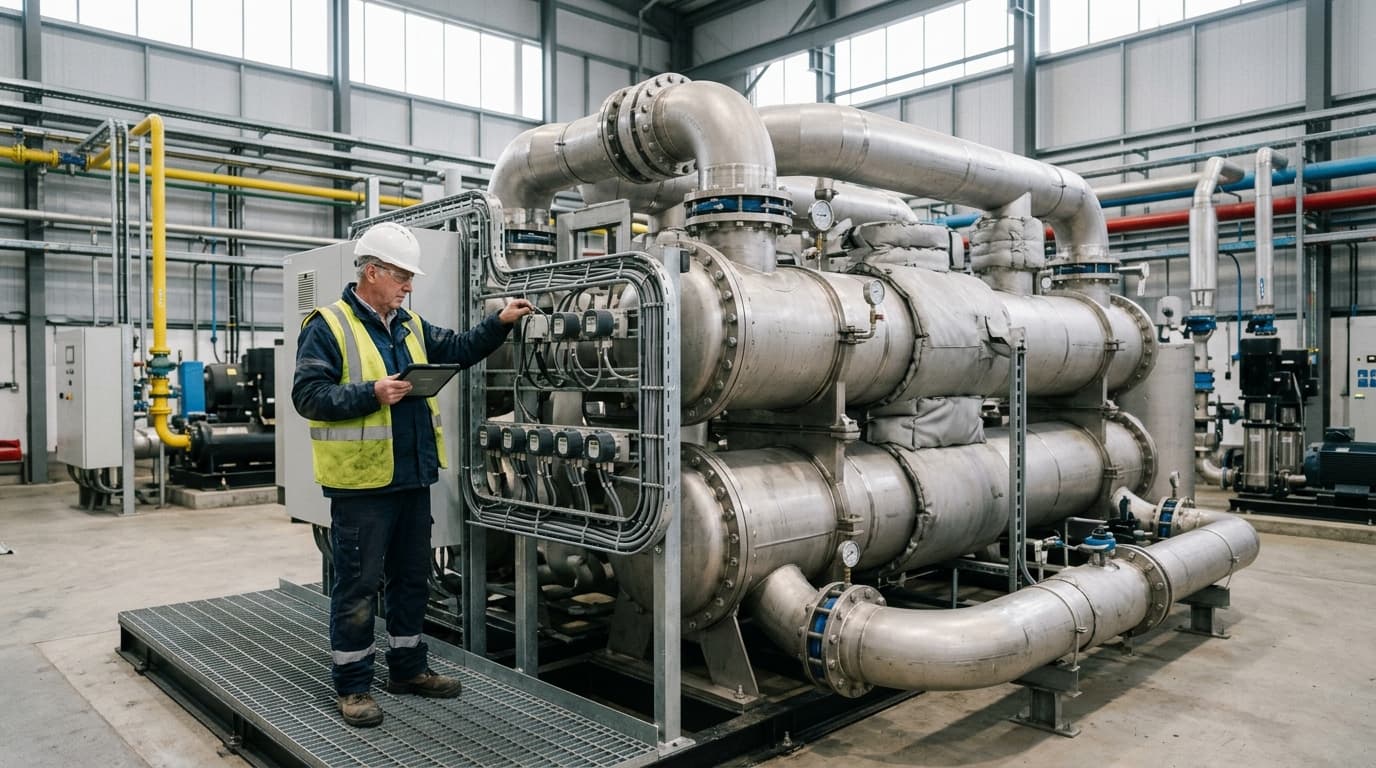
Predictive maintenance should not introduce unnecessary physical contact points into hygienic process areas. Exterior-mounted vibration sensors, panel-based electrical metering and selected readings from existing equipment can provide useful condition evidence without contacting product or opening process lines.
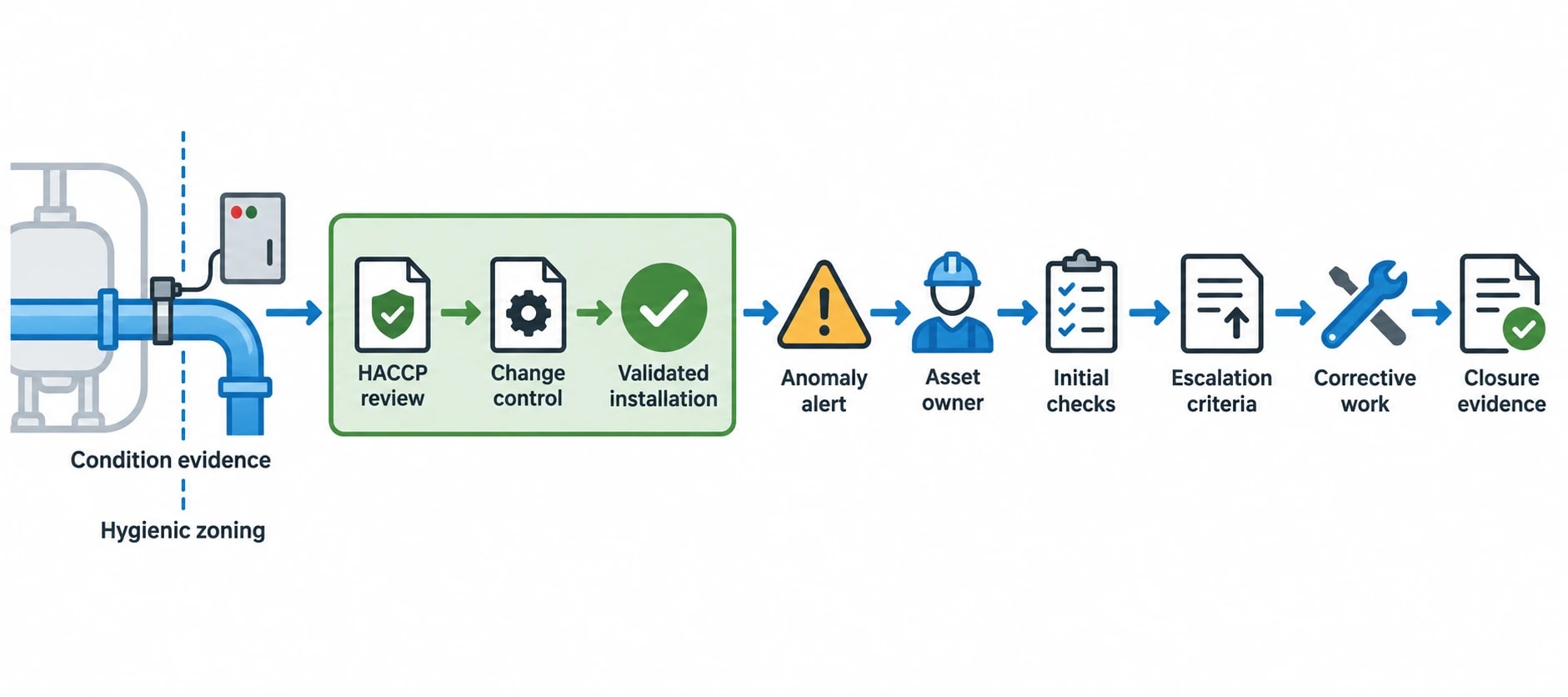
The food-safety team should still review each installation through the site’s HACCP and engineering change-control arrangements. Sensor position, hygienic zoning, cable routing, enclosure cleaning, calibration and maintenance access all require assessment.
Non-invasive installation reduces the intervention burden. It does not remove the need for validation. The site must establish that the arrangement does not create a physical, chemical or microbiological hazard, obstruct cleaning or interfere with inspection.
Alerts need documented corrective actions
The useful output of an alert programme is a controlled maintenance response. Each asset category needs a defined decision path covering ownership, initial checks, escalation criteria, corrective work and closure evidence.
For a cold-store alert, the first response may include reviewing room-temperature trends, compressor state, associated alarms, condenser cleanliness, refrigerant indicators and door activity. For a steam alert, engineers may review boiler load, water chemistry, blowdown records and condensate return before planning intrusive maintenance.
Food-safety and quality teams should define which alert conditions require escalation because they could affect a critical control point, a product-hold decision or a contingency plan. This keeps predictive maintenance within HACCP governance rather than operating as a separate engineering dashboard.
Track energy consumption, emissions, and process parameters with seamless PLC/SCADA integration via Modbus, OPC-UA, and MQTT protocols.
Building AI Alerts That Maintenance Teams Trust
An alert system earns trust through accuracy, relevance and clear ownership. A dashboard with hundreds of unranked deviations creates more work for an already stretched maintenance team.
Establish an asset baseline first
AI models require a representative record of healthy operation. For refrigeration, that baseline should include variation in ambient temperature, product load, defrost cycles and shift pattern. For boilers, it should capture different steam demands, start-up conditions and cleaning activity.
Maintenance teams should define the monitored points and confirm their quality before modelling begins. Missing samples, inconsistent timestamps, uncalibrated sensors and poorly labelled assets reduce the quality of anomaly detection.
A practical preparation programme includes:
- An asset register with consistent names, locations, criticality and maintenance ownership.
- A measurement plan covering units, sampling frequency, sensor calibration and data retention.
- Operating-state records for production, cleaning, shutdown, defrost and known process changes.
- A maintenance history that records confirmed failure modes, inspections and corrective action.
- A regular review of false alerts, missed events and the lead time provided by each alert.
Rank alerts by operational consequence
A small thermal deviation on a non-critical utility pump requires a different response from a compressor alert in a freezer serving high-value stock. Maintenance managers should rank assets by their food-safety, production, safety and energy consequences before setting alert priorities.
The alert should distinguish between an abnormal measurement and a condition that requires immediate action. A useful escalation structure may separate:
- Information alerts for an observed deviation
- Inspection alerts for a condition requiring planned checks
- Urgent alerts for a condition with a credible near-term risk to product, safety or production
Teams should review outcomes after each closed alert. Did inspection confirm a condition? Did maintenance receive enough warning? Was the alert tied to a process change rather than a defect? This feedback improves the model and the maintenance plan.
Measuring Downtime, Energy and Product Protection
Predictive maintenance should measure avoided disruption and energy performance together. A refrigeration defect may increase electricity use before it threatens product temperature. A steam-system problem may increase gas demand before it interrupts a cooking or cleaning process.
ISO 50001:2018 provides a framework for managing energy performance through objectives, measurement, review and continual improvement. Food manufacturers can apply that discipline by selecting measures that represent the duty of each critical asset.
Use production-linked performance indicators
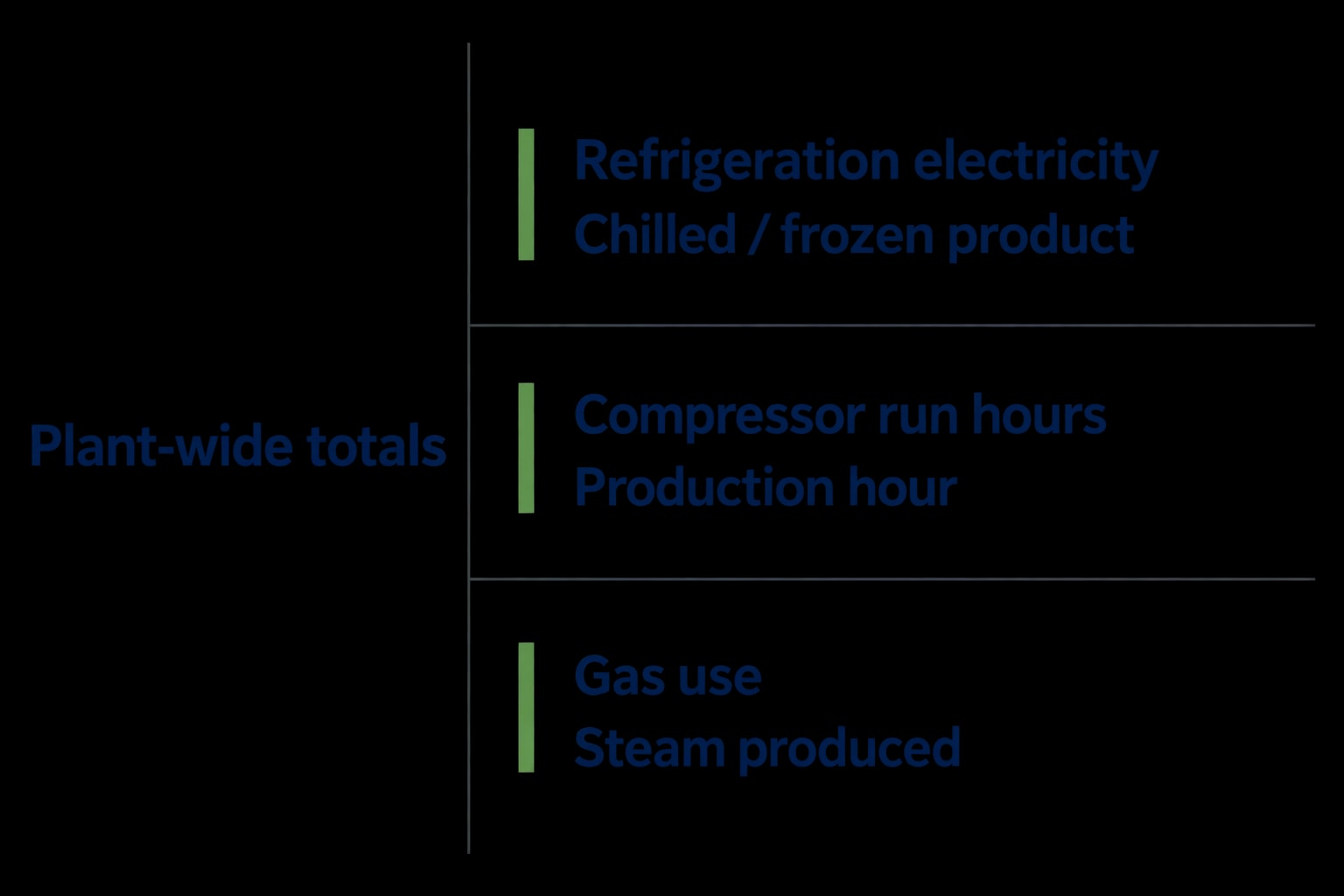
Plant-wide utility totals provide a broad view but are too coarse to diagnose an individual compressor or boiler. More useful measures connect energy with asset duty and production output.
Examples include:
- Electricity per tonne of chilled or frozen product
- Compressor run hours per production hour
- Refrigeration electricity adjusted for ambient temperature
- Gas use per tonne of steam produced
- Condensate return rate
- Compressed-air baseload during non-production periods
- Unplanned downtime hours by asset group
- Product held or discarded after equipment-related events
- Mean time between confirmed failures
For organisations in scope, Streamlined Energy and Carbon Reporting requires energy and greenhouse-gas disclosures. Direct emissions from an owned or controlled boiler fall within Scope 1. Purchased electricity used for refrigeration and plant equipment falls within Scope 2. Granular utility records provide a stronger audit trail for those figures and show the energy-efficiency actions behind reported changes.
The Food and Drink Federation’s Ambition 2030 identifies net zero, food waste and packaging among its five strategic pillars. Reduced breakdown-driven waste and lower avoidable energy use support those sector priorities, but each site should quantify its own result against a documented baseline.
PAS 2060 is now a historical reference for carbon-neutrality claims. BSI has replaced PAS 2060 with ISO 14068-1:2023 in its carbon-neutrality verification scheme. Predictive maintenance can provide evidence of operational energy reductions, but it cannot by itself substantiate a carbon-neutrality claim.
A Practical Deployment Plan for Predictive Maintenance in Food and Beverage Manufacturing
A focused programme builds confidence more effectively than an attempt to model every asset on day one. Start with a limited group of critical assets with accessible data, a known downtime history and measurable energy use.
Select the first use cases carefully
Refrigeration compressors, cold-store evaporator fans, boilers, condensate systems and compressed-air compressors are sensible early candidates. Each has a measurable duty, a material energy cost and a recognisable consequence if it fails.
The site survey should document asset criticality, available condition measures, existing maintenance history, food-safety constraints and the desired lead time for intervention. Teams should agree what a successful alert looks like before setting up reporting.
An alert that gives an engineer two days to inspect a deteriorating compressor has a clear purpose. An alert with no owner, action or consequence does not.
Validate, learn and expand
Begin with a verified healthy operating baseline. Include seasonal conditions, shifts, product ranges and cleaning activity. Engineers should assess early anomalies alongside physical inspection and the maintenance record before using them to support decisions on planned work.
Each closed alert should answer four questions:
- Was there a confirmed condition issue?
- What did inspection find?
- What corrective action was taken?
- Did the alert provide enough time to protect product and production?
This creates a maintenance history that is more useful than a simple fault log. Over time, the site can extend monitoring from the first critical assets to associated utilities and secondary equipment, while maintaining clear links to food safety, energy use and plant availability.
This article reflects the independent analysis and editorial opinion of EnerTherm Engineering. Product names, trademarks, and brands mentioned belong to their respective owners. EnerTherm Engineering is not affiliated with, endorsed by, or a licensee of any third-party software or product mentioned unless explicitly stated.

Managing Director — EnerTherm Engineering
Dr. François Pierrel is Managing Director of EnerTherm Engineering with over two decades of expertise in thermal design, heat transfer, and industrial energy optimisation. He holds a PhD in Heat Transfer from Cranfield University and a Post-Doctorate from Heriot-Watt University.
