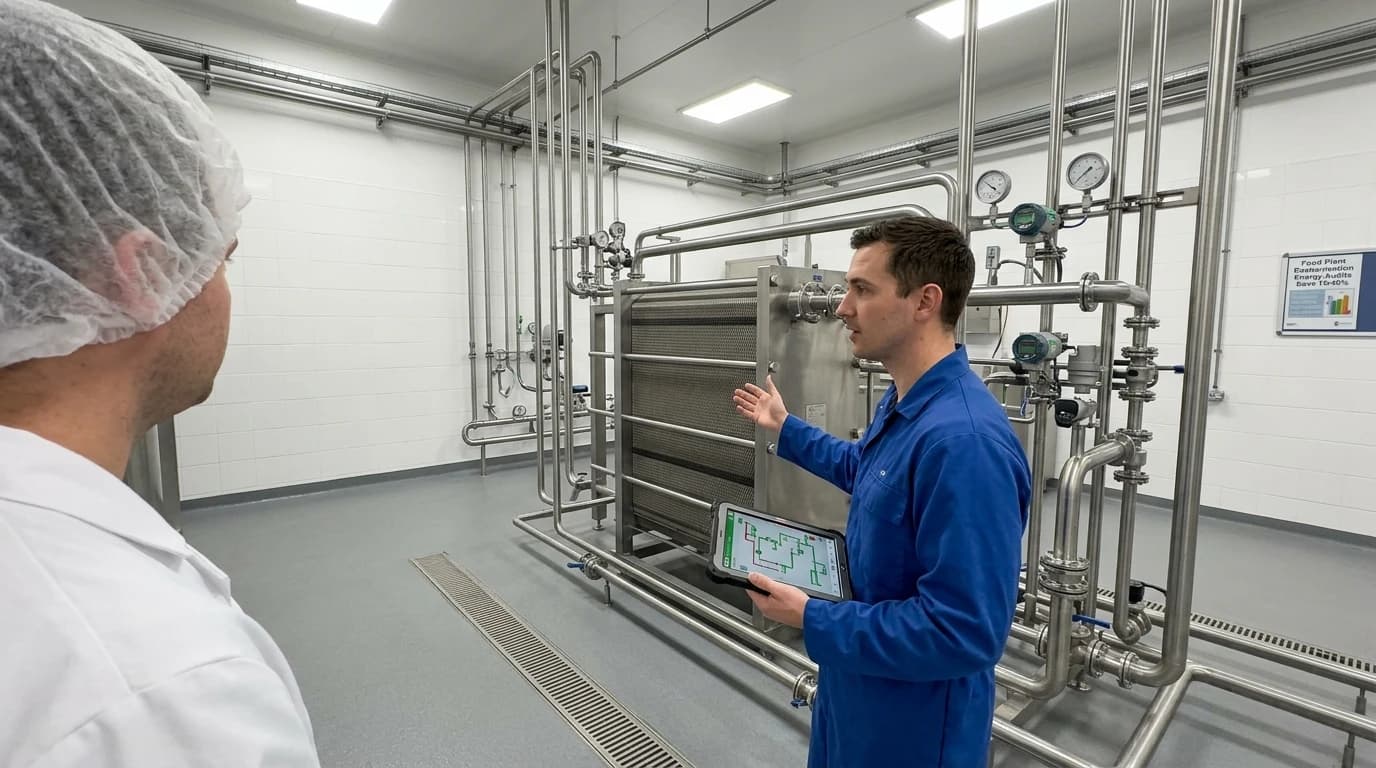
Food Plant Pasteurisation Energy Audits Save 19-40%
Optimising regeneration loops to recover 90-95% of heat with a typical 1.4-year payback.
Steam generation and cooling systems consume up to 60 per cent of the total utility budget in commercial liquid food manufacturing facilities, yet much of this thermal energy escapes directly into wastewater drains or the atmosphere. In commercial liquid food plants—such as dairies, juice processors, and breweries—the pasteurisation process is the single largest consumer of thermal and electrical utility streams. Conducting a comprehensive food plant pasteurisation energy audit maps these thermal flows, frequently revealing total thermal energy savings of 19 to 40 per cent. By applying rigorous thermodynamic analysis and process integration, plants can drastically reduce steam and cooling utility bills without compromising product safety or quality.
What is a Food Plant Pasteurisation Energy Audit?
Defining the Scope of Thermal Auditing in Liquid Food Plants
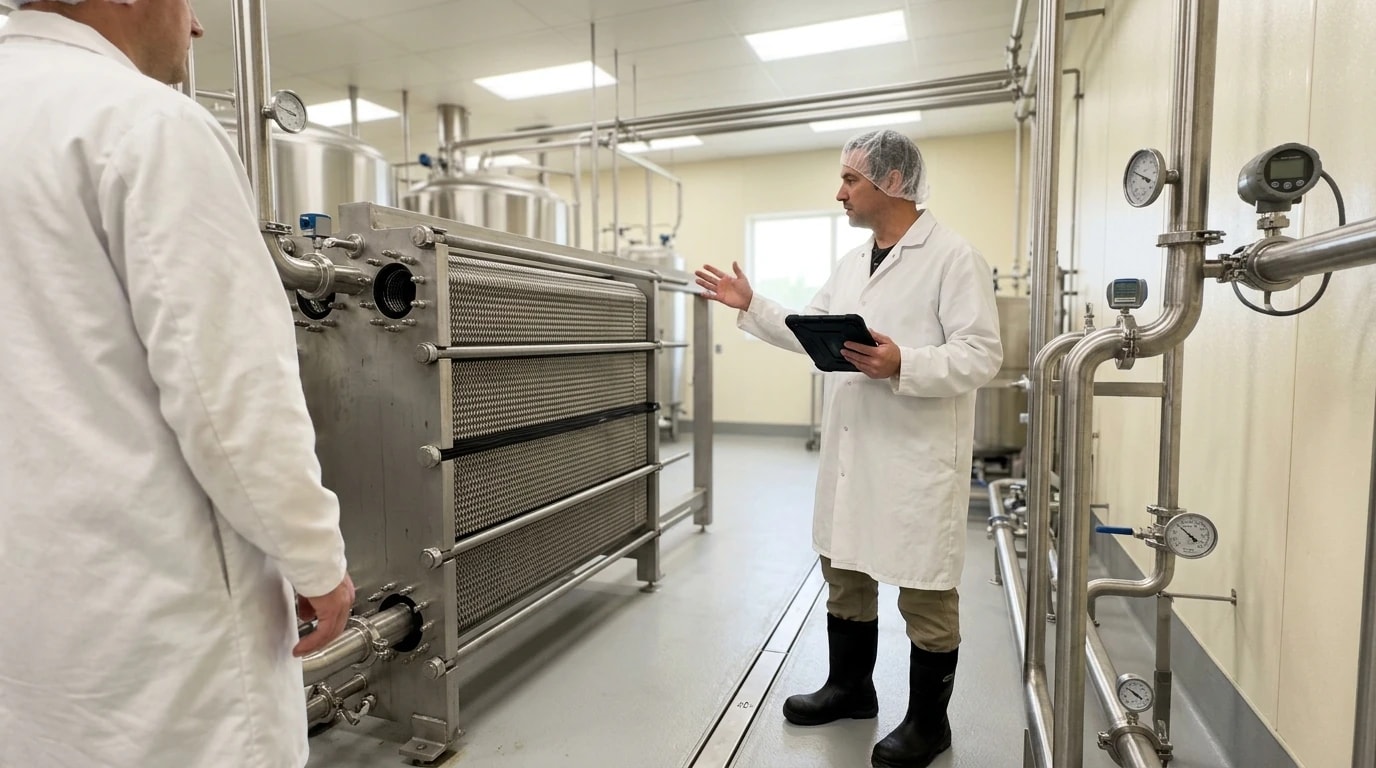
A food plant pasteurisation energy audit is a structured, thermodynamic investigation designed to trace every unit of thermal energy from its utility point of origin to its ultimate release or recovery. Unlike a standard facility energy audit, which might focus broadly on lighting, motor efficiencies, or steam trap health, a process-specific thermal audit examines the heat transfer mechanics within the pasteuriser itself. Engineers evaluate how well the system recirculates internal energy before calling for external utility steam or chilled water. This requires measuring flow rates, temperatures, and pressures at every inlet and outlet port of the plate heat exchanger (PHE). By establishing a complete, species-level mass balance and thermodynamic energy balance, engineers can pinpoint exactly where heat is lost to the environment or bypassed without doing useful work.
Why Audits Must Target the Process Boundary Over the Boiler House
Many facility managers mistakenly audit only the boiler house or refrigeration plant. While optimising combustion efficiency or upgrading compressor valves provides minor incremental gains, it does not alter the core process demand for heat. A dairy processing audit must start at the process boundary, where raw milk reception, standardisation, homogenisation, pasteurisation, packaging, and clean-in-place (CIP) cycles define the baseline thermal load. A pasteuriser with a degraded regeneration loop pulls excessive steam from the boiler and demands excessive chilled water from the refrigeration plant. Diagnosing the process boundary first ensures that utility-side upgrades are correctly sized for the optimised process load, preventing costly oversizing of replacement boilers or chillers.

Map every energy and material flow in your process with detailed heat and mass balance calculations — the foundation for any optimisation or design project.
The Thermodynamics of HTST Pasteurisation and Regeneration
Calculating Regeneration Efficiency in Plate Heat Exchangers
The core of High-Temperature Short-Time (HTST) pasteurisation is the regeneration section of the plate heat exchanger. Regeneration uses hot, pasteurised product to pre-heat incoming cold raw product, simultaneously pre-cooling the hot product before it enters the final chilling section.
In a highly efficient HTST pasteuriser, the regeneration loop can achieve 90 to 95 per cent heat recovery. The regeneration efficiency of a continuous-flow pasteuriser is calculated using the following established thermodynamic formula:
R=Tp−TcTr−Tc×100Where:
- R is the regeneration efficiency expressed as a percentage (%).
- Tr is the temperature of the pre-heated product leaving the regenerator section (°C).
- Tc is the temperature of the incoming raw cold product (°C).
- Tp is the pasteurisation holding temperature (°C).
For example, in a dairy processing plant, raw milk enters the pasteuriser from cold storage at 4°C (Tc). If the regeneration section pre-heats this incoming milk to 68°C (Tr) using the hot pasteurised milk returning from the holding tube, and the final pasteurisation temperature is 72°C (Tp), the regeneration efficiency is calculated as:
R=72−468−4×100=6864×100≈94.1%In this highly optimised scenario, the steam-heated utility section only needs to raise the milk temperature by 4°C (from 68°C to 72°C) rather than the full 68°C temperature rise (from 4°C to 72°C). This simple loop reduces the external heating utility demand by 94.1 per cent. If the regeneration efficiency drops to 80 per cent due to hydraulic imbalances or undersized plates, the pre-heat temperature (Tr) falls to 58.4°C, which forces the steam heater to supply 13.6°C of heat instead of 4°C. This represents a 240 per cent increase in steam consumption for that single process line.
The diagram below illustrates the physical flow of the liquid product and utility streams through the different sections of an HTST plate heat exchanger equipped with a regeneration loop:
Overcoming Fouling and Thermal Resistance on Plate Surfaces
Over time, organic fluids such as milk or juice deposit proteins, fats, and minerals on heat transfer surfaces, causing fouling. This buildup increases conductive thermal resistance across the stainless steel plates, restricting heat transfer and steadily degrading regeneration efficiency during a production run. As the heat transfer coefficient decreases, the hot utility steam valve must open wider to maintain the critical pasteurisation temperature, while the chilling section requires more glycol or ice water to achieve the target packaging temperature.
Furthermore, the buildup of milk stone or product residue increases pressure drops across the plate pack. To prevent cross-contamination, plants must maintain a strict pressure differential where the pasteurised product is kept at a higher pressure than the raw product. A food plant pasteurisation energy audit analyses these pressure and temperature trends over time to identify opportunities to optimise CIP schedules and plate configurations, ensuring plate surfaces remain clean and thermal transfer remains at peak efficiency.
Balancing Energy Savings with HACCP and Food Safety Standards
Maintaining Pasteurisation Critical Limits under Reduced Thermal Load
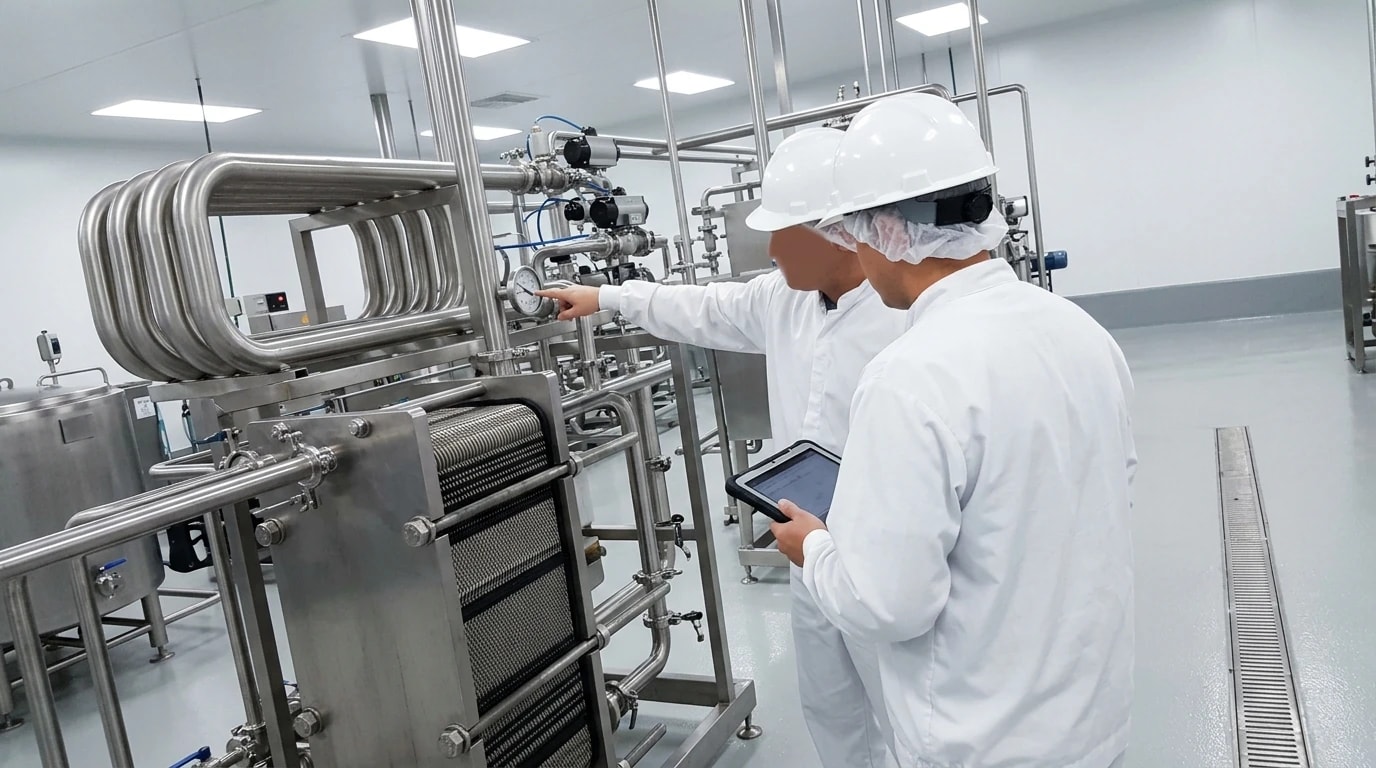
Every energy-saving measure identified in a food plant pasteurisation energy audit must be validated against the facility’s Hazard Analysis and Critical Control Point (HACCP) plan. In liquid food manufacturing, microbiological safety is paramount; thermal processing cannot be compromised to cut utility costs.
For milk pasteurisation, UK food standards (enforced by the Food Standards Agency and aligned with Regulation (EC) No 853/2004) require the product to be heated to a minimum of 72°C and held for at least 15 seconds. If the temperature falls even 0.1°C below this critical limit, the automated flow diversion valve (FDV) instantly diverts the product back to the balance tank. This disruption wastes significant energy because the diverted milk must be reheated, while also increasing product degradation through double-processing.
To prevent this, thermal energy audits focus on steady-state stability. Engineers examine control loop tuning on the steam modulating valves and thermal dampening in the hot water loop. Precise, stable temperature control allows plants to operate safely closer to regulatory minimum temperatures without risking accidental diversions.
Holding Tube Insulation and Thermal Loss Prevention
The holding tube is the physical pipeline where heated liquid resides for the mandatory holding period to ensure complete pathogen deactivation. Despite its critical role, the holding tube in many older food plants remains completely uninsulated. Exposed to ambient draught conditions in the processing hall, it suffers from radiative and convective heat losses. If the product temperature drops below the legal limit while passing through the holding tube, the system triggers a flow diversion.
Applying high-density, sanitary clad insulation to the holding tube is a low-cost energy conservation measure. It eliminates ambient thermal losses, stabilises the holding temperature, and prevents unnecessary product diversions without altering hydraulic retention time or compromising the HACCP sanitary boundary.

Map every energy and material flow in your process with detailed heat and mass balance calculations — the foundation for any optimisation or design project.
Advanced Heat Recovery: Dual Accumulator Storage Systems
Integrating Dual Accumulator Loops to Bridge Batch Process Gaps
While plate heat exchanger regeneration loops excel at recovering heat within a single continuous process stream, they cannot easily transfer energy to other independent plant systems. This is where advanced, process-integrated heat recovery methods, such as dual accumulator storage loops, provide significant value.
A major challenge in food plant energy management is the temporal mismatch between heat availability and heat demand. Pasteurisation runs continuously during production, whereas Clean-In-Place (CIP) cleaning cycles and boiler feedwater make-up occur in intermittent, high-volume batches. Direct heat integration between these systems is impossible without causing severe process instability.
A dual accumulator storage system solves this by using two thermal storage vessels to buffer the energy. The first accumulator stores low-grade hot water recovered from pasteuriser cooling phases, boiler blowdown, or exhaust gas economisers. The second accumulator acts as a cold buffer receiving return water from cleaning loops or raw incoming mains water. Isolating these volumes allows the system to continuously absorb waste heat and discharge it on demand, bypassing the physical and temporal limitations of direct heat exchangers.
Reclaiming Low-Grade Waste Heat for CIP and Boiler Feedwater Pre-Heating
Integrating a dual accumulator loop allows food plants to pre-heat CIP water and boiler feed loops up to 85°C without consuming raw boiler steam. This configuration preserves the sanitary boundary of the pasteuriser, as there is no physical contact or pressure cross-over between waste streams and the food product.
According to industry analyses, deploying these dynamic thermal storage systems to capture waste heat from pasteuriser cooling loops and boiler operations is a primary contributor to these substantial plant-wide savings. Furthermore, feeding pre-heated water to the boiler reduces thermal shock, minimising stress on the boiler shell and tubes, lowering ongoing maintenance costs, and extending the operational lifespan of the utility plant.
Cost-Benefit Analysis: The Financial Return of a Pasteurisation Energy Audit
Capital Expenditure vs. Operational Expenditure Savings
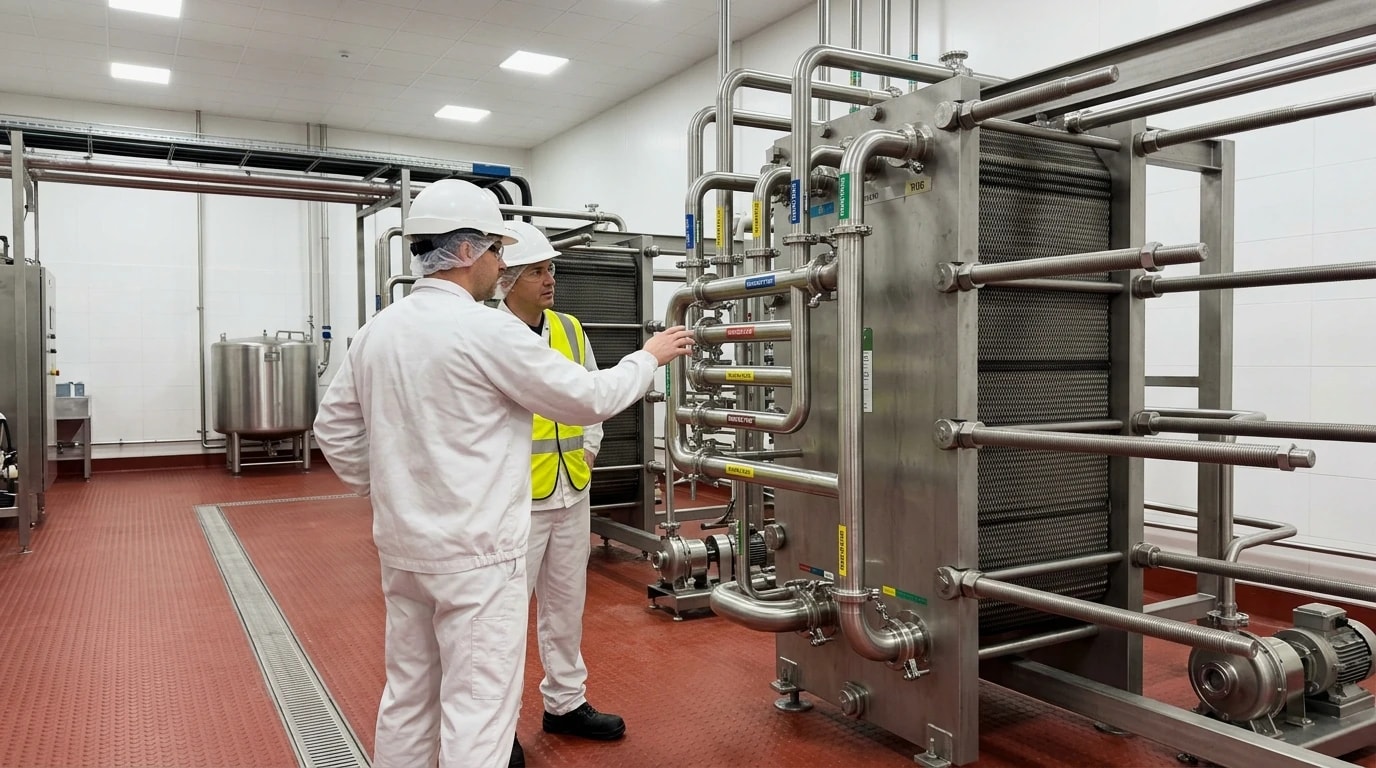
For utility managers and operations directors, justifying the cost of a comprehensive food plant pasteurisation energy audit requires a clear demonstration of financial return. A detailed thermal energy audit typically costs between £15,000 and £45,000, depending on facility size and the number of pasteurisation lines, but the resulting operational savings quickly offset this initial capital expenditure.
Most energy conservation measures identified during a pasteurisation audit fall into low-cost operational adjustments or moderate-capital retrofits. Recalibrating temperature control loops, balancing flow rates, and insulating holding tubes require minimal capital outlay but yield immediate reductions in gas and water bills. Larger retrofits—such as adding plates to upgrade a regeneration loop from 88 to 94 per cent efficiency, or integrating a dual accumulator system—require higher capital expenditure but deliver permanent, multi-decade operational savings.
To illustrate the financial impact, the table below provides a cost-benefit breakdown of typical energy conservation measures implemented in a medium-scale commercial dairy processing 10,000 litres of milk per hour:
| Energy Conservation Measure (ECM) | Typical Capital Cost (£) | Annual Operational Savings (£) | Payback Period (Months) | Expected Thermal Savings (%) |
|---|---|---|---|---|
| PHE Regeneration Loop Optimisation (88% to 94%) | 18,000 - 35,000 | 24,000 - 55,000 | 6 - 9 | 10 - 15% |
| Holding Tube Sanitary Insulation | 1,500 - 3,500 | 3,000 - 8,000 | 4 - 6 | 1 - 3% |
| Dual Accumulator CIP Pre-Heating System | 75,000 - 150,000 | 50,000 - 110,000 | 12 - 18 | 15 - 25% |
| Boiler Condensate Recovery & Economiser Retrofit | 40,000 - 85,000 | 25,000 - 60,000 | 15 - 19 | 8 - 12% |
| PID Loop Tuning and Automated Flow Matching | 5,000 - 12,000 | 8,000 - 20,000 | 6 - 8 | 2 - 5% |
Payback Period Analysis for Commercial Dairies and Breweries
As shown in the cost-benefit analysis, the payback periods for individual measures range from 4 to 19 months, with a combined system-wide payback period of approximately 1.4 years. This rapid return on investment is driven by the high cost of industrial natural gas, electricity, and water. By reducing steam consumption, facilities directly lower their carbon emissions, helping UK and EU food manufacturers meet strict environmental compliance targets and avoid carbon taxation under schemes like the UK Emissions Trading Scheme (UK ETS).
Standardising Savings: The EnerTherm Heat and Mass Balance Methodology
Data Acquisition and Base Flowsheet Construction in Process Simulators
To ensure energy-saving projections are accurate and reproducible, industrial thermal engineering consultancies implement a highly structured approach. EnerTherm Engineering utilises a proprietary 11-step engineering methodology that standardises the transition from initial raw plant data to a validated, low-risk capital investment proposal.
The 11-step methodology standardises every phase of the project:
- Initial Consultation / Meeting: Define project objectives, operational constraints, and success criteria in technical workshops.
- Data Gathering: Collect P&IDs, SCADA logs, datasheets, and physical layout data to catalogue every thermal parameter.
- Process Simulation: Construct a base flowsheet model in advanced thermodynamic simulators.
- Data Analysis: Evaluate simulated heat transfer rates, exergy losses, and bottleneck locations.
- Report & Presentation: Present initial findings, highlighting structural inefficiencies and critical thermal losses.
- Process Flow Diagram (PFD): Create a unified PFD with embedded stream tables containing temperature, pressure, and mass flow rates.
- Mass Balance Calculations: Calculate species-level mass balances across all liquid, vapour, and solid phases.
- Energy Balance Calculations: Resolve detailed energy balances, accounting for sensible heat, latent heat, and mechanical pump work.
- Iteration & Optimisation: Perform parametric optimisation to test heat exchanger configurations and control strategies.
- Simulation & Validation: Validate the optimised simulation against physical site data to ensure mathematical convergence and regulatory safety.
- Reporting & Documentation: Deliver a comprehensive engineering report, providing a single source of truth for capital planning and HACCP verification.
Rather than relying on static estimates, thermal design teams construct high-fidelity steady-state and dynamic simulations of the pasteurisation system. Process simulation software platforms—such as Aspen Plus, HYSYS, or open-source alternatives like DWSIM—are configured to model the exact physical and thermodynamic properties of the liquid food streams. By calibrating these models against actual operating data, engineers establish a highly accurate 'digital twin' of the thermal process.
Resolving Energy Balances and Preventing Double-Counted Savings
One of the most frequent errors in industrial energy auditing is "double-counting" waste heat savings. For example, an auditor might identify hot water from a pasteuriser cooling loop and suggest routing it to pre-heat the CIP tanks, while simultaneously claiming that same thermal energy can pre-heat the boiler feedwater. In reality, a single unit of thermal energy can only be used once.
By using a unified Heat and Mass Balance (HMB) framework, process simulation models evaluate every stream simultaneously, ensuring that exergy is tracked sequentially. The final output includes a detailed Sankey energy map that visually traces the exact path of every kilowatt-hour of heat, guaranteeing that all projected energy savings are thermodynamically verified, legally compliant, and fully achievable on the factory floor.
This article reflects the independent analysis and editorial opinion of EnerTherm Engineering. Product names, trademarks, and brands mentioned belong to their respective owners. EnerTherm Engineering is not affiliated with, endorsed by, or a licensee of any third-party software or product mentioned unless explicitly stated.

Managing Director — EnerTherm Engineering
Dr. François Pierrel is Managing Director of EnerTherm Engineering with over two decades of expertise in thermal design, heat transfer, and industrial energy optimisation. He holds a PhD in Heat Transfer from Cranfield University and a Post-Doctorate from Heriot-Watt University.
