Predictive Maintenance: PLC Data Flags Refrigeration Faults
How Modbus and OPC-UA data expose refrigerant leaks and compressor degradation early.
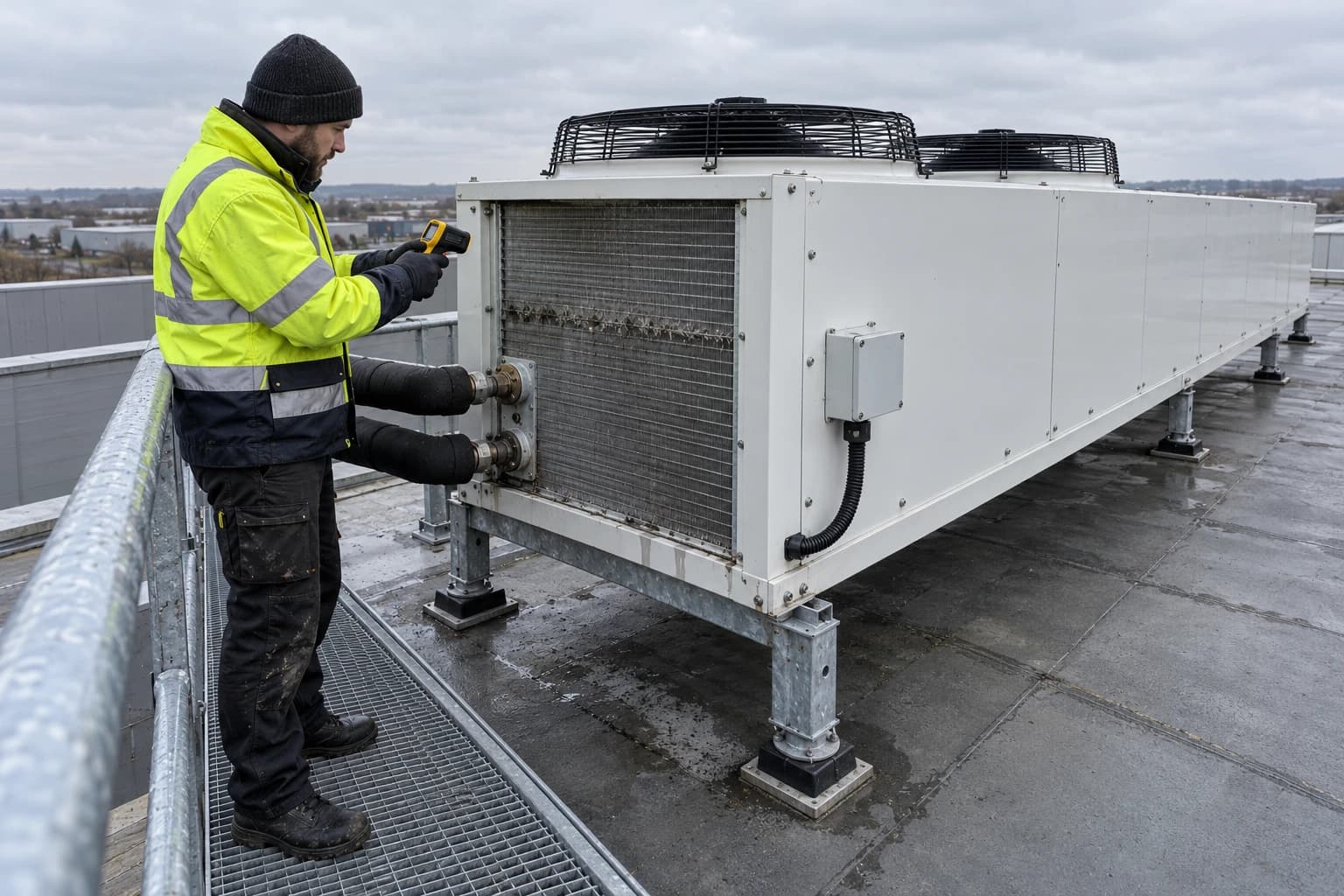
Predictive maintenance for industrial refrigeration uses operating data to identify developing equipment faults before they cause a temperature excursion, emergency shutdown or product loss.
A cold store can remain within its temperature setpoint while refrigeration capacity deteriorates. Compressor power can rise for the same duty. A receiver level can drift. Condensing pressure can climb as heat rejection weakens. Traditional alarm thresholds may remain untouched until the available operating margin has narrowed.
That makes time-stamped PLC data valuable to refrigeration engineers. Compressor packs, variable-speed drives, evaporator controllers and supervisory systems already record much of the evidence needed to spot a developing fault. Predictive maintenance converts those measurements into an earlier engineering prompt: investigate, verify the condition, schedule the repair and protect product before an alarm becomes an incident.
For food and beverage operations, the objective is practical. Engineers do not need a system that claims to predict an exact failure date. They need earlier warning of refrigerant leakage, compressor degradation, poor condenser performance or abnormal defrost behaviour, with enough context to decide what to inspect.
Why predictive maintenance for industrial refrigeration matters
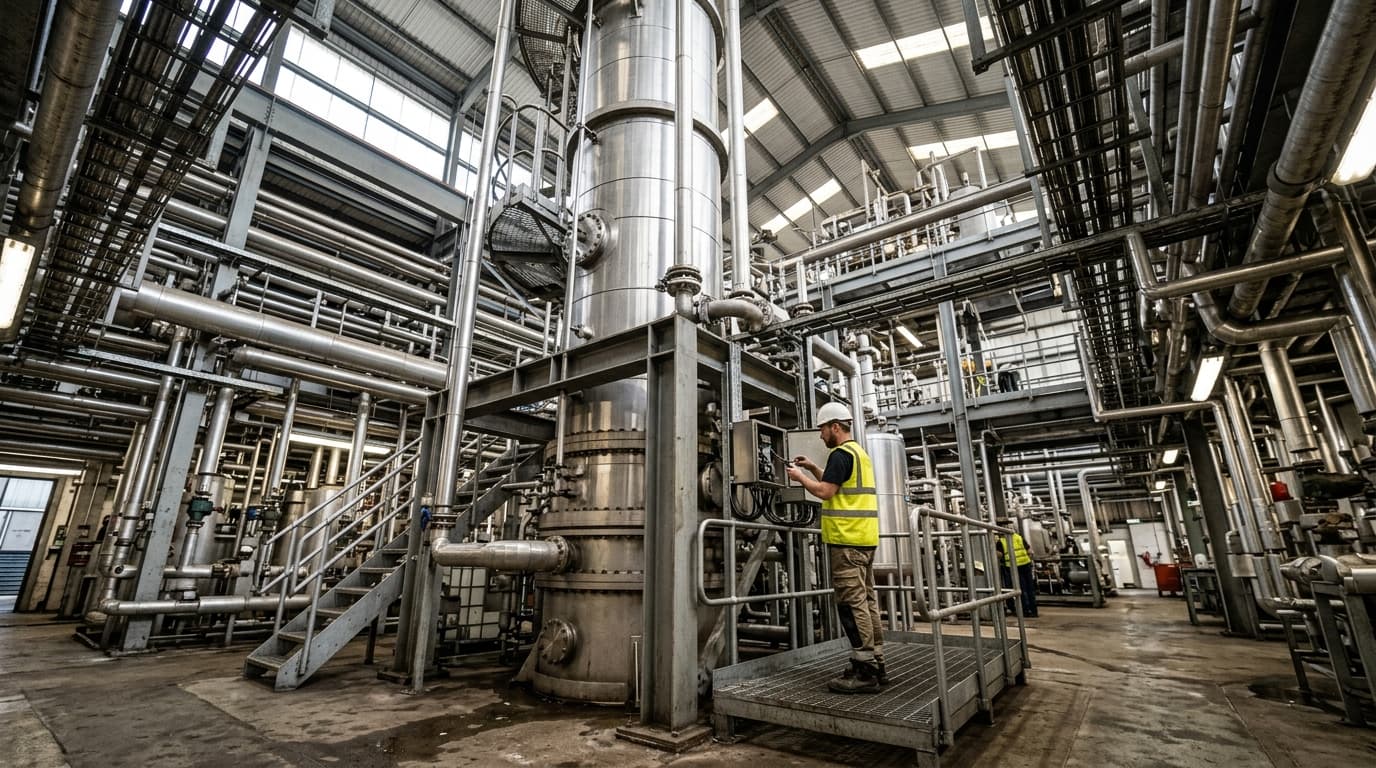
Industrial refrigeration supports chilled storage, frozen stock, blast freezing, process cooling, fermentation, ingredient handling and dispatch. A plant failure can interrupt production, trigger product segregation, constrain warehouse capacity and force emergency engineering work.
The financial impact extends beyond repair costs. A deteriorating refrigeration system often consumes more electricity before it loses temperature control. Higher condensing pressure, reduced evaporator heat transfer, cycling compressors and unstable controls increase the work required to maintain a given condition.
The Energy Technology List identifies refrigeration compressors as central components in vapour-compression and transcritical R744 refrigeration cycles. Its compressor criteria cover high-, medium- and low-temperature applications, including transcritical and subcritical CO₂ systems used in industrial settings such as breweries.
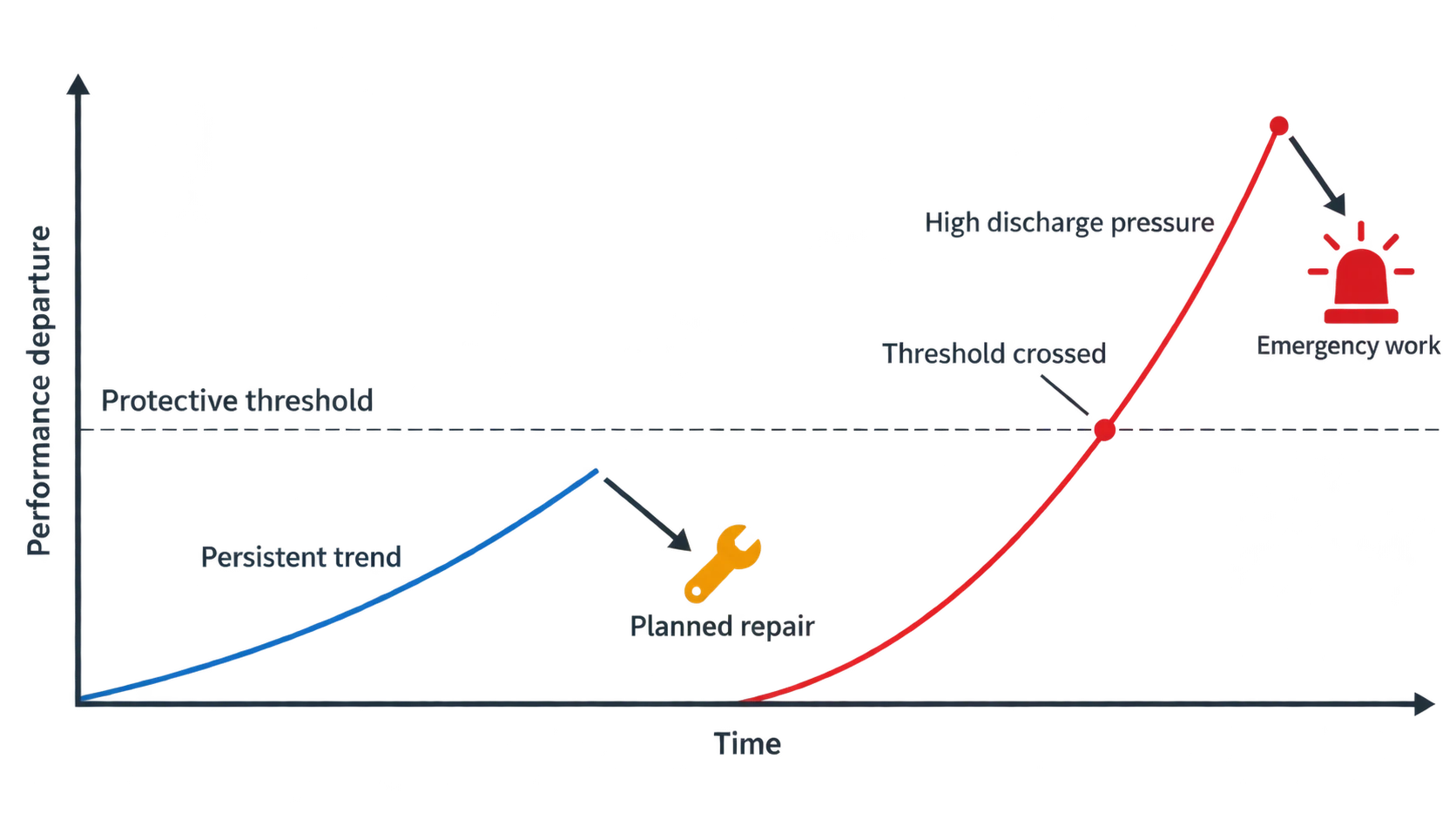
Predictive maintenance helps teams detect a departure from normal performance before the plant reaches a protective limit. It gives maintenance managers time to allocate labour, obtain parts, coordinate access and select a lower-risk intervention window.
Alarms protect plant, trends expose deterioration
An alarm is a protective control measure. It identifies a condition that has crossed a predefined threshold, such as high discharge pressure, low suction pressure, high room temperature or a compressor trip.
A trend can identify a weaker but persistent change before that threshold is reached. A compressor may need longer run time during comparable production periods. A condenser fan may operate at a higher speed than its historical range for the same ambient conditions. An evaporator may show a widening air-temperature difference during normal refrigeration duty.
These patterns require comparison with relevant operating conditions. A rise in discharge pressure on a hot afternoon does not automatically indicate condenser fouling. The interpretation changes if the rise persists after ambient temperature falls, fan status remains normal and refrigeration load is comparable.
Product exposure sets the maintenance priority
An anomaly score alone does not determine urgency. The engineering response should reflect the asset’s effect on food safety, product integrity and production continuity.
A refrigeration pack serving high-value frozen stock may need prompt investigation even if the temperature remains stable. A deviation on a duty-standby compressor arrangement may be monitored until the next planned inspection. Engineers should assess available redundancy, room temperature margin, product turnover, repair lead time and the trend’s rate of change.
Omni Vision delivers turnkey utility metering, CO2 tracking, and AI-powered production KPI intelligence — giving you real-time dashboards and actionable insights across your entire facility.
Which PLC data supports refrigeration fault prediction?
The strongest maintenance models combine refrigeration measurements, equipment status, control position and electrical demand. PLC data should be reviewed during commissioning to confirm tag naming, scaling, engineering units and time alignment.
Core refrigeration signals
| Data point | Maintenance value |
|---|---|
| Suction pressure and temperature | Indicates load changes, evaporator restriction, control instability or reduced refrigerant availability |
| Discharge pressure and temperature | Supports diagnosis of poor heat rejection, fan issues, elevated ambient conditions and compressor stress |
| Compressor current, power and speed | Identifies abnormal loading, excessive work, cycling or electrical changes |
| Compressor run hours, starts and trips | Reveals cycling, duty imbalance, overload and repeated protective events |
| Receiver liquid level | Supports investigation of refrigerant inventory changes where the system has a suitable level measurement |
| Evaporator air-on and air-off temperature | Indicates heat-transfer deterioration, icing, airflow restriction or load variation |
| Condenser fan status and drive feedback | Helps identify reduced heat rejection or a fan-control issue |
| Expansion-valve position and superheat | Indicates possible starving, unstable feed or control hunting |
| Defrost state and duration | Helps separate expected defrost behaviour from icing, heater or valve faults |
| Room temperature, door status and setpoint | Provides operating context for refrigeration load and recovery performance |
Setpoints, operating modes, manual overrides, maintenance events and alarms should accompany the measurement set. Without those records, a detection model may misclassify a planned defrost, washdown, shutdown or production change as an equipment fault.
Data quality determines alert quality
A drifting pressure transmitter can resemble a refrigeration problem. A reversed current transformer can create misleading energy trends. A room sensor installed close to a door can distort the apparent thermal load.
Before using data for fault prediction, site teams should confirm:
- Sensor range and engineering units.
- Time synchronisation between control panels and meters.
- Plausible values during known operating states.
- Consistent asset names across PLC tags, maintenance records and drawings.
- A clear record of sensor replacement, refrigerant additions and control changes.
This work reduces false alerts and makes later investigations faster. It also allows engineers to distinguish a plant condition from an instrumentation problem.
Refrigerant leakage detection from performance drift
Refrigerant leakage affects capacity, energy use, maintenance cost and environmental compliance. For equipment containing F gas equivalent to 500 tonnes CO₂e or more, UK guidance requires an automatic leak-detection system. Operators must arrange an annual check of that system on refrigeration equipment.
Performance analytics does not replace statutory leak checks, fixed leak detection or examination by appropriately qualified personnel. It provides another source of evidence that a circuit may be losing charge before the condition develops into a capacity problem.
How a slow leak can appear in operating data
A developing leak often produces a combination of smaller changes:
- Receiver liquid level falls during comparable operating conditions.
- Superheat or expansion-valve position shifts from its established range.
- Compressor run time or speed rises while room-temperature demand remains similar.
- Pull-down performance weakens after comparable door-opening or production activity.
- Compressor electrical input rises during matched operating periods.
The final indicator needs careful treatment. Electrical input per unit of refrigeration duty requires an independently measured duty value. On a chilled-water or glycol circuit, this may require fluid-flow measurement and accurately measured supply and return temperatures. On a direct-expansion cold store, air-side measurements and moisture effects can make duty calculation more difficult.
Where no measured cooling duty exists, engineers should compare compressor power, speed, run time and room-temperature recovery across equivalent operating windows. This produces a useful operational comparison without claiming a calculated efficiency value that the available data cannot support.
Receiver level needs operating context
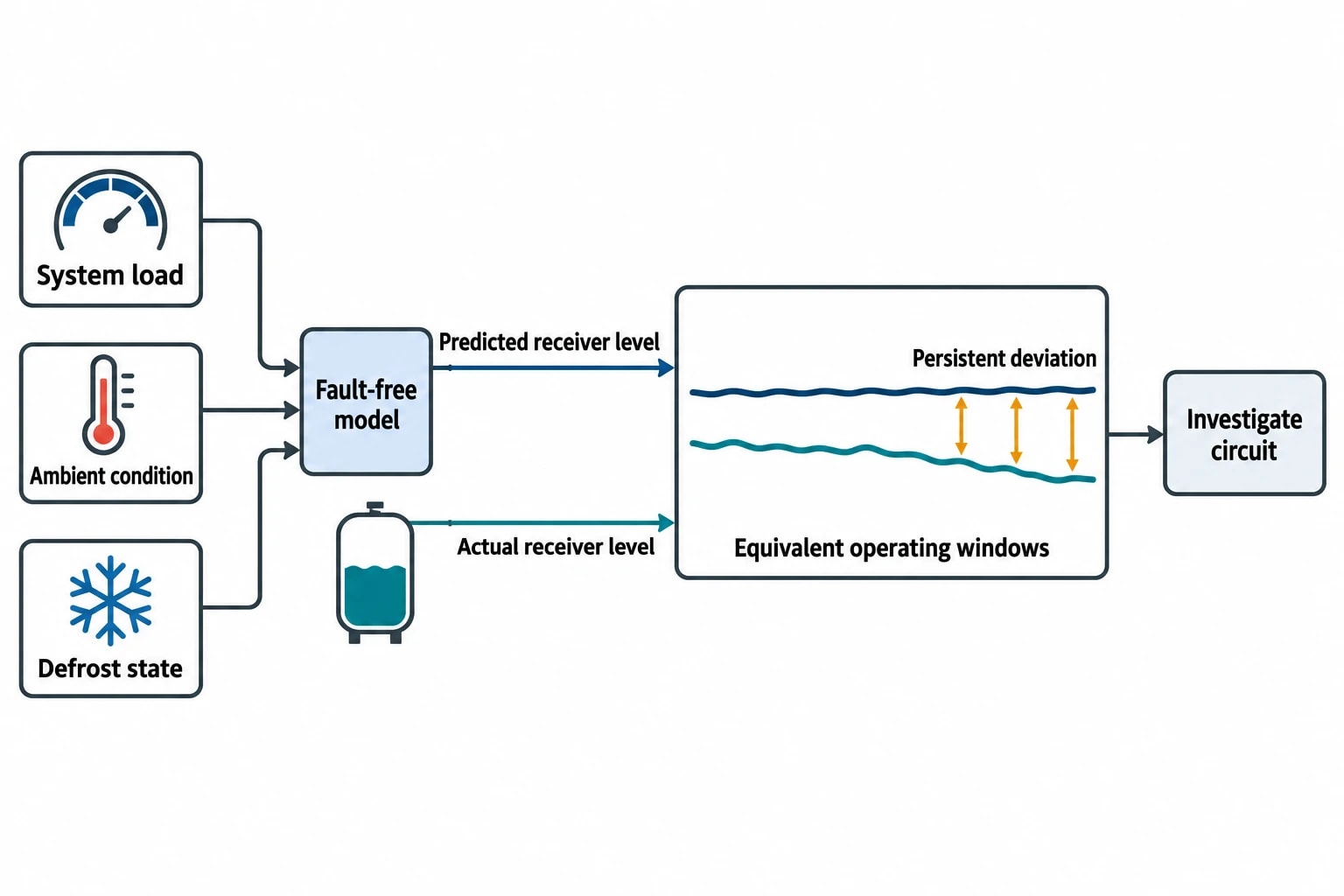
Receiver level changes with system load, ambient condition, defrost state and plant configuration. A single low reading does not prove refrigerant loss.
Research published in the International Journal of Refrigeration in 2024 examined industrial installation data by comparing actual receiver liquid level with a predicted fault-free level. The study found that receiver level and system-performance indicators can support long-term refrigerant leak detection. This approach compares a plant with its expected behaviour under stated conditions rather than relying on a generic low-level threshold.
A meaningful alert should identify the duration of the deviation, the operating conditions included in the comparison and the records that support the finding. Engineers can then inspect the circuit, review refrigerant additions and carry out appropriate testing.
A predictive alert does not locate the leak
A trend can indicate that refrigerant behaviour has changed. It cannot identify the exact leak point or replace a qualified inspection.
The maintenance case should link the alert to the refrigerant register, circuit charge, prior repairs, service history and mandatory leak-check status. That creates an auditable starting point for investigation and helps the engineer decide whether the deviation relates to leakage, control behaviour, changing load or sensor error.
Detecting compressor degradation before failure
Compressor degradation can arise from mechanical wear, valve problems, lubrication issues, overheating, electrical faults or abnormal operating conditions. A single high-current reading rarely provides a reliable diagnosis.
The maintenance value comes from combining electrical and refrigeration signals over time.
Compare equivalent operating windows
A compressor should be assessed against periods with similar conditions:
- Equivalent room or process setpoints.
- Similar outdoor conditions for air-cooled condensers.
- Similar production throughput or product loading.
- Comparable defrost status.
- Similar pack staging and compressor speed.
This comparison avoids treating seasonal variation or a planned production change as degradation. It also reveals when a compressor needs progressively more work to provide the same service.
Patterns that justify investigation
A developing compressor issue may present as rising current, higher discharge temperature, longer run time, increased starts, altered suction conditions and slower room-temperature recovery. The combination matters more than any individual measurement.
For example, rising electrical current may result from higher cooling load or elevated condensing pressure. Investigation is more justified when current rises alongside longer run time, persistent high discharge temperature and worsening room recovery during comparable periods.
Where vibration or bearing-temperature instrumentation is present, it can add useful evidence. Those measurements should complement refrigeration performance data. Mechanical condition and cycle performance need to be considered together.
Residual analysis provides an earlier signal
A residual is the difference between an expected value and the observed value. A predictive model may estimate expected compressor power from variables such as suction pressure, discharge pressure, speed, ambient condition and operating state. The residual increases when actual power persistently exceeds that expectation.
This method is more selective than a static high-power alarm because it considers the conditions under which the compressor operates. A widening residual warrants investigation, particularly when it coincides with more frequent trips, reduced capacity or increasing discharge temperature.
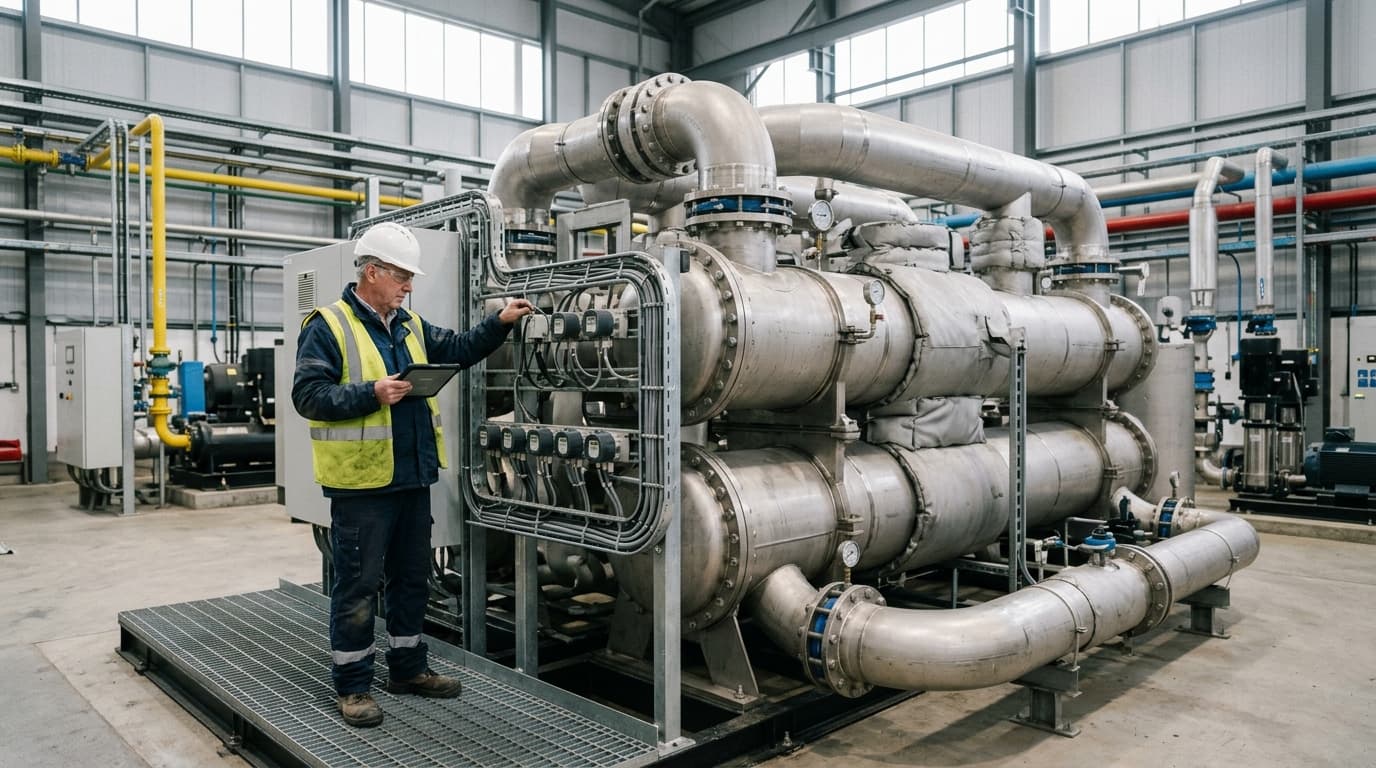
Track energy consumption, emissions, and process parameters with seamless PLC/SCADA integration via Modbus, OPC-UA, and MQTT protocols.
Turning anomalies into maintenance action
A dashboard alone does not reduce refrigeration risk. The maintenance process needs to convert an anomaly into a defined engineering task.
Five questions each alert should answer
A useful refrigeration alert should state:
- Which compressor, pack, condenser, evaporator or circuit is affected?
- Which measurement or relationship has moved outside its normal range?
- How long has the deviation persisted?
- What operational consequence could follow if it continues?
- Which checks should the refrigeration engineer perform first?
An alert for a low-temperature compressor could show sustained rising power and discharge temperature during comparable duty periods, increased run time over seven days and slower room-temperature recovery. The engineer can then inspect condenser heat rejection, refrigerant condition, compressor operation and sensor integrity.
Engineer feedback improves the programme
Completed investigations should be classified as a confirmed mechanical fault, refrigeration-system condition, controls issue, instrumentation problem or no fault found. Maintenance teams should also record the corrective action and completion date.
This feedback enables alert rules or the data model to be reviewed against real outcomes. It helps remove nuisance alerts, identify missing data points and build confidence that the system highlights conditions worth investigating.
Prioritise operational exposure
Maintenance planners should rank faults according to food safety exposure, product value, available redundancy, rate of deterioration and repair lead time. A persistent trend on a pack serving a freezer with limited standby capacity deserves earlier action than a similar deviation on a non-critical asset with full redundancy.
Temperature margin also matters. A room operating close to its acceptable limit has less capacity to absorb a compressor or condenser problem. Predictive maintenance should make that margin visible before a high-temperature alarm forces an emergency response.
BS EN 378 and ETL criteria in the maintenance plan
BS EN 378-1:2016+A1:2020 sets out basic requirements, definitions, classification and selection criteria for refrigerating systems and heat pumps. BS EN 378-4:2016+A1:2019 covers operation, maintenance, repair and recovery.
These standards provide the safety and environmental framework around refrigeration plant management. A predictive maintenance system can support records, trends and early intervention, but it does not establish compliance by itself. Operators remain responsible for appropriate inspection, documented maintenance, risk assessment, competent personnel and corrective work.
ETL performance criteria provide a reference point
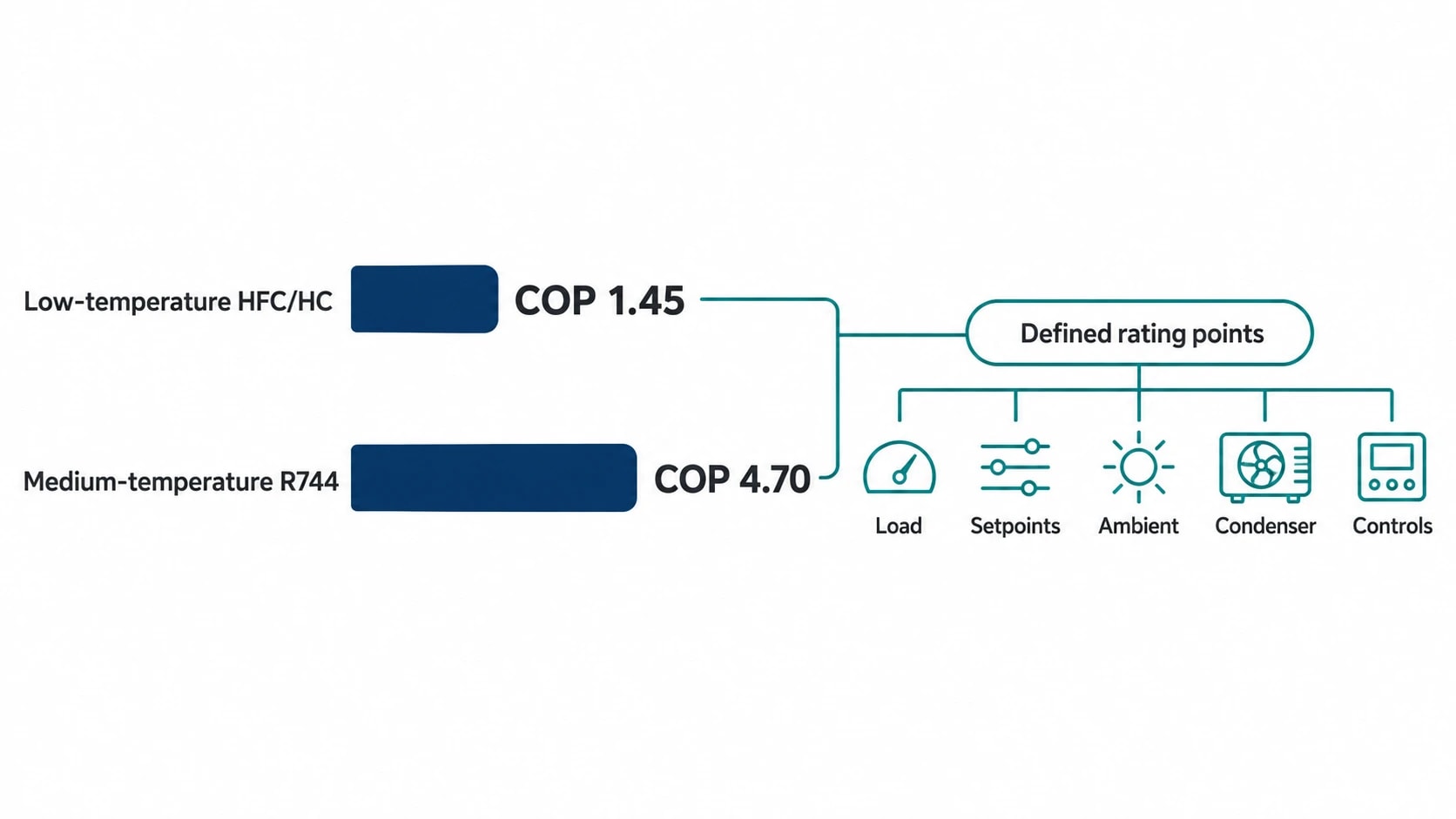
The Energy Technology List assesses refrigeration compressors at specified rating conditions. Its current COP thresholds range from 1.45 for low-temperature HFC or hydrocarbon compressor applications to 4.70 for medium-temperature transcritical or subcritical R744 applications.
Those values should not be treated as site performance targets. They apply at defined rating points, while actual energy use depends on load, setpoints, ambient conditions, condenser performance, controls and system condition.
They remain useful in maintenance planning. When an asset’s operating trends deteriorate, engineers can ask whether the issue lies with the compressor or the wider refrigeration system. Poor heat rejection, unstable head-pressure control, inadequate defrost performance and refrigerant loss can all cause an efficient compressor to perform poorly on site.
Building a practical predictive maintenance programme
A staged deployment helps maintenance teams establish useful alerts without flooding engineers with low-value notifications.
Begin with an asset and failure review
The first step is to identify refrigeration packs, compressors, condensers, evaporators, cold rooms, control panels and existing measurements. The review should document refrigerant type, asset criticality, available redundancy, known failure history and the consequences of capacity loss.
Sites should then identify the highest-risk failure modes. Refrigerant leakage, compressor degradation, condenser fouling, fan failure, evaporator icing and defrost faults are suitable priorities because they can affect capacity and energy use before a final trip occurs.
Establish normal operating behaviour
The baseline period should cover production cycles, defrosts, changing ambient conditions, cleaning activity and planned shutdowns. Engineers should define comparable operating states before setting escalation criteria.
A site may begin with rule-based detection, such as persistent elevated discharge pressure under matched conditions. It can then add expected-value models as the data history matures. The progression should follow engineering evidence, not software ambition.
Keep the response focused on refrigeration performance
The most valuable predictive maintenance programme identifies a developing condition early enough for a refrigeration engineer to act. It preserves the trend evidence, records the outcome and improves the next decision.
For food and beverage sites, that means fewer emergency call-outs, better control of refrigeration energy use and more time to prevent a plant condition becoming a cold-storage failure.
This article reflects the independent analysis and editorial opinion of EnerTherm Engineering. Product names, trademarks, and brands mentioned belong to their respective owners. EnerTherm Engineering is not affiliated with, endorsed by, or a licensee of any third-party software or product mentioned unless explicitly stated.

Managing Director — EnerTherm Engineering
Dr. François Pierrel is Managing Director of EnerTherm Engineering with over two decades of expertise in thermal design, heat transfer, and industrial energy optimisation. He holds a PhD in Heat Transfer from Cranfield University and a Post-Doctorate from Heriot-Watt University.
