Realising Accurate Energy Savings by Remodelling Dryer Exhaust Performance
The Challenge: Validating Performance Variables
A manufacturing facility operating two distinct dryer lines identified an opportunity to integrate a waste heat recovery system into their exhaust ducting. While early feasibility assessments based on initial data provided a baseline for potential savings, key stakeholders required a higher level of certainty before committing capital expenditure. Previous audits had relied on static assumptions that did not fully account for the operational volatility inherent in the drying process.
The facility engaged an engineering consultancy firm to undertake a comprehensive, high-resolution mass balance exercise. The objective was to verify the actual exhaust temperature and velocity profiles across both lines, ensuring that the proposed heat exchanger system would be sized correctly for real-world conditions rather than theoretical peaks.
Engineering Approach: High-Resolution Data Gathering
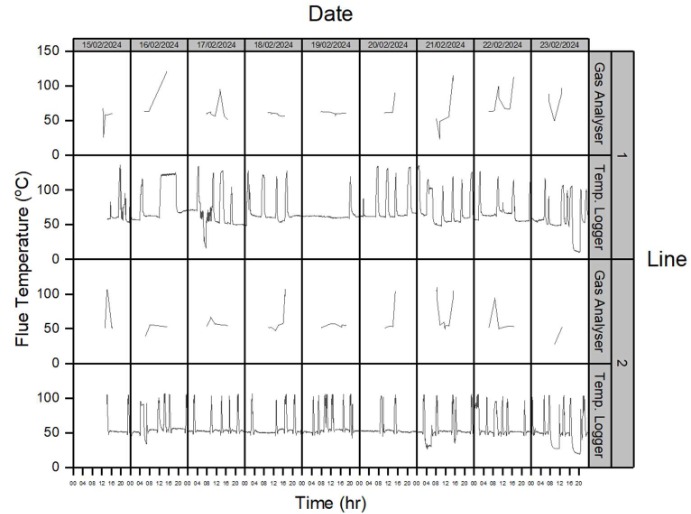
The team deployed a series of industrial-grade measurement tools, including gas analysers and continuous temperature data loggers, over a multi-day operation cycle. This approach allowed for the collection of high-frequency data, filtering out anomalies and capturing the true operational range of the dryer exhaust.
The investigation focused on two critical metrics: exhaust gas temperature and velocity. By collecting data simultaneously across both lines, the engineers could compare the consistency of Line 1 against the performance of Line 2. The data acquisition programme was designed to ensure that the resultant heat recovery design would remain robust against fluctuations in production demand.
Findings: Identifying Line-Specific Variability
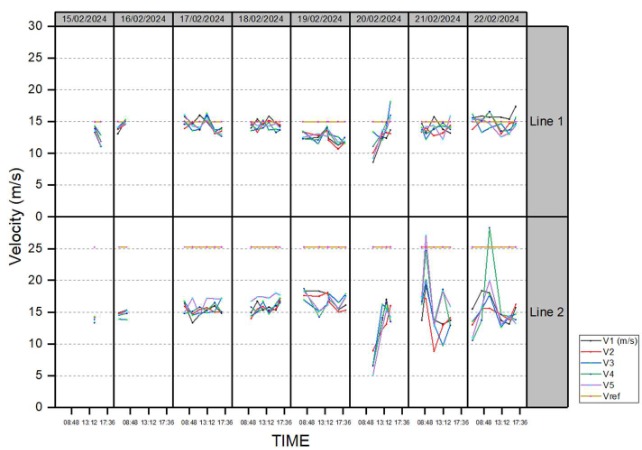
The site measurements revealed distinct operational differences between the two dryer lines. Line 1 demonstrated a consistent profile, with exhaust gas velocities holding steady at approximately 15 m/s. This stability aligned closely with the findings of the previous thermal recovery project, providing confidence in the baseline data for this specific line.
Conversely, the data for Line 2 indicated significant instability. Measured velocities fluctuated wildly, ranging from as low as 6.78 m/s to as high as 21.64 m/s. This variance deviated significantly from the previous assumption of a constant 25 m/s airflow. The analysis concluded that the previous thermal recovery project had overestimated the available mass flow for Line 2, a finding that necessitated a recalculation of the expected energy recovery potential.
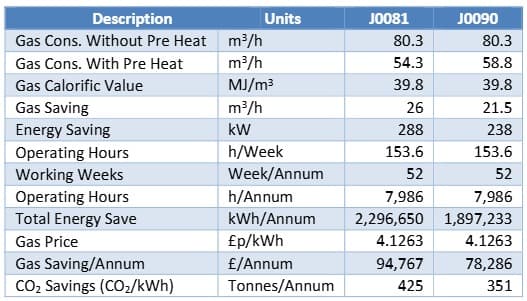
| Description | Units | The previous thermal recovery project | The thermal recovery project |
|---|---|---|---|
| Gas Cons. Without Pre Heat | m³/h | 80.3 | 80.3 |
| Gas Cons. With Pre Heat | m³/h | 54.3 | 58.8 |
| Gas Saving | m³/h | 26 | 21.5 |
| Energy Saving | kW | 288 | 238 |
| Total Energy Save | kWh/Annum | 2,296,650 | 1,897,233 |
| Gas Saving/Annum | £/Annum | 94,767 | 78,286 |
| CO₂ Savings | Tonnes/Annum | 425 | 351 |
Operational Impact and Recalibration
The disparity between the initial estimates and the validated onsite data highlighted the critical value of detailed CFD and mass flow analysis prior to equipment procurement. By revising the gas savings to 21.5 m³/h, the engineering team prevented the risk of installing oversized heat recovery hardware, which would have operated inefficiently and failed to deliver the projected return on investment.
The revised analysis provided the project stakeholders with a clear, defensible business case. While the annual gas savings were adjusted to £78,286 per annum, this figure is grounded in empirical data, providing the client with an accurate representation of the project's financial viability. Furthermore, the analysis quantified the CO₂ reduction at 351 tonnes per annum, ensuring that the facility's sustainability targets remain achievable and transparent.
Conclusion
The thermal recovery project analysis report underscores that precision in the early stages of project development is paramount. The facility now moves forward with a heat recovery strategy designed for the reality of their production line performance, rather than theoretical models. Through rigorous process evaluation and data-led decision making, the client successfully mitigated the financial risk of over-capitalisation while maintaining a clear pathway to significant energy and carbon reductions.

Managing Director — EnerTherm Engineering
Dr. François Pierrel is Managing Director of EnerTherm Engineering with over two decades of expertise in thermal design, heat transfer, and industrial energy optimisation. He holds a PhD in Heat Transfer from Cranfield University and a Post-Doctorate from Heriot-Watt University.
