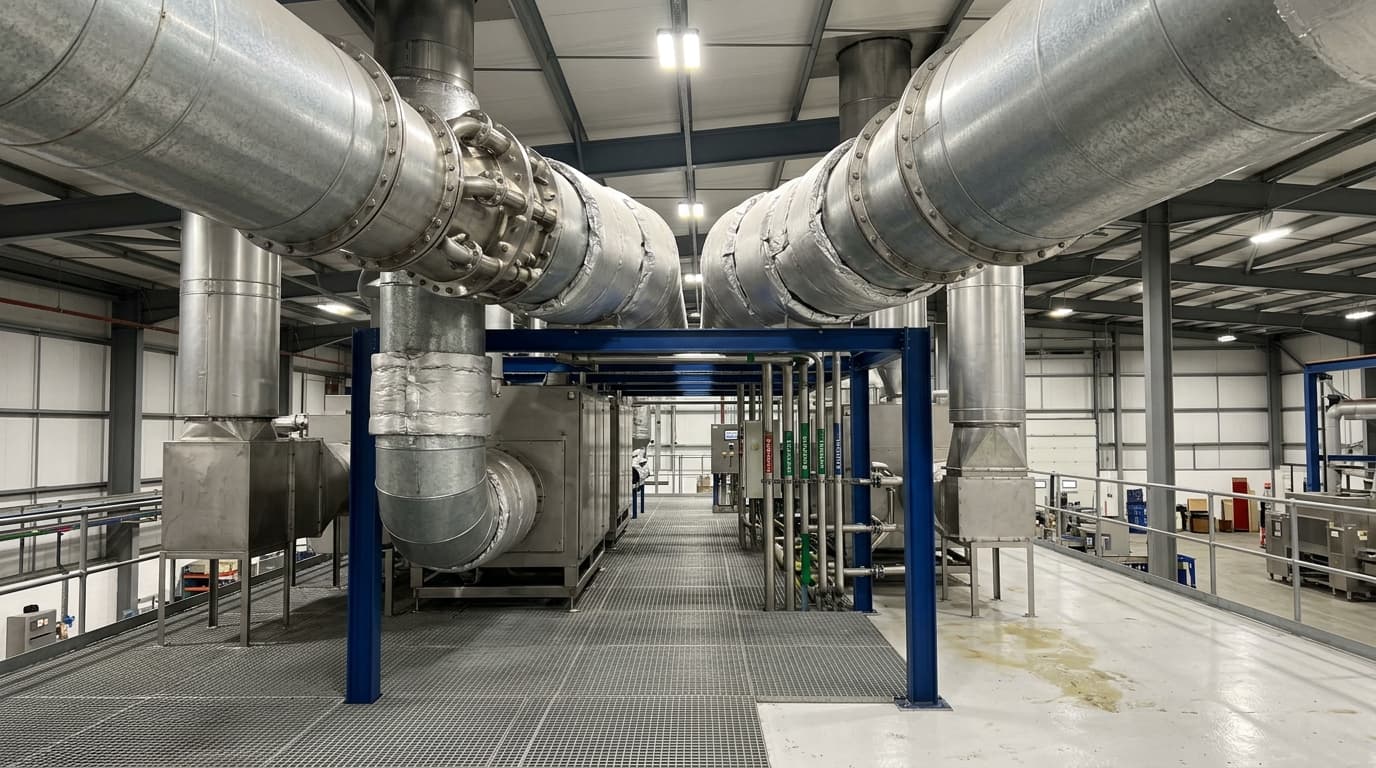
Reducing Gas Consumption by 53% Through Advanced Heat Recovery at a Food Production Facility
Operational Context
A food production facility in a region in Northern England was operating two primary dryer lines that were venting significant volumes of thermal energy directly into the atmosphere. With each line consuming 71 m³/h of gas, the site was experiencing considerable thermal loss, presenting a clear opportunity to improve operational efficiency. The facility operator engaged an industrial engineering consultancy to assess the feasibility of integrating a heat recovery strategy to reclaim this wasted energy.
The primary objective was to analyse the composition, flow rate, and temperature of the stack flue gases from the drying lines. By characterising this exhaust, the team aimed to determine the potential reduction in gas consumption achievable through pre-heating the combustion air.
Investigating Thermal Efficiency
The project engineer team conducted a site visit to survey the dryers in lines 1 and 2. While an initial assessment had focused exclusively on Line 1, discussions on-site confirmed the strategic advantage of extending the analysis to include the flue gases from Line 2. This expansion was essential to develop a holistic approach to energy saving, rather than treating the lines as isolated units.
To ensure precision in the installation design, the team utilised 3D laser scanning. This technology provided a comprehensive visual and spatial representation of the mezzanine and ground floor areas. The scan served three critical purposes:
- Evaluating the suitability of the space for a bespoke heat recovery system.
- Identifying viable routes for new ductwork and ancillary equipment.
- Creating a digital reference model to facilitate future plant modifications and maintenance.
Data-Driven Design
The collected flow data allowed for a rigorous heat and mass balance analysis. The investigation revealed that by redirecting flue gas heat, the plant could fundamentally alter the combustion profile of the dryers. By capturing waste heat from both Line 1 and Line 2, the facility could reduce gas consumption from the baseline of 71 m³/h to 33 m³/h per line. This represents a reduction of 38 m³/h, a significant improvement over treating a single line.
The engineering team also examined the exhausted air parameters from the Line 1 cooler, determining that this stream could be integrated into the combustion air feed for the burner, further enhancing the savings profile.
Project Impact
The financial and operational benefits of the proposed heat recovery installation are substantial. The following table illustrates the projected performance gains based on the combined output of Lines 1 and 2 compared to the baseline.
| Metric | Baseline (No Pre-Heat) | Proposed (With Pre-Heat) |
|---|---|---|
| Gas Consumption (per line) | 71 m³/h | 33 m³/h |
| Total Energy Saving/Annum | - | 3,670,091 kWh |
| Total Gas Saving/Annum | - | 403,710 £/annum |
| Payback Period | - | 1.6 Years |
The analysis indicates that the project offers a robust return on investment, with a payback period of just 1.6 years. The capital expenditure accounts for the installation of high-efficiency heat exchangers and a tailored ductwork configuration, as informed by the 3D spatial data.
Process Control Integration
Beyond the thermal recovery installation, the project engineer team identified an opportunity to optimise the end-product quality. During the site survey, the team located an ideal mounting point for an online moisture meter. This device will allow the facility to monitor and control final dryer moisture levels in real time.
The facility is currently in discussions to initiate a trial of this monitoring system. This addition complements the energy reduction measures by ensuring that while gas consumption is minimised, product quality remains consistent. By combining advanced heat recovery with precise process control, the client is positioned to significantly lower operating costs while maintaining the integrity of their production processes.

Managing Director — EnerTherm Engineering
Dr. François Pierrel is Managing Director of EnerTherm Engineering with over two decades of expertise in thermal design, heat transfer, and industrial energy optimisation. He holds a PhD in Heat Transfer from Cranfield University and a Post-Doctorate from Heriot-Watt University.
