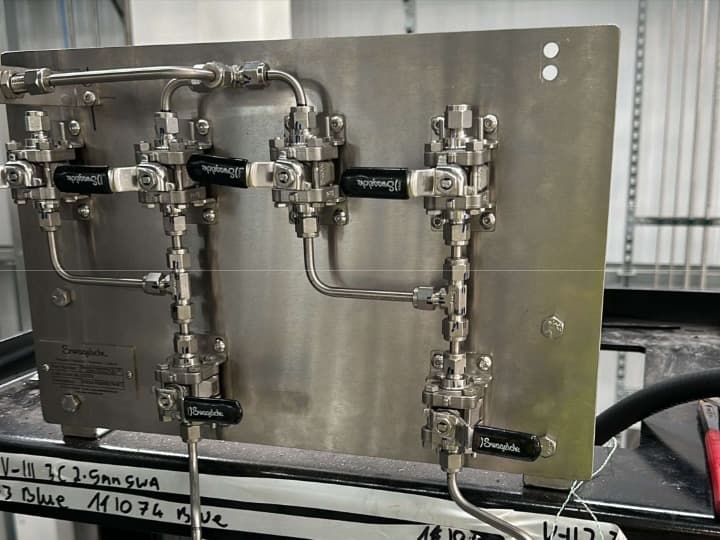
Standardising Process Temperature: Trace Heating for Manufacturing Streams
A client manufacturing company operating in the local district of operations required consistent thermal management for process pipework to maintain fluid viscosity and reactor performance. The facility faced challenges regarding heat loss at valve manifolds and reactor interfaces, which threatened the stability of the production output. To address this, the installation service provider was commissioned to design and install a comprehensive trace heating system across two distinct production streams.
Phase 1: Addressing Infrastructure Constraints
The initial phase of the project, detailed in the phase 1 installation documentation, focused on the integration of hot and cold trace heating loops. During the site survey, the technical team identified a critical integration challenge at the reactor interface. The back plate mounting the valves was acting as a heat sink, creating a risk of excessive thermal dissipation that would compromise the efficacy of the trace heating.
The installation service provider coordinated with a specialist engineering firm to relocate the back plate by 25 mm. This adjustment provided the necessary clearance to install the heating cable and the subsequent thermal insulation without compromising the structural integrity of the valve assembly. Following this modification, the team finalised the trace heating routes, ensuring a single continuous pipe length above the reactor to minimise joint risks.
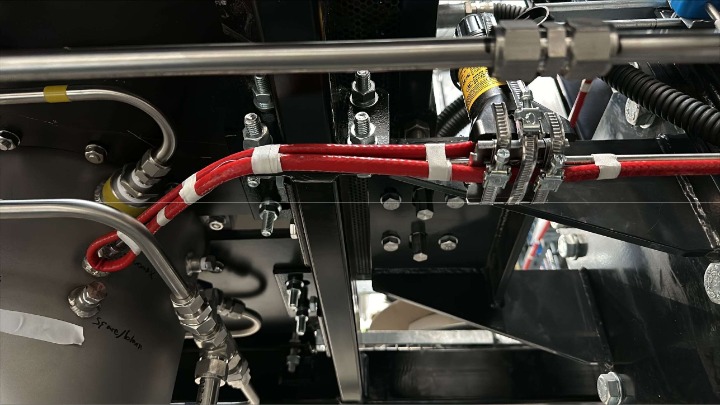
Technical Specifications and Load Calculations
The system design required precise power output management to meet the operational temperature targets. The installation service provider specified different cable outputs for the hot and cold streams, ensuring both were protected by a 30 mA RCD and a 25 amp breaker. The following table outlines the load requirements calculated for the installation.
| System Type | Nominal Output (W/m) | Total Length (m) | Calculated Current (A) |
|---|---|---|---|
| Cold Trace Heating | 16 | 11.6 | 0.8 |
| Hot Trace Heating | 92 | 6.6 | 2.64 |
The electrical configuration required a return leg for the trace heating cables, as the controller positioning and end termination geometry did not support a single-pass loop. The installation technicians consulted with a heating equipment manufacturer to confirm the feasibility of this arrangement, ensuring a minimum 15 mm clearance was maintained between parallel heating legs to prevent localised overheating.
Phase 2: Stream 2 Implementation and Remediation
The second phase of the project, outlined in the phase 2 installation documentation, involved scaling the trace heating solution to the second production stream. Upon arrival, the installation technicians observed that the pipework leading to the control panel was incomplete. The site contact coordinated the necessary pipework installation, allowing the team to proceed with the cable routing.
During the inspection, the team identified that temporary cabling previously installed was insufficient for operational requirements. The existing wires were undersized at less than 2.5 mm squared, which presented a fire risk and would have failed under the specified electrical load. The team replaced these with compliant, the client site representativeust cabling suitable for long-term industrial use.
Thermal Integrity and Commissioning
The final installation involved fitting the thermal insulation around the trace heating cables. This stage proved challenging due to restricted clearance around the pipework, which necessitated thinning the insulation layer to accommodate the geometry. The installation service provider managed this constraint to ensure the heat tracing continued to control the process temperature at 60 degrees Celsius.
A post-installation inspection using infrared monitoring initially flagged areas that appeared as hot spots. However, diagnostic checks confirmed this was a result of the reflectivity of the trace heating components interfering with the sensor readings rather than actual thermal leakage. No excessive heat loss was detected in areas where the insulation was correctly applied.
Outcome
The installation of the trace heating systems for both production streams was successfully completed. By resolving the back plate clearance issues, upgrading the electrical wiring, and accurately calibrating the heat outputs for the respective hot and cold loops, the installation service provider achieved stable thermal control at the required 60 degrees Celsius. The client manufacturing company successfully integrated the new system, ensuring consistent performance for the ongoing production programme.

Managing Director — EnerTherm Engineering
Dr. François Pierrel is Managing Director of EnerTherm Engineering with over two decades of expertise in thermal design, heat transfer, and industrial energy optimisation. He holds a PhD in Heat Transfer from Cranfield University and a Post-Doctorate from Heriot-Watt University.
