Thermodynamic Property Package Selection: NRTL or SRK?
How DWSIM VLE data regression validates packages for reactors and distillation
Thermodynamic property package selection is the choice of models and fitted parameters used to calculate phase equilibrium, enthalpy, density and related fluid properties in a process simulation. That choice can move a predicted azeotrope, vapour fraction, reboiler duty or recycle composition far enough to change an engineering decision.
NRTL and Soave-Redlich-Kwong, usually shortened to SRK, address different mixture behaviours. NRTL is an activity-coefficient model for strongly non-ideal liquid mixtures. SRK is a cubic equation of state used widely for hydrocarbons and gases. A flowsheet can converge with either method while describing the wrong physical behaviour.
The practical question for a petrochemical, specialty chemical or fine chemical plant is not which package has the stronger reputation. It is which package, parameter set and validation evidence represent the fluids, phases and operating conditions that control the duty under review.
What thermodynamic property package selection controls
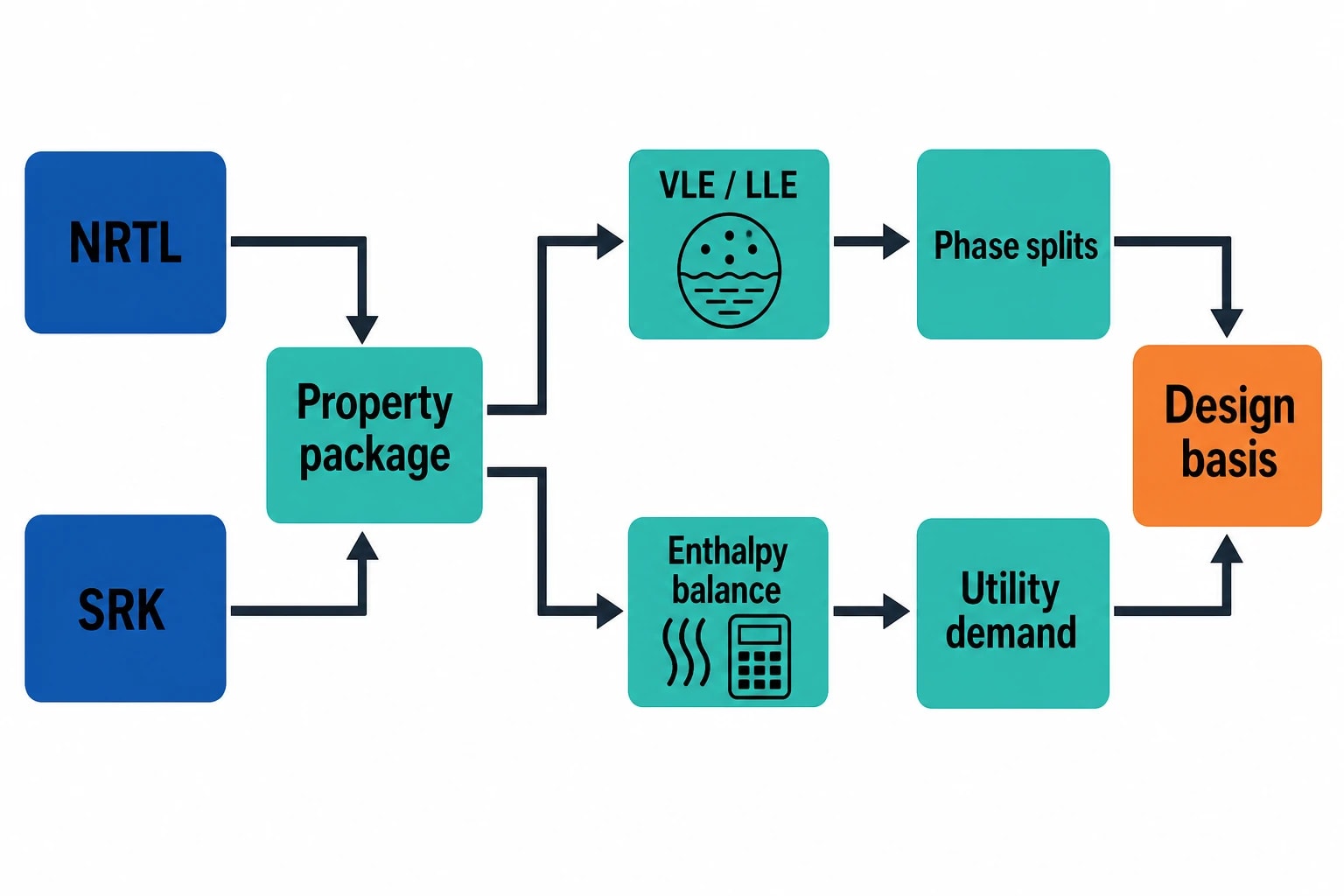
A property package supplies the relationships used repeatedly by Aspen Plus, Aspen HYSYS, DWSIM and comparable simulators. Unit operations draw on those relationships to calculate phase splits, equilibrium compositions, enthalpy changes, density, heat capacity and, depending on the package, associated transport-property correlations.
Phase equilibrium sets the separation result
Distillation columns, flash vessels, absorbers, condensers and decanters depend on vapour-liquid equilibrium, liquid-liquid equilibrium, or both. An unsuitable model can predict an incorrect relative volatility. The resulting stage count, reflux ratio, recovery and utility demand then lose value as design inputs.
Water and ethanol illustrate the point. Their azeotrope constrains conventional distillation. The liquid phase is strongly non-ideal because of molecular interactions, including hydrogen bonding. NRTL is often an appropriate starting method because it represents liquid-phase non-ideality through activity coefficients.
A high-pressure hydrocarbon separator presents a different problem. Pressure-dependent vapour and liquid behaviour governs liquid dropout and gas composition. SRK or Peng-Robinson may be suitable starting methods because cubic equations of state describe these hydrocarbon phase relationships.
Enthalpy changes alter thermal duties
Property-package selection affects more than equilibrium compositions. It affects the enthalpy balance behind a reactor jacket, reboiler, condenser, feed preheater and heat-recovery study.
A shift in calculated vapour fraction changes the latent-heat contribution to a condenser or reboiler duty. In an exothermic reactor, the predicted outlet temperature depends on feed enthalpy, mixture heat capacity, reaction enthalpy treatment and possible phase change. Inadequate thermodynamics can therefore move a calculated utility demand or heat-exchanger sizing basis.
Recycles magnify small errors
A recycle loop returns any phase-equilibrium error to the front of the process. A component predicted to leave in a vapour purge rather than a liquid recovery stream may accumulate through successive passes. The flowsheet may report convergence while the calculated impurity level, purge requirement, compressor load or solvent circulation rate remains unrepresentative of plant operation.
Engineers should therefore review recycle-stream phase regimes, component splits and interaction-parameter coverage alongside convergence tolerances.

Map every energy and material flow in your process with detailed heat and mass balance calculations — the foundation for any optimisation or design project.
NRTL or SRK: the technical distinction
NRTL and SRK start from different thermodynamic frameworks. The molecular interactions, expected phases and pressure range should determine the initial choice.
NRTL for non-ideal liquid mixtures
NRTL, the Non-Random Two-Liquid model, is an activity-coefficient model. It is commonly applied where liquid mixtures deviate substantially from ideal behaviour, including systems containing water, alcohols, acids, aldehydes and ketones.
The model represents liquid-phase interactions through binary parameters. The reliability of those parameters matters as much as selecting NRTL from a simulator menu. Parameters fitted for one temperature range or composition region may be unsuitable for a different operating envelope.
DWSIM’s current Property Packages Guide identifies NRTL for alcohol/water systems and lists NRTL or UNIQUAC for acid/water mixtures, describing NRTL as the safer default. It also advises experimental verification where aldehyde or ketone behaviour is material to the result.
NRTL is often an appropriate package to evaluate first for:
Aqueous solvent recovery.
Alcohol dehydration and azeotropic distillation.
Acid/water separations.
Reactive distillation involving polar liquid mixtures.
Liquid-liquid extraction and decanter systems.
Fine-chemical processes containing polar organics and water.
This remains a starting hypothesis. Measured VLE, LLE or plant data must confirm the package and parameter set before the model supports a capital decision or debottlenecking recommendation.
SRK for hydrocarbons and gases
SRK, the Soave-Redlich-Kwong equation of state, is a cubic equation of state. It calculates vapour and liquid behaviour from a pressure-volume-temperature relationship and is widely used for non-polar gases and hydrocarbon mixtures.
DWSIM guidance positions cubic equations of state, including SRK and Peng-Robinson, for non-polar gases at elevated pressure. Its current package guide also lists SRK or Peng-Robinson with pseudo-components for petroleum cuts generated from boiling-curve data.
SRK can be a sensible first package for duties governed by:
Hydrocarbon vapour-liquid equilibrium.
Gas compression, cooling and condensation.
High-pressure flash calculations.
Light-hydrocarbon feed conditioning.
Petroleum fraction studies using pseudo-components.
Gas-phase recycle systems where pressure effects dominate.
SRK does not make NRTL redundant, and NRTL does not replace SRK in gas processing. The two methods address different phase-equilibrium problems.
Water is often the decisive component
Water frequently exposes a poor property-package choice. It forms strong hydrogen bonds, produces pronounced non-ideality with many oxygenated organics and may form azeotropes or separate liquid phases.
DWSIM specifically flags Peng-Robinson as effective for hydrocarbons and gases but poor for water/alcohol mixtures because the cubic equation-of-state form does not capture strong hydrogen bonding well. The same limitation should inform SRK screening. A hydrocarbon process with a trace, well-characterised water content may remain adequately represented by an equation of state with appropriate binary interaction parameters. A separation whose result depends on water partitioning needs direct validation.
A selection route for NRTL, SRK and alternatives
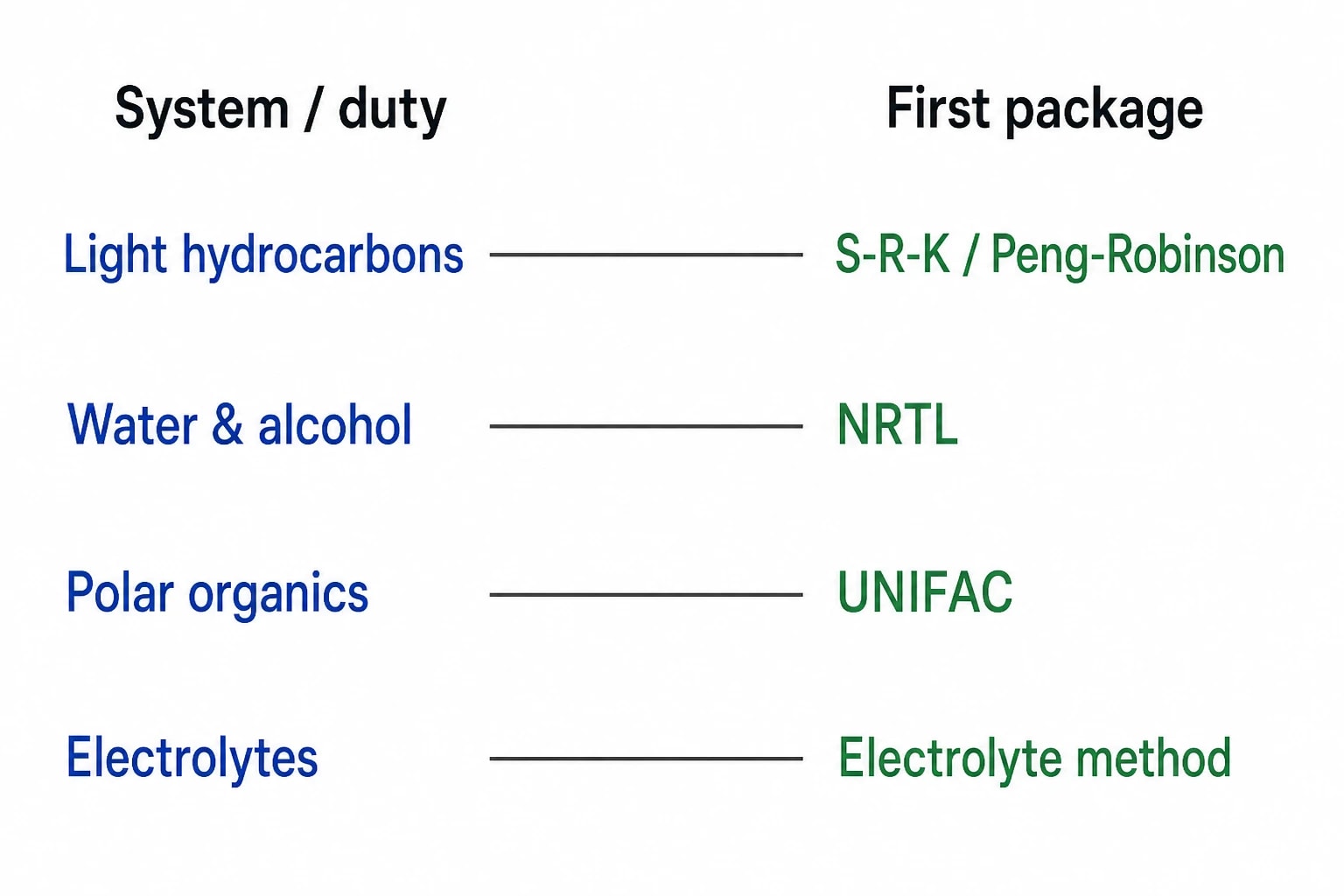
Thermodynamic property package selection should begin before detailed column specifications or heat-exchanger duties are fixed. The early screen should identify the chemistry, the phase behaviour that matters and the evidence available to test the model.
System or dutyFirst package to evaluateWhy it is a starting pointPrimary validation checkLight-hydrocarbon gas processingSRK or Peng-RobinsonCubic equations of state suit hydrocarbons and gasesDew point, liquid dropout, density and compressor discharge conditionPetroleum cuts with pseudo-componentsSRK or Peng-RobinsonCompatible with pseudo-component treatmentAssay characterisation, flash results and cut-point sensitivityWater and alcohol separationNRTLRepresents liquid-phase non-ideality and azeotropesVLE data, azeotrope position, reflux and reboiler dutyAcid and water mixtureNRTL or UNIQUACActivity-coefficient methods suit polar liquid mixturesVLE or LLE data, phase split and dutyMixed polar organics without fitted dataUNIFAC or Modified UNIFACProvides a group-contribution estimateSensitivity study and targeted data collectionAqueous electrolyte systemAn electrolyte method suited to the chemistryIonic speciation requires specialised treatmentpH, solubility, ionic strength and phase dataPure water or steam utility dutyIAPWS-IF97 steam tablesDedicated water and steam formulationSteam quality, enthalpy, density and condensate state
Define the real component inventory
Start with P&IDs, laboratory analyses, raw-material specifications, batch records and historical operating data. Include contaminants, solvents, catalyst residues, additives and utilities crossing the model boundary.
Nominal feed composition is often insufficient. A low-concentration impurity can create a second liquid phase, shift a dew point or alter an azeotrope. A process model should include the components capable of changing the physical behaviour relevant to the decision.
Specify the operating envelope
A model may fit one operating point while performing poorly at another. Grade changes, batch temperature excursions, pressure variation, seasonal cooling-water conditions and feed composition changes can each move the system into a different equilibrium region.
The validation envelope should state:
Feed-rate and composition ranges.
Temperature and pressure ranges.
Expected phases under normal operation.
Relevant start-up, shutdown and upset conditions.
The unit-operation outputs that will support a decision.
A package validated at atmospheric pressure should not be assumed suitable for a pressurised separator without supporting evidence.
Identify the governing equilibrium
The physical question should be explicit. VLE may control a distillation column. LLE may control a decanter or solvent extractor. Vapour-liquid-liquid equilibrium can determine the behaviour of a heterogeneous azeotropic system. Chemical reaction equilibrium and electrolyte speciation may control reactive aqueous systems.
A model built for the wrong governing equilibrium can produce polished results with little engineering meaning.
Binary interaction parameters make or break the package
A recognised property method can still be unsuitable for a particular binary pair. Binary interaction parameters are central to thermodynamic property package selection.
Check parameter coverage and provenance
For NRTL and UNIQUAC, interaction parameters describe liquid-phase interactions. For SRK and Peng-Robinson, binary interaction parameters affect mixture behaviour and phase-equilibrium predictions. Missing values, zero defaults, automatically generated estimates and values inherited from an older study each require review.
DWSIM advises engineers to confirm that required interaction parameters exist for the selected compounds. Its guidance also highlights the importance of binary interaction parameters for Peng-Robinson and SRK where carbon dioxide or hydrogen sulphide are present.
The same discipline applies across process simulators. Simulator choice does not remove the need to establish parameter source, temperature dependence, units, directionality and intended range of use.
Regress against the phase behaviour that matters
DWSIM’s Data Regression Utility supports binary-parameter regression for NRTL, UNIQUAC, Peng-Robinson and SRK. It accepts VLE datasets in Txy, Pxy and TPxy forms, plus LLE datasets in Txx, Pxx and TPxx forms.
Fit and test parameters against measurements resembling the duty under design. A distillation case requires relevant VLE evidence. A decanter or extraction study requires LLE evidence. Data gathered near ambient pressure may have limited relevance to a high-pressure flash calculation.
A controlled regression record should include:
Data source and experimental method.
Component identities, purity and analytical basis.
Temperature, pressure and composition range.
Property model and fitted parameters.
Optimisation objective and weighting.
Calculated versus experimental residuals.
Limits on the intended use of the parameters.
DWSIM notes that regressed interaction parameters must be entered manually into the simulation rather than automatically written back to its binary-parameter database. Preserve a controlled record of the values used in the production model.

Map every energy and material flow in your process with detailed heat and mass balance calculations — the foundation for any optimisation or design project.
Validate unit operations as well as flash calculations
A binary VLE fit is valuable, but it does not complete model qualification. The full flowsheet should reproduce the phenomena that determine the engineering decision.
Test distillation and decanting predictions
For a distillation model, compare calculated overhead and bottoms compositions, reflux demand, reboiler duty, condenser duty, temperature profile and pressure profile against reliable plant data. Where a decanter is present, test both liquid-phase compositions and phase flowrates.
A model can predict the right overall recovery while getting the liquid split wrong. That error can misdirect vessel sizing, solvent circulation or downstream treatment requirements.
Known azeotropes provide a demanding check. Their composition and pressure dependence should remain physically reasonable before the model supports optimisation or capacity work.
Test reactor and heat-exchanger duties
For reactor models, validate feed enthalpy, heat release, outlet temperature and vapour fraction. Even where plant conversion is imposed, property-package selection can alter the estimated heat-removal requirement.
For heat exchangers, compare predicted duty, hot and cold outlet temperatures, phase state and pressure assumptions with operating records. A latent-heat error can be material where a process stream approaches its bubble or dew point.
Test the recycle under realistic disturbances
Reconcile the model to a defined period of stable plant operation before sensitivity studies. Then assess credible disturbances, such as increased feed water, declining solvent purity, cooling-water temperature change, column-pressure movement or a reduced purge route.
A recycle that requires aggressive numerical relaxation deserves investigation. The root cause may be an equilibrium assumption, a missing component, an unsupported specification or a configuration error. Fixing the physical basis is more useful than masking it with solver settings.
Use comparison deliberately, rather than accepting defaults
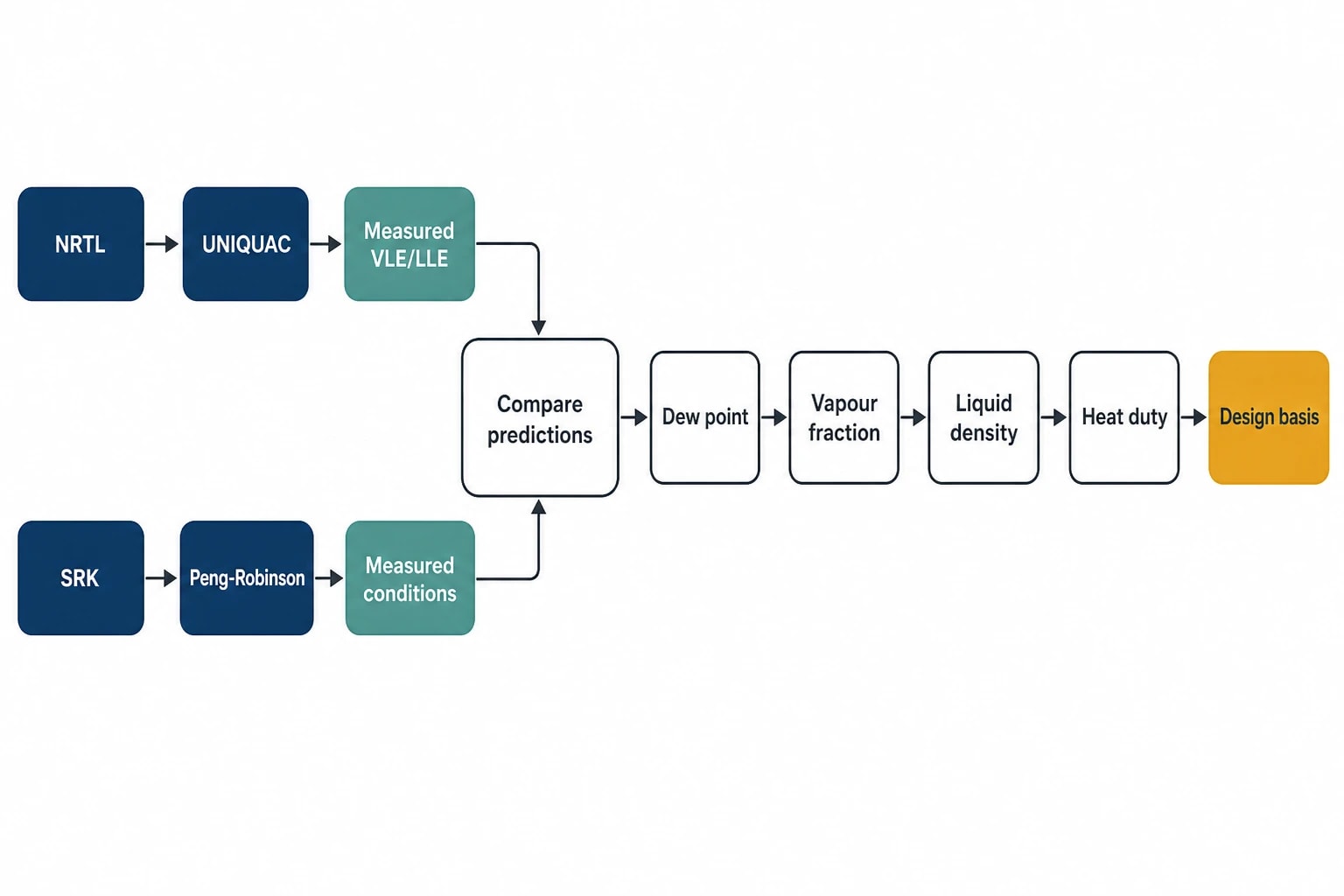
A comparison between models can identify where the process is thermodynamically sensitive. For a polar system with appropriate data, NRTL and UNIQUAC can be run against the same measured VLE or LLE set. Material differences in azeotrope location, relative volatility or liquid split require explanation before either model becomes the design basis.
For hydrocarbon systems, SRK and Peng-Robinson can also be compared against relevant measured conditions. The comparison should focus on outputs that affect the process: dew point, vapour fraction, liquid density, separator temperature, compressor discharge condition and heat duty.
Predictive group-contribution methods, including UNIFAC and Modified UNIFAC, are useful during early screening when fitted parameters are unavailable. Their outputs should be identified as estimates until experimental or plant data provides a defensible basis for selection.
DWSIM’s package guidance recommends checking phase predictions, density and known azeotropes against experimental information or sources such as the NIST Chemistry WebBook. This is a proportionate early check before committing engineering effort to a larger simulation study.
Document the selection in the heat and mass balance
A credible heat and mass balance records more than flowrates and temperatures. It should identify the selected property package, source of binary interaction parameters, validation dataset, calculation envelope and material sensitivities.
The controlled model can then support a process flow diagram with stream tables, duty estimates and a clear record of the assumptions behind them. Technical managers can judge whether the model is suitable for feasibility work, operational optimisation, debottlenecking or design support.
NRTL is generally the stronger starting choice for water-rich and polar liquid systems where activity coefficients govern phase equilibrium. SRK is generally the stronger starting choice for hydrocarbon and gas duties where pressure-dependent behaviour governs the result. The final choice rests on measured behaviour, parameter quality and validation against the conditions that determine plant performance.
This article reflects the independent analysis and editorial opinion of EnerTherm Engineering. Product names, trademarks, and brands mentioned belong to their respective owners. EnerTherm Engineering is not affiliated with, endorsed by, or a licensee of any third-party software or product mentioned unless explicitly stated.

Senior Process Engineer — EnerTherm Engineering
Masab Javed is a Senior Process Engineer at EnerTherm Engineering with extensive expertise in chemical process design, decarbonisation, and sustainable industrial solutions. He holds an MSc from TUM School of Management and a BEng in Chemical Engineering from NUST, with experience spanning ammonia production, CO2 capture, and semiconductor manufacturing optimisation.
