How HMB Models Expose Chemical Plant Bottlenecks
A cost-benefit case for throughput gains with COMAH and utility checks.
A reactor campaign scheduled for 20 batches a week can lose a full batch before the reactor becomes the constraint: an undersized condenser, saturated chilled-water header or overloaded vacuum system may set the real production limit.
That is the commercial problem chemical plant debottlenecking services must solve. Plants rarely operate as neat design cases. Feedstock composition shifts, fouling reduces heat transfer, recycle streams accumulate impurities, and operators work around recurring control problems. Production may appear limited by the item with the longest residence time, while the underlying restriction sits several units away.
A validated heat and mass balance, or HMB, turns this uncertainty into an engineering case. It accounts for what enters, leaves, reacts, evaporates, condenses, recycles and accumulates across the process. The model then tests whether the proposed higher rate can pass safely through reactors, separation equipment, heat exchangers, utilities, relief systems and downstream treatment.
For UK petrochemical, speciality chemical and fine-chemical sites, that work supports a capital decision and a managed technical change. It provides evidence of where expenditure will release saleable throughput, where operating changes can defer capital, and where the apparent bottleneck is actually a process-safety or utility constraint.
Why chemical plant bottlenecks are often misidentified
The production rate is set by the whole system
A nameplate capacity typically belongs to an item of equipment. Sustainable plant capacity belongs to the connected process.
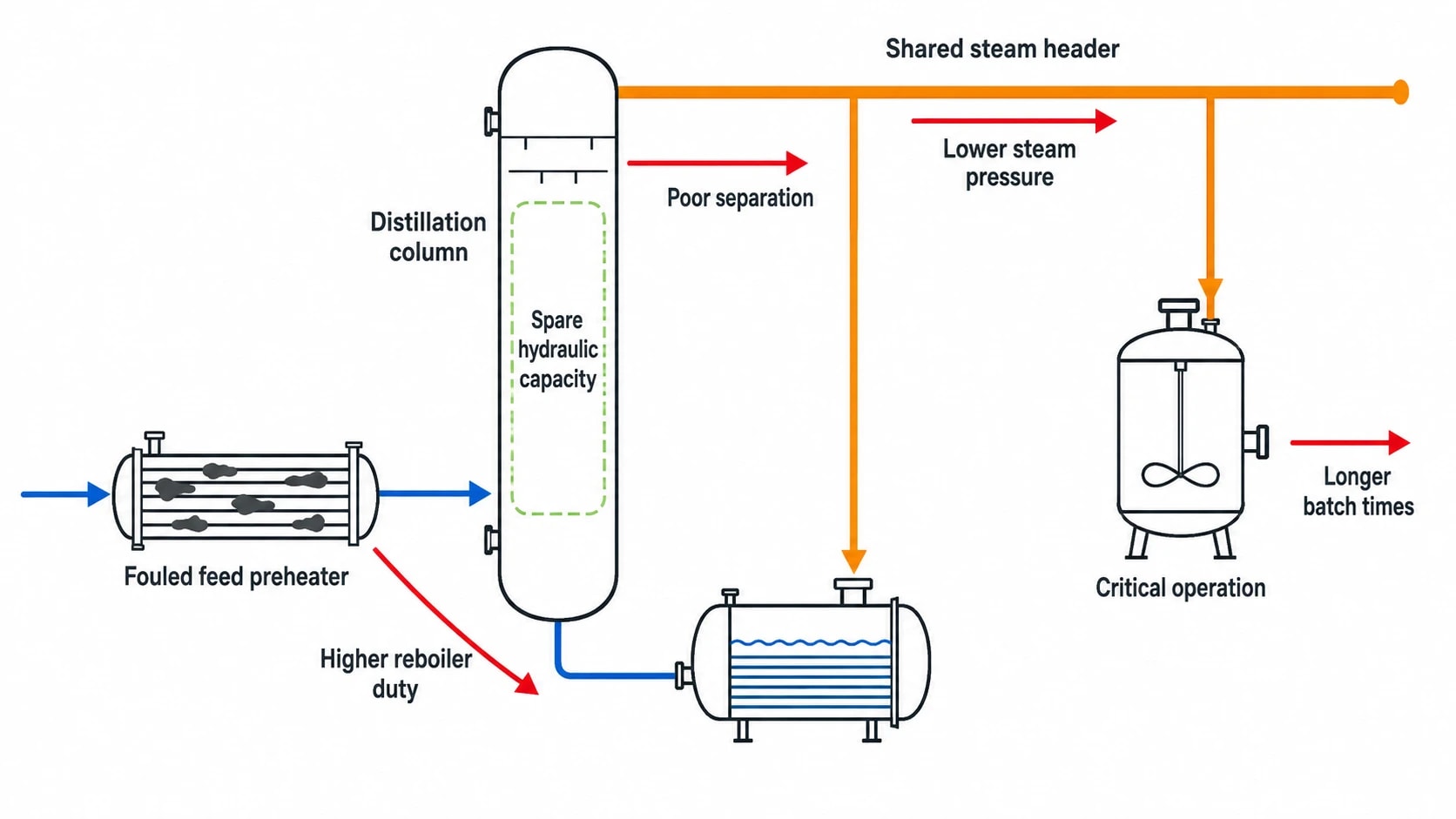
Consider a distillation column that appears to limit output. The column may have spare hydraulic capacity, but a fouled feed preheater could increase reboiler steam demand. That additional duty can pull pressure down on a shared steam header, reducing heat available to another critical operation. Raising feed rate without resolving the heat balance then produces longer batch times, poorer separation or both.
The same pattern appears across chemical manufacturing:
- A reactor may have physical volume available, while jacket duty or agitator power limits the safe reaction rate.
- A column may have spare tray capacity, while condenser duty, cooling-water temperature or vacuum capacity sets the ceiling.
- A filtration step may seem slow because upstream crystallisation produces a finer particle-size distribution at a higher throughput.
- A recycle loop may limit fresh feed because impurity concentration rises as purge capacity becomes inadequate.
- A flare, scrubber or wastewater system may constrain an otherwise attractive process change.
An HMB model connects those interactions. It converts individual observations into a site-wide picture of flows, compositions, temperatures, pressures and duties.
Historical trends need engineering interpretation
Historian data is valuable, but it reflects plant operation rather than a controlled experiment. A low-throughput period may coincide with a different product grade, a maintenance restriction, low ambient temperature, a raw-material change or manual intervention. Trend charts can identify symptoms, but they do not establish cause.
A heat and mass balance uses historical logs alongside P&IDs, laboratory results, operating procedures, equipment data sheets and field checks. The resulting model tests whether observed plant behaviour is physically consistent. Material-balance closure can reveal unmeasured losses, incorrect flow measurements or a missing recycle stream. Energy closure can highlight misplaced temperature measurements, condensate losses, fouling or an incorrect assumed utility condition.
That distinction prevents an expensive error: replacing visible equipment before proving that it is the limiting item.

Map every energy and material flow in your process with detailed heat and mass balance calculations — the foundation for any optimisation or design project.
How HMB models support chemical plant debottlenecking services
Establishing a credible base case
The first task is to define a representative operating case. For a continuous plant, that may be a stable period at current maximum sustainable production. For a batch facility, it may include charging, reaction, work-up, distillation, filtration and cleaning steps across several campaigns.
EnerTherm Engineering’s 11-step engineering methodology begins with project scope and data acquisition. P&IDs, historical logs and plant-specific operating data establish the model boundary and data quality. Engineers then construct an authoritative process flow diagram with embedded stream tables, material balances and energy balances.
The base case should capture more than average throughput. It should show the operating margin at key equipment and utilities:
- Feed composition, contaminant levels and moisture content
- Reactor temperature, pressure, heat release and batch duration
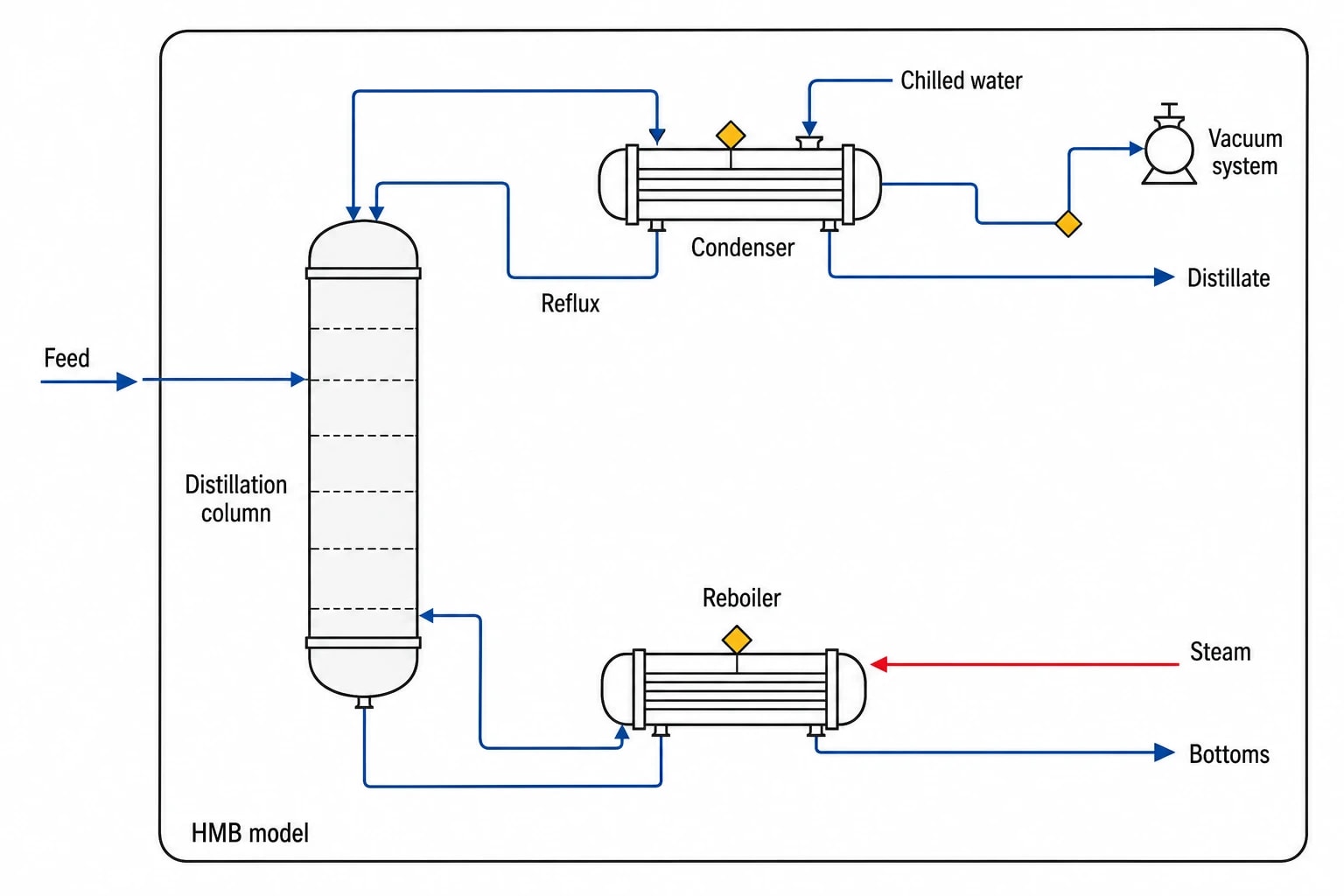
- Column reflux, reboiler duty, condenser load and pressure profile
- Heat-exchanger approach temperatures and estimated fouling effect
- Steam, cooling water, chilled water, thermal fluid, electricity, compressed air and vacuum demand
- Recycle, purge, vent, wastewater and off-spec product flows
These values create the reference point for every later scenario.
Selecting thermodynamics that match the chemistry
The thermodynamic method determines whether a simulation represents phase behaviour and energy demand credibly. This matters most where separation performance drives the bottleneck.
NRTL and UNIQUAC methods are commonly considered for strongly non-ideal liquid systems, including many polar and associating mixtures. SRK and Peng-Robinson equations of state are widely applied to hydrocarbon and gas-processing duties. The appropriate selection depends on the chemical system, available interaction parameters, measured phase data, operating pressure and the process question.
A model for a solvent-recovery column must represent vapour-liquid equilibrium accurately enough to predict condenser and reboiler demand. A model for liquid-liquid extraction may also need credible liquid-liquid equilibrium. Reactive distillation, azeotropic separation and complex recycle systems require the same discipline. A convenient thermodynamic package can produce a converged simulation while giving a misleading equipment duty.
Process engineers commonly build and test such models in Aspen Plus, Aspen HYSYS or DWSIM. The value comes from validation around the software: correct components, defensible thermodynamics, verified operating conditions and comparison with plant measurements.
Which constraints does an HMB model expose?
Reactor heat removal and batch-cycle restrictions
For exothermic reactions, a proposed throughput increase can raise the rate of heat release and shorten the available response time during loss of cooling or agitation. For endothermic operations, heating capacity may dictate reaction duration and batch turnaround.
The HMB quantifies reactor duty across the operating cycle and tests the consequences of higher feed rate, different initial temperatures, altered concentration or changed addition profiles. Dynamic simulation may be needed where temperature, composition and heat release change sharply through the batch.
The commercial gain from a shorter batch cycle only exists if downstream vessels, filtration, drying and packaging can accept the additional campaign output. The model therefore follows material through the full route rather than treating a reactor improvement as an isolated project.
Distillation, evaporation and solvent recovery limits
Distillation bottlenecks have several causes. Vapour traffic can approach flooding limits. A condenser can run out of cooling duty. A reboiler can lack steam capacity. Vacuum pressure may drift upward as non-condensables accumulate or ejector capacity becomes insufficient. Feed composition changes can also raise reflux and reboiler requirements before a hydraulic limit appears.
A validated model evaluates those effects together. It can compare increased feed rate with operating strategies such as changing reflux ratio, feed condition, pressure or recovery target. The output should identify the price of each option in steam, cooling, yield and product purity.
For solvent recovery, the mass balance also matters commercially. A higher recovery target may reduce solvent purchases but increase energy demand and restrict throughput. The economically preferred operating point depends on solvent cost, utility cost, production value, disposal charges and quality requirements.
Heat-exchanger networks and shared utilities
Plant teams often identify individual heat exchangers with poor temperature approach or fouling. An HMB shows whether cleaning or replacing the heat exchanger releases the actual constraint.
The model can quantify heat duties and utility loads across the affected process area. It can also show whether a heat-recovery change shifts the constraint to cooling-water availability or an existing control valve.
Shared utility systems require particular care. A project that consumes available chilled-water capacity may reduce operating margin for another product line. Similarly, higher steam demand can affect pressure control and condensate return across the site. The plant-wide model makes those trade-offs visible before equipment is ordered.
Recycle loops, purge rates and downstream treatment
Recycle loops improve raw-material utilisation, but they can concentrate inerts, salts, by-products and water. Small deviations in purge rate may materially alter feed composition to a reactor or separation train.
The HMB identifies where material accumulates and tests the throughput effect of increasing purge, adding recovery capacity or improving separation. It can also calculate incremental loads to wastewater treatment, thermal oxidation, scrubbers and flare systems. These are engineering constraints with direct operating and compliance costs.
Building the cost-benefit case for debottlenecking
Compare options using the same production basis
A sound cost-benefit case compares options at the same product specification, annual operating profile and utility basis. The goal is to distinguish a genuine increase in saleable production from a shift in cost or risk.
| Decision option | HMB evidence required | Commercial question |
|---|---|---|
| Operating change | Predicted throughput, quality, utility use and operating margin | Can an operating change release capacity without unacceptable variability? |
| Maintenance intervention | Heat-transfer, pressure-drop and cycle-time effect | Does cleaning recover sufficient output to justify outage time? |
| Equipment modification | Equipment sizing, tie-in conditions and utility impact | Which item produces the largest verified capacity release per pound spent? |
| New parallel capacity | Full upstream and downstream loading | Will the added unit shift the bottleneck into shared services or finishing operations? |
| Process redesign | Mass yield, energy demand, emissions and waste changes | Does the higher production rate improve contribution after variable costs and compliance impacts? |
The economic model should include the contribution from additional on-spec product, raw-material consumption, energy and water demand, waste handling, maintenance, installation, outage duration and contingency. It should also recognise the value of avoided investment where an operating change or targeted modification releases enough capacity.
A larger throughput number without a quality and yield check can overstate benefit. For speciality and fine chemicals, an increase in off-spec material, rework or solvent loss can erode the value of an apparently successful capacity project.
Rank projects by certainty as well as payback
A low-capital option may have an attractive apparent return but depend on uncertain plant data. A larger heat exchanger or vacuum-system project may have a stronger evidence base. The cost-benefit case should record both.
Useful ranking criteria include:
- Incremental saleable throughput at the required specification.
- Capital cost and outage requirement.
- Incremental steam, power, cooling, water and solvent consumption.
- Effect on yield, recycle inventory and waste generation.
- Remaining margin at reactors, columns, relief systems and utilities.
- Process-safety, environmental-permit and mechanical-integrity actions.
- Confidence level based on data quality and model validation.
This approach gives production, engineering and finance teams a common decision basis. It also separates a promising concept from an executable project.
Map every energy and material flow in your process with detailed heat and mass balance calculations — the foundation for any optimisation or design project.
Validation turns a simulation into a decision tool
Match the model to plant data
A model earns confidence by reproducing known plant operation. Validation compares calculated and measured flows, compositions, temperatures, pressures, utility duties and product qualities. It should examine more than a single steady period where the plant experiences frequent grade changes or batch variability.
Discrepancies are useful. They may indicate instrument error, heat loss, unrecorded venting, bypass flow, fouling, a hidden control action or incomplete chemistry. Engineers should investigate material and energy imbalances rather than force the model to match a preferred answer.
For a proposed higher throughput, the model should test normal operation and relevant upset cases. That can include loss of cooling, loss of reflux, utility interruption, blocked outlet, changed feed composition or reduced vacuum performance, according to the hazards and process design.
Convert results into design-ready outputs
The useful deliverables from chemical plant debottlenecking services are specific. They include a validated simulation model, an updated PFD with stream tables, equipment-sizing summaries for reactors and heat exchangers, utility-demand scenarios and prioritised optimisation recommendations.
Each recommendation should state the changed operating condition, the predicted capacity release, assumptions, affected equipment, remaining constraint and work needed before implementation. This makes the HMB a living engineering reference rather than a feasibility file.
Debottlenecking is a managed technical and safety change
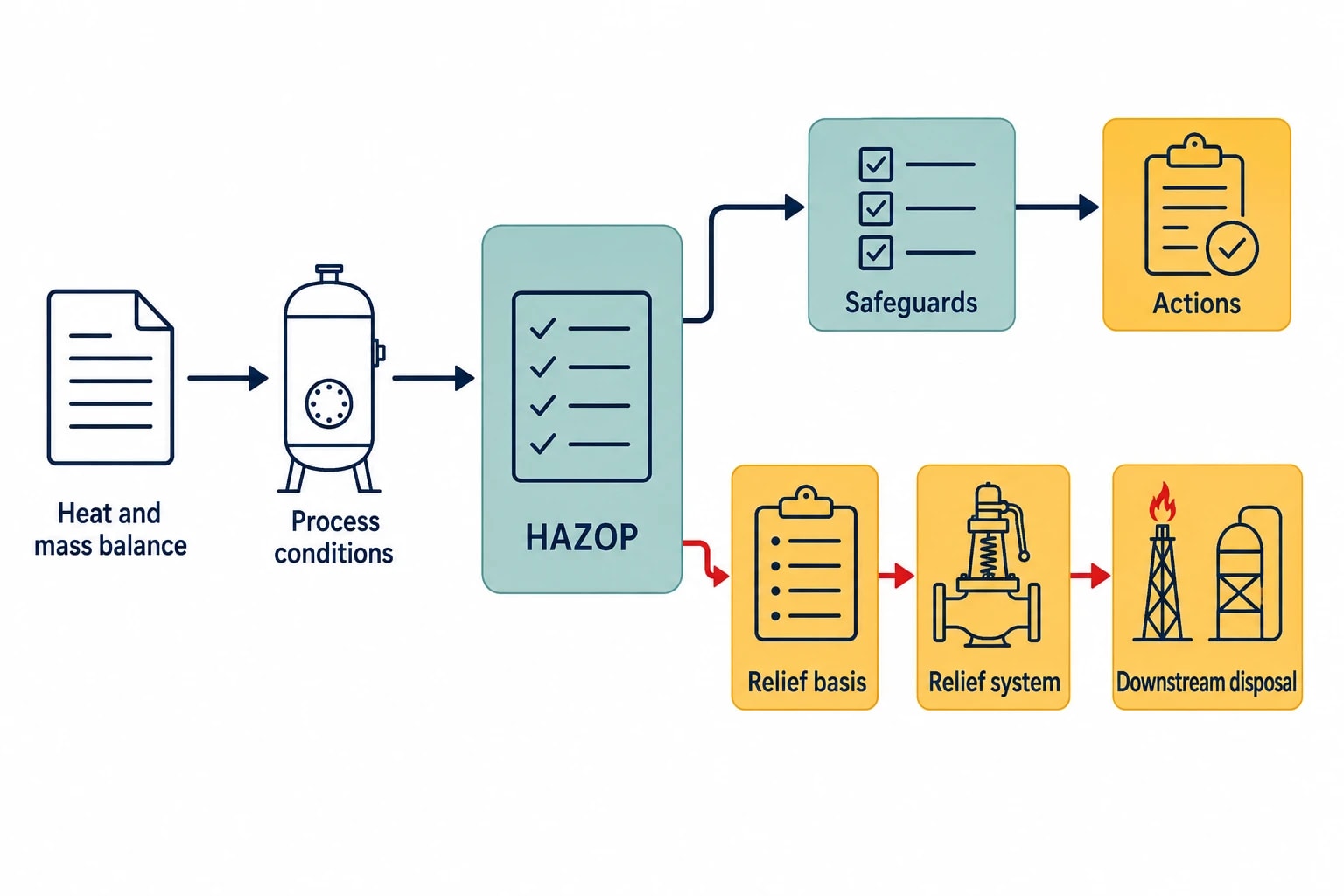
COMAH and HAZOP implications
For an upper-tier COMAH establishment, the Control of Major Accident Hazards Regulations 2015 require the operator to review and, where necessary, revise its safety report after a modification that could have significant consequences for major-accident hazards. HSE guidance also calls for traceable safety, engineering and technical review of modifications affecting process conditions, operating methods, safety, environmental conditions and hardware design.
That makes the HMB a valuable HAZOP input. It defines intended process conditions and exposes changed flows, temperatures, pressures, inventories and utility dependencies. The HAZOP then examines deviations from that basis, identifying safeguards and actions appropriate to the modification.
HSE guidance stresses that changes can affect remote parts of a plant. This is particularly relevant where debottlenecking increases pressure-relief load, flare demand, scrubber duty, cooling demand or hazardous inventory in a downstream vessel.
Pressure and relief-system checks
Higher rates can change design and operating conditions across vessels, pipework, condensers, reactors and utility systems. Under the Pressure Systems Safety Regulations 2000, pressure systems within scope require a written scheme of examination and examination before first use after installation. Modifications may also require review by a competent person under the applicable written scheme.
Relief and vent systems require equally careful review. HSE guidance states that the design basis and methodology for relief-stream calculations should be documented and incorporated into plant-modification procedures. The HMB supplies key inputs, including composition, vapour fraction, temperature, pressure and credible flow to downstream disposal equipment.
A higher reactor feed rate can alter runaway-reaction duty. A changed column pressure can alter vapour-release behaviour. A new heat source can affect fire-case assumptions. Each scenario needs assessment against the site’s defined relief basis and safeguards.
Environmental performance can strengthen the investment case
Resource efficiency for EU-facing sites
Directive (EU) 2024/1785 amended the Industrial Emissions Directive 2010/75/EU. It extends the environmental-performance concept to material, water and energy use, reuse of materials and water, and waste generation. It also introduces BAT-associated environmental performance levels and benchmarks.
For sites supplying or operating within the EU, this reinforces the value of a debottlenecking case that reports more than tonnes per year. The same HMB can quantify energy per tonne, water consumption, solvent recovery, purge losses, waste generation and emissions-related process loads under each capacity scenario.
That information can identify projects where throughput and environmental performance improve together. Heat recovery may reduce steam demand while releasing condenser capacity. Better solvent recovery may reduce purchases and waste load. A revised separation sequence may improve yield and reduce material sent to treatment.
The strongest projects protect operating margin
The best debottlenecking projects retain room for normal plant variation. They avoid running a condenser, steam header, reactor jacket or relief system at its calculated edge through every season and product grade.
This article reflects the independent analysis and editorial opinion of EnerTherm Engineering. Product names, trademarks, and brands mentioned belong to their respective owners. EnerTherm Engineering is not affiliated with, endorsed by, or a licensee of any third-party software or product mentioned unless explicitly stated.

Senior Process Engineer — EnerTherm Engineering
Masab Javed is a Senior Process Engineer at EnerTherm Engineering with extensive expertise in chemical process design, decarbonisation, and sustainable industrial solutions. He holds an MSc from TUM School of Management and a BEng in Chemical Engineering from NUST, with experience spanning ammonia production, CO2 capture, and semiconductor manufacturing optimisation.
