
How Aspen HYSYS Consulting Finds Recycle Loop Gains
Validated HMB models expose recycle, distillation and energy-saving options
Aspen HYSYS consulting uses process simulation to quantify how recycled material, energy and contaminants affect a chemical plant’s heat and mass balance. Recycle loops can retain valuable reactants, solvents and hydrogen-rich gas, yet they can also concentrate water, inerts, heavy ends and trace impurities until a reactor, compressor or distillation column becomes the production constraint.
For UK petrochemical, speciality chemical and fine chemical plants, the key question is whether the operating model represents true composition, flow, phase split and energy demand well enough to support a decision.
A separator return may appear stable on a total-flow trend while its composition shifts materially. That shift can change reactor conversion, hydrogen partial pressure, compressor power, condenser load, reboiler duty, solvent quality and purge losses. Aspen HYSYS consulting turns these linked effects into tested operating cases, provided the model is calibrated against the plant rather than treated as a design-document calculation.
Why recycle loops create disproportionate losses
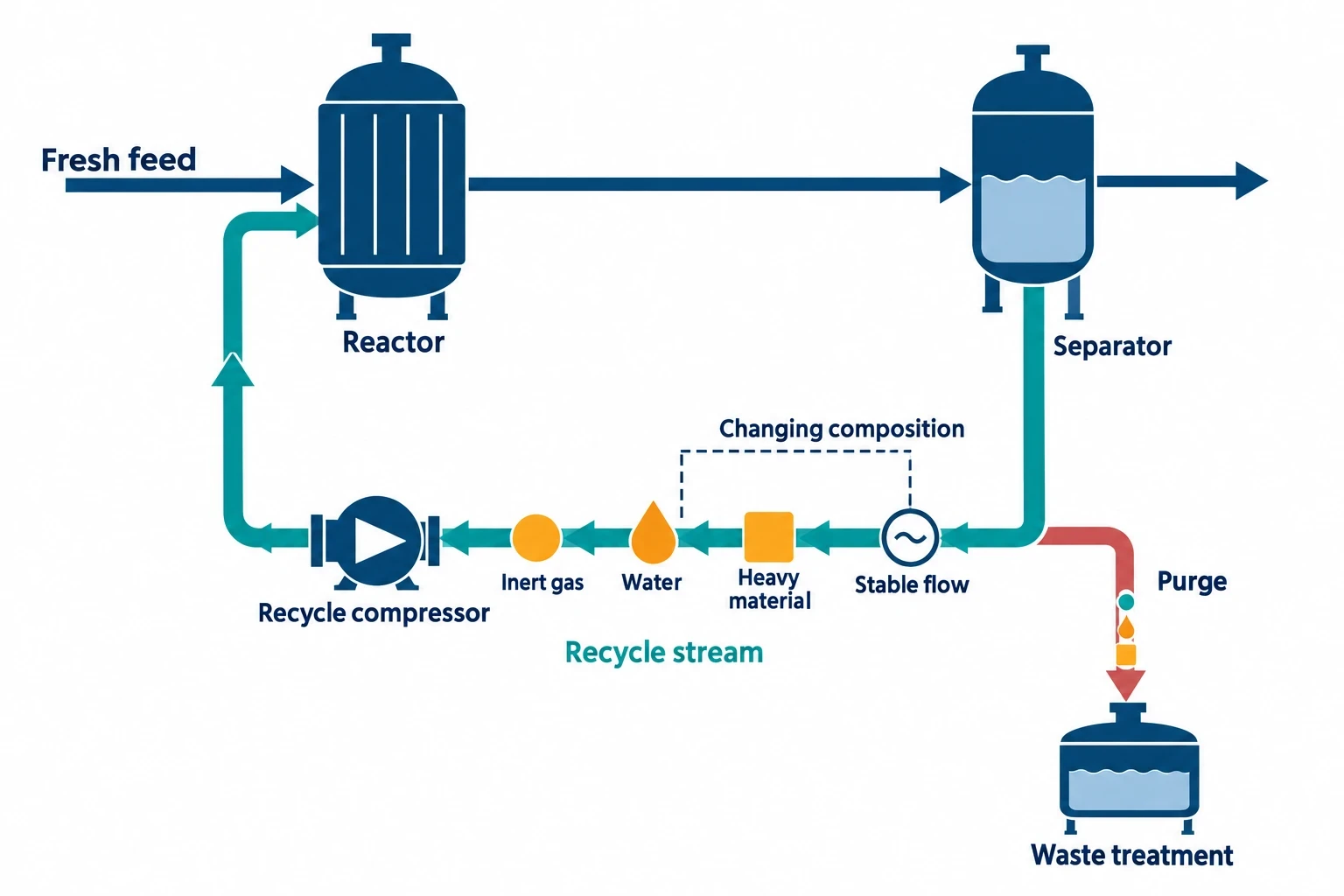
A recycle loop returns material to the process because it has value. It may recover unreacted feed, maintain solvent inventory, return hydrogen-rich gas or improve separation recovery. The same loop may also retain substances with no productive outlet.
Accumulation changes reactor and separation performance
Inerts can enter with fresh feed, form through reaction or reach the process through utility contamination and air ingress. A purge controls their concentration, although it also removes recoverable material. Purge rate therefore affects raw-material use, yield, fuel demand and waste treatment.
Water, salts, catalyst fines and heavy organic compounds create similar effects. A modest increase in water in recycled solvent can alter liquid-liquid separation, reaction selectivity or downstream drying demand. In a petrochemical gas loop, molecular-weight change can increase compression duty while lower hydrogen concentration affects reactor performance.
A defensible heat and mass balance traces components around the whole loop. Total flow is not enough. A recycle flow meter can report a stable rate while changing fractions of light gas, water or heavy material create a different process load.
Measurement gaps spread through the model
Recycle streams are often poorly measured. Plants may record flow, temperature and pressure continuously but collect composition samples infrequently. Laboratory results can represent an earlier operating period, while density alone cannot resolve a multicomponent mixture.
A consulting study should assemble evidence from several sources:
- P&IDs, line lists and equipment data sheets to establish the intended process boundary.
- Historian data to identify stable operating windows and disturbance sequences.
- Laboratory assays, tank inventories and product analyses to constrain compositions.
- Utility metering to test calculated steam, fuel, cooling-water and electricity duties.
- Operator observations to identify bypasses, manual additions, intermittent drains and abnormal line-ups.
This evidence prevents a common modelling failure: forcing balance closure by assigning an implausible stream composition or invented heat loss.

Map every energy and material flow in your process with detailed heat and mass balance calculations — the foundation for any optimisation or design project.
Building a validated Aspen HYSYS heat and mass balance
A converged Aspen HYSYS case is a mathematical result. A validated model is an engineering record that can support production, energy and capital decisions.
Select a property method that matches the chemistry
The fluid package must represent the real mixture across the operating range. Peng-Robinson and Soave-Redlich-Kwong methods are widely used for hydrocarbon-rich systems, gas processing and refinery services. NRTL and UNIQUAC often suit non-ideal liquid mixtures, including solvent, alcohol and water systems.
Property-method selection should follow the decision. A distillation-recycle study needs credible vapour-liquid equilibrium in the relevant composition range. A process with phase splitting needs a reliable liquid-liquid equilibrium basis. Reactive distillation, acid-gas treatment and high-pressure separation introduce further property and reaction requirements.
Known plant behaviour provides the first test. Phase split, vapour pressure, density, stream temperature and heat duty should agree with relevant measured data before optimisation begins.
Set acceptance criteria before model calibration
A useful validation plan states what the model must predict, who owns the source data and what result will count as acceptable. Generic percentage targets can conceal a poor fit on the stream or duty that controls the decision.
The acceptance criteria should be tied to the proposed decision.
| Decision area | Required comparison | Acceptance criterion |
|---|---|---|
| Mass closure | Unit and whole-process inlet, outlet and inventory data | The unresolved balance must remain within the combined uncertainty of reconciled measurements and must not require an unexplained source or sink. |
| Temperature | Reactor feed, separator outlet, exchanger outlet and column-feed temperatures | Prediction must fall within calibrated instrument uncertainty after aligning historian and laboratory timestamps. |
| Heat duty | Reboiler, condenser, exchanger, furnace and cooling duties | Calculated duty must agree with metered utility use after defining steam quality, condensate return, heat losses and the comparison period. |
| Pressure | Compressor suction and discharge, column profile, control-valve and exchanger pressure drop | Prediction must reflect transmitter uncertainty, elevation datum and known hydraulic restrictions. |
| Composition | Recycle, purge, reactor feed and product impurity levels | Prediction must match the laboratory method’s reproducibility for components governing yield, specification or safety. |
| Constraint margin | Flooding, compressor head, exchanger approach and utility capacity | The predicted operating margin must exceed the combined uncertainty in plant data and model assumptions. |
For a debottlenecking case, the model must predict the constraint more accurately than the claimed gain. A calculated 2% throughput increase has little value if uncertainty in column hydraulic margin or recycle composition exceeds that change.
Use multiple operating periods
One favourable operating snapshot does not validate a process model. A suitable data set includes normal production, high and low throughput, an alternative feedstock case, and a period near the reported constraint.
EnerTherm Engineering’s 11-step engineering methodology provides a practical sequence, beginning with project scoping and site-data gathering, then progressing through model development, validation, scenario testing and documented recommendations. The completed PFD, stream tables and heat and mass balance provide a shared reference for production, engineering and project teams.
How Aspen HYSYS consulting diagnoses recycle constraints
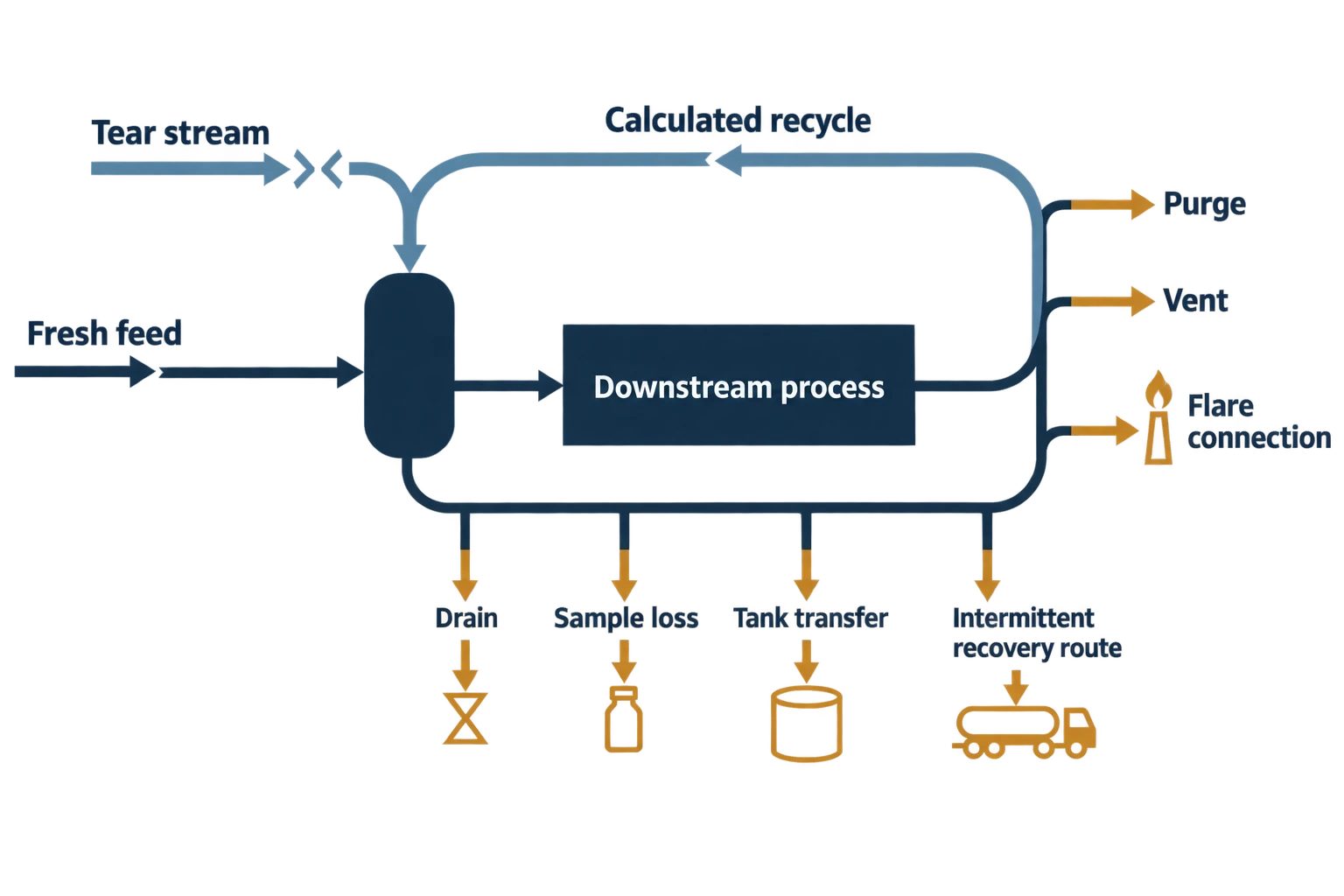
Recycle convergence establishes what the process recirculates at steady state. Consultants define a tear stream, calculate the downstream process, return the calculated stream to the loop entry and iterate until the assumed and calculated recycle conditions agree.
Define the actual physical boundary
The loop boundary must include each inlet and outlet: fresh feed, purge, vent, flare connection, drain, sample loss, tank transfer and intermittent recovery route. A missing sidestream can produce a model that converges cleanly yet cannot reproduce plant composition.
The time basis matters. A daily production balance cannot validate a recycle drum whose inventory persists for several days. Dynamic simulation may be appropriate where inventory, pressure control, start-up, grade change or upset response governs the decision.
Test competing explanations
Plant symptoms rarely identify one cause. Rising recycle-compressor load may result from increased molecular weight, higher flow, lower suction pressure, fouling-related pressure drop or changed purge composition. A credible study tests these explanations against the same evidence.
| Plant symptom | Modelled checks | Potential outcome |
|---|---|---|
| Rising recycle-compressor load | Molecular weight, recycle rate, suction conditions, pressure drop and purge composition | Lower compression duty or more throughput margin |
| Falling reactor conversion | Inert concentration, reactant partial pressure, recycle temperature and feed composition | Higher conversion or lower fresh-feed demand |
| Distillation instability | Reflux, feed condition, non-condensables, reboiler duty and hydraulics | More stable specification control and reduced energy use |
| High solvent make-up | Recovery, purge loss, entrainment, phase split and vent losses | Lower solvent loss and waste handling |
| Exchanger duty shortfall | Fouling allowance, phase change, flow distribution, approach temperature and pressure drop | Better heat recovery or a justified modification |
Sensitivity testing should change one variable at a time before evaluating combined cases. This reveals whether a favourable case depends on unavailable steam, excessive compressor duty or an impractical operating target.
Recycle loop gains in distillation systems
Distillation frequently controls recycle quality. It determines what returns to reaction, how much solvent or unreacted feed is recovered, and how heavily the utility system is loaded.
Model the critical impurities
Overall recovery can mask the component creating the operating problem. A solvent-recovery column can achieve high solvent recovery while returning a small but accumulating heavy impurity to the reactor. The impurity may alter product quality, reaction selectivity or downstream separation duty.
AspenTech identifies distillation improvement as an Aspen HYSYS application and describes hydraulic visualisation for examining the effects of feedstock, feed condition, internal flows and internals condition. This helps process engineers distinguish thermodynamic limitations from hydraulic limitations.
Useful cases include changes to feed temperature, vapour fraction, reflux ratio, reflux subcooling, column pressure, condenser conditions, reboiler duty, feed location and side-draw configuration. Each case needs a physical constraint. Higher reboiler duty may improve recycle composition, yet the assessment must check flooding, condenser duty, available steam pressure and downstream pressure limits.
Follow heat across the linked process
Recycle changes redistribute heat as well as material. Higher reflux can reduce impurity carry-over while increasing condenser duty. Lower flash pressure may reduce compressor work while increasing refrigeration demand. Returning a hotter recovered stream may reduce preheat duty while affecting reaction conversion.
The heat and mass balance must therefore cover reaction, separation, compression, heat exchange, utilities and purge treatment. A local change should proceed only where the linked process shows a net operational benefit.

Map every energy and material flow in your process with detailed heat and mass balance calculations — the foundation for any optimisation or design project.
Reactor and refinery applications
For reactor recycle systems, the key test is whether the model reproduces measured conversion, selectivity and heat release at the observed feed composition and operating conditions.
Validate yield before changing recycle ratio
A reaction model calibrated solely to design data can overstate the benefit of changing recycle ratio, temperature or hydrogen availability. Validation should compare predicted and observed reactor inlet composition, product yield, heat-removal duty, recycle composition, separator phase split, fresh-feed demand and purge rate.
Where site evidence cannot support kinetics, a bounded yield model can still quantify heat and mass balance sensitivities. Its limitations must remain explicit where catalyst activity, residence time or side-reaction formation affects the decision.
Represent feedstock variation in refinery studies
Refinery-wide cases require more than a single pseudocomponent feed basis. AspenTech’s 2025 refinery-simulation brochure states that Aspen HYSYS Petroleum Refining provides 330 petroleum properties, a crude library of more than 950 assays, and rigorous kinetic models for major refinery reactors.
These capabilities can support crude-blend, yield, hydrogen-use and preheat-train assessments. The same validation discipline applies: reconcile the model against plant data, document the assay basis and test feasible operating or capital cases. A refinery debottlenecking recommendation should show where the constraint moves between units after each proposed change.
Energy, safety and UK compliance
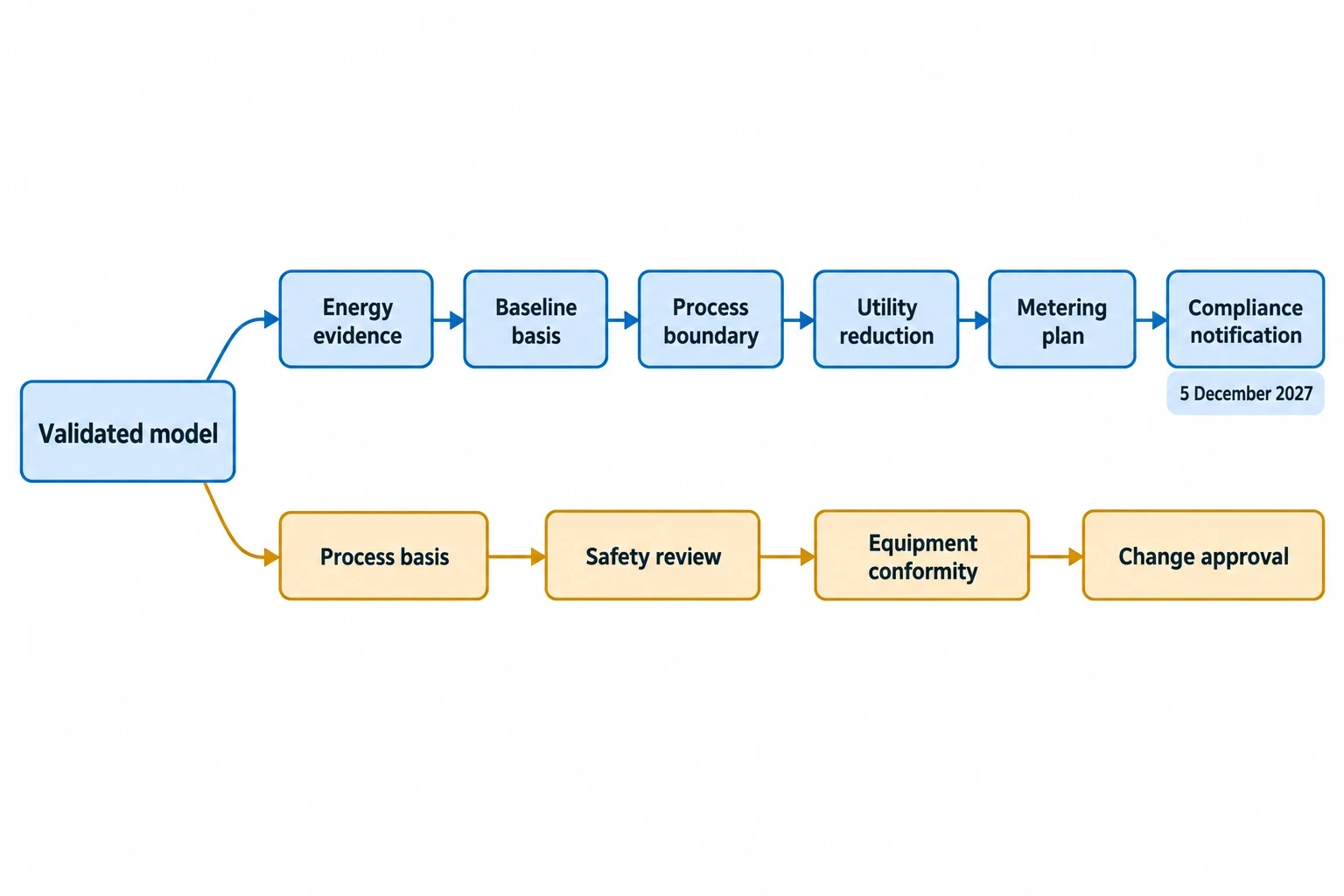
A validated model can quantify heat-integration opportunities, utility reduction and associated production effects. It cannot approve a plant change on its own.
Prepare model outputs for ESOS Phase 4
The Energy Savings Opportunity Scheme Regulations 2014, S.I. 2014/1643, were amended by the Energy Savings Opportunity Scheme (Amendment) Regulations 2023. ESOS Phase 4 requires qualifying organisations to assess energy use, identify energy-saving opportunities and submit a compliance notification by 5 December 2027.
A model-led recommendation should record:
- The baseline period, production rate and feedstock basis.
- The defined process boundary.
- Utility reduction by fuel, steam, electricity or cooling service.
- Production, quality and emissions assumptions.
- Capital requirement, operational change and implementation constraint.
- A metering plan for post-implementation verification.
This record helps distinguish a genuine energy reduction from a lower-throughput period or utility load shifted beyond the study boundary. ISO 50001:2018 provides a relevant structure for managing energy performance and maintaining evidence.
Keep flammable-service constraints inside the case
The Dangerous Substances and Explosive Atmospheres Regulations 2002 require employers to assess and control fire and explosion risks from dangerous substances. Recycle-model scenarios involving flammables should consider changed inventory, operating pressure, vent composition, temperature and pump or compressor duty.
The Equipment and Protective Systems Intended for Use in Potentially Explosive Atmospheres Regulations 2016 apply to relevant equipment and protective systems. Simulation informs the process basis. Hazardous-area classification, relief assessment, HAZOP, equipment conformity and management-of-change approval remain separate engineering and regulatory activities.
What a useful consulting deliverable contains
The valuable output from Aspen HYSYS consulting is a decision package that makes assumptions visible. It should include a validated steady-state model, dynamic analysis where inventories or control behaviour matter, an annotated PFD, stream tables, a heat and mass balance, property-method rationale, validation comparison, equipment-sizing summary, scenario register and recommendations.
Each recommendation should identify its limiting condition and next action. That may involve a targeted sampling campaign, exchanger inspection, hydraulic survey, control study, site trial or capital estimate.
This article reflects the independent analysis and editorial opinion of EnerTherm Engineering. Product names, trademarks, and brands mentioned belong to their respective owners. EnerTherm Engineering is not affiliated with, endorsed by, or a licensee of any third-party software or product mentioned unless explicitly stated.

Senior Process Engineer — EnerTherm Engineering
Masab Javed is a Senior Process Engineer at EnerTherm Engineering with extensive expertise in chemical process design, decarbonisation, and sustainable industrial solutions. He holds an MSc from TUM School of Management and a BEng in Chemical Engineering from NUST, with experience spanning ammonia production, CO2 capture, and semiconductor manufacturing optimisation.
