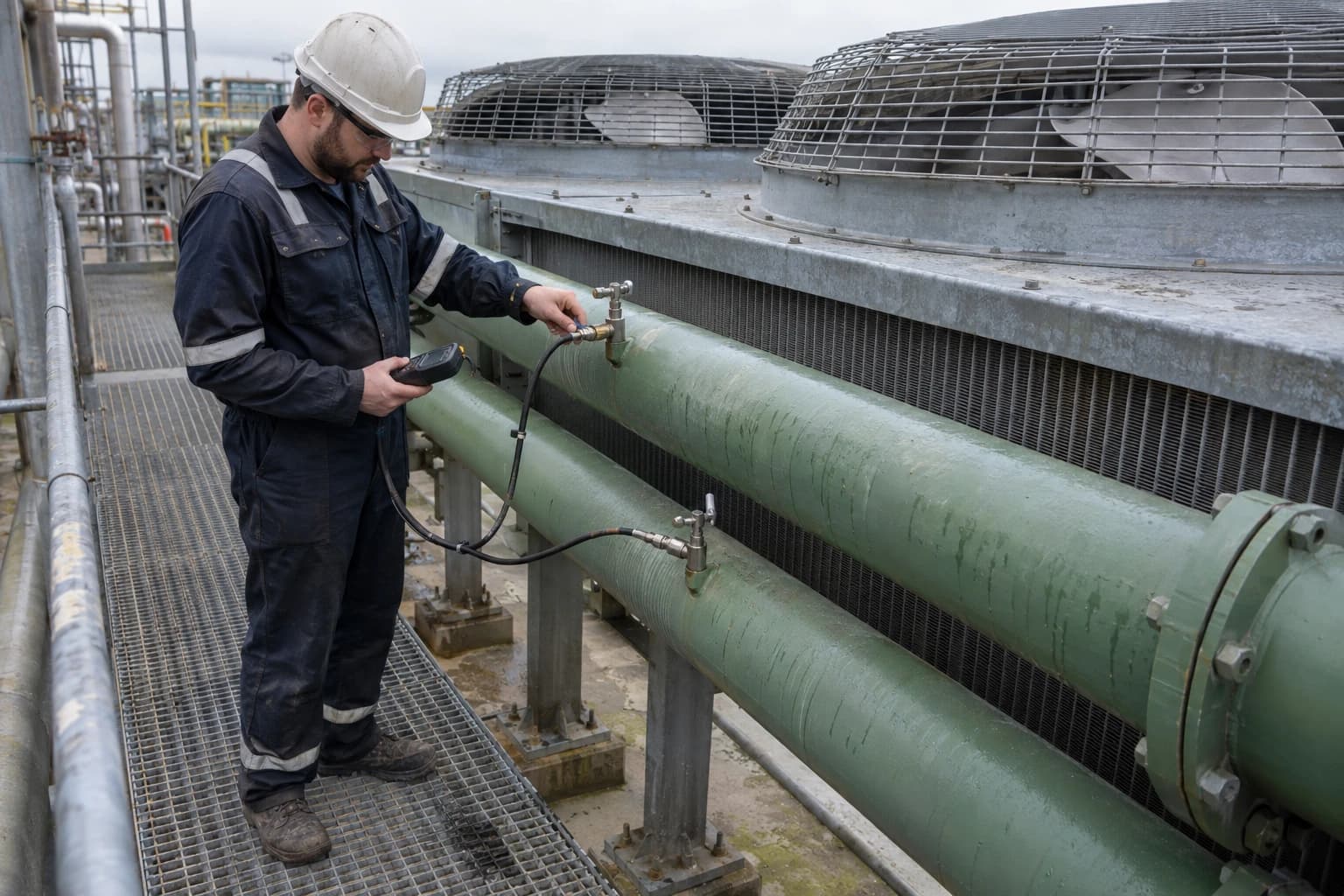
Thermal Design Engineering Services for Heat Exchanger Risk
Validated heat and mass balances expose fouling, overheating and tube rupture risks.
HSE identifies fouling, polymerisation, solidification, overheating, leakage, tube vibration and tube rupture as heat-exchanger design problems that can affect process safety. For a petrochemical, speciality chemical or fine chemical plant, these risks make exchanger sizing and debottlenecking a wider engineering decision.
Thermal design engineering services should establish whether a heat and mass balance reflects plant operation, test credible operating conditions and produce process inputs that mechanical, inspection, controls and process-safety teams can use. Calculating heat-transfer area alone does not establish whether an exchanger will remain operable through a campaign, maintain containment at peak duty or support a proposed throughput increase.
The difference is material where an exchanger cools an exothermic reactor, provides reboiler duty, condenses a volatile overhead, handles a crystallising stream or recovers energy from a contaminated process fluid. In each case, an apparently simple duty calculation can conceal pressure-drop, phase-behaviour, fouling or control limitations.
For process engineers and engineering managers, the key is to compare thermal design engineering services when heat-exchanger risk is part of the brief.
Why heat-exchanger risk changes consultancy scope
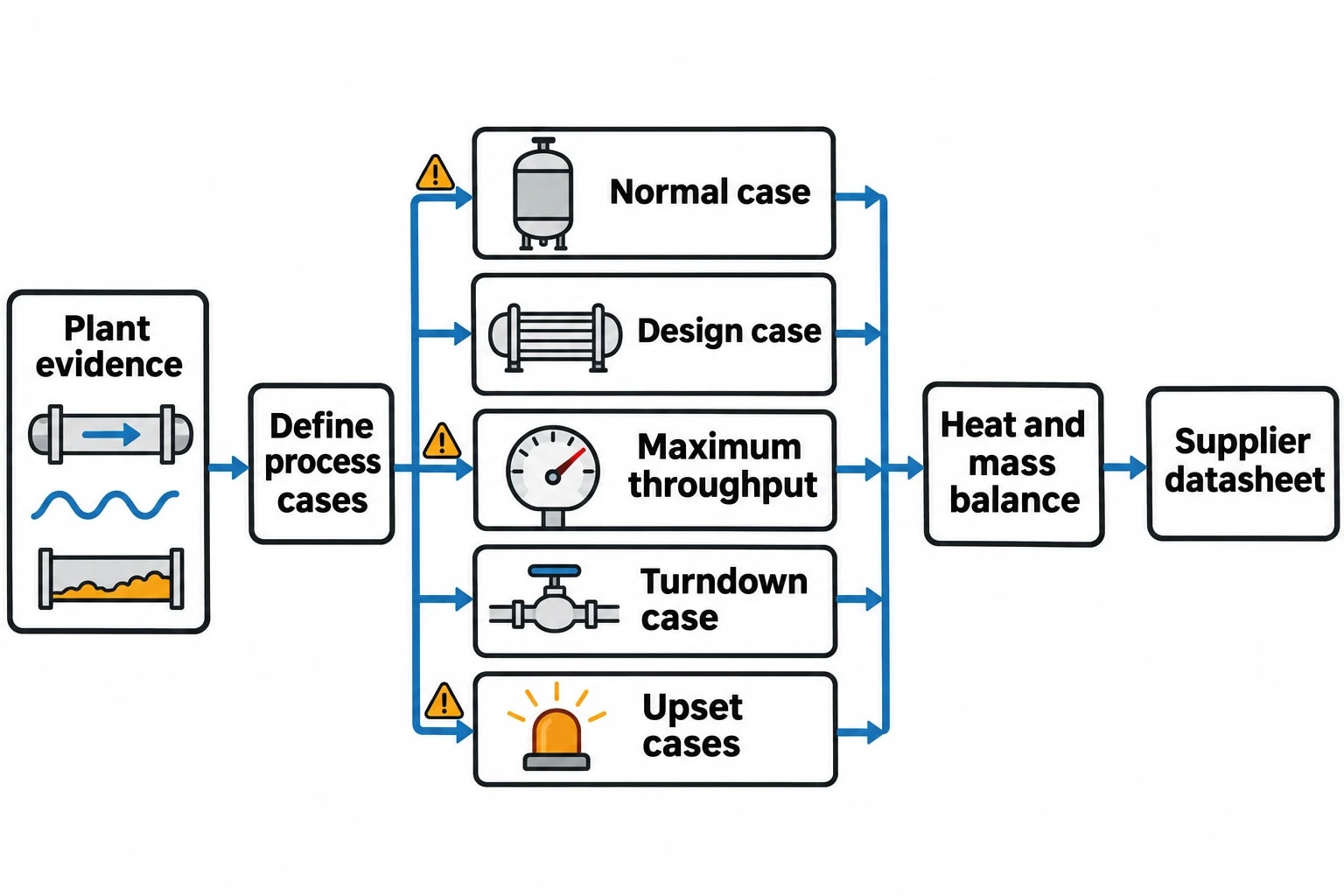
A heat exchanger transfers duty between streams, but the process conditions that determine its performance can change substantially. Feed composition may vary between campaigns. Cooling-water temperature rises in summer. Steam-header pressure falls during high site demand. Deposits reduce heat-transfer performance and restrict flow. A control valve may reach its travel limit before the exchanger achieves its calculated duty.
A consultancy scope should turn these variables into defined process cases. It should identify the normal case, design case, maximum-throughput case, turndown case and relevant upset cases before a supplier receives a datasheet.
The danger of a plausible but wrong heat and mass balance
A heat and mass balance can appear internally consistent while representing the wrong plant condition. This is common when a study relies on a single historian period, design documentation that no longer reflects modifications, or laboratory composition data that do not match production feedstock.
Typical weaknesses include:
- Treating a variable feed as a fixed composition.
- Ignoring non-condensables in a condenser model.
- Using nameplate heat-transfer area without confirming the installed configuration.
- Applying clean-exchanger performance to equipment with an established fouling history.
- Omitting bypasses, recycle streams or intermittent batch transfers.
- Assuming utility pressure or temperature that the site cannot sustain at peak demand.
- Taking flowmeter readings as settled facts without checking measurement range, calibration and operating context.
These errors can distort predicted duty, temperature approach and pressure drop. They can make a replacement exchanger appear to be the solution when the constraint lies in circulation, utility supply, separation performance or an upstream reaction.
Failure-mode screening belongs in the process scope
HSE guidance on design codes under COMAH provides a useful test for consultancy proposals. The failure modes identified at the start of this article should be screened where they apply to the service, chemistry and exchanger type.
That screening should be specific. Fouling may arise from cooling-water scale, coking, precipitation or biological growth, each requiring different evidence and mitigation. Polymerisation risk requires an understanding of composition, temperature history, residence time and inhibitor control. Vibration risk may require specialist mechanical assessment, but the process study should supply the flow envelope, vapour fraction and physical-property information needed for that assessment.
A credible consultancy report records which hazards fall within scope, which require specialist review and which data remain uncertain. This gives project teams a clear basis for deciding whether further mechanical, corrosion, inspection, relief or process-safety work is needed.

Map every energy and material flow in your process with detailed heat and mass balance calculations — the foundation for any optimisation or design project.
UK pressure-equipment duties set the context
For relevant equipment placed on the Great Britain market, the Pressure Equipment (Safety) Regulations 2016 exclude pressure equipment at or below 0.5 bar maximum allowable pressure. They apply essential safety requirements to equipment within the Regulation 6 categories and thresholds. Heat exchangers can form part of pressure equipment or an assembly, depending on their design and intended service.
The Regulations govern design, manufacture and conformity assessment. A thermal design consultancy does not provide legal conformity assessment. Its role is to provide the process conditions, operating envelope and documented assumptions needed by the parties responsible for equipment design and compliance.
Overheating must be assessed as an operating condition
Schedule 2, Part 5, paragraph 33 of the Pressure Equipment (Safety) Regulations 2016 applies to fired or otherwise heated pressure equipment with an overheating risk. It requires calculation, design and construction that avoid or minimise significant loss-of-containment risk from overheating.
The provision identifies protection relating to heat input, heat take-off and fluid level. It also addresses sampling where fluid properties must be assessed for deposit or corrosion risk, measures against deposit damage and the safe removal of residual heat after shutdown.
Studies involving a reboiler, thermal-oil heater, electrically heated vessel, reactor cooling circuit or other heated pressurised equipment should examine the conditions governing heat removal. Normal-duty calculations leave gaps where loss of cooling, reduced circulation, fouled surfaces, blocked outlets or utility failure can alter the thermal response.
Existing plant needs operating evidence
The Pressure Systems Safety Regulations 2000 apply to pressure systems in use. HSE states that qualifying pressure equipment must have a written scheme of examination before use, with examination undertaken in accordance with that scheme.
Thermal design work should support, rather than duplicate, that regime. A process study can document revised fluid properties, maximum temperatures, maximum pressures, likely deposits and changed duty following a modification. The competent person, equipment designer and site dutyholder retain responsibility for examination, safe operating limits and compliance.
What a validated thermal design study should contain
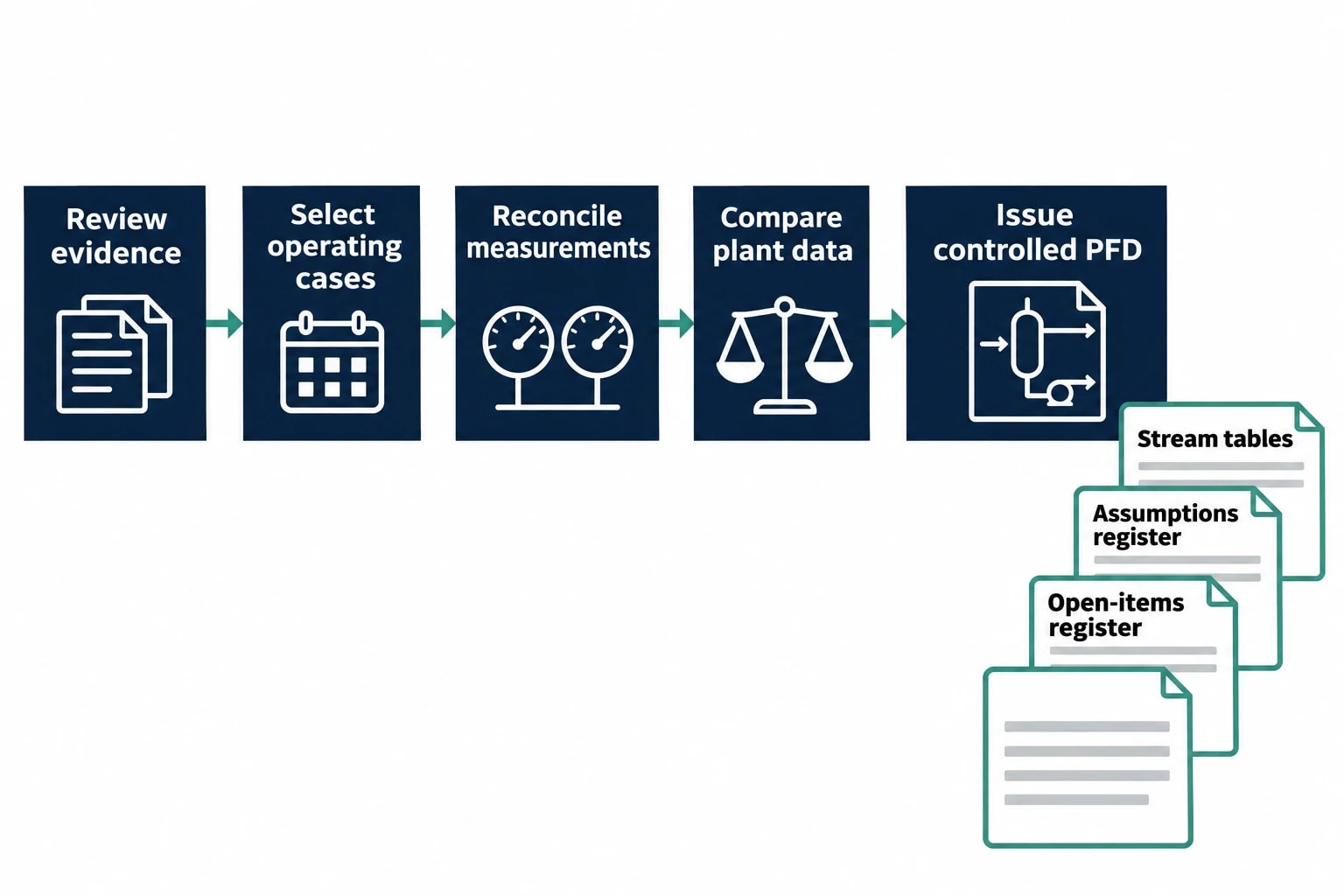
The strongest proposals state how the consultant will create and validate the process basis. Buyers should be wary of scopes that move directly from a few client-supplied stream conditions to an exchanger-area estimate.
Define the model boundary and data plan
The proposal should identify the unit boundary, battery limits and interfaces with adjacent units. It should also specify the evidence needed to validate the heat and mass balance.
A practical validation sequence includes:
-
Review P&IDs, process-flow diagrams, equipment data sheets, operating procedures, laboratory results and modification records.
-
Select operating periods representing steady production, peak throughput, turndown and relevant campaign conditions.
-
Reconcile measured flows, compositions, pressures, temperatures, utility loads and product rates.
-
Compare calculated results with plant data and investigate meaningful discrepancies.
-
Issue a controlled process-flow diagram with embedded stream tables, an assumptions register and an open-items register.
The work should make data quality visible. A calculated duty based on uncertain feed composition may still guide a decision, provided the report quantifies the uncertainty and identifies the data needed to reduce it.
Select thermodynamic methods for the actual chemistry
Thermodynamic-package selection can materially affect vapour-liquid equilibrium, liquid-liquid phase splits, condensation loads and predicted temperatures. For non-ideal liquid mixtures, consultants may consider activity-coefficient methods such as NRTL or UNIQUAC. Hydrocarbon systems may require an equation-of-state method such as Soave-Redlich-Kwong or Peng-Robinson.
The appropriate method depends on the components, pressure range, expected phases and available data. A process engineer should expect the consultancy to document the selected property method, explain its suitability and identify model limitations.
This is particularly important for azeotropic systems, dissolved gases, reactive distillation, hydrogen-containing circuits and streams close to dew point, bubble point or freezing conditions. A poor property method can produce a convincing heat duty while misrepresenting vapour fraction, condensation temperature or solids risk.
Test plant cases beyond normal operation
An exchanger must often perform outside its preferred steady state. The required cases depend on the service, but commonly include:
- Minimum, normal and maximum throughput.
- Campaign feed compositions.
- Seasonal cooling-medium conditions.
- Minimum and maximum utility pressure or temperature.
- Start-up and shutdown conditions.
- Reduced circulation or partial blockage.
- Relevant control-valve or pump limits.
- End-of-run fouling performance.
Dynamic modelling may be justified where heat capacity, control response, reaction kinetics or batch operation determine risk. Many assignments need a validated steady-state model first. The proposal should explain why a dynamic study is required and which operational question it will answer.
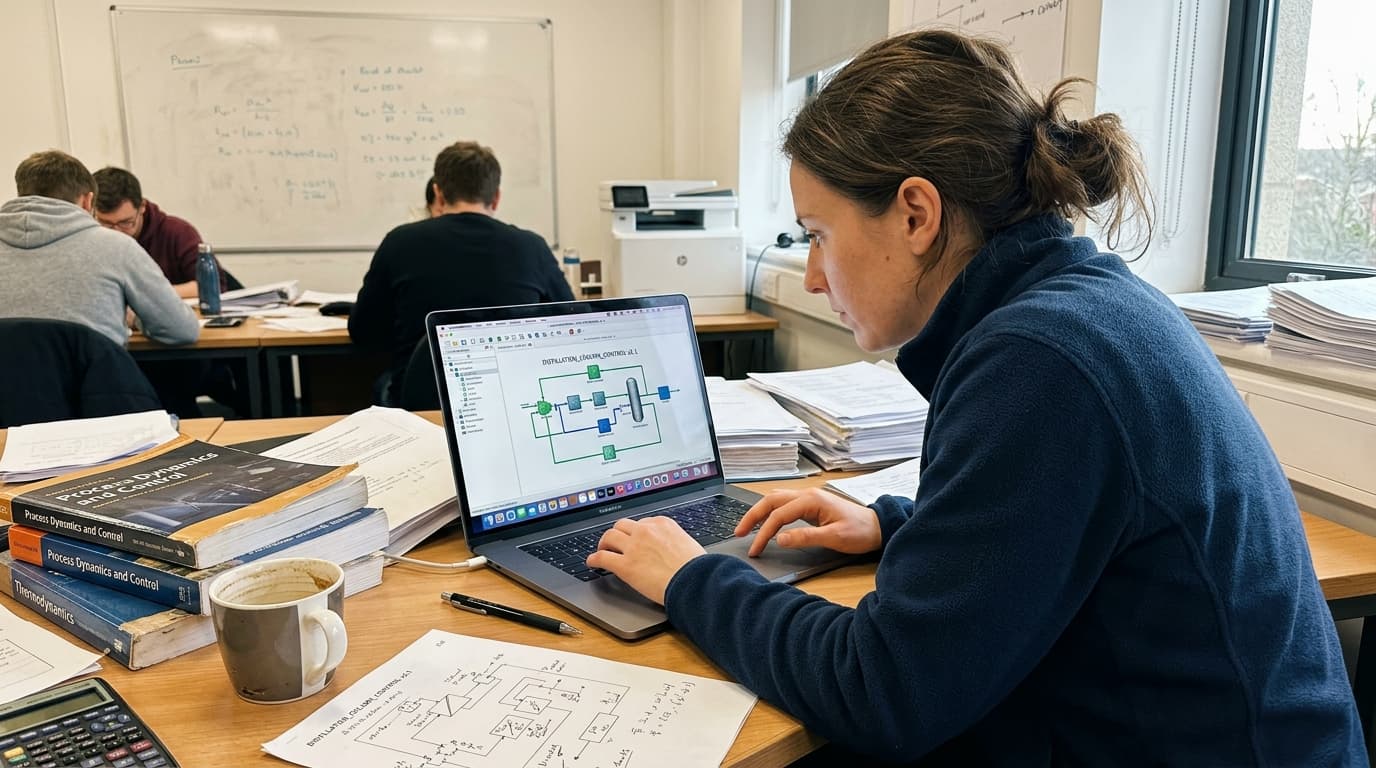
Map every energy and material flow in your process with detailed heat and mass balance calculations — the foundation for any optimisation or design project.
Demand exchanger-specific deliverables
A process simulation model is not, by itself, a heat-exchanger design package. Thermal design engineering services should translate the validated model into inputs that a mechanical equipment engineer or exchanger manufacturer can use.
| Deliverable | Decision supported |
|---|---|
| Duty and temperature profile for each operating case | Establishes the load range and limiting thermal case |
| Flow, composition and phase information | Supports property selection and identifies flashing, condensation or solids risk |
| Pressure-drop limits | Checks pump, compressor and control-valve capability |
| Fouling basis and cleaning assumptions | Makes end-of-run performance and availability visible |
| Utility conditions and control basis | Identifies limits from steam, cooling water, chilled water or thermal oil |
| Equipment sizing summary | Provides process inputs for configuration and thermal-performance review |
| Assumptions and risk register | Preserves unresolved issues for mechanical, operations and safety review |
Separate process design from mechanical design
The process consultant should define duty, temperatures, pressures, flowrates, compositions, phase behaviour and allowable pressure drop. The mechanical design function then considers configuration, materials, tube layout, vibration analysis, fabrication, inspection access, code compliance and test requirements.
These disciplines overlap, but they should not be blurred. A proposal that promises a complete exchanger solution without identifying the mechanical design boundary may leave critical questions unresolved. Equally, a mechanical quotation based on incomplete process cases can lock a project into an unsuitable design basis.
For a replacement exchanger, the scope should also confirm the installed nozzle arrangement, plot constraints, isolation requirements, bypasses, available head, cleaning method and outage window. A theoretically sound exchanger can still be impractical to install or maintain.
Compare thermal design engineering services by evidence, not report length
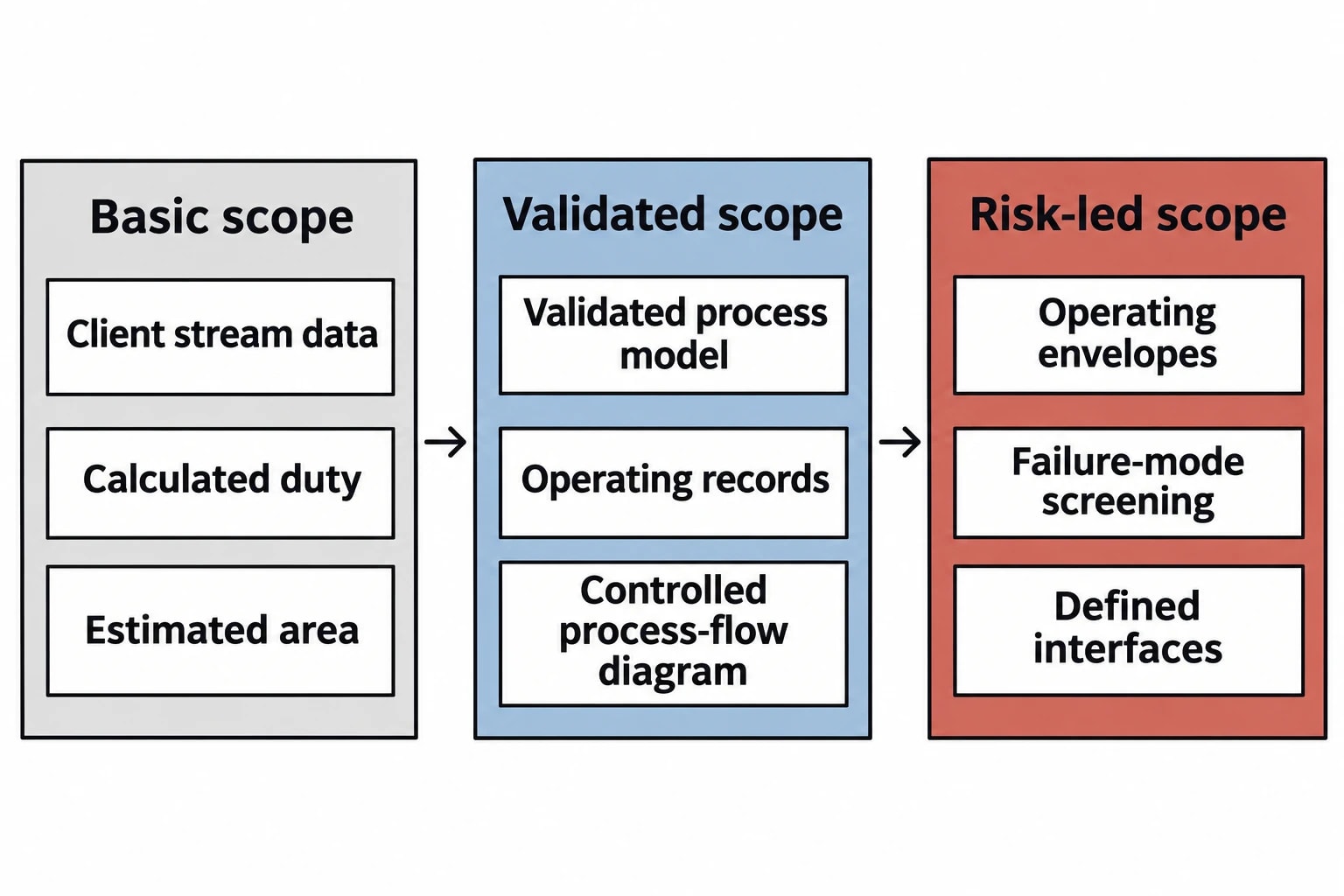
Consultancy proposals often vary widely in price because they offer different levels of engineering evidence. The useful comparison is not the number of calculations or pages, but whether the scope resolves the decision the plant needs to make.
Basic calculation scope
A basic scope uses client-provided stream conditions to calculate duty and estimate heat-transfer area. It can suit a stable utility service where composition, flow, fouling behaviour and utility availability are already well established.
This level of work is weak for exchangers that are safety-relevant, phase-changing, prone to fouling, connected to reactive chemistry or central to a capacity increase. In those cases, buyers should question proposals that omit operating cases, pressure-drop criteria, validation activity or a stated fouling basis.
Validated heat and mass balance scope
A validated scope develops and tests a process model against operating records. It supplies a controlled process-flow diagram, stream tables and an energy account for the unit.
This is usually the right starting point for debottlenecking. It can distinguish a genuine exchanger constraint from an upstream imbalance, reduced utility pressure, incorrect instrumentation, recycle limitation or deterioration in heat-transfer performance.
The resulting model provides a common technical basis for operations, projects and equipment suppliers. Teams can assess a proposed area increase against the actual reason for lost capacity before committing capital.
Risk-led thermal design scope
A risk-led scope adds operating envelopes, exchanger failure-mode screening and defined interfaces with other disciplines. It suits reactor coolers, reboilers, condensers, corrosive service, polymerising streams and exchangers whose loss could initiate a significant plant upset.
The output should identify credible conditions needing safeguards or further verification. Examples include a temperature excursion following reduced heat removal, excessive pressure drop at end-of-run fouling, liquid carry-over into a condenser or a process condition outside the available pump head.
A simulation cannot demonstrate mechanical integrity or replace a hazard study. It can provide the quantitative process evidence those activities require.
Questions to ask before appointing a consultancy
A buyer should be able to identify the expected decision, evidence and handover package before appointing a consultant.
Questions for the proposal review
-
Which P&IDs, historical logs, laboratory results and equipment records will validate the heat and mass balance?
-
How will the study define normal operation, turndown, peak throughput, campaign change, start-up, shutdown and relevant utility failures?
-
Which thermodynamic method will be used, and how will the consultant test its suitability against plant or laboratory evidence?
-
Will the deliverables state duty, temperatures, pressures, flows, phase behaviour, pressure-drop limits, utility conditions and fouling assumptions for each relevant case?
-
How will the study apply the HSE failure-mode screen described above to the exchanger service?
-
Where do responsibilities pass to mechanical, corrosion, relief, controls, inspection and process-safety specialists?
-
Will the final package include controlled stream tables, a sizing summary, assumptions register, open data items and prioritised recommendations?
This article reflects the independent analysis and editorial opinion of EnerTherm Engineering. Product names, trademarks, and brands mentioned belong to their respective owners. EnerTherm Engineering is not affiliated with, endorsed by, or a licensee of any third-party software or product mentioned unless explicitly stated.

Managing Director — EnerTherm Engineering
Dr. François Pierrel is Managing Director of EnerTherm Engineering with over two decades of expertise in thermal design, heat transfer, and industrial energy optimisation. He holds a PhD in Heat Transfer from Cranfield University and a Post-Doctorate from Heriot-Watt University.
