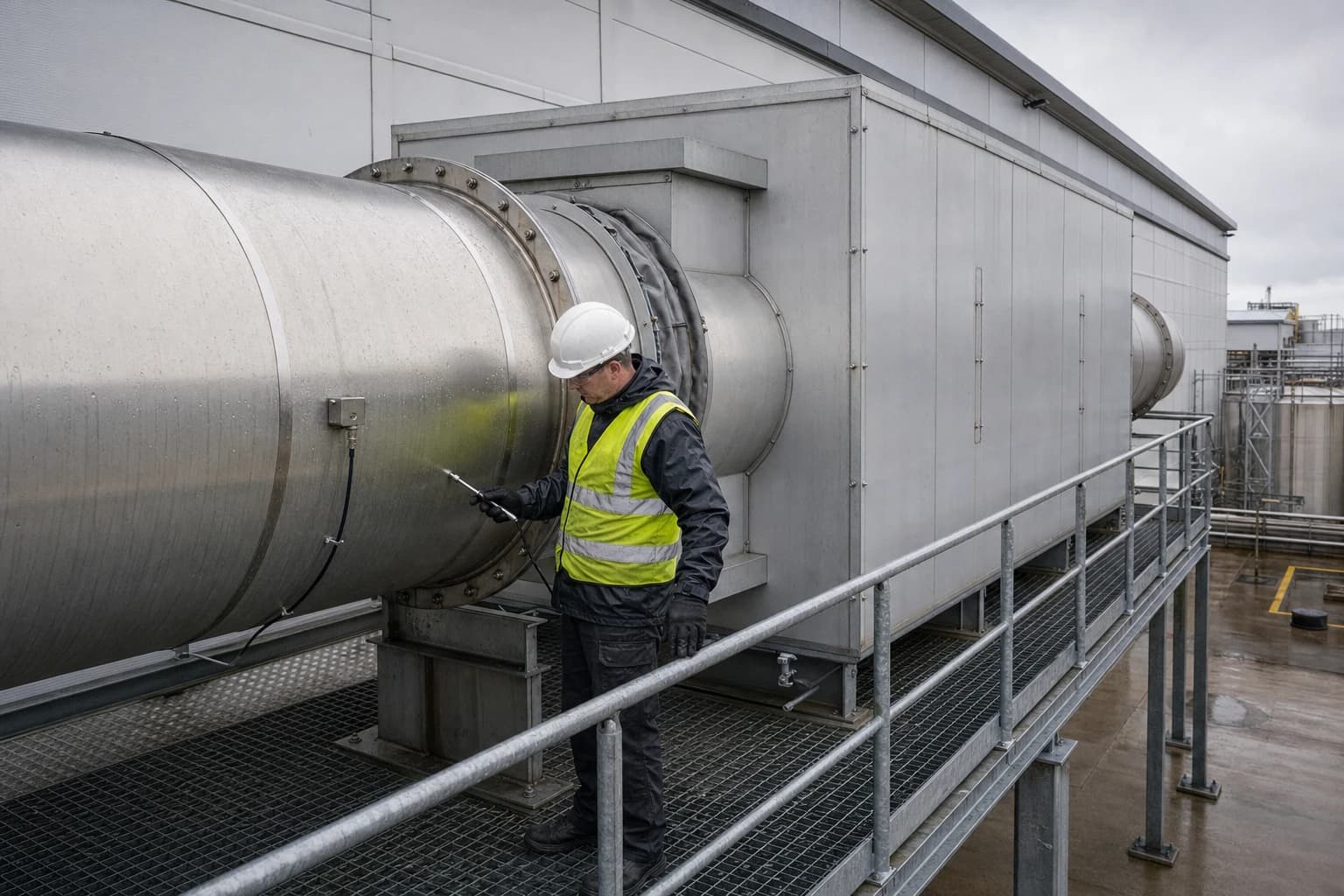
Why Thermal Process Simulation Matters for ESOS Phase 4
How PAS 51215-1:2025 supports evidence-led industrial energy assessments
Thermal process simulation uses calibrated engineering models to predict heat transfer, fuel use, utility demand and operating behaviour before a plant changes equipment or process conditions. For large UK undertakings, 31 December 2026 is the ESOS Phase 4 qualification date, followed by a 5 December 2027 compliance notification deadline.
That timetable brings industrial heat into the audit frame. The Environment Agency requires participants to identify significant energy consumption covering at least 95% of total energy consumption, assess opportunities, and provide evidence of costs, benefits and implementation considerations. At a chemical plant, food factory, paper mill or pharmaceutical site, that work often depends on understanding interconnected thermal duties rather than reviewing a boiler, dryer or heat exchanger in isolation.
Thermal process simulation gives the audit team a tested basis for that understanding. It converts measured plant data and operating constraints into scenarios that can be checked before capital is committed. The result is stronger evidence for an ESOS recommendation and a clearer route from an audit finding to an implementable process change.
Thermal process simulation turns ESOS energy data into process evidence
ESOS requires verifiable energy-consumption data over 12 consecutive months, expressed in energy units rather than spend. That establishes the scale of consumption. It does not explain why a process uses energy at a particular rate or whether a proposed intervention will perform through the production cycle.
A thermal process simulation connects energy use with the physical conditions that drive it: mass flow, temperature, pressure, composition, phase change, heat-transfer area, furnace loading, production rate and utility conditions. Engineers can then test the effect of changing a duty without waiting for a shutdown or putting production at risk.
From a consumption total to a thermal balance
A site may know its annual gas consumption and steam generation. A model can allocate that energy between process heating, evaporation, heat losses, condensate return, exhaust heat and part-load operation. This matters because each energy-saving opportunity needs a credible technical boundary.
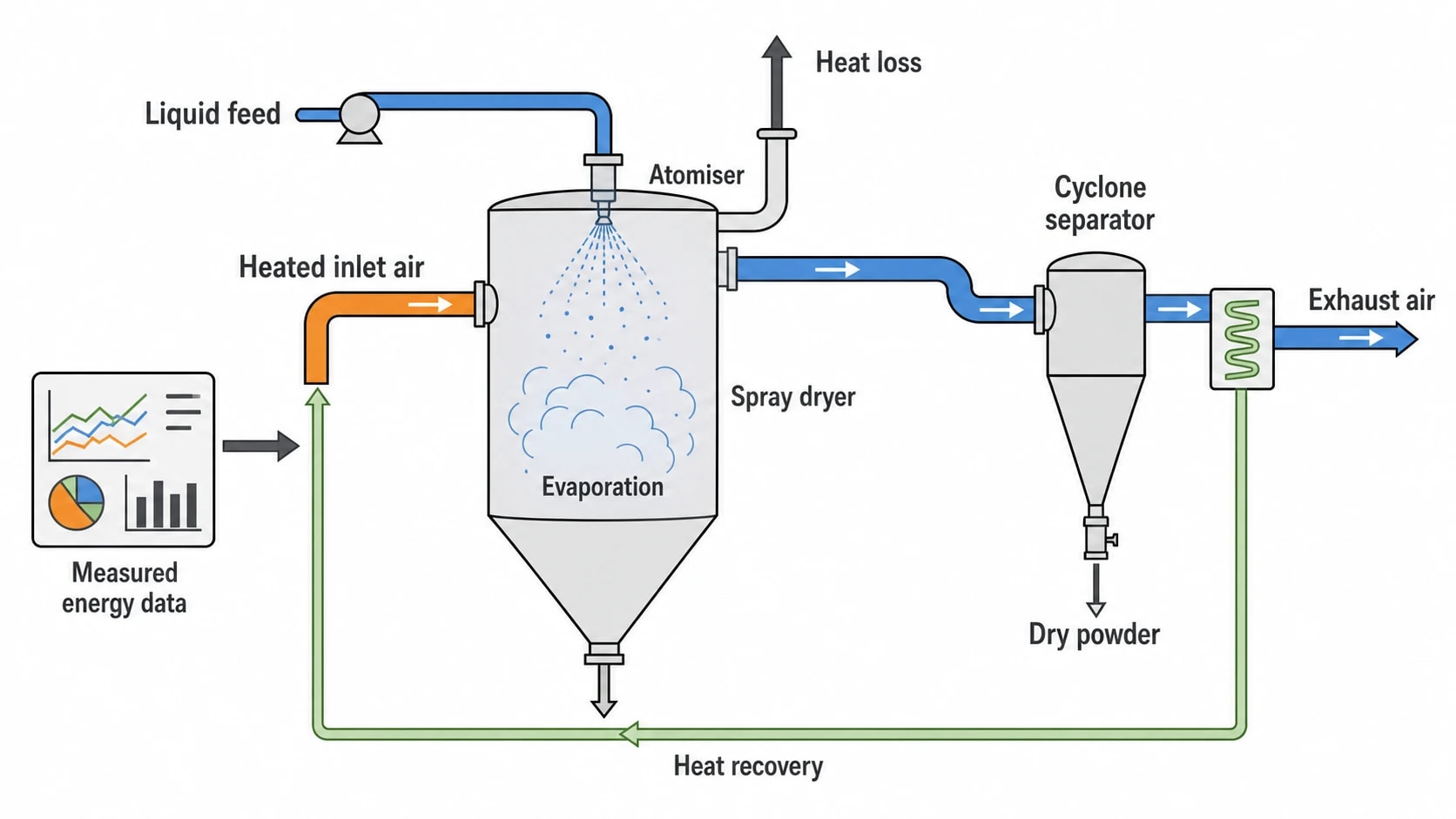
Consider a spray dryer. The gas meter may show high consumption, but the cause may be excess exhaust-air flow, variable feed solids, inlet-air temperature control, heat loss from ductwork or poor heat recovery between exhaust and incoming air. Simulation evaluates those factors as a connected process.
The same principle applies across industrial sectors:
- Chemical processing: reactor heating and cooling, distillation reboilers, vapour recompression, solvent recovery and heat-exchanger networks.
- Food and beverage: pasteurisation, evaporation, cooking, baking, frying, refrigeration heat rejection and clean-in-place heating.
- Pharmaceuticals: batch reactors, purified-water systems, sterilisation, drying, HVAC thermal loads and clean steam.
- Paper and pulp: steam systems, dryer sections, condensate recovery, hood ventilation, evaporation and heat cascading.
- Manufacturing: furnaces, ovens, kilns, curing lines, washing stages and thermal treatment equipment.
A model cannot improve weak measurement. It can expose where plant metering does not support the claimed energy balance. That is useful where sub-metering, steam measurement or temperature data would remove uncertainty before a larger project proceeds.
A model needs a defined operating case
A simulation should represent a defined production state, not an idealised nameplate condition. The baseline needs data from normal operation, including product throughput, batch duration, seasonal utility conditions, start-up and shutdown periods, product specifications and process constraints.
The audit team should record the calibration window and the source of key inputs. If a heat-exchanger model uses assumed fouling resistance or a dryer model uses an estimated exhaust-moisture level, those assumptions should be visible. This allows the ESOS evidence pack to distinguish measured results from projections.
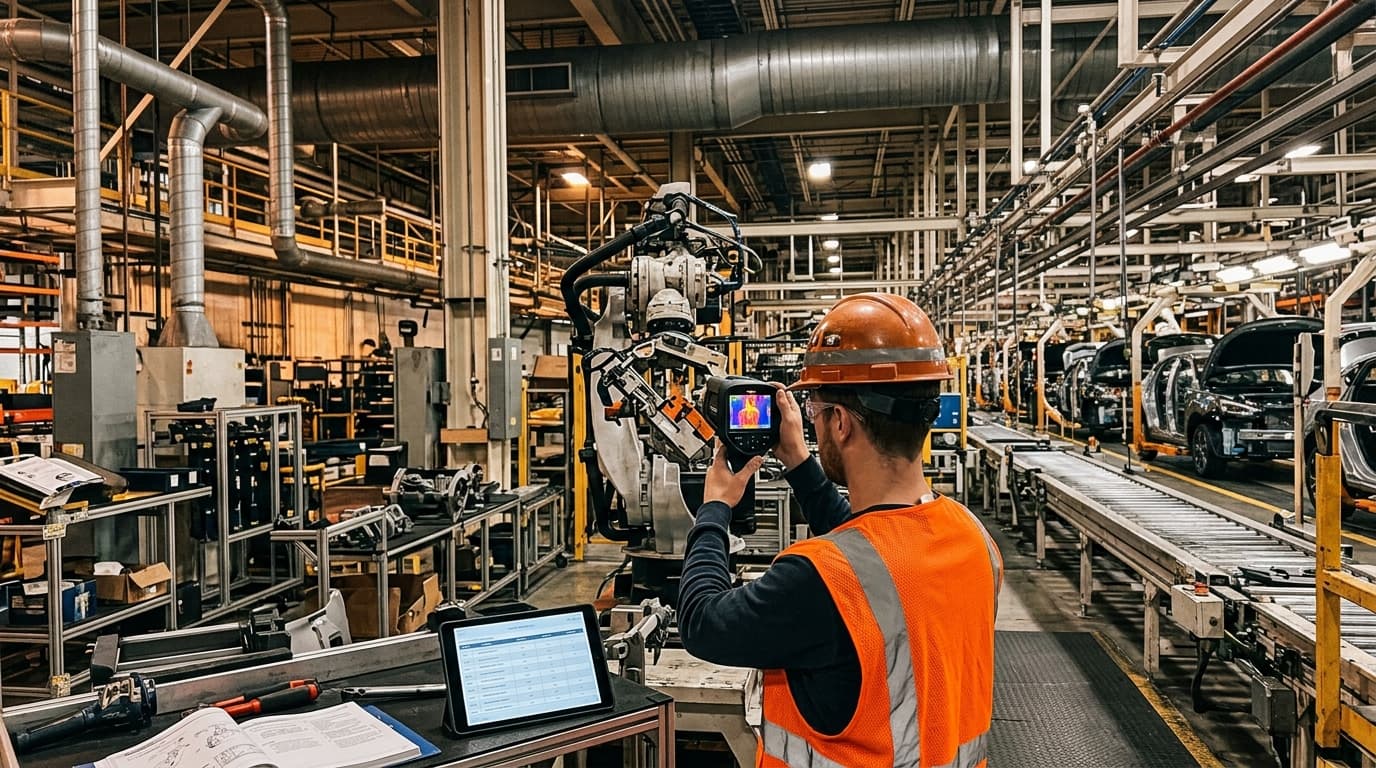
Identify where your plant is losing energy and quantify the savings potential — our audits map every heat source, sink, and waste stream in your facility.
ESOS Phase 4 makes technical confidence more valuable
ESOS Phase 4 is an energy-assessment scheme, but its recommendations must connect costs, benefits and practical implementation. Environment Agency guidance also requires an action-plan review and reporting of energy savings achieved during the compliance period. A generic list of thermal measures has little value where plant conditions determine whether a measure will work.
The scope includes industrial processes
The scheme applies to qualifying large undertakings and groups. A UK undertaking qualifies if it employs 250 or more people, or has annual turnover above £44 million and an annual balance-sheet total above £38 million, subject to the detailed ESOS rules.
Industrial processes can dominate significant energy consumption at manufacturing sites. Thermal simulation helps distinguish a meaningful process opportunity from a broad recommendation such as “recover waste heat” or “optimise steam use”.
Waste heat has a temperature, flow profile, contaminants, availability pattern and distance from a useful sink. A warm exhaust stream can appear attractive on a site walk-through yet offer little annual benefit if the receiving duty operates intermittently. Conversely, a moderate-temperature stream can have a strong case where it displaces steady hot-water or make-up-water heating.
Recommendations need operating context
ESOS audit guidance says opportunities should be reasonably practicable and cost-effective, with estimated costs, benefits, implementation considerations and a suggested programme. Thermal process simulation supports those requirements by testing operating cases before a recommendation enters the programme.
Useful model outputs include:
| Audit question | Simulation evidence |
|---|---|
| What energy does the measure displace? | Fuel, steam, electricity or cooling duty under a defined baseline |
| Does a heat source match a heat sink? | Temperature approach, flow availability, timing and controllability |
| Will product quality be maintained? | Process temperatures, residence time, moisture, pressure and batch conditions |
| What equipment duty is required? | Heat-exchanger area, utility demand, pump duty, fan duty or storage requirement |
| How sensitive is the case? | Effect of throughput, ambient conditions, fouling, production mix and utility pressure |
| What could prevent delivery? | Space, hygiene, contamination, materials, operability, maintenance and shutdown constraints |
Simulation does not remove the need for engineering judgement, site verification or a lead assessor. It makes that judgement traceable.
How thermal process simulation identifies credible heat-recovery opportunities
DESNZ’s March 2026 report, Updating evidence on energy efficiency potential for UK industry, places process design, energy management and waste-heat recovery among the measures affecting industrial fuel-for-heat demand. It also highlights the importance of metering and data integration into process control for paper and pulp operations.
Heat recovery cannot be assessed accurately from a single temperature reading or annual fuel total. The model must represent source quality, sink demand and how both change over time.
Matching temperature level and availability
A heat-recovery study begins with the hot and cold streams. The source could be boiler blowdown, condensate flash steam, oven exhaust, dryer exhaust, refrigeration heat rejection, process cooling water, flue gas or product cooling. The sink could be boiler make-up water, combustion air, wash water, incoming product, process water, building heating or another process stream.
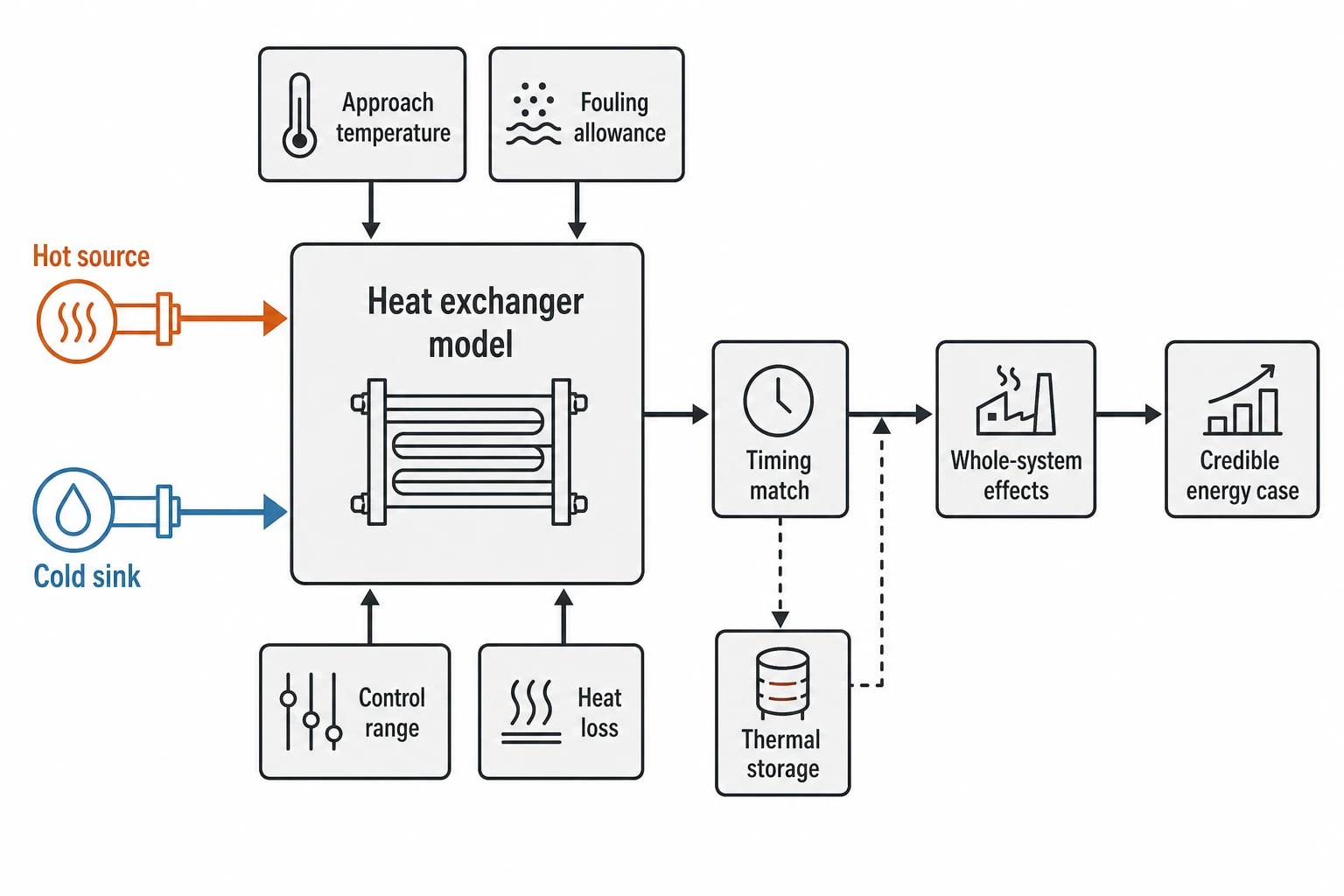
The process model tests whether the source retains useful temperature after allowing for heat-exchanger approach, fouling allowance, control range and heat loss between source and sink. It also examines whether the hot stream and cold demand occur at the same time.
A steady source and a batch sink may require thermal storage, a different receiving duty or a revised operating sequence. Without that analysis, annual savings can be overstated.
Pinch analysis and simulation serve different purposes
Pinch analysis identifies the theoretical and practical scope for heat integration across a defined set of process streams. Thermal process simulation develops the operating representation needed to test an option in more detail.
The two methods work well together. Pinch analysis can identify utility targets and heat-recovery opportunities across a process area. Simulation can then assess heat-exchanger sizing, control behaviour, seasonal effects, batch sequencing and the consequences of production changes.
For a dairy evaporator, pinch analysis may identify available vapour or condensate heat. Simulation can test whether that heat remains available during cleaning cycles, whether product-side fouling changes heat-transfer performance, and how the proposal affects steam demand at different production rates.
For a paper-machine dryer section, the model can examine condensate pressure, flash-steam recovery, hood-air conditions and drying load together. This provides more useful evidence than applying a generic steam-saving percentage to annual consumption.
Heat recovery needs a whole-system view
A recovery project can shift energy demand rather than reduce it. A new heat exchanger may increase pumping power. Lower flue-gas temperature can affect draft. A heat pump can reduce fuel consumption while adding electrical demand. Changes to a steam-pressure level can alter downstream equipment performance.
The model should include these secondary effects in the energy case and state the boundary used for the saving calculation. A claim based solely on reduced boiler fuel can mislead if a compressor, fan or heat pump materially changes electrical consumption.

Identify where your plant is losing energy and quantify the savings potential — our audits map every heat source, sink, and waste stream in your facility.
Building a thermal process simulation for an industrial energy audit
A proportionate model is better than an elaborate model built on uncertain data. The required detail depends on the decision. Screening an opportunity may need a steady-state energy balance. Selecting a heat-recovery configuration, changing furnace operation or resizing a utility system often requires more detailed scenarios.
1. Define the decision and boundary
Start with a precise question. Examples include whether boiler blowdown can preheat make-up water, whether furnace exhaust can preheat combustion air, or whether a heat pump can serve a low-temperature process-water duty.
Set the model boundary around the process and utilities affected by that decision. Identify imports and exports of steam, electricity, fuel, cooling water, compressed air, hot water and recovered heat. Define the baseline period and production basis, such as per tonne of product, per batch or per operating hour.
2. Gather data from the operating plant
Priority data normally includes:
- Fuel, electricity, steam and water meter readings.
- Flow, pressure and temperature measurements.
- Product throughput, moisture, composition and temperature.
- Equipment design data, including heat-transfer area and utility connections.
- Control setpoints and operating histories.
- Maintenance records identifying fouling, steam-trap faults, leakage or bypass operation.
- Laboratory or quality data where the proposal could affect product specification.
The audit team should reconcile readings where possible. A substantial mismatch between fuel input and calculated thermal duties can indicate missing loads, poor meter quality, unrecorded venting or inaccurate assumptions.
3. Calibrate and test the baseline
Calibration compares the model with observed plant operation across representative conditions. A model that matches one favourable snapshot may fail at lower throughput, a different product mix or a changed ambient temperature.
Sensitivity testing shows how the recommendation responds to uncertainty. A heat-recovery case could be tested at low, typical and high production rates; minimum and maximum source temperature; and realistic heat-exchanger fouling conditions. This range informs the saving estimate and avoids presenting a single optimistic value as a guaranteed outcome.
4. Model the intervention and implementation constraints
The final model should evaluate the proposed configuration against the baseline using the same production basis. It should show utility change, equipment duty, expected operating range and interactions with existing controls.
Implementation constraints belong in the same technical review. Food and pharmaceutical sites may need hygienic design, cleanability and separation between process streams. Chemical plants may need materials compatibility, pressure protection, hazardous-area review and emissions controls. Paper mills may face access limitations around dryer sections and hood systems. A project that cannot be installed during an available shutdown should be described as such in the ESOS programme.
PAS 51215-1:2025 provides a structured assessment frame
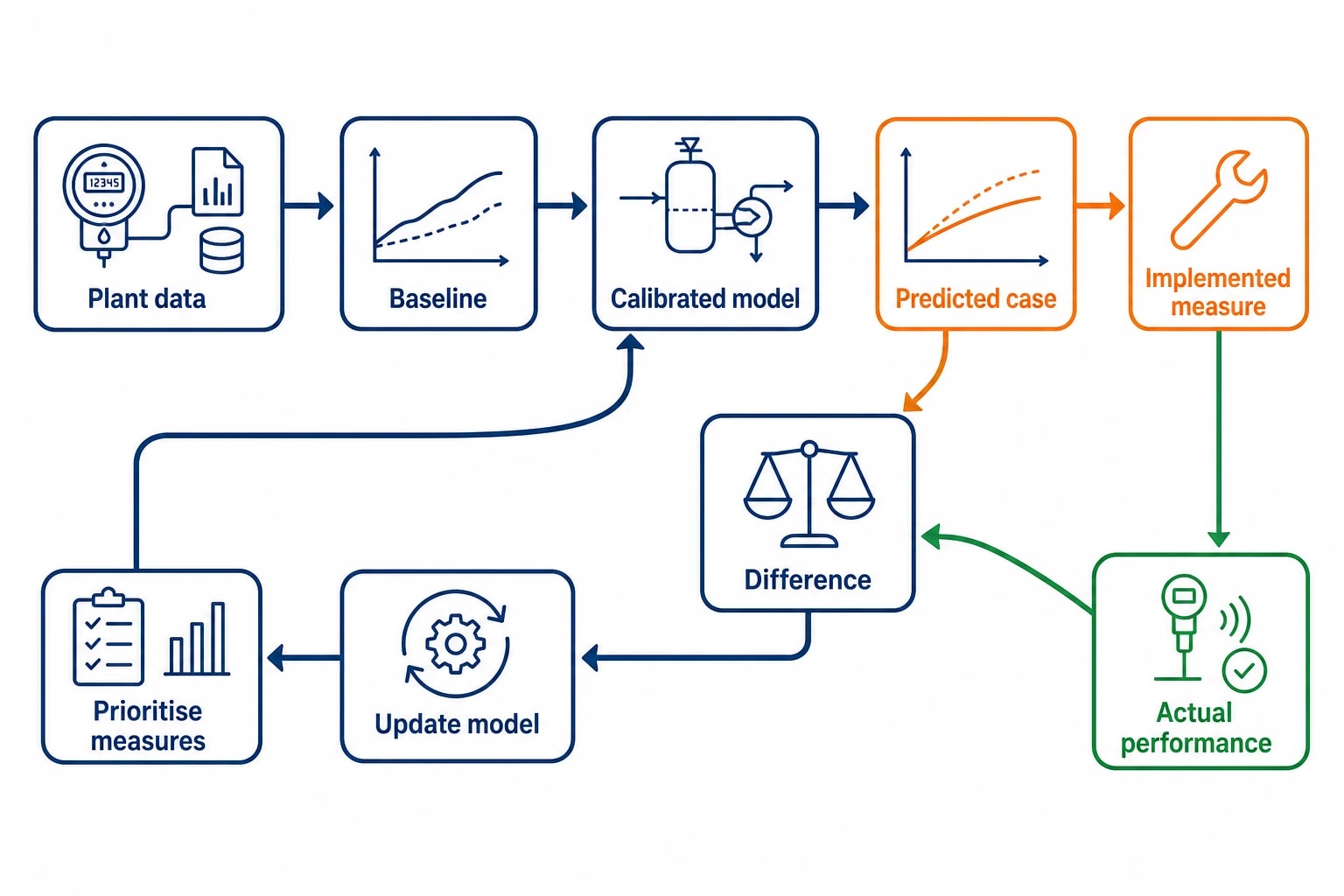
PAS 51215-1:2025, Energy and decarbonisation assessment - Part 1: Process - Specification, describes a harmonised process for assessing energy use and associated greenhouse-gas emissions, identifying improvement opportunities and producing an implementation plan within a defined assessment boundary.
Its emphasis on a documented process and clear outputs fits thermal process simulation. The simulation supplies evidence for the baseline, technical evaluation, prioritisation and implementation plan. It also provides a record that can be updated when production conditions or utility infrastructure change.
Use the model as a living audit record
A one-off model has value for an ESOS audit. A maintained model has value for energy management. After a measure is implemented, site data can compare actual energy performance with the predicted case. Differences can reveal changed throughput, altered operating practice, unmeasured losses, degraded equipment or an incorrect baseline assumption.
Consumption monitoring supports that cycle. EnerTherm Engineering’s Ecolog monitoring and process optimisation work can provide plant data for heat-loss audits, pinch analysis and thermal process simulation, allowing engineers to check results against normal operation rather than relying on a design-case estimate.
Prioritise measures by evidence, not familiarity
Thermal measures should be ranked by site-specific energy effect, capital requirement, production risk, operating dependency and delivery route. A modest insulation repair may be readily delivered. A larger heat-integration project may require longer design, a shutdown and detailed process-safety review while delivering a larger reduction in fuel demand.
Simulation gives both measures a transparent basis for comparison. It also identifies measures that should be implemented in sequence. Improving heat-exchanger performance or condensate return may alter the best size and economics of a later heat-recovery project. That sequence can be reflected in the ESOS implementation programme.
Thermal process simulation improves the quality of Phase 4 decisions
ESOS Phase 4 requires large undertakings to identify savings opportunities across significant energy consumption and provide information that supports practical implementation.
For thermal processes, the strongest opportunities sit in the interaction between production, utilities and heat recovery. Thermal process simulation creates an auditable baseline, tests operating scenarios, quantifies utility effects and identifies the conditions that determine whether a project will deliver.
This article reflects the independent analysis and editorial opinion of EnerTherm Engineering. Product names, trademarks, and brands mentioned belong to their respective owners. EnerTherm Engineering is not affiliated with, endorsed by, or a licensee of any third-party software or product mentioned unless explicitly stated.

Simulation Engineer — EnerTherm Engineering
Rajesh Sekar is a Simulation Engineer at EnerTherm Engineering, specialising in computational fluid dynamics (CFD), finite element analysis (FEA), and thermal process simulation. He holds a degree from Cranfield University and brings extensive experience in simulation-based product development from the automotive, aerospace, and energy sectors.
