Heat Recovery Feasibility Study: The 8 MW Threshold
A cost-benefit assessment of heat exchangers, heat pumps, CHP and off-site heat users.
Eight megawatts of average annual total energy input is the threshold at which Directive (EU) 2023/1791 requires Member States to ensure that proposed new or substantially refurbished industrial installations receive a formal heat recovery cost-benefit analysis. For UK energy managers, it is not a domestic legal threshold, but it remains a useful prompt for a more disciplined examination of large thermal loads.
A heat recovery feasibility study determines whether waste heat can be captured, transferred to a viable user and delivered at an acceptable cost and operational risk. It must test more than the quantity of heat leaving a stack, cooling circuit or process drain. Temperature, contamination, production patterns, maintenance access, shutdown windows and the heat user’s demand profile determine whether an opportunity becomes a project.
What the 8 MW threshold requires
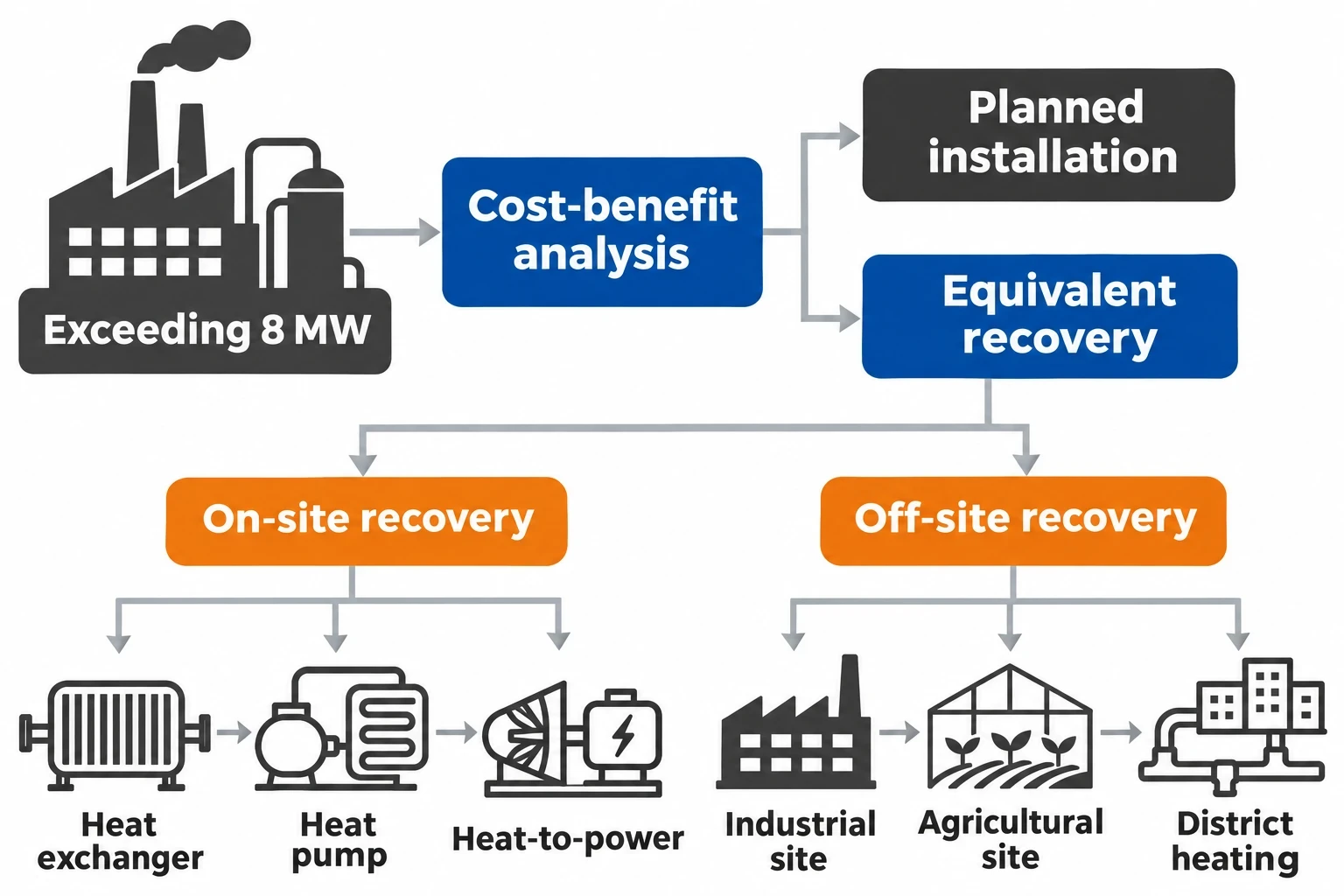
Article 26(7)(b) of Directive (EU) 2023/1791 applies to industrial installations with average annual total energy input exceeding 8 MW. The required cost-benefit analysis must assess the use of waste heat on site and off site.
Annex XI requires comparison between the planned installation or refurbishment and an equivalent arrangement that recovers waste heat. The analysis must consider electrical and thermal capacity, fuel, expected annual operating hours, location, electricity demand and thermal demand.
For on-site recovery, the Directive specifies assessment of:
- Heat exchangers
- Heat pumps
- Heat-to-power technologies
For off-site recovery, the assessment must consider industrial installations, agricultural sites and district heating networks as potential heat users. The financial analysis must reflect actual cash flows from investing in and operating the installation. A result is positive where discounted benefits exceed discounted costs.
An EU requirement, a useful UK benchmark
The Directive applies through EU Member State law. A UK-only installation is not directly subject to Article 26. Businesses operating sites in both the UK and EU should establish which projects fall within national transposition measures in the relevant Member State.
The engineering logic still applies. An 8 MW energy-input threshold identifies a facility large enough for a formal assessment of lost heat to be proportionate. Sites below that level can support viable recovery schemes, particularly where a high-temperature source matches continuous nearby process demand. Conversely, a site above 8 MW can fail the feasibility test if its available heat is intermittent, too low in temperature, contaminated, remote from demand or tied to production equipment that cannot tolerate additional pressure drop.
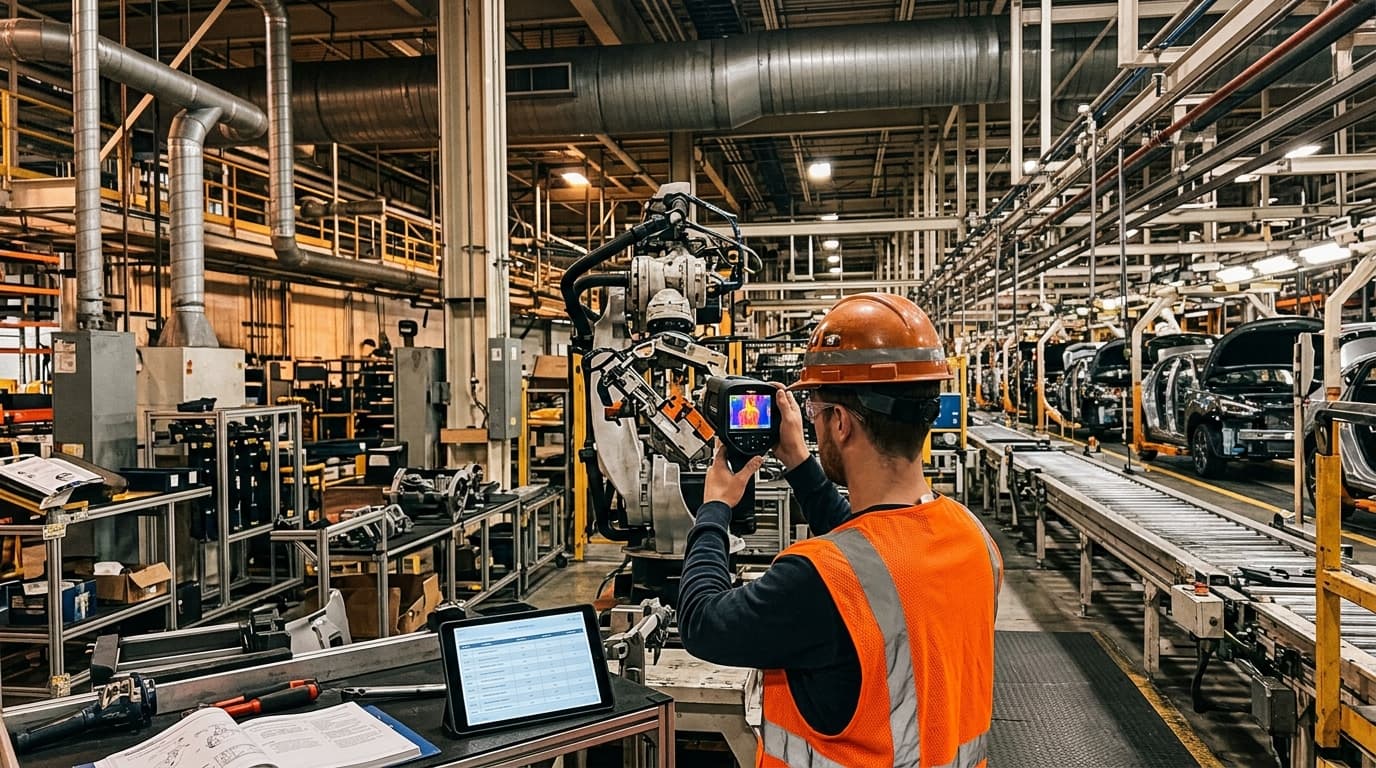
Identify where your plant is losing energy and quantify the savings potential — our audits map every heat source, sink, and waste stream in your facility.
Start a heat recovery feasibility study with measured heat
A feasibility study should begin with site evidence, not annual fuel consumption alone. Gas, electricity and steam bills show the scale of energy purchase, but cannot establish the temperature, flow, timing or condition of recoverable heat.
Build a source and sink register
The first fieldwork stage identifies each credible heat source and heat sink. Sources may include flue gas, compressor cooling, refrigeration plant condensers, hot wastewater, dryer exhausts, product cooling loops, boiler blowdown and process condensate. Sinks may include boiler feedwater, process water, washdown water, space heating, drying air, preheating duties, low-pressure steam generation or a nearby heat-network connection.
For each source, the study should record:
- Fluid or gas composition and contamination risk
- Temperature range at normal, minimum and maximum production
- Flow rate and its variation
- Available operating hours and seasonal profile
- Existing heat-rejection method
- Permitted pressure drop and process constraints
- Cleaning, inspection and maintenance requirements
For each sink, it should record the same operating detail, alongside the current heating fuel or electricity source and required delivery temperature.
This register prevents a common error: treating peak heat as annual recoverable energy. A heat source that appears substantial during a short batch step may have little value if the intended sink operates at another time.
Establish the true energy baseline
Metered data should cover enough operating modes to distinguish stable production from start-up, cleaning, campaign changeovers and reduced-load operation. Utilities engineers should reconcile the resulting baseline against fuel purchases, steam-generation records, electricity imports and production output.
Consumption monitoring can identify the production conditions that create recoverable heat and demand. A process-optimisation platform such as Ecolog can make those patterns visible where metering is available. The feasibility report should state meter locations, the data period, missing-data treatment and the assumptions used to convert measurements into annual energy estimates.
A credible baseline separates avoidable heat loss from heat needed to keep the process stable and enables later savings verification.
Match heat quality before choosing equipment
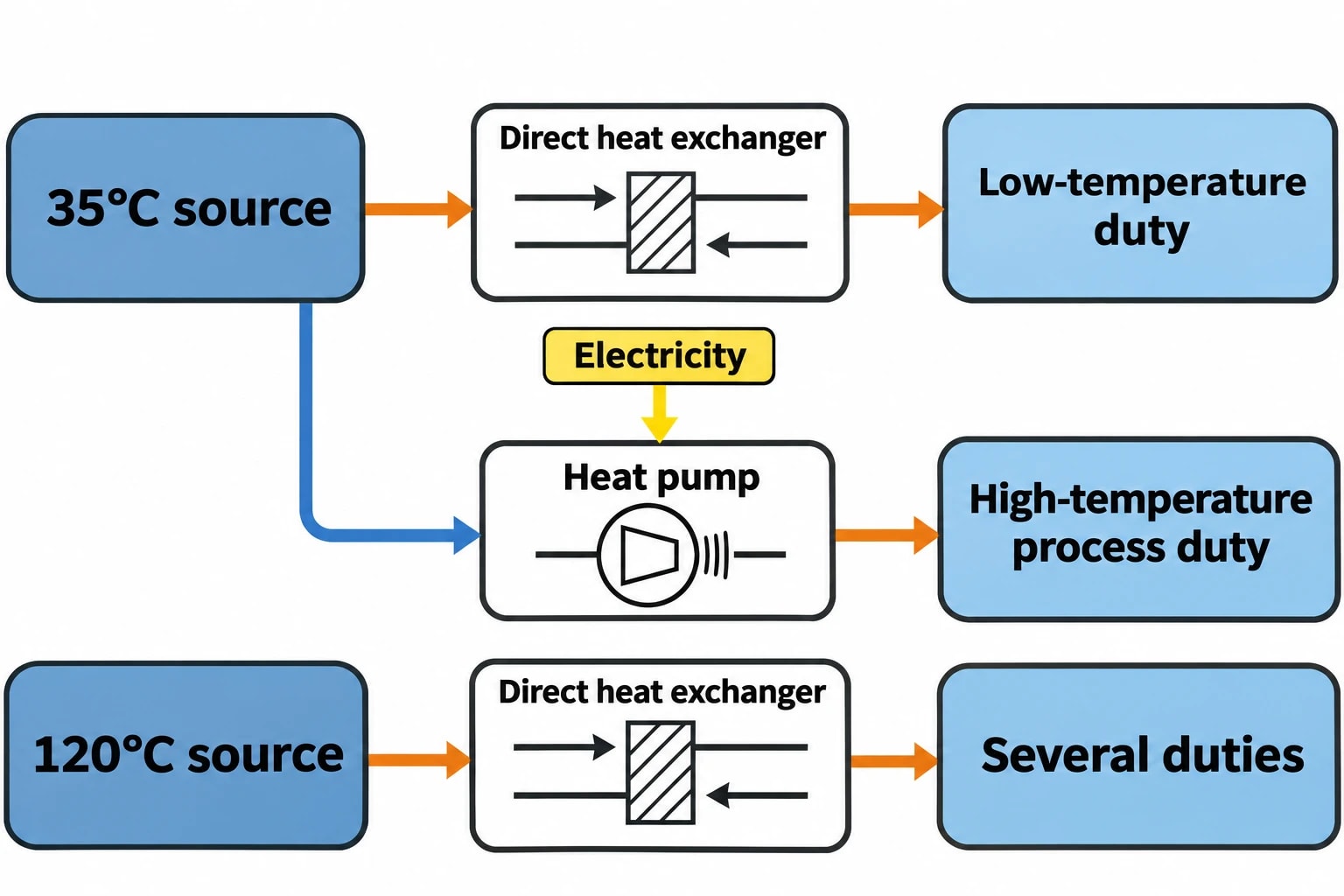
Heat quantity has limited value without heat quality. A source at 35°C may be useful for preheating incoming water or supporting a low-temperature heating circuit, but cannot directly replace a high-temperature process duty. A source at 120°C may support several duties, but corrosion, fouling or variable flow can narrow the equipment choices.
Direct recovery usually deserves first assessment
A direct heat exchanger is often the first option to test where source and sink temperatures align. The feasibility study should define the approach temperature, expected pressure drop, materials of construction, isolation arrangement and cleaning strategy.
Food and beverage sites may need hygienic separation and a secondary closed loop between the process stream and recovered-heat circuit. Chemical and pharmaceutical sites may require containment and segregation where the source could contaminate a product-contact utility. Paper and pulp operations may need close attention to fibre, scale and fouling in heat exchangers handling process water.
The assessment should show duty across normal operating conditions rather than a single nameplate value. It should also identify the fallback heating arrangement when the heat source is unavailable.
Heat pumps can upgrade low-grade heat
A heat pump can raise the temperature of a lower-grade source to a useful level, subject to its operating envelope and electricity demand. The feasibility case should test the expected source temperature, delivery temperature, load profile, refrigerant selection, peak electrical demand, resilience requirements and effects on site power infrastructure.
Heat pumps should not be assessed as isolated electrical loads. Their value depends on the fuel displaced, heat delivered during operating hours and the site’s ability to manage source-side and sink-side variability. A heat pump serving a continuous low-temperature duty may have a different business case from one serving a variable batch process with frequent start-stop operation.
CHP and heat-to-power need a realistic comparison case
Combined heat and power and heat-to-power technologies should be considered only where the site has a credible use for the electricity and heat produced. The comparison must reflect expected annual operating hours, maintenance outages, export arrangements where relevant, fuel exposure and the value of alternative heat supply.
A feasibility study should not claim all rejected heat as a benefit. The useful outcome is heat that displaces a measurable existing energy input without creating unacceptable production, safety or maintenance consequences.
Put integration risk into the cost-benefit analysis
Capital cost is only one component of a heat recovery decision. The physical connection between source and sink can cost more than the heat exchanger or heat pump itself, especially on a congested, regulated or continuously operating site.
Include the full project scope
A properly developed estimate includes enabling works as well as the main equipment. Typical items include pipework, pumps, control valves, insulation, electrical supply, civils, steelwork, access platforms, fire protection, instrumentation, drainage, commissioning, design assurance and contingency.
It should also include the production cost of installation. A recovery scheme requiring a major shutdown must compete for the same outage window as statutory inspections, capacity projects and reliability work. Where a tie-in is only possible during a multi-year turnaround, the cash-flow model should reflect the delay.
| Cost or benefit area | Questions for the feasibility study |
|---|---|
| Capital expenditure | What equipment, pipework, access, civils and electrical works are required? |
| Operating expenditure | What pumping power, heat-pump electricity, maintenance, water treatment and cleaning are needed? |
| Energy benefit | Which fuel or electricity use is displaced, under which operating conditions? |
| Production impact | Does the design add pressure drop, alter temperatures or constrain throughput? |
| Availability | What happens when the source, sink or recovery equipment is out of service? |
| Carbon benefit | Which metered energy source is reduced and how will the reduction be evidenced? |
Use scenarios rather than a single energy-price assumption
Energy managers should test sensitivity to operating hours, fuel and electricity prices, maintenance cost, production volume and heat-source availability. A project with an attractive base case but weak economics under a modest reduction in operating hours needs a different approval route from one that remains positive across credible scenarios.
The financial model should identify the investment metrics used by the organisation, such as payback period, net present value and internal rate of return. It should disclose the discount rate, asset life, replacement assumptions and residual value, allowing management to judge whether a recommendation depends on engineering performance or an optimistic financial assumption.

Identify where your plant is losing energy and quantify the savings potential — our audits map every heat source, sink, and waste stream in your facility.
Assess on-site and off-site heat users separately
On-site reuse generally has fewer counterparties and less network infrastructure, but still requires matching the source to real demand over time. Boiler-feedwater preheat, process-water heating and drying duties can be strong candidates where the source and sink operate together.
Off-site heat recovery needs a deliverable customer
Off-site heat can create a larger use for surplus energy, but introduces distance, ownership and demand risk. A nearby industrial user may have a more compatible load profile than a housing development, while an agricultural heat user may have seasonal demand that does not match continuous process heat.
The study should identify the likely route, pipe length, operating temperature, connection point, permissions, metering boundary and commercial responsibility for each option. It should also test the consequences if the external user reduces demand, changes fuel or ceases operation.
District heating assessments need particular care. The value of recovered heat depends on the network’s temperature regime, existing or planned heat sources, network losses, connection timing and the contractual allocation of performance risk. A technically possible connection does not provide a bankable revenue stream without an agreed heat-offtake arrangement.
Turn the study into an ESOS-ready investment case
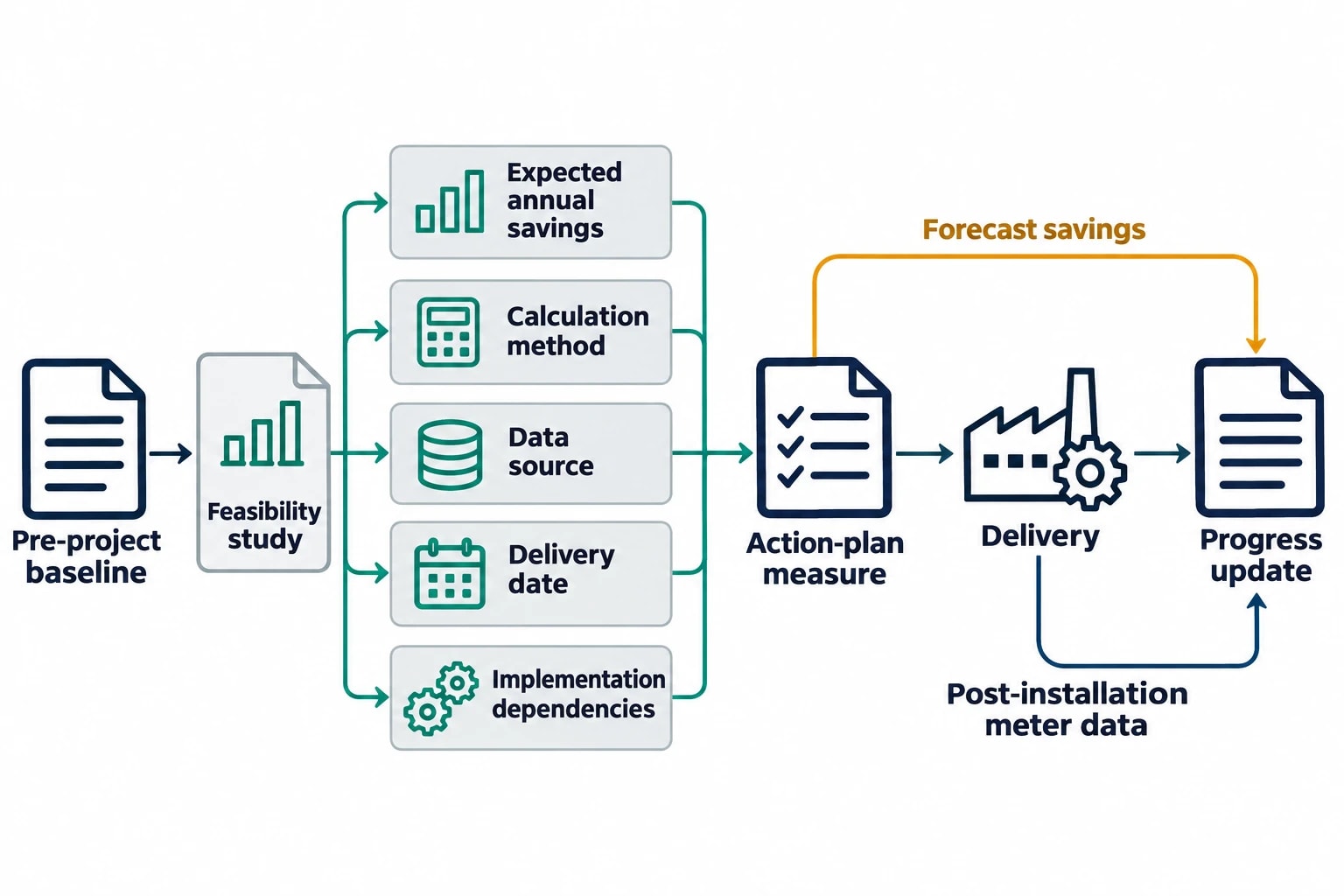
The Energy Savings Opportunity Scheme has made evidence quality more important for UK large undertakings. ESOS Phase 3 action plans require participating organisations to state expected energy savings and explain the estimation method. The second annual progress update is due by 5 December 2026.
A heat recovery feasibility study can provide the engineering evidence behind an action-plan measure. It should document the pre-project baseline, expected annual savings, delivery date, calculation method, data source and implementation dependencies. The eventual progress update should distinguish forecast savings from savings supported by post-installation meter data.
The UK Industrial Heat Recovery Support programme provides a useful structure, although applications closed in 2020 and the programme completed in 2022. Its £18 million programme separated Phase 1 feasibility and preliminary engineering from Phase 2 detailed design, procurement, construction, commissioning, operation start-up, monitoring and evaluation. That sequence remains sensible because it resolves technical and commercial uncertainties before a site commits delivery capital.
What a decision-ready feasibility report should contain
A feasibility study should allow a site director, finance lead and engineering manager to reach the same conclusion from the same evidence. The final document should include:
- A defined system boundary, process description and operating profile.
- A source and sink register with measured temperatures, flows, duties and operating hours.
- A shortlist of technically credible recovery options, including direct recovery and heat-pump upgrading where appropriate.
- A layout concept showing equipment location, routing, access and tie-in points.
- A capital and operating-cost estimate with stated accuracy basis and contingency.
- Financial scenarios with explicit energy, production and availability assumptions.
- Production, process-safety, hygiene, maintenance and shutdown risks.
- A delivery plan covering design, approvals, procurement, construction, commissioning and measurement.
The best heat recovery feasibility study identifies energy that can be recovered reliably, matches it to durable demand and states exactly what the site must spend, change and manage to capture the value.
This article reflects the independent analysis and editorial opinion of EnerTherm Engineering. Product names, trademarks, and brands mentioned belong to their respective owners. EnerTherm Engineering is not affiliated with, endorsed by, or a licensee of any third-party software or product mentioned unless explicitly stated.

Managing Director — EnerTherm Engineering
Dr. François Pierrel is Managing Director of EnerTherm Engineering with over two decades of expertise in thermal design, heat transfer, and industrial energy optimisation. He holds a PhD in Heat Transfer from Cranfield University and a Post-Doctorate from Heriot-Watt University.
