Validating Thermodynamic Models to Uncover Efficiencies in MDF Recovery
A Medium-Density Fibreboard (MDF) recovery plant operating a 750 kg/hr capacity line required a comprehensive review of its heat and mass balance. The facility faced challenges in accurately quantifying energy and material flows, which hindered efforts to optimise system performance. A specialized engineering consultancy was engaged to construct a rigorous thermodynamic model to validate the existing operational data and provide actionable insights into the thermal dynamics of the plant.
The scope of the thermal recovery project included the analysis of the brine and saline production system, boiler heat generation, MDF disaggregator power requirements, the dewatering press system, and the evaporative drying process. The objective was to replace the legacy client model with a robust system capable of simulating the entire plant operation as a holistic, integrated process.
Addressing Modelling Inconsistencies
The investigation revealed that the legacy client model was consistently underestimating energy demands. This discrepancy was primarily attributed to the assumption that all process streams operated under ambient conditions. The legacy client model calculated specific heat capacity values for water at room temperature, failing to account for the actual temperature-dependent and composition-dependent variations found in an active industrial process.
The specialized engineering consultancy implemented an NRTL model to simulate the process, accounting for the actual chemical composition of the MDF and the varying temperatures across the recovery stages. This approach allowed the team to capture the cumulative effects of interacting processes, rather than analysing systems in isolation.
Key Findings in System Discrepancies
The validation process compared the findings of the new model against the legacy client model. Several areas showed significant variations, particularly in the boiler and disaggregator systems where energy demand calculations diverged due to improper accounting of feed composition and heat capacity.
| Process Parameter | Legacy Client Model | New EENG Model | Discrepancy |
|---|---|---|---|
| Boiler Feed Water Mass Flow | 5,885 kg/hr | 9,000 kg/hr | 52.9% |
| MDF Heating Load (10C to 90C) | 22 kW | 29 kW | 31.8% |
| Boiler Heat Load (1500 kg/hr feed) | 249 kW | 268 kW | 7.6% |
The 52.9% discrepancy in boiler feed water flow was particularly notable. The legacy client model failed to account for the additional hot water required to heat the MDF feed from 10C to 90C. By integrating the chemical composition of the wood into the new thermodynamic model, the team provided a more accurate assessment of the energy required for the disaggregator and boiler.
Optimization Opportunities
Beyond correcting the legacy inaccuracies, the thermal recovery project documentation identified several strategic areas for process improvement. The flexibility of the new model allows for the simulation of various scenarios, enabling the team to evaluate efficiency gains before implementing physical changes.
Thermal Oxidiser Integration
In many similar manufacturing contexts, flue gases produced during the process contain volatile organic compounds. The study highlighted an opportunity to integrate a thermal oxidiser—a device that incinerates these gases—to serve a dual purpose. This equipment could function as a primary water boiler, capturing thermal energy from the incineration process to heat the plant's water supply.
System Simplification
The current brine and saline system relies on multiple dilution tanks, which increases infrastructure complexity and maintenance requirements. The analysis suggests that merging these systems into a single, unified unit would not only reduce equipment costs but also significantly improve the ease of operation and plant footprint.
Drying Efficiency
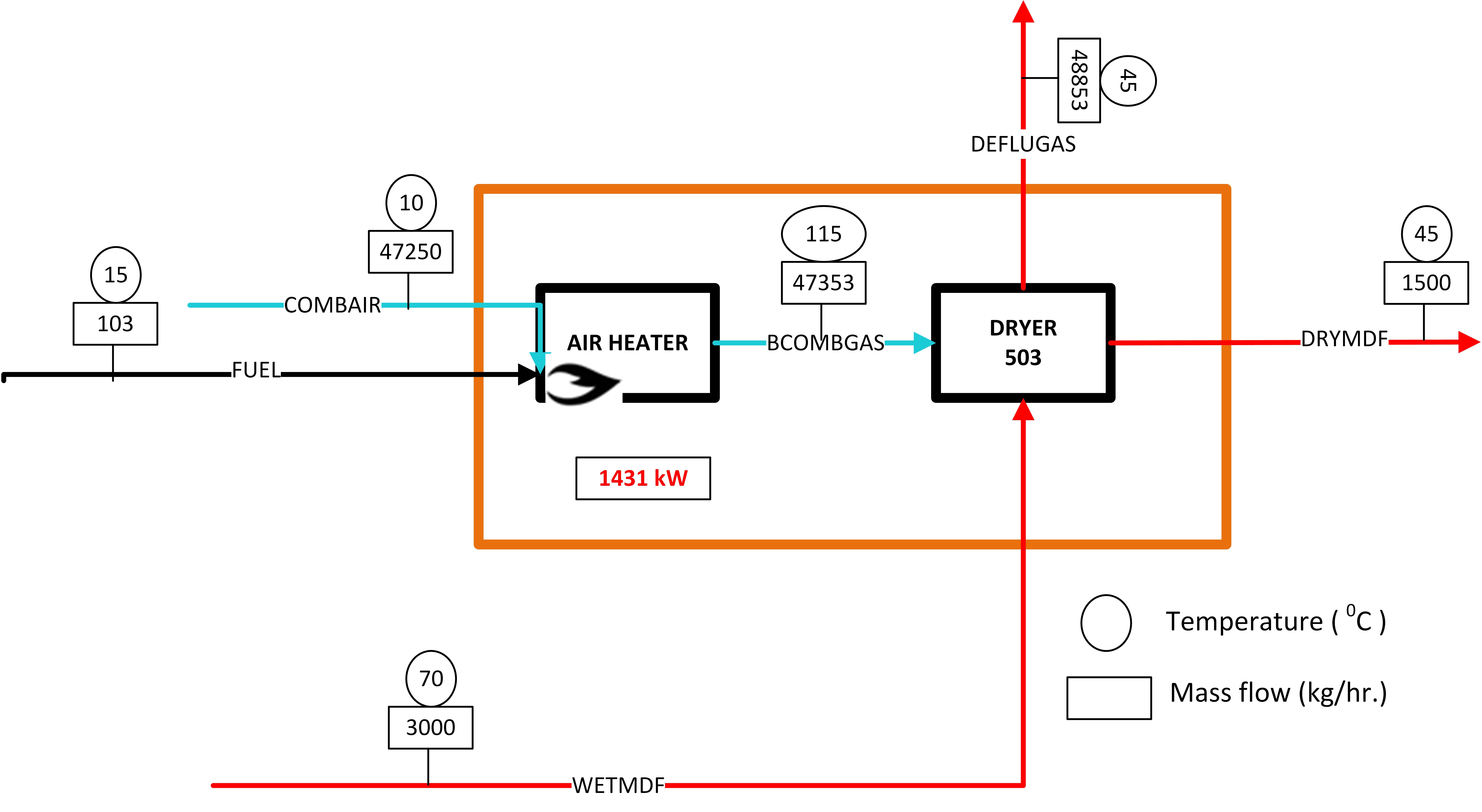
The modelling team evaluated the impact of recirculating dryer flue gas on energy efficiency. The data indicates that increasing the recirculation rate from 50% to 80% yields substantial energy savings:
- Dryer heat demand decreases from 1,376 kW to 1,235 kW.
- Natural gas consumption drops as the system better retains heat within the loop.
- Air mass flows are reduced, lowering fan power requirements.
Conclusion
The thermal recovery project successfully established a precise thermodynamic baseline for the MDF recovery facility. By moving away from simplified assumptions and adopting a composition-aware model, the specialized engineering consultancy identified that the plant was operating with an under-calculated energy demand. This new, validated model serves as a foundation for future plant modifications, ensuring that the facility can achieve higher efficiency through targeted thermal integration and equipment consolidation.

Managing Director — EnerTherm Engineering
Dr. François Pierrel is Managing Director of EnerTherm Engineering with over two decades of expertise in thermal design, heat transfer, and industrial energy optimisation. He holds a PhD in Heat Transfer from Cranfield University and a Post-Doctorate from Heriot-Watt University.
