
Why UK Tier 1 Suppliers Need an ESOS Energy Audit
How 12-month energy data and kWh-per-vehicle metrics support the 2026 ESOS assessment.
31 December 2026 determines whether a UK automotive Tier 1 supplier must comply with ESOS Phase 4, and the compliance notification deadline is 5 December 2027. For factories operating paint booths, curing ovens, welding cells, compressors and extensive HVAC plant, an industrial energy audit can turn a regulatory exercise into a capital plan grounded in site data.
Tier 1 status does not itself create an ESOS obligation. The scheme applies to large UK undertakings and qualifying corporate groups. An organisation qualifies where it employs 250 or more people, or exceeds both £44 million annual turnover and £38 million annual balance-sheet total. A smaller UK production site can still fall within scope where another UK entity in its corporate group meets the qualification threshold.
That group test matters across automotive supply chains. Multi-site suppliers often centralise finance, purchasing and sustainability reporting while energy waste occurs at individual sites. The audit therefore needs to establish the group compliance boundary while examining the machinery, operating practices and production constraints that determine energy use at each site.
ESOS Phase 4 places industrial energy use in scope
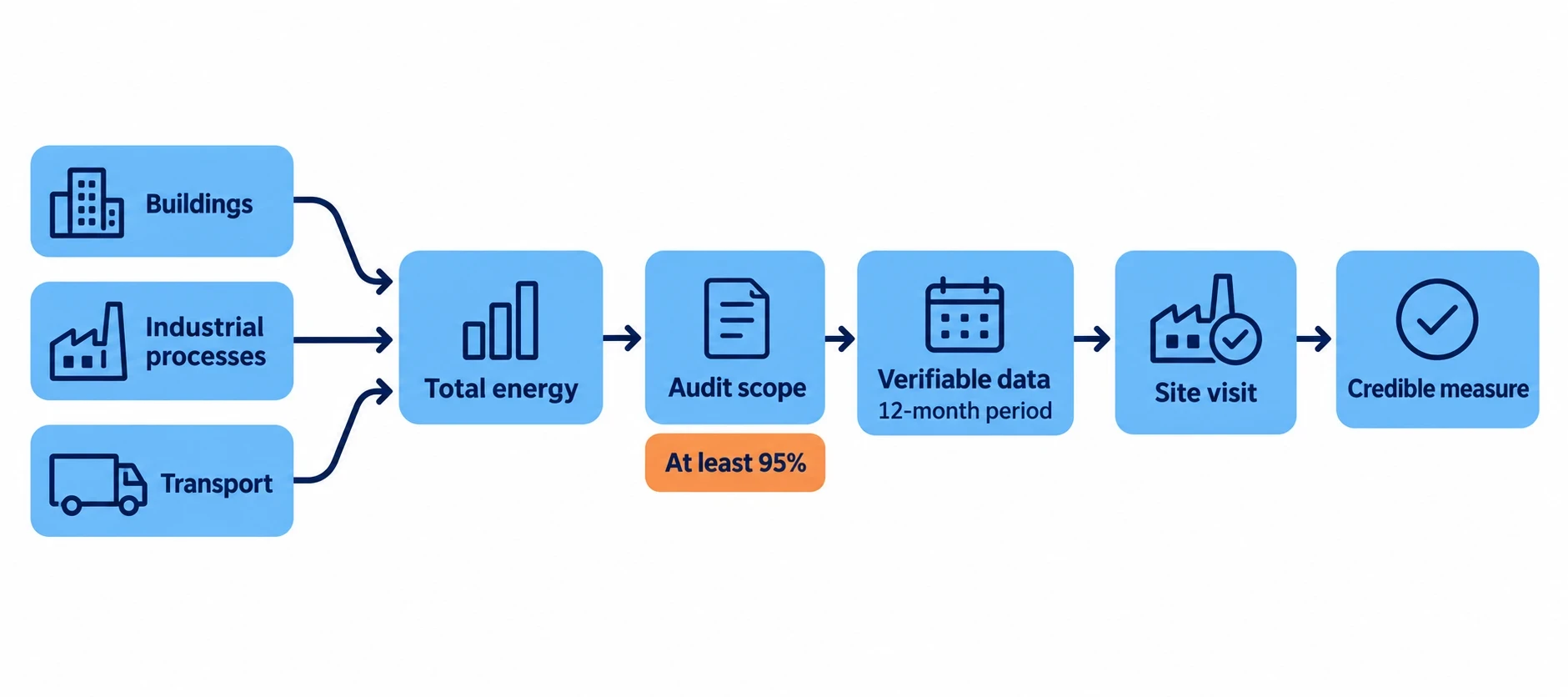
ESOS requires qualifying organisations to calculate energy used in buildings, industrial processes and transport. The areas selected for audit or an alternative compliance route must account for at least 95% of total energy consumption.
For an automotive Tier 1 supplier, that threshold directs attention towards energy that materially affects the factory cost base. It brings paint-shop ventilation, process heating, compressed air, welding extraction, robotics and production HVAC into the assessment rather than treating them as background utilities.
What an ESOS-compliant audit requires
An ESOS energy audit must use, so far as reasonably practicable, verifiable energy-consumption data from a 12-month period. It must include site visits, analyse consumption and energy efficiency, and identify energy-saving opportunities.
Utility invoices establish total cost and annual consumption. They rarely explain operational causes. A site needs a more detailed evidence trail:
- Half-hourly or interval utility data.
- Sub-metered electricity, gas and compressed-air data where available.
- Production volumes, operating hours and shift patterns.
- Asset condition, control settings and maintenance records.
- Process observations during production, idle periods and shutdowns.
- Interviews with engineering, production and facilities personnel.
The site visit is central to the commercial value of an industrial energy audit. It shows where a fan continues at full speed after a line stops, where a compressor runs unloaded overnight, or where an oven remains at temperature during a prolonged changeover. These findings often disappear within aggregated utility data.
Phase 4 also asks what happened after the previous audit
Phase 4 requires organisations to report progress against action-plan commitments. Where a planned measure was not implemented, the organisation must explain why.
That requirement should improve project selection. A generic recommendation to “optimise compressed air” offers little support for an investment decision. A credible measure identifies the affected assets, baseline consumption, engineering scope, implementation cost, production risk, anticipated savings and method of verification.
The board-level sign-off requirement reinforces that point. An ESOS report needs to withstand review by directors who will ask whether a project can be delivered safely, without disrupting customer schedules or compromising component quality.

Identify where your plant is losing energy and quantify the savings potential — our audits map every heat source, sink, and waste stream in your facility.
Why energy intensity matters in automotive manufacturing
Total kWh remains necessary for ESOS reporting, yet it cannot show whether an automotive plant has become more efficient. A site can reduce total electricity consumption because output fell, a model changed, or a shift was removed.
Phase 4 requires energy-intensity ratios for buildings, transport, industrial processes and other energy uses. The activity indicator must be quantifiable, associated with the energy use and based on verifiable data where reasonably practicable.
kWh per vehicle connects energy and production
For vehicle-facing assembly operations, kWh per vehicle provides a useful management measure. Component suppliers may need a more specific equivalent: kWh per painted panel, kWh per assembled module, kWh per thousand welded assemblies, or kWh per tonne of processed material.
The metric must fit the process. A supplier producing low-volume, high-complexity modules should not force its performance into a vehicle metric that obscures its manufacturing activity.
A sound intensity measure should:
- Use energy and production data from the same reporting period.
- Define the output unit consistently across shifts and product variants.
- Separate processes with very different energy profiles.
- Record major changes in mix, working hours or utilisation.
- Support regular management review after the ESOS assessment.
A production-normalised measure can reveal fixed energy loads during low-output periods. During a model transition, ventilation, process heating and compressed-air generation may remain close to normal output levels. The kWh-per-unit figure rises sharply, giving management a reason to review shutdown procedures, standby settings and utility schedules.
Better intensity data strengthens OEM discussions
OEM sustainability requirements increasingly ask suppliers for credible evidence of Scope 1 and 2 emissions reduction. An audited energy baseline, a transparent production metric and measured results provide a more defensible record than an annual carbon statement alone.
The same evidence supports internal decision-making. Manufacturing teams can identify process constraints. Finance can examine avoided energy expenditure. Sustainability managers can use verified energy reductions within the organisation’s carbon-accounting method. The audit creates a common reference point across functions that often work from different data sources.
Where Tier 1 energy audits find the strongest opportunities
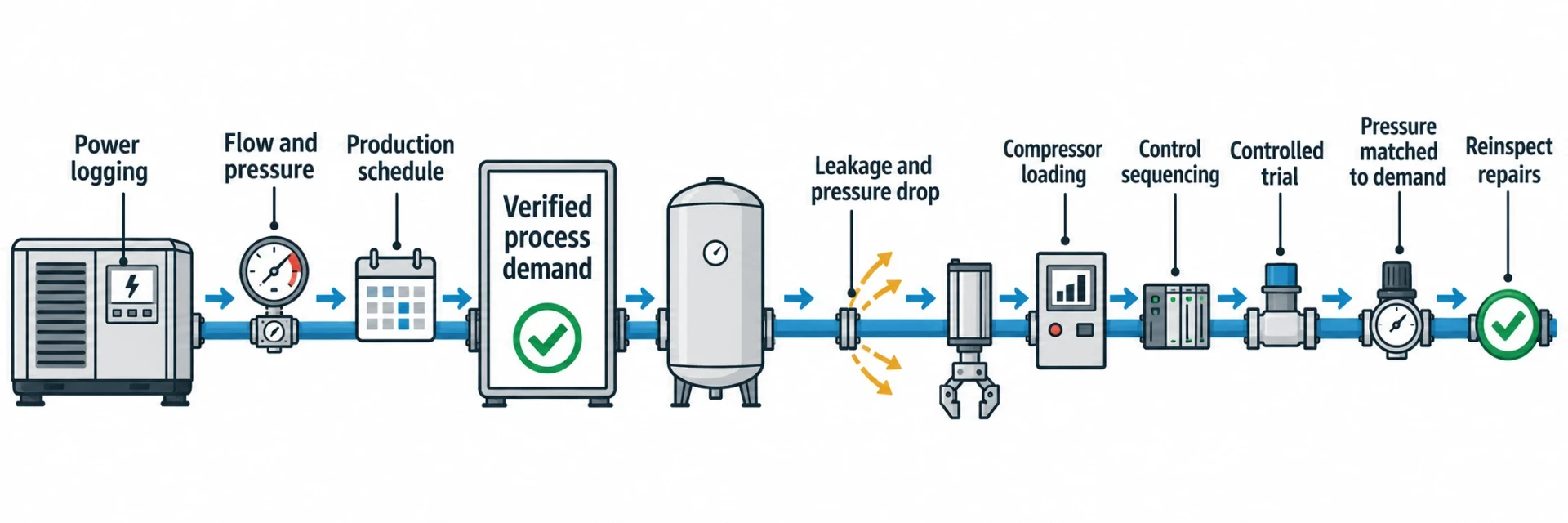
The most valuable opportunities often sit in systems with long running hours, variable demand or unclear ownership. The audit should follow energy into the manufacturing process, establish the required operating conditions, then identify avoidable runtime and losses.
| Energy area | Audit evidence | Commercial decision supported |
|---|---|---|
| Paint booths and air handling | Fan load, airflow, temperature, operating schedules and production demand | Airflow control, schedule changes, fan-drive upgrades |
| Curing ovens and thermal processes | Fuel or electricity use, temperature trends, exhaust conditions and idle periods | Insulation repair, control review, heat-recovery assessment |
| Compressed air | Compressor power, flow, pressure, leakage and sequencing | Leak repair, pressure optimisation, storage and control upgrades |
| Welding and robotic cells | Cell load, transformer demand, standby consumption and utilisation | Shutdown procedures, standby controls and replacement cases |
| HVAC and utilities | Heating, cooling and ventilation demand against weather and occupancy | Zoning, control tuning, setpoint review and maintenance work |
Paint operations need thermal and airflow evidence
Paint shops combine process heating, spray-booth ventilation, make-up air, extraction, curing and cooling. Product quality depends on defined temperature, humidity and contamination conditions. Any energy measure must preserve the validated process envelope.
An audit should compare fan operation, booth airflow and thermal demand against actual production. It should also review idle operation, breaks, shift changes and planned shutdowns. Thermal imaging can identify damaged insulation and surface heat losses around ovens, doors and distribution equipment. Logged temperature and fuel data can establish whether thermal plant operates outside required production periods.
Variable-speed fan control, revised schedules and improved control logic can merit further engineering assessment where measurements show excess airflow or unnecessary runtime. The investment case must include paint-quality controls, maintenance needs and commissioning requirements.
Compressed air deserves detailed attention
SAE technical paper 2012-01-0327 reports that compressed-air systems can account for 5% to 20% of manufacturing-plant energy consumption. Its automotive case study measured compressor current over two weeks, reduced pressure progressively while monitoring production, then logged performance again to verify savings.
The paper concerns a United States automotive interiors site, so its consumption range and results should frame investigation rather than serve as a forecast for a UK site. Each site has its own pressure requirements, leak profile, compressor configuration and operating pattern.
A useful compressed-air assessment reviews more than leakage. It examines:
- End-use pressure requirements and pressure drop across the distribution system.
- Compressor loading and unloaded running.
- Sequencing between fixed-speed and variable-speed compressors.
- Air demand during breaks, weekends and shutdowns.
- Artificial demand created by unnecessarily high pressure.
- Blow-off applications that may require a separate engineering review.
- Leak-repair ownership and reinspection arrangements.
Pressure reduction requires controlled trials with production and quality teams. Pneumatic actuators, test equipment and safety-related systems need defined minimum conditions. The commercial benefit comes from matching generation and pressure to verified process demand, then maintaining the change.
Welding and robots can create a persistent base load
Welding transformers, robot controllers, extraction fans, local cooling and ancillary equipment can continue drawing power outside active weld periods. Short-interval metering helps distinguish equipment that must remain energised from avoidable standby loads.
A shutdown matrix gives this work structure. It should identify the asset owner, safe isolation procedure, restart requirements, permitted shutdown window and systems that must remain live for safety, traceability or production readiness. The aim is controlled energy reduction rather than informal switch-off activity that creates restart failures or quality risks.

Identify where your plant is losing energy and quantify the savings potential — our audits map every heat source, sink, and waste stream in your facility.
Turning ESOS findings into a capital plan
The commercial value of an ESOS assessment depends on the action register that follows it. Facilities directors need enough detail to separate operational corrections from maintenance work, capital projects and longer-term process changes.
Rank opportunities by certainty as well as payback
Simple payback is useful for screening. It does not capture all delivery risks or operational benefits. An opportunity register should record the baseline evidence, assumptions, capital and maintenance cost, production implications, expected life, responsible owner and verification method.
Measures can then be grouped into practical routes:
- Operational actions, including revised schedules, leak repairs and shutdown discipline.
- Maintenance-linked work, including insulation repairs, valve repairs and control calibration.
- Capital projects, such as compressor controls, variable-speed drives, heat recovery or thermal-plant replacement.
- Strategic engineering studies for measures that require process redesign, major infrastructure work or planned shutdowns.
The UK Government states that ESOS assessment costs are expected to be significantly outweighed by savings from implementing recommendations. Individual Tier 1 suppliers should still establish their own business case. Energy prices, annual operating hours, production plans, engineering scope and installation windows determine whether a project is financially viable.
Measurement and verification protects the savings claim
A measure should have a measurement and verification plan before installation. IPMVP Core Concepts 2022 provides established principles for defining the measurement boundary, baseline period, adjustments and reporting approach.
For a compressed-air project, the plan may compare compressor kWh, airflow and pressure across equivalent production periods. An air-handling measure may require fan power, airflow, ambient conditions and operating hours. An oven improvement may require fuel use, throughput, product mix and required temperature data.
This process prevents lower production output from being reported as an engineering saving. It also exposes commissioning problems early. If post-installation results fall short, engineers can investigate controls, setpoints, maintenance condition or operator practices while the project evidence remains current.
ISO 50001 can provide an ESOS alternative route
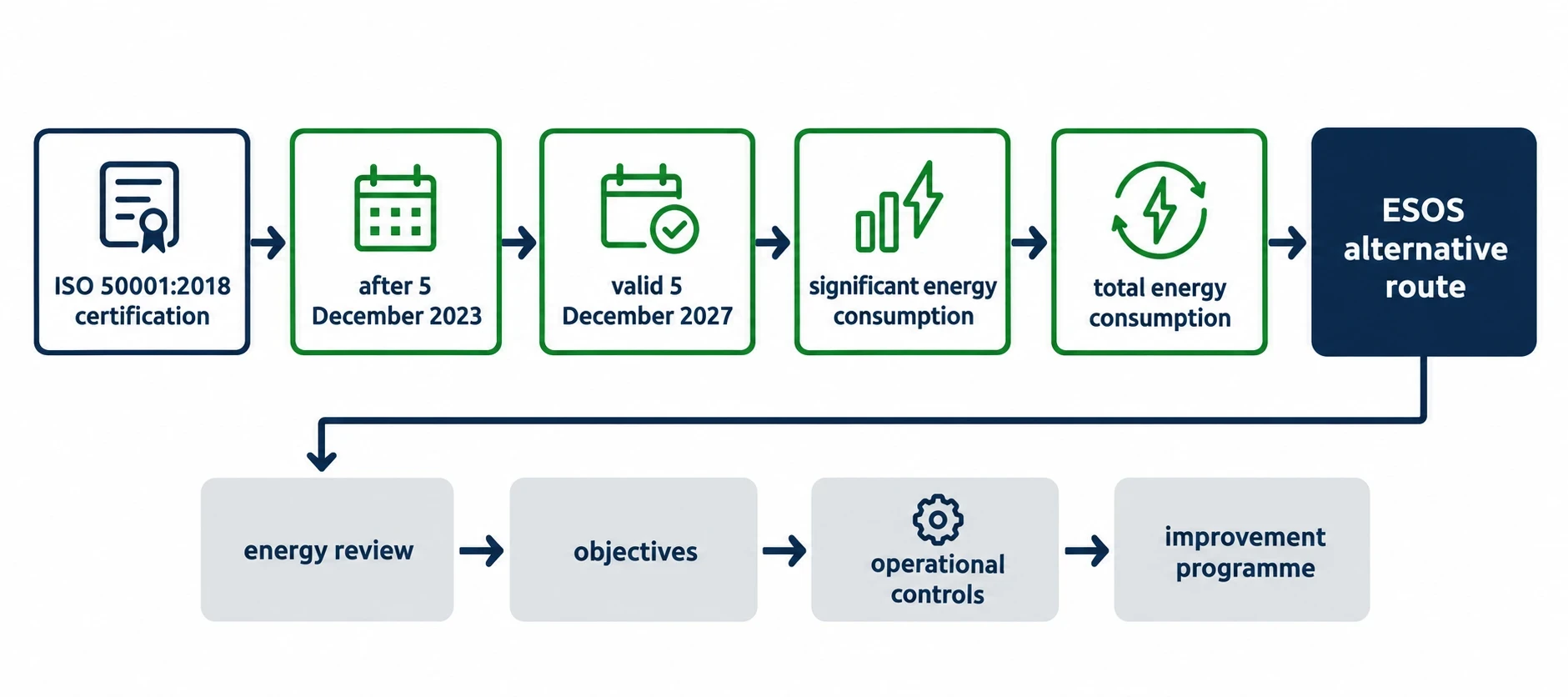
ISO 50001:2018 provides an alternative route where valid certification covers the required significant or total energy consumption. For ESOS Phase 4, the certification must have been issued after 5 December 2023 and remain valid on the compliance date.
A Tier 1 supplier with ISO 50001:2018 certification may align its energy review, objectives, operational controls and improvement programme with ESOS evidence requirements. Where certification covers significant energy consumption, the organisation can use it as its compliance route.
Certification still requires plant-level discipline. Energy managers need to understand which assets drive consumption, why energy varies, which actions are viable and whether implemented measures perform as intended. For sites without a certified energy-management system, an ESOS audit can establish useful foundations: sub-metering priorities, energy-performance indicators, process baselines and accountable ownership.
A seven-step industrial energy audit for Tier 1 suppliers
A practical programme should link compliance evidence to implementation from the outset.
- Define the group boundary, qualification status, energy uses and production scope.
- Collect 12 months of utility, fuel, production, operating-hour and maintenance data.
- Complete the site assessment using power analysers, ultrasonic leak detection, thermal imaging and process observation.
- Establish an energy baseline and production-normalised metrics, including kWh per vehicle or an equivalent output measure.
- Identify and quantify opportunities across thermal processes, compressed air, welding, HVAC and controls.
- Develop project cases covering costs, production constraints, safety requirements, ownership and measurement plans.
- Monitor post-installation energy use through metering, production data and documented measurement and verification reviews.
The Phase 4 deadline creates a fixed compliance timetable. A Tier 1 supplier that measures major energy uses against production can prioritise projects with credible economics, maintain evidence for OEM sustainability requests and reduce avoidable energy cost in demanding manufacturing operations.
This article reflects the independent analysis and editorial opinion of EnerTherm Engineering. Product names, trademarks, and brands mentioned belong to their respective owners. EnerTherm Engineering is not affiliated with, endorsed by, or a licensee of any third-party software or product mentioned unless explicitly stated.

Managing Director — EnerTherm Engineering
Dr. François Pierrel is Managing Director of EnerTherm Engineering with over two decades of expertise in thermal design, heat transfer, and industrial energy optimisation. He holds a PhD in Heat Transfer from Cranfield University and a Post-Doctorate from Heriot-Watt University.
