Waste Heat Recovery in Automotive Plants: What Pays Back?
A source-to-sink audit maps compressor streams below 50°C and RTO exhaust below 200°C.
The paint shop is often the first place to look for waste heat recovery in automotive plants, particularly where curing ovens, regenerative thermal oxidisers, compressed-air systems and air-handling units operate across several shifts.
The investment case depends less on the apparent size of a hot exhaust stream than on a practical question: can the plant use the heat reliably, nearby and at the required temperature? A recovery project pays back when it displaces a measured thermal duty without affecting paint quality, VOC abatement, production availability or maintenance access.
For UK OEM plants and Tier 1 suppliers, this is an energy-audit issue as much as an equipment-selection issue. Utilities engineers need dependable process data. Production leaders need safeguards for takt time and finish quality. Finance teams need net savings after fan, pump and heat-pump electricity. Sustainability teams need a defensible account of Scope 1 and Scope 2 effects.
Why waste heat recovery in automotive plants starts in the paint shop
Paint processes combine large thermal loads with long operating hours
Paint shops require controlled air temperature and humidity, high ventilation rates, flash-off zones, curing ovens, spray booths and VOC abatement. These systems consume substantial electricity and gas while maintaining conditions for coating application and curing.
Commission Implementing Decision (EU) 2020/2009 sets a BAT-associated environmental performance level of 0.5 to 1.3 MWh per vehicle coated for passenger-car coating. It is a benchmark for annual specific energy consumption, not a design target for a single heat-recovery scheme.
Plants should use the range to frame an energy-audit question: how much energy does the paint shop consume per vehicle coated, and how much of that demand could recovered process heat reduce? Production mix, vehicle size, coating chemistry, ambient conditions, operating hours and metering boundaries affect the answer.
A plant operating towards the upper end of the range has reason to investigate losses and demand. It does not mean every available heat source justifies capital expenditure. The site still needs a suitable heat sink.
The source-to-sink relationship determines value
A hot stream creates financial value only when it replaces purchased energy at the required temperature and when the process needs it.
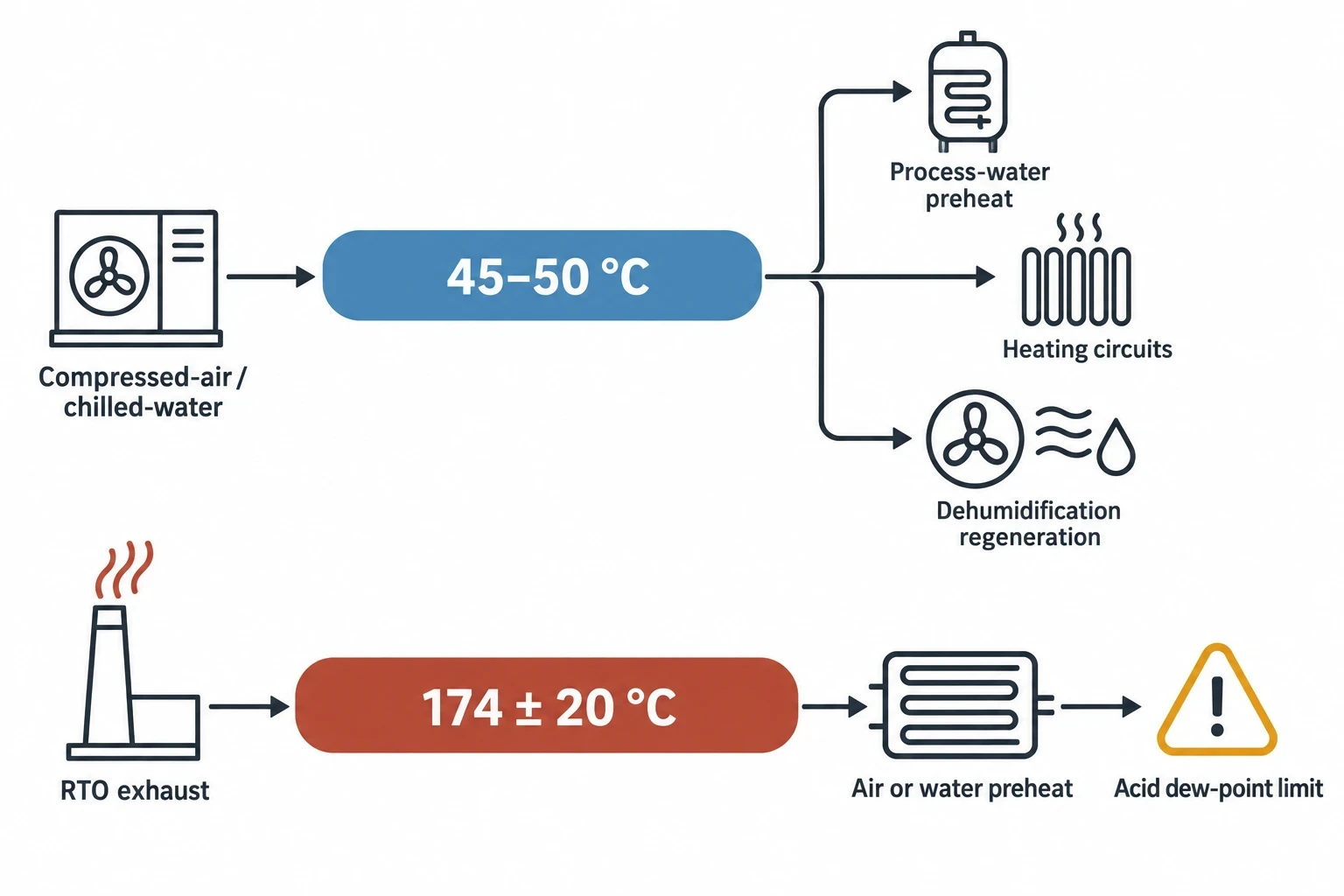
Research at Nissan Motor Manufacturing UK provides a useful illustration. It identified recoverable heat at about 45 to 50°C from compressed-air and chilled-water systems, and assessed regenerative thermal oxidiser, or RTO, exhaust. The RTO exhaust reached a reported 174 ± 20°C, but acid dew-point limits restricted how far it could be cooled.
These sources are not interchangeable.
Low-temperature compressor and condenser heat may suit process-water preheat, low-temperature heating circuits or dehumidification regeneration. RTO exhaust may support air or water preheating where exhaust chemistry, pressure drop and abatement performance allow. The highest-temperature source does not necessarily offer the best payback.

Identify where your plant is losing energy and quantify the savings potential — our audits map every heat source, sink, and waste stream in your facility.
Which automotive heat-recovery projects usually make the strongest capital case?
Oven and RTO exhaust recovery for make-up air
Paint-shop ovens and RTOs can offer high-value recovery opportunities where a nearby air-handling system requires continuous make-up-air heating. A properly specified heat exchanger can reduce burner or boiler gas duty by transferring heat to an incoming air stream or closed water circuit.
The case improves when source and sink operate together for most of the production year. Short duct runs, accessible plant areas and a stable demand profile reduce installation cost and improve utilisation.
Several engineering constraints need attention before equipment is sized:
- Exhaust composition and contamination risk
- Acid dew point and condensate management
- Added pressure drop across heat exchangers, ducts and filters
- Fan power and available static pressure
- Burner turndown and control interaction
- Access for cleaning, inspection and replacement
- Continued compliance with VOC destruction requirements
An RTO is emissions-control equipment, not a spare heat source. Any recovery system must preserve destruction performance and process-air balance. The audit should quantify the electricity penalty from additional fan duty and deduct it from fuel savings.
Compressor heat recovery for process water
Compressed-air systems reject much of their electrical input as heat. This makes compressor heat recovery attractive where a plant has steady demand for warm water or low-temperature process heat.
Automotive applications include wash processes, domestic hot water, boiler-feedwater preheat, space-heating coils and make-up-water preheat. The strongest projects use recovered heat throughout the production year rather than only during the heating season.
A compressor heat-recovery assessment must sit alongside a compressed-air audit. Leak reduction, pressure optimisation and improved compressor sequencing reduce electricity use, but may also alter the amount and profile of recoverable heat. The capital case must not claim the same benefit twice.
Recovering heat from a poorly controlled compressed-air system can create an incentive to preserve avoidable compressor load. First reduce unnecessary air demand. Then assess the dependable heat remaining after optimisation.
Chilled-water condenser recovery and heat pumps
Chilled-water systems reject heat through condensers or cooling towers. In a paint shop, this can provide a dependable low-grade source where the site needs preheated water, low-temperature heating or controlled dehumidification.
Heat pumps can raise this heat to a more useful delivery temperature. Their return depends on temperature lift, source stability, seasonal operating hours, part-load performance, electricity price and displaced fuel.
A heat pump delivering 55°C water from a 45°C source has a very different annual performance from one serving a high-temperature oven circuit. Projects should be modelled using measured source and sink temperatures, flow rates and operating profiles. A generic coefficient of performance is insufficient for capital approval.
HVAC recovery in body-in-white and assembly
Body-in-white welding areas, assembly halls and logistics spaces may offer recovery opportunities through extract-air heat exchangers, destratification and demand-controlled ventilation. These measures can reduce heating demand, but returns often depend on weather and shift patterns.
A winter-only space-heating duty can leave a large recovery system underused during warmer months. Projects become more investable when they serve a year-round process demand, such as wash-water preheat or controlled supply-air conditioning.
How an energy audit identifies the heat that can be sold internally
Measure the source and the demand
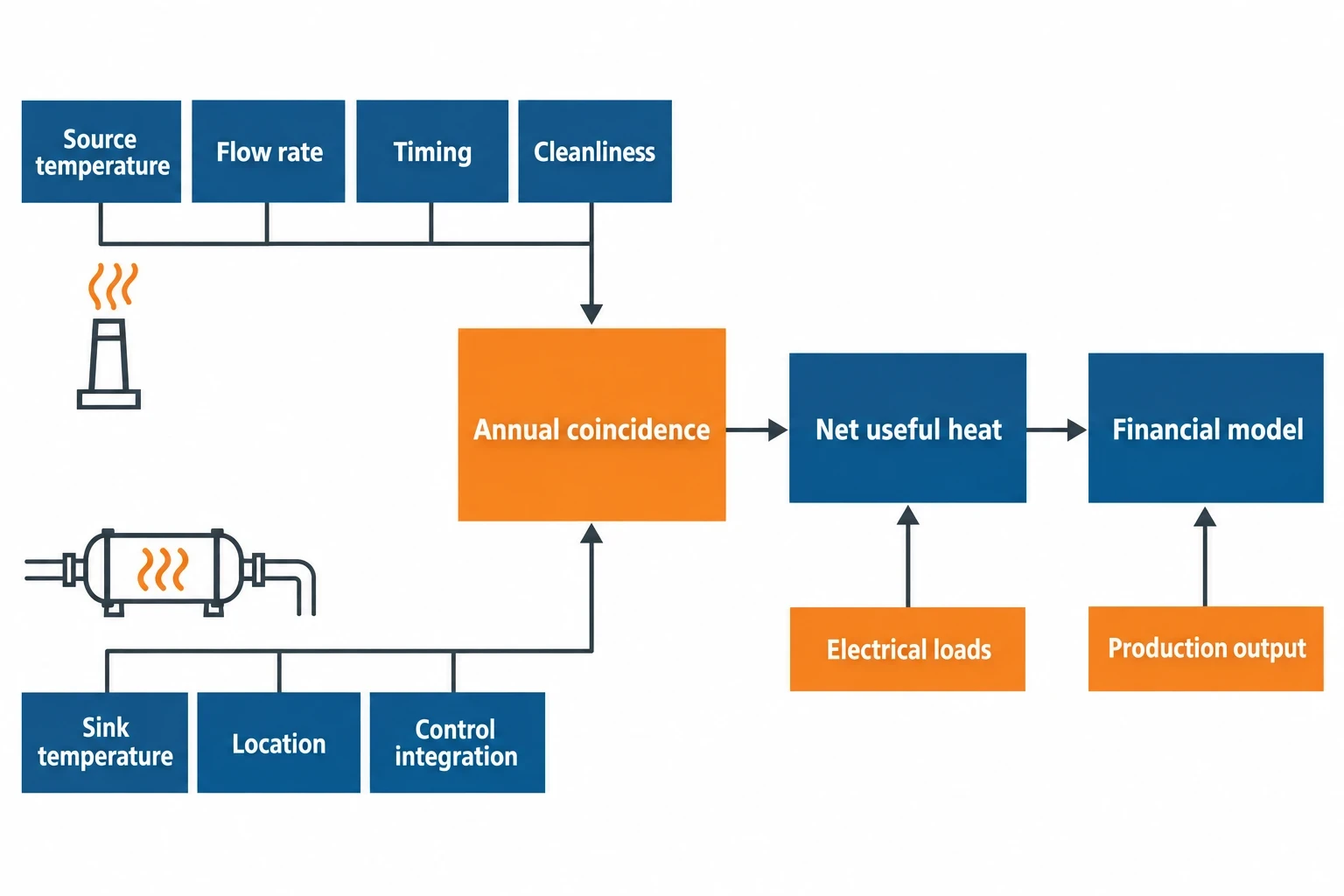
Utility bills show total consumption. They do not show whether an exhaust stream can meet a thermal load. A source-to-sink audit should establish temperature, flow, timing, cleanliness, location and control constraints on both sides of the proposed recovery link.
The survey should include gas, electricity, compressed air, chilled water, ventilation and relevant thermal circuits. It should also capture production output, whether as vehicles coated, bodies welded, components machined or another appropriate unit.
The essential test is annual coincidence. A large source operating when no demand exists offers little value without thermal storage, an alternative sink or operational changes that create a useful load.
Rank opportunities before seeking quotations
The following factors provide a practical screening method for waste heat recovery in automotive plants.
| Assessment factor | Effect on payback |
|---|---|
| Source temperature | Establishes whether direct recovery is possible or a heat pump is required |
| Sink temperature | Determines the temperature lift and likely equipment cost |
| Annual coincidence | Shows how often recovered heat displaces purchased energy |
| Source cleanliness | Affects exchanger type, fouling risk and maintenance |
| Distance and route | Drives ductwork, pipework, insulation, civils and heat loss |
| Displaced fuel | Determines the energy-cost and Scope 1 or Scope 2 case |
| Production dependency | Tests exposure to model changes, downtime and shift reduction |
| Control integration | Captures fan, pump, burner and chiller interactions |
The audit should assess net useful heat, not gross heat available at the source. Additional pressure drop can increase fan energy. Pumped circuits consume electricity, and heat pumps add electrical load. These costs belong in the financial model.
Use production-normalised metrics
Production-normalised metrics prevent output changes from being mistaken for efficiency gains. For paint operations, kWh per vehicle coated is more useful than absolute monthly energy consumption alone.
A robust baseline normally combines:
- Metered gas and electricity consumption.
- Source and sink temperatures over representative operating periods.
- Water, air or exhaust flow rates.
- Fan, pump and compressor electrical loads.
- Vehicles coated or other relevant production output.
- Outdoor-air conditions where ventilation demand is material.
- Known changes in production schedule, product mix and process settings.
EnerTherm Engineering’s automotive energy-audit methodology includes initial consultation, on-site assessment, instrumented measurement, data analysis, implementation support and ongoing measurement and verification. Power analysers, ultrasonic leak detectors and thermal imaging can reveal losses that interval utility data alone may miss. Ecolog consumption monitoring can then help distinguish production effects from utility-system performance.

Identify where your plant is losing energy and quantify the savings potential — our audits map every heat source, sink, and waste stream in your facility.
What belongs in a waste heat recovery ROI model?
Calculate savings from useful heat delivered
The financial model should start with the annual useful heat reaching the sink, then calculate the energy it displaces. This prevents a proposal from treating all extracted heat as a saving.
Direct displacement of gas-fired heating normally reduces Scope 1 emissions where the site owns or controls the combustion source. A heat-pump project may reduce Scope 1 emissions while increasing purchased electricity and affecting Scope 2 emissions. The proposal should present each energy stream separately.
The UK Government’s greenhouse-gas conversion factors support emissions reporting using activity data such as fuel use and purchased electricity. Teams should apply factors for the relevant reporting year and state the reporting boundary.
Include installed cost and operational penalties
A heat-exchanger quotation is rarely the full project cost. Enabling works often determine whether an automotive project proceeds.
A complete capital paper should cover:
- Heat exchanger, heat pump, ductwork, pipework and insulation
- Structural supports, access platforms and fire-stopping
- Electrical supplies, controls integration and instrumentation
- Filters, cleaning systems, condensate handling and corrosion-resistant materials
- Production downtime, commissioning and operator training
- Additional fan, pump and heat-pump electricity
- Planned maintenance and replacement components
- Avoided fuel cost by tariff period
- Sensitivity to output, energy prices and operating hours
Simple payback remains useful for screening. It compares installed cost with annual net financial benefit. Capital approval should also consider equipment life, production risk, maintenance burden and the organisation’s financial hurdle rate.
EnerTherm Engineering reports average outcomes across its energy-audit work of 19% energy-cost reduction, a 1.9-year payback period, and 1,400 tonnes of CO₂ reduction annually. These portfolio figures should not be used in an individual automotive heat-recovery business case. Each site needs a measured baseline and defined installation scope.
Measurement and verification protects the claimed return
Set the baseline before installation
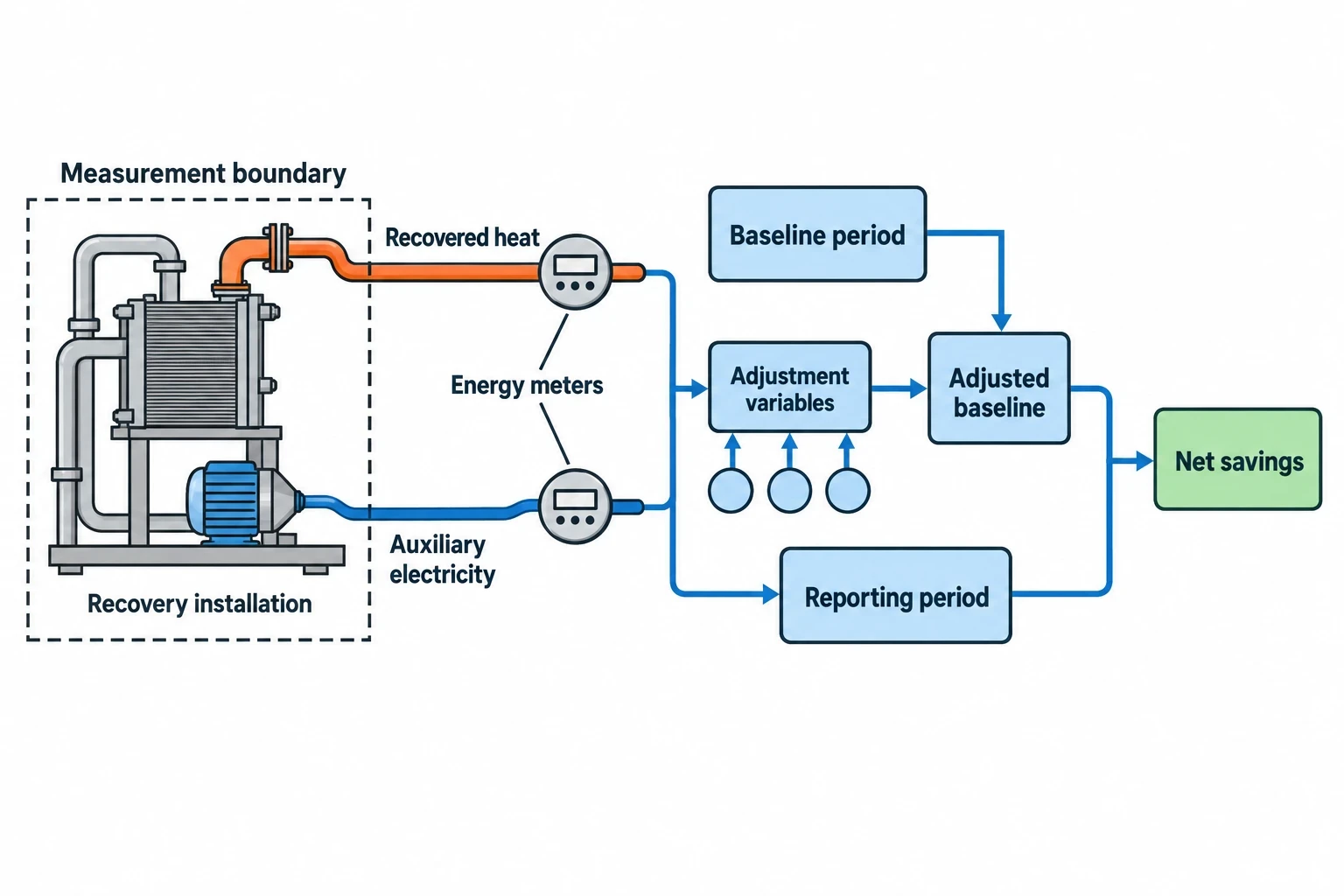
Savings are energy the plant no longer consumes, so they cannot be measured directly. The International Performance Measurement and Verification Protocol, IPMVP Core Concepts 2022, provides a recognised framework for comparing a baseline period with post-installation performance while adjusting for material changes.
For oven or RTO recovery, relevant variables may include vehicles coated, oven schedule, outdoor temperature, make-up-air volume and coating recipe. For compressor recovery, they may include compressor load, air demand, process-water draw and operating hours.
The measurement boundary must include recovered heat and the energy needed to move or upgrade it. This avoids reporting gross recovered heat while excluding additional fan, pump or heat-pump consumption.
Select a method that fits the measure
A discrete heat-recovery installation can often use retrofit isolation, with metering around affected equipment and key operating variables. A wider paint-shop programme may require a whole-facility approach where several measures influence the same gas and electricity meters.
The measurement and verification plan should define meter locations, data intervals, baseline period, reporting period, adjustment variables, calculation responsibility and reporting frequency before equipment is ordered. This gives finance teams a credible post-project result and helps utilities teams identify fouling, controls drift or production changes that reduce performance.
ESOS Phase 4 strengthens the evidence base
Industrial-process intensity requires credible data
ESOS Phase 4 applies to qualifying large UK undertakings. Organisations must calculate total energy consumption, identify significant energy consumption covering at least 95% of the total, and calculate energy-intensity ratios for buildings, transport, industrial processes and other energy uses.
The qualification date is 31 December 2026 and the notification-of-compliance deadline is 5 December 2027.
ESOS Phase 4 operates under the Energy Savings Opportunity Scheme Regulations 2014, substantially amended by the Energy Savings Opportunity Scheme (Amendment) Regulations 2023 and subject to subsequent amendments. Current guidance requires evidence based, where reasonably practicable, on verifiable energy-consumption data measured over a 12-month period.
For automotive manufacturing, a structured heat-recovery audit can support the industrial-process assessment by recording the source, sink, baseline energy, estimated saving, cost, production-normalised metric and verification approach.
Fund the projects with a dependable thermal duty
The strongest waste heat recovery projects in automotive plants displace a stable thermal load near the source. Paint-shop exhaust, compressor cooling and chilled-water condensers can support viable capital projects where temperature fit, annual coincidence and installed complexity stack up.
A disciplined energy audit identifies where a heat exchanger is sufficient, where a heat pump can justify its electrical demand, and where a promising source should remain an option until the plant has a better year-round use for it.
This article reflects the independent analysis and editorial opinion of EnerTherm Engineering. Product names, trademarks, and brands mentioned belong to their respective owners. EnerTherm Engineering is not affiliated with, endorsed by, or a licensee of any third-party software or product mentioned unless explicitly stated.

Managing Director — EnerTherm Engineering
Dr. François Pierrel is Managing Director of EnerTherm Engineering with over two decades of expertise in thermal design, heat transfer, and industrial energy optimisation. He holds a PhD in Heat Transfer from Cranfield University and a Post-Doctorate from Heriot-Watt University.
