ESOS Compliance Software: Is Your Data Ready for Phase 4?
Real-time metering supports audit-ready evidence for ESOS Phase 4 before 5 December 2027.
The Phase 4 ESOS compliance notification deadline is 5 December 2027, and eligibility is assessed on 31 December 2026. For UK manufacturers, the immediate task is not completing a form. It is proving that the energy data behind that form is complete, traceable and credible.
ESOS compliance software can bring discipline to a process that often still depends on supplier invoices, disconnected meter exports and spreadsheets maintained across several sites. The Environment Agency’s Phase 4 guidance increases the importance of a controlled evidence trail. Organisations must calculate total energy consumption, identify significant energy consumption, calculate energy-intensity ratios and select an appropriate compliance route. They must also account for savings achieved since the previous assessment and review action-plan commitments that did not proceed.
Software does not replace the judgement of an ESOS lead assessor, site visits or director sign-off. It should make those activities more effective by giving assessors a reliable route from a reported figure to the meter reading, invoice, calculation method and responsible person behind it.
ESOS Phase 4 dates and qualification criteria
ESOS applies to large UK undertakings and groups containing at least one large undertaking. A business qualifies where, on the qualification date, it employs 250 or more people, or exceeds both financial thresholds: annual turnover above £44 million and an annual balance sheet total above £38 million.
The group test matters in industrial businesses with multiple subsidiaries, warehouses, factories and shared utility arrangements. If one UK undertaking in the group qualifies, the wider UK operation may need to participate. Corporate structure, energy responsibility and written agreements between group entities belong in the compliance record alongside consumption data.
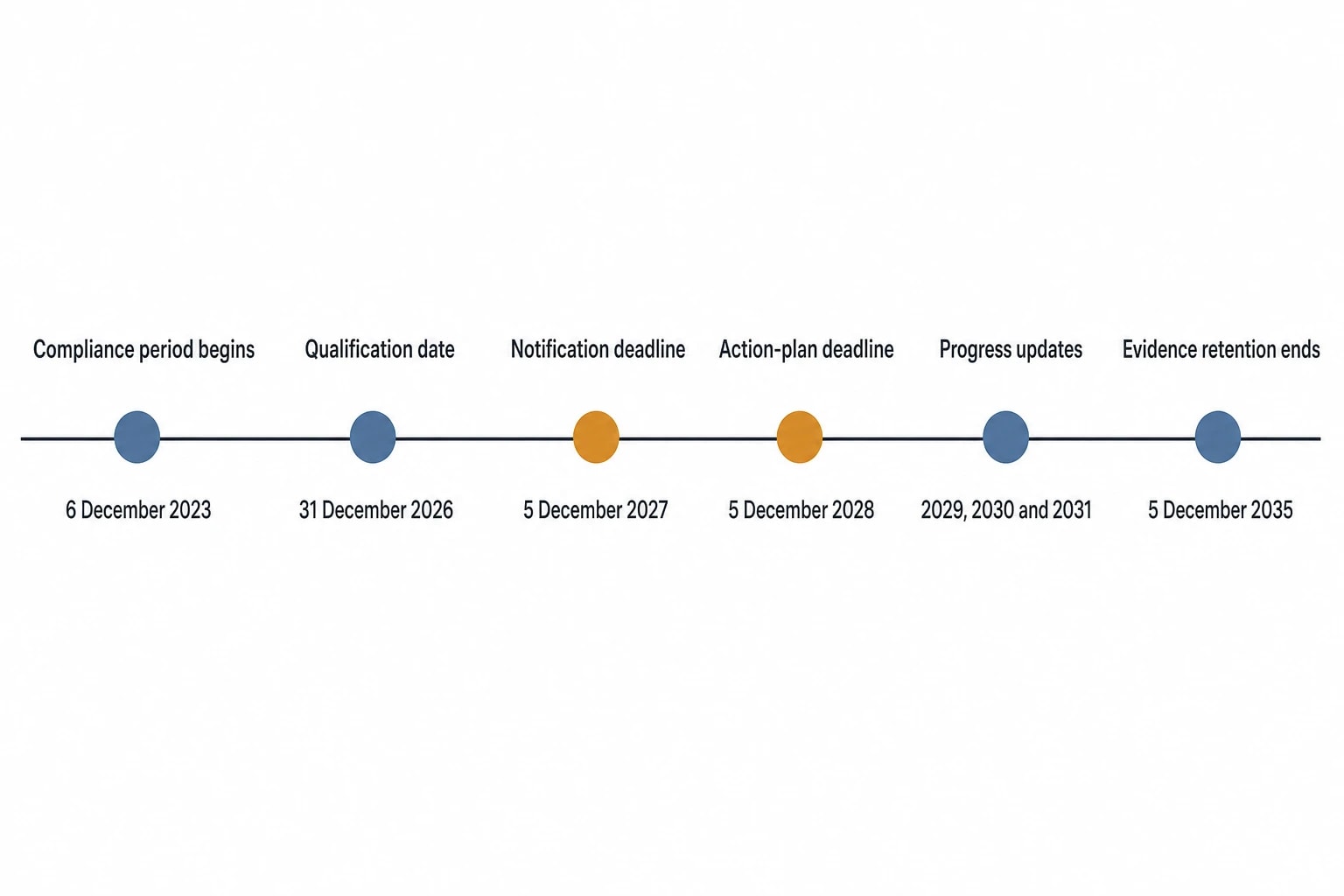
| Phase 4 milestone | Date | Software and evidence implication |
|---|---|---|
| Compliance period begins | 6 December 2023 | Retain records of energy-saving measures implemented during the period |
| Qualification date | 31 December 2026 | Confirm legal entities, employee numbers and financial status |
| Compliance notification deadline | 5 December 2027 | Complete assessment, sign-off, evidence pack and MESOS notification |
| Action-plan deadline | 5 December 2028 | Submit director-approved plan for the following four-year period |
| Progress updates | 2029, 2030 and 2031 | Record measures implemented and estimated savings for each reporting period |
| Evidence-pack retention ends | 5 December 2035 | Preserve records for the required retention period |
A late start commonly exposes gaps that cannot be repaired quickly. Electricity may be available at half-hourly resolution, while gas data appears only in monthly invoices. Fuel-oil delivery records may sit with procurement. Steam, compressed-air and process-water records may exist only in engineering files. A software programme should begin with a data and asset register that identifies every UK site, supply, activity, meter, data owner and evidence source.

Omni Vision delivers turnkey utility metering, CO2 tracking, and AI-powered production KPI intelligence — giving you real-time dashboards and actionable insights across your entire facility.
Verifiable energy data is the foundation of ESOS compliance software
Phase 4 requires a calculation of total energy consumption over a reference period of 12 consecutive months. That period must include the qualification date and end before the compliance date. The Environment Agency requires verifiable data where reasonably practicable.
Verifiable data includes invoices and delivery notes, meter-reading records, stock records for stored fuels, and outputs from automatic, smart or half-hourly metering. Energy cost is useful for prioritisation, but the core audit must analyse consumption in energy units. A rising or falling tariff cannot explain whether a process has become more or less efficient.
Why estimates need active control
Estimates remain permissible where verifiable information cannot be obtained. They are not blank cells to fill with a convenient annual average.
The organisation must use a reasonable estimation method, record why it was required, retain the underlying data and method in the evidence pack, and notify the scheme administrator where the estimate relates to total consumption. Direct comparison, pro-rata extrapolation and benchmarking can be suitable approaches where their assumptions are documented and proportionate.
ESOS compliance software should distinguish measured data from estimated data at record level. Each estimate should retain:
- The affected site, asset, fuel or activity.
- The missing period and quantity.
- The reason the primary record was unavailable.
- The source data used to produce the estimate.
- The calculation method and approving person.
- The date the record was created or amended.
This prevents estimates from being silently merged into actual consumption. It also gives the lead assessor a clear view of where the evidence is strongest and where data-improvement work remains necessary.
Metering improves the quality of industrial analysis
A supplier meter establishes a site total. Sub-metering makes the audit more useful by showing where that energy goes. In a manufacturing facility, material energy uses may include boilers, ovens, refrigeration, compressed-air systems, process lines, clean utilities and building services.
The aim is not to meter every motor. It is to establish enough resolution to identify significant energy consumption and build an intelligible energy profile. A site electricity total should reconcile with major sub-metered loads, allowing for documented losses and unmetered demand. Incoming gas should reconcile with boiler and direct-fired process use where those are material. Persistent differences can reveal incorrect meter multipliers, failed communications, allocation errors or a missed energy supply.
High-quality ESOS energy audits need usable consumption profiles
An ESOS energy audit must assess energy consumption and energy efficiency, identify reasonably practicable and cost-effective opportunities, and include site visits. It must cover either total consumption or significant energy consumption, which represents at least 95% of total energy consumption.
The Environment Agency expects audit analysis to use energy-consumption profiling where appropriate and reasonably practicable. A profile describes how an asset or activity uses energy and how that use varies. For manufacturing, time-based profiles can show load by shift, product run, shutdown period or season. Static profiles can break down a complex site by process area or major utility.
Production-linked intensity ratios reveal operational changes
Phase 4 requires energy-intensity ratios for buildings, transport, industrial processes and other energy uses. For an industrial process, a suitable indicator may be tonnes produced, batches completed, operating hours or another quantifiable factor associated with the activity.
A monthly site total does not distinguish lower energy use caused by reduced production from a real efficiency improvement. Energy per tonne or energy per batch can provide that distinction when the production record and energy boundary align.
The software record should retain the selected activity indicator, unit, data owner and allocation method. Changes to product mix, batch size, operating hours or site boundary should be recorded rather than treated as insignificant background variation. That history helps an assessor determine whether an apparent performance movement reflects a process change, a data change or an energy-saving measure.
Where AI-driven analysis helps, and where it does not
AI-driven analysis can help an energy team identify unusual baseload demand, changes in energy intensity, unexpected weekend operation or a widening gap between a utility total and sub-metered demand. It can focus engineering attention on events worth investigating while they are recent.
The Environment Agency does not prescribe artificial intelligence as an ESOS compliance method. Anomaly detection does not make a missing record verifiable, and a software-generated insight does not replace a site visit or technical assessment. The audit still needs source data, stated assumptions, sound engineering judgement and evidence of how the organisation reached its conclusions.
What ESOS compliance software should provide
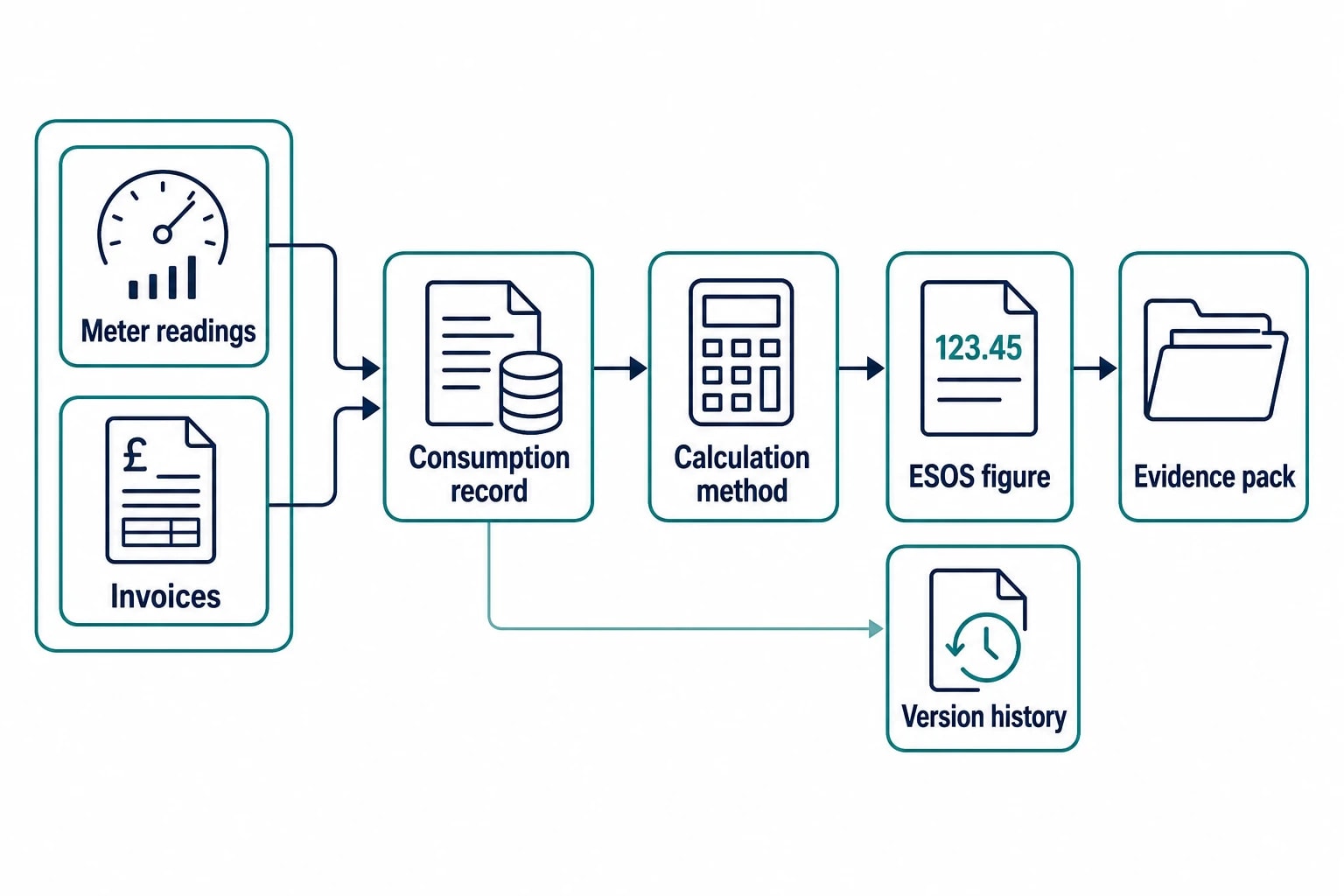
The practical test is straightforward: can the system provide a regulator or lead assessor with a clear route from an ESOS figure back to its source?
A suitable platform should support a controlled workflow across consumption, calculation, audit evidence and action tracking.
A structured energy register
The software should maintain a register of sites, legal entities, assets, activities, energy supplies and meters. Each record should show who is responsible for the data and whether the energy falls within the ESOS boundary.
This matters where group companies share premises, where a tenant pays for energy through a landlord, or where a factory has temporary assets and portable equipment. A stated allocation rule is more defensible than a spreadsheet adjustment made near the deadline.
Calculation traceability and audit exports
The system should preserve original units, conversion factors, periods and source records. It should show how the organisation moved from individual readings and invoices to total consumption, significant energy consumption and intensity ratios.
Version history is equally important. If a meter reading is corrected, the record should show what changed, when it changed and why. Assessors need to review the current calculation, while compliance teams need to explain the history behind it.
Useful exports include a meter register, missing-data log, consumption breakdown by site and activity, intensity-ratio record, estimate register and evidence-pack index. These documents reduce the time spent reconstructing calculations when an assessor asks a follow-up question.
Controls for recommendations and savings
Phase 4 reporting includes estimated savings achieved during the compliance period. The ESOS report and notification must describe implemented measures, quantify the estimated savings achieved by each measure and identify the relevant energy-saving category.
A digital opportunity register should link each measure to:
- The audit finding or management decision that initiated it.
- The affected asset, site and organisational purpose.
- The category of measure, such as controls improvement, capital investment or energy-management practice.
- Expected implementation date and actual implementation date.
- Estimated annual reduction in energy consumption and spend.
- Evidence supporting the estimate or post-implementation result.
- The person accountable for delivery.
This creates a record that survives staff changes and allows the organisation to explain the link between a recommendation, implementation decision and reported savings.

Track energy consumption, emissions, and process parameters with seamless PLC/SCADA integration via Modbus, OPC-UA, and MQTT protocols.
ISO 50001 is a deemed compliance route, subject to scope
ISO 50001:2018 sets requirements for establishing, implementing, maintaining and improving an energy management system. It is a deemed compliance route for Phase 4, provided the certification meets the ESOS conditions.
For the Phase 4 route, the certificate must have been issued on or after 6 December 2023 and remain valid on 5 December 2027. Certification must come from a UKAS-accredited certification body, an EU member state national accreditation body, or an International Accreditation Forum member-accredited body.
Coverage is the decisive issue
The certified energy management system must cover at least 95% of total energy consumption. The participant does not then need to prepare an ESOS report or appoint a lead assessor. It must still calculate total consumption, calculate intensity ratios, retain an evidence pack, secure director confirmation and notify through MESOS.
A certificate for one manufacturing site does not necessarily cover transport, warehouses, offices or other group operations. ESOS compliance software should map each energy supply and activity against the ISO 50001 scope. Any uncovered significant consumption requires an audit or another compliant route to ensure the required boundary is covered.
Evidence-pack management is a long-term compliance function
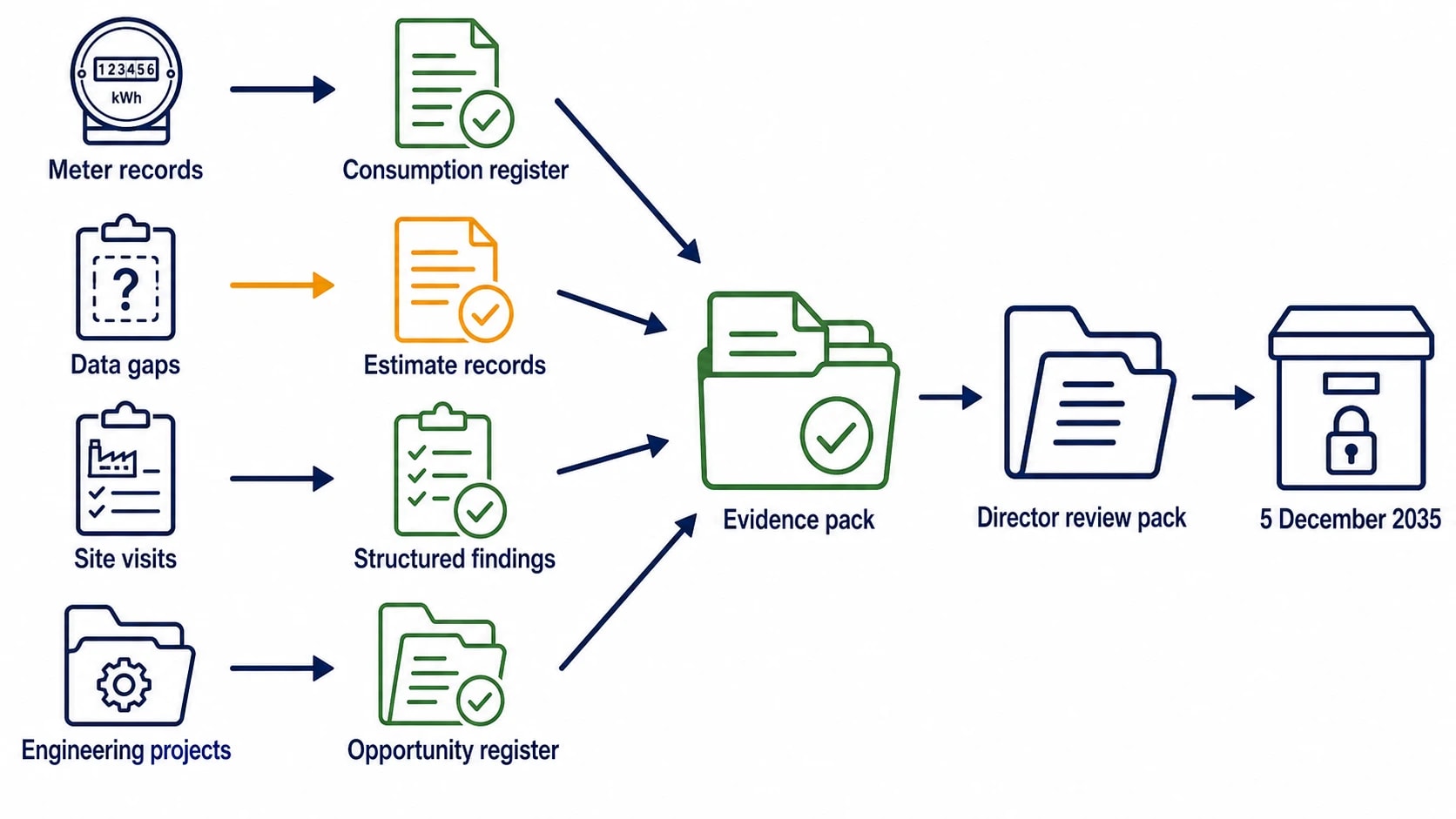
The evidence pack is the working file behind the ESOS notification. It should include records of data used for calculations, evidence of ISO 50001 certification where applicable, group agreements, audit information, opportunities, savings estimates, sign-off and notification records.
Phase 4 evidence packs must be retained until 5 December 2035. A final PDF report is insufficient if it cannot be supported by the underlying data, calculation method and decision record years later.
Build the evidence pack as work proceeds
The strongest workflow creates evidence as normal energy-management work takes place. Meter records flow into the consumption register. Data gaps create estimate records. Site visits produce structured findings. Engineering projects update the opportunity register. Directors receive a defined review pack rather than an improvised summary.
This also makes the action-plan review more manageable. Phase 4 requires organisations to identify proposed measures from the preceding action plan that were not implemented and explain why. A controlled register can show whether a measure was deferred, superseded, rejected after feasibility work or delivered through a different project.
ESOS and SECR need reconciled records, not copied figures
ESOS is separate from Streamlined Energy and Carbon Reporting. Many organisations in scope of ESOS also have SECR duties, which require specified energy, emissions and energy-efficiency disclosures in annual reports.
A shared meter-backed data foundation can reduce duplicated collection work. It should not lead teams to assume that the two regimes have identical boundaries, reporting periods or methodologies. ESOS includes energy used by buildings, industrial processes and transport within its rules. SECR reporting follows its own corporate-reporting requirements and greenhouse-gas methodology.
The sound approach is to preserve a common source record and document the reconciliation. Where the reported boundary, period, conversion factor or treatment of transport differs, the reason should be clear to the energy manager, finance team and compliance officer. That reduces the risk of contradictory disclosures while keeping ESOS work focused on its statutory assessment requirements.
A practical Phase 4 data-readiness programme
The time to establish data quality is before the qualification date, not during report drafting. A focused programme can proceed in this order:
-
Confirm the UK group structure and assess Phase 4 qualification against the 31 December 2026 test.
-
Create a complete register of sites, assets, activities, energy supplies, meters and data owners.
-
Select the 12-month reference period that includes the qualification date, then assess coverage, continuity and verifiability.
-
Separate measured records from estimates, documenting every gap and the method used to fill it.
-
Reconcile site totals with material sub-metered demand and investigate significant variances.
-
Calculate total consumption, identify the consumption representing at least 95% of the total, and define appropriate intensity ratios.
-
Map ISO 50001 certification scope where used, then identify any energy use requiring an ESOS audit.
-
Maintain a controlled opportunity and action register, including Phase 3 commitments, implementation status and savings evidence.
-
Assemble the evidence pack continuously, then prepare director review and MESOS notification well before 5 December 2027.
This article reflects the independent analysis and editorial opinion of EnerTherm Engineering. Product names, trademarks, and brands mentioned belong to their respective owners. EnerTherm Engineering is not affiliated with, endorsed by, or a licensee of any third-party software or product mentioned unless explicitly stated.

Technical Manager — EnerTherm Engineering
John Naranjo is Technical Manager at EnerTherm Engineering, bringing specialist expertise in chemical and environmental engineering. He recently led the implementation of Omni Vision, EnerTherm's real-time energy and utility monitoring platform. He holds an MSc in Environmental Engineering from the University of Huelva and a BSc in Chemical Engineering, with memberships in both the Energy Institute and IChemE.
