Why SECR Reporting Software Matters After FRC Reviews
How automated Scope 1 and 2 data trails support audit-ready annual reporting
For financial years beginning on or after 1 April 2019, the Streamlined Energy and Carbon Reporting framework requires in-scope UK businesses to disclose energy use, greenhouse gas emissions, an intensity ratio, methodology and energy-efficiency action in their annual report. That disclosure may draw on thousands of meter readings, supplier invoices, fuel records, mileage claims and production records.
The Financial Reporting Council's January 2025 thematic review did not change SECR requirements. It reviewed climate-related financial disclosures by AIM and large private companies. Its findings still matter to SECR reporters because they exposed recurring weaknesses in climate reporting: unclear KPI calculations, incomplete target information and poor explanation of reporting boundaries.
For sustainability managers, finance directors and EHS officers, the lesson is practical. An annual carbon figure needs a controlled evidence trail from source data to published disclosure. SECR reporting software provides that structure, replacing the annual spreadsheet chase with monitored data collection, documented calculation rules and a review record for finance and assurance teams.
What SECR reporting software needs to support
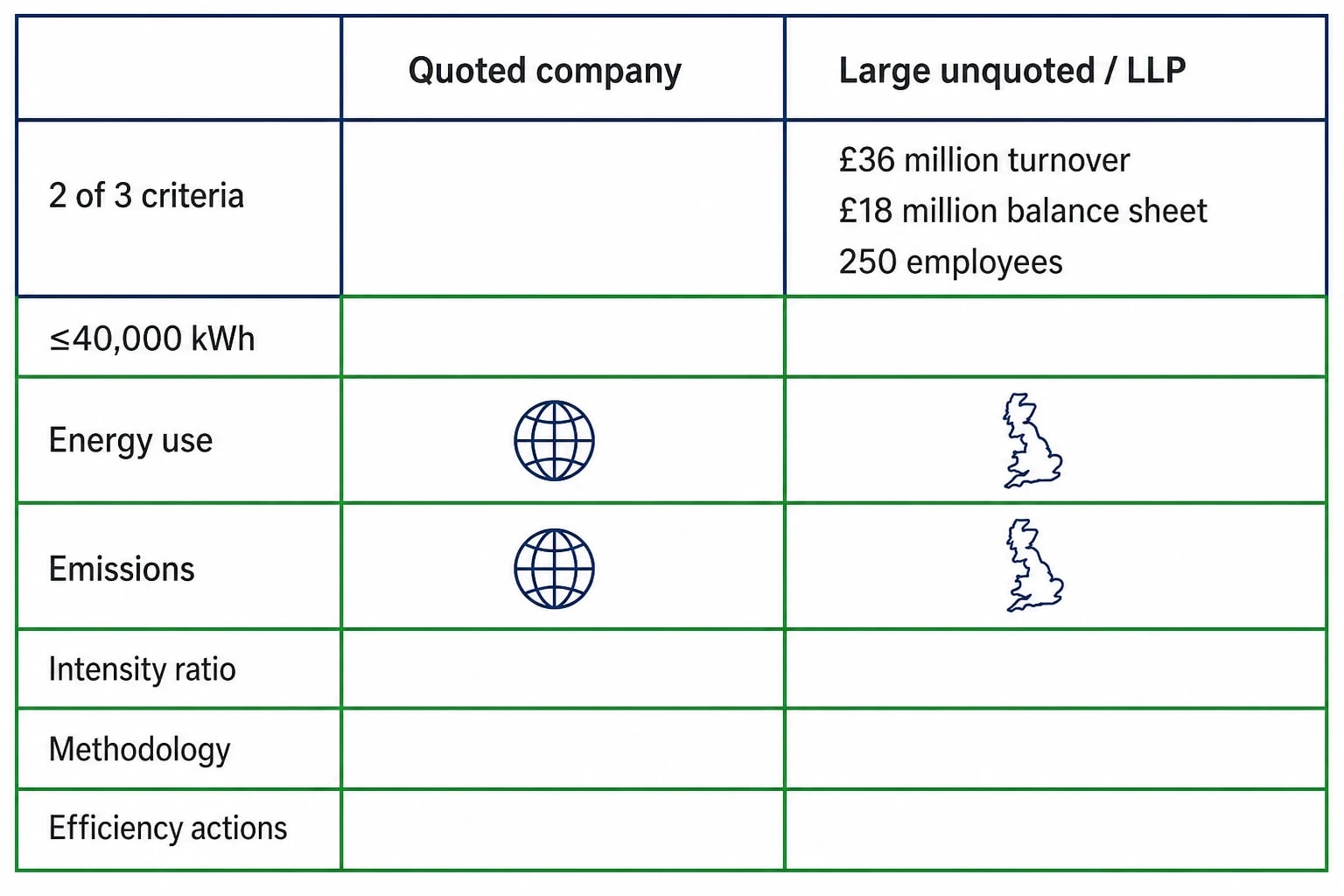
The Companies (Directors' Report) and Limited Liability Partnerships (Energy and Carbon Report) Regulations 2018 apply to quoted companies and to large unquoted companies and LLPs. A large unquoted company or LLP meets at least two of these conditions:
- Turnover of £36 million or more
- Balance sheet total of £18 million or more
- 250 or more employees
Large unquoted organisations and LLPs with annual UK energy use of 40,000 kWh or less qualify as low-energy users. They must state that fact in the relevant report instead of providing the full disclosure.
Requirements differ by organisation type. Quoted companies disclose global energy use and global greenhouse gas emissions. Large unquoted companies and LLPs disclose UK energy use and associated emissions. Both groups must report at least one intensity ratio, the methodology used and principal energy-efficiency actions during the financial year. Previous-year figures are required after the first reporting year.
The SECR figures that create the most work
A compliant disclosure is more than a total in tonnes of CO₂e. Industrial businesses must collect and reconcile the activity data behind it.
For a large unquoted manufacturer, this normally includes purchased electricity, gas combustion and transport fuel that the company buys. Transport can include company cars, fleet vehicles, reimbursed business mileage, forklift trucks and other onsite transport. Contracted haulage, rail travel and flights fall outside the mandatory transport-energy calculation where the business neither operates the vehicle nor buys its fuel.
Quoted companies have a wider requirement. Their global emissions cover fuel combustion and facility operation, plus purchased electricity, heat, steam and cooling for their own use. This broadly corresponds to Scope 1 and Scope 2 emissions.
SECR reporting software should maintain a clear register of energy sources, meters, invoices, fuel accounts and sites. Each record needs a reporting period, unit, owner and source. Without that structure, teams may struggle to prove whether a figure came from a supplier bill, automated meter, estimate or corrected import.
Omni Vision delivers turnkey utility metering, CO2 tracking, and AI-powered production KPI intelligence — giving you real-time dashboards and actionable insights across your entire facility.
Why the FRC review matters to SECR data governance
The FRC's 2025 thematic review focused on mandatory climate-related financial disclosures, not SECR. Its conclusions do not amend the Companies (Directors' Report) and Limited Liability Partnerships (Energy and Carbon Report) Regulations 2018.
They show how climate metrics can fail under scrutiny. The FRC found that information on performance against climate targets and the basis for calculating climate-related KPIs was not consistently disclosed. Good examples specified the target base year, emissions scope, reporting boundary and timescale. The review also noted that UK-only groups with Scope 1 and Scope 2 targets could cross-refer to SECR disclosures when explaining related KPIs.
That connection matters in an industrial annual report. A directors' report may state a SECR intensity ratio of tonnes of CO₂e per tonne of output, while the strategic report presents a carbon-reduction target. Both figures need compatible scopes, boundaries and time periods. A discrepancy may have an innocent explanation, such as an acquisition, divestment or different reporting perimeter. The annual report should explain it clearly.
From disconnected spreadsheets to a controlled record
Spreadsheet reporting often begins with requests to site engineering, procurement, fleet managers and finance. The team converts energy units, fills data gaps, applies emission factors and combines the results into an annual total. This can work for a small, stable organisation with few sources, but its limits become clear across multiple industrial sites.
Common failure points include:
- A gas invoice entered twice after a supplier-account change
- Electricity consumption assigned to the wrong legal entity
- A missing month filled with an estimate that is not identified later
- A revised formula copied into one reporting tab but not another
- A production denominator changed after the intensity ratio has been calculated
- Current-year conversion factors applied to historical emissions without a documented policy
SECR reporting software creates a controlled dataset. It can assign source records to sites and entities, flag gaps against expected meter intervals, preserve imported invoice files and record the status of estimates. Raw activity data should remain separate from calculated results, allowing reviewers to distinguish a supplier-provided kWh figure from the carbon calculation derived from it.
This is an operational control, not merely a reporting convenience. Teams can investigate an abnormal gas profile during the reporting period while engineering records and staff knowledge remain available. The cause may be a faulty meter, estimated bill, boiler issue or production shutdown. The annual report can then reflect a documented resolution rather than a late adjustment made under deadline pressure.
Building an auditable SECR emissions trail
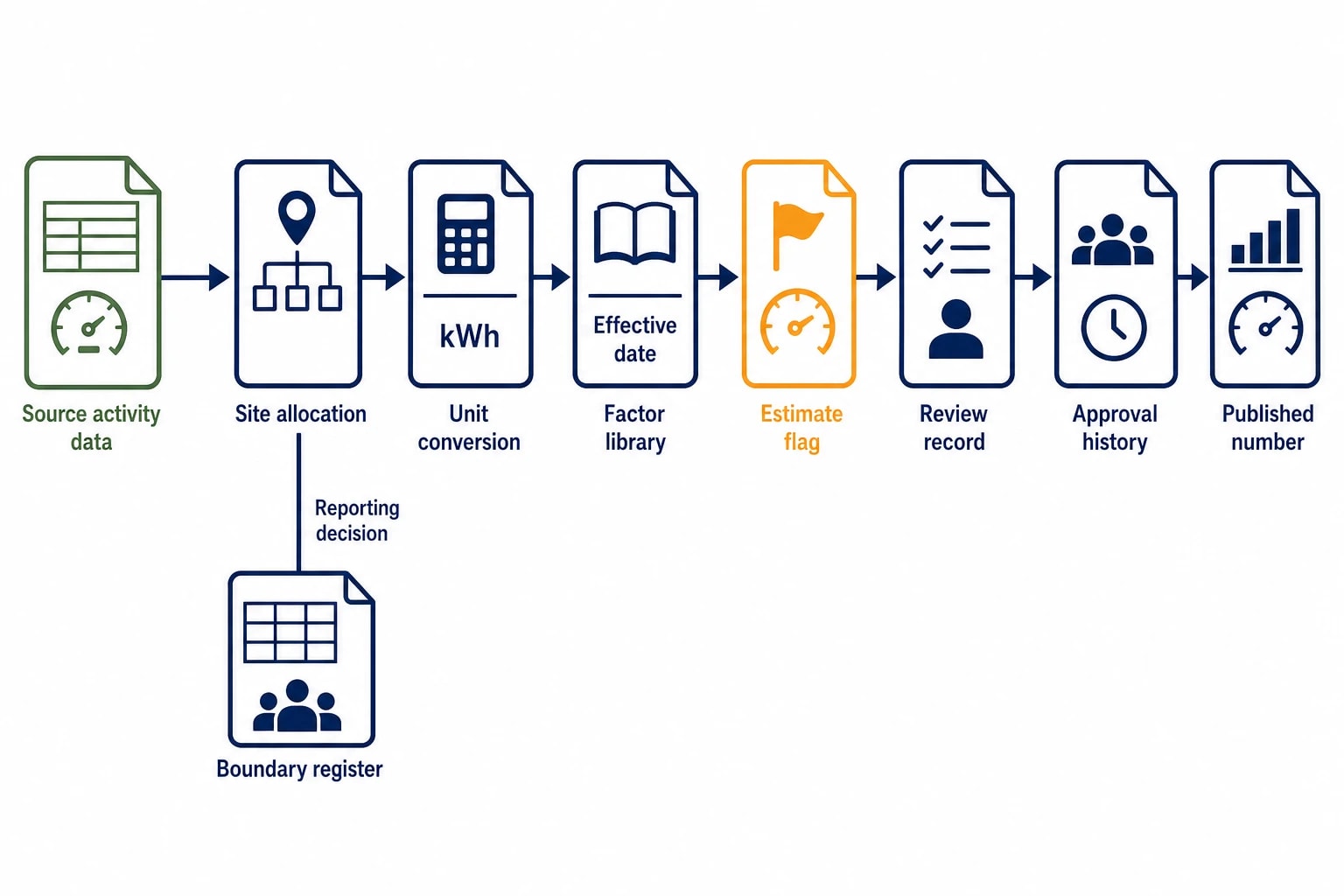
An auditable SECR record allows a reviewer to work backwards from a published number. They should be able to identify the source activity data, calculation method, relevant conversion factors, review performed and person who approved the result.
Source data and calculation controls
Government guidance encourages organisations to use verifiable data where reasonably practicable. Meter readings, supplier invoices and annual supplier statements provide a stronger foundation than unsupported estimates. Where data is unavailable, the guidance permits reasonable estimation through direct comparison, pro-rata extrapolation or benchmarking. The organisation should disclose its approach and retain the supporting rationale.
A well-configured SECR reporting software workflow should hold the following information for each material data point:
| Control | What it demonstrates |
|---|---|
| Source reference and covered period | Where activity data originated and which reporting month it supports |
| Site and entity allocation | Which operation carries responsibility for the energy use |
| Unit conversion record | How litres, therms or other source units became kWh where needed |
| Factor library and effective date | Which government conversion factors were applied |
| Estimate flag and rationale | Where primary data was unavailable and how the substitute figure was produced |
| Change and approval history | Who amended a value, why and who reviewed it |
The UK government's greenhouse gas conversion factors are updated annually. The software should preserve the factor set used for each reporting year and protect it from casual overwriting. Finance teams also need a clear policy for recalculating comparative figures when methodology, organisational structure or conversion factors change.
Boundaries need explicit ownership
Reporting boundaries become difficult when a group has leased premises, shared utilities, contract manufacturing or recently acquired sites. The energy purchaser is not always the party that should report consumption. Government guidance states that, in landlord and tenant arrangements, the party responsible for energy consumption should report it. Sub-meter data or an estimate may be necessary where a tenant consumes energy but does not receive the utility bill.
SECR reporting software should record the reporting decision for each site and supply. A practical boundary register includes the legal entity, facility, operational-control status, inclusion date, exclusion reason and supporting evidence. It gives finance, sustainability and EHS teams one agreed basis for the annual report.
This avoids a familiar year-end problem: the energy team reports a site because it has meter data, while finance excludes it from the reporting group, or the reverse. A documented decision provides the reconciliation.
Making intensity ratios useful rather than decorative
SECR requires at least one intensity ratio. A ratio converts absolute energy use or emissions into a measure connected to business activity. For industrial businesses, useful denominators include tonnes of product, production batches, operating hours, square metres of conditioned space or £ million of revenue.
The choice should reflect the operation. Tonnes of CO₂e per tonne of finished product may suit a continuous manufacturing process. Energy per batch can be more meaningful in pharmaceutical production, where output mass varies sharply between campaigns. Revenue-based ratios can help group-level comparison, although price changes may obscure physical efficiency.
Keep numerator and denominator under the same control
An intensity ratio is credible only if the carbon numerator and activity denominator cover the same population and period. A site-level electricity total divided by group-wide product output produces a distorted result. So does a calendar-year output figure paired with a financial-year emissions total.
SECR reporting software can link approved production and finance data to the emissions inventory while retaining the source, definition and cut-off date of the denominator. Where production data changes after close, the workflow should identify whether the intensity ratio needs recalculation and reapproval.
Teams should retain the narrative behind major movements. A ratio can rise because a facility operated below capacity, product mix changed, a new line was commissioned or energy use genuinely worsened. Directors and investors need that context.
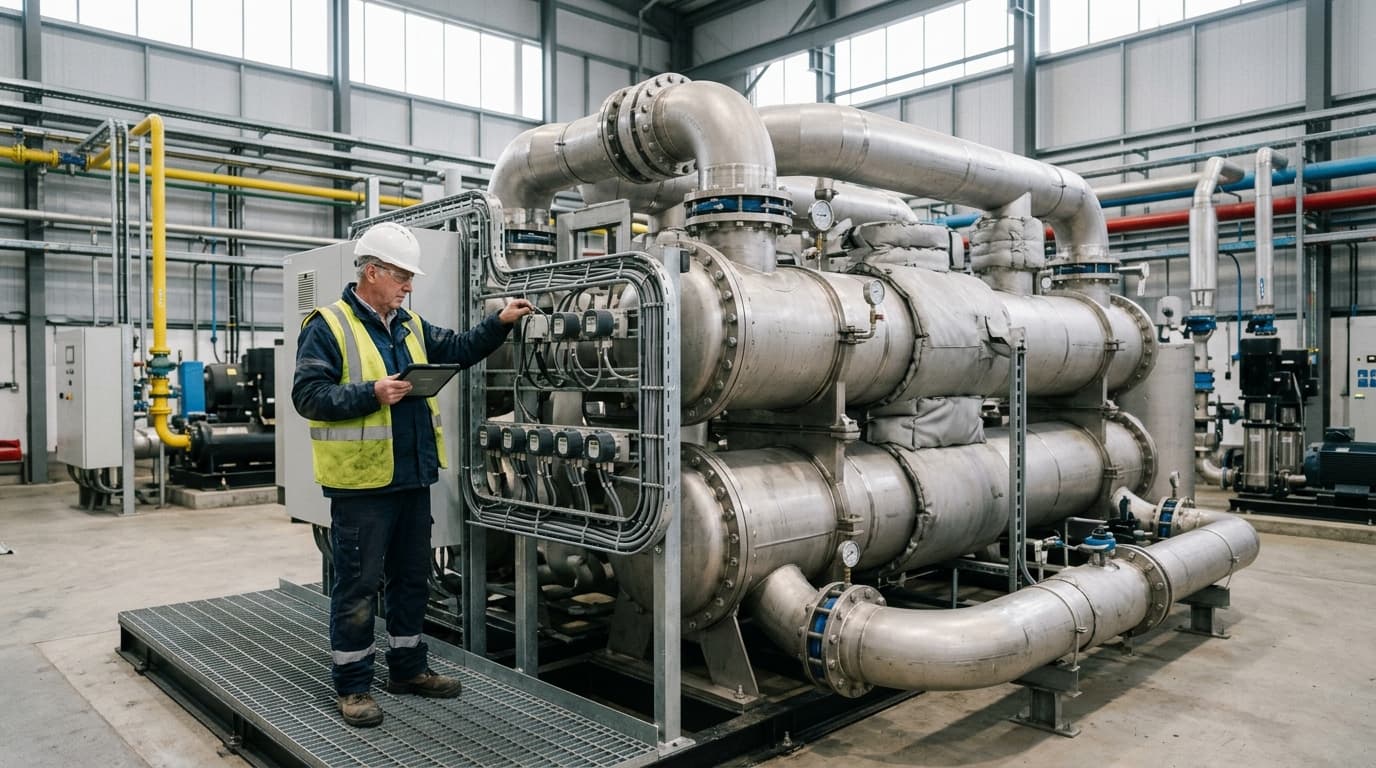
Track energy consumption, emissions, and process parameters with seamless PLC/SCADA integration via Modbus, OPC-UA, and MQTT protocols.
ISO 14064-1 and assurance readiness
ISO 14064-1:2018 specifies organisation-level requirements for quantifying and reporting greenhouse gas emissions and removals. Its focus on inventory design, management, reporting and verification makes it useful for SECR programmes, particularly where a company also prepares voluntary carbon disclosures.
SECR does not require universal independent assurance. Government guidance nevertheless encourages voluntary assurance. It also states that the statutory auditor considers whether directors' report information is consistent with the financial statements, prepared in accordance with applicable legal requirements and free from material misstatement based on audit work performed.
A platform cannot guarantee an assurance outcome. An assurance provider determines the scope, materiality and conclusion. Software can prepare a business for review by making evidence accessible and showing that management controlled the data through the year.
Reasonable-assurance preparation starts before year end
ISO 14064-3:2019 sets requirements and guidance for verification and validation of greenhouse gas statements. Organisations pursuing reasonable assurance should agree the intended scope and evidence requirements with their assurance provider early in the reporting cycle.
For SECR reporting software, this means configuring controls before the annual report is drafted:
- Define the reporting boundary and approve the site register.
- Assign accountable owners for meters, invoices, fleet data and production denominators.
- Lock the approved conversion-factor set for the reporting year.
- Create exception workflows for missing readings, estimates and material anomalies.
- Require review and approval before figures enter the reporting output.
- Retain prior-year results, adjustments and explanations for comparability.
This gives an external reviewer a practical route through the inventory and gives management earlier warning of missing data and unexplained movements.
Selecting SECR reporting software for industrial operations
The strongest SECR reporting software serves the reporting process first. Dashboards matter, but the decisive questions concern evidence quality, control and reporting scope.
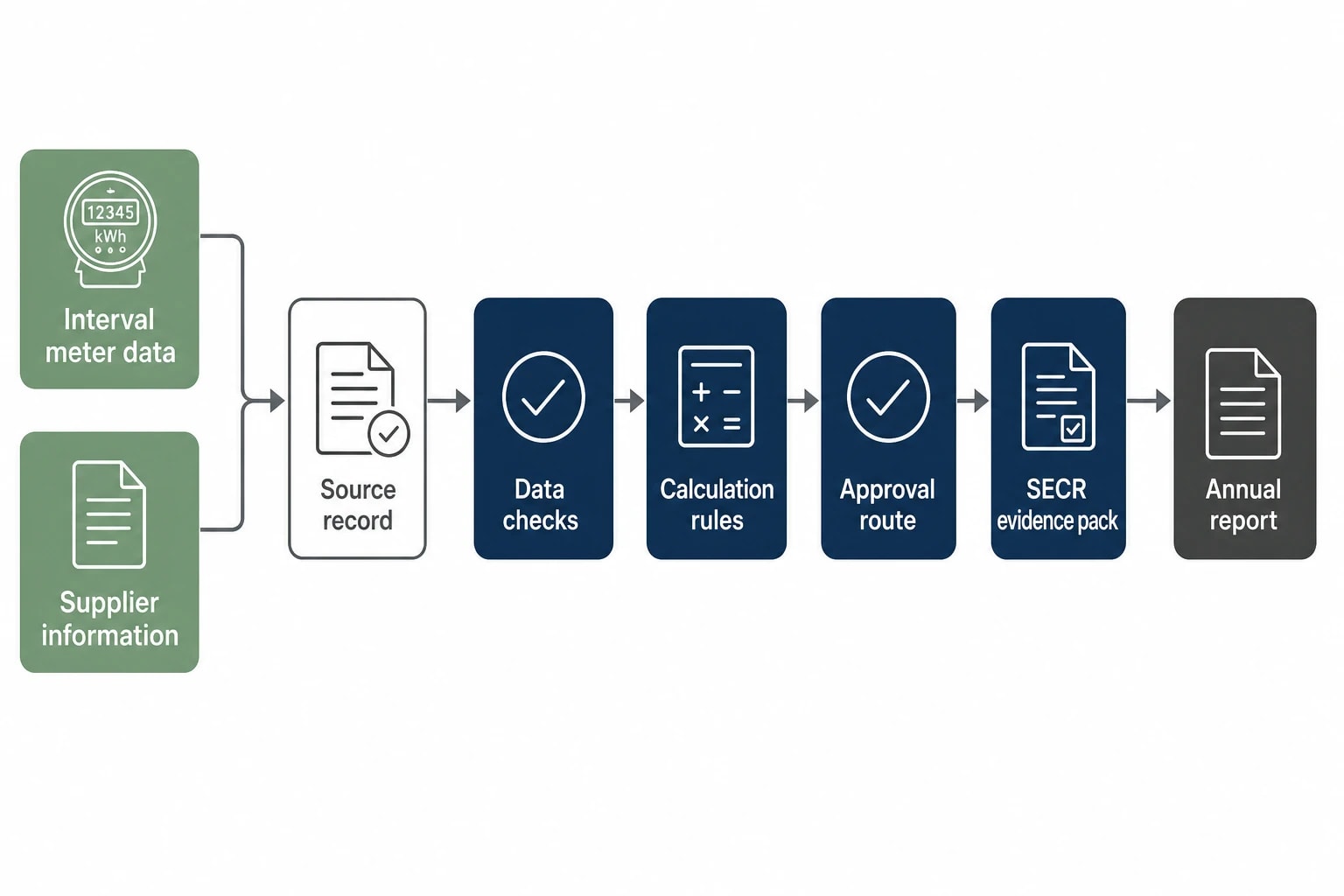
Sustainability managers should assess whether the system can capture interval meter data and supplier information without losing the original source record. Finance directors should examine approval routes, change logs, period controls and the ability to reproduce a submitted annual-report figure. EHS officers should check whether it can record energy-efficiency actions with supporting documentation, responsible owners and dates within the financial year.
A practical selection checklist
A suitable system should be able to:
- Maintain distinct records for legal entities, sites, meters and energy sources
- Capture electricity, gas, transport fuel and purchased heat, steam or cooling where relevant
- Apply and preserve annual government conversion factors
- Identify missing data, duplicate imports and implausible consumption movements
- Document estimates, corrections, exclusions and methodology changes
- Link emissions to an approved intensity-ratio denominator
- Retain prior-year comparatives and restatement explanations
- Produce a reviewable SECR evidence pack alongside annual-report outputs
The software must also fit the organisation's reporting calendar. A pharmaceutical site with validated production records and a chemical business with shared utilities each need clear data ownership and change control. The process should establish those decisions during implementation, then revisit them when sites, assets or corporate structures change.
SECR reporting software turns annual disclosure into a managed process
The FRC's review warns against climate metrics that lack explanation, calculation detail and internal consistency. SECR reporting software does not create compliance by itself. Management still owns the boundary, methodology, disclosures and sign-off.
It makes those decisions visible and repeatable. Meter and invoice data can be checked throughout the year. Emission factors remain tied to the reporting period. Estimates have a documented basis. Intensity ratios retain their denominator history. Energy-efficiency projects can be evidenced rather than reconstructed from memory.
This allows industrial organisations to treat SECR as a governed carbon-accounting process, with data capable of supporting directors, auditors and sustainability teams from the first source record to the final disclosure.
This article reflects the independent analysis and editorial opinion of EnerTherm Engineering. Product names, trademarks, and brands mentioned belong to their respective owners. EnerTherm Engineering is not affiliated with, endorsed by, or a licensee of any third-party software or product mentioned unless explicitly stated.

Technical Manager — EnerTherm Engineering
John Naranjo is Technical Manager at EnerTherm Engineering, bringing specialist expertise in chemical and environmental engineering. He recently led the implementation of Omni Vision, EnerTherm's real-time energy and utility monitoring platform. He holds an MSc in Environmental Engineering from the University of Huelva and a BSc in Chemical Engineering, with memberships in both the Energy Institute and IChemE.
