
How Scope 1 and 2 Software Makes SECR Data Audit-Ready
Automated metering supports SECR, ESOS and ISO 14064 reporting with audit-ready data.
UK Government conversion factors for company reporting are updated annually, creating a moving calculation input for every SECR reporter. A business that cannot show which factor set it used, which energy data fed the calculation and who approved adjustments faces a difficult year-end review.
The Streamlined Energy and Carbon Reporting framework requires qualifying companies and LLPs to disclose energy consumption and greenhouse gas emissions in annual reports. The published figure may appear simple. The underlying process rarely is.
Industrial sites often hold gas data in supplier invoices, electricity use in fiscal-meter portals, fuel deliveries in purchasing records and production information in separate operational systems. Spreadsheet consolidation can create gaps between those records and the final tonnes of CO₂e. A formula may be correct while the data set remains incomplete, duplicated, estimated without approval or mapped to the wrong reporting entity.
Scope 1 and 2 emissions tracking software creates the controls needed to turn energy records into a traceable reporting record. It does not remove management responsibility for SECR. It gives sustainability managers, environmental compliance officers and operations directors a practical way to prove how each material number was assembled.
What SECR requires from industrial businesses
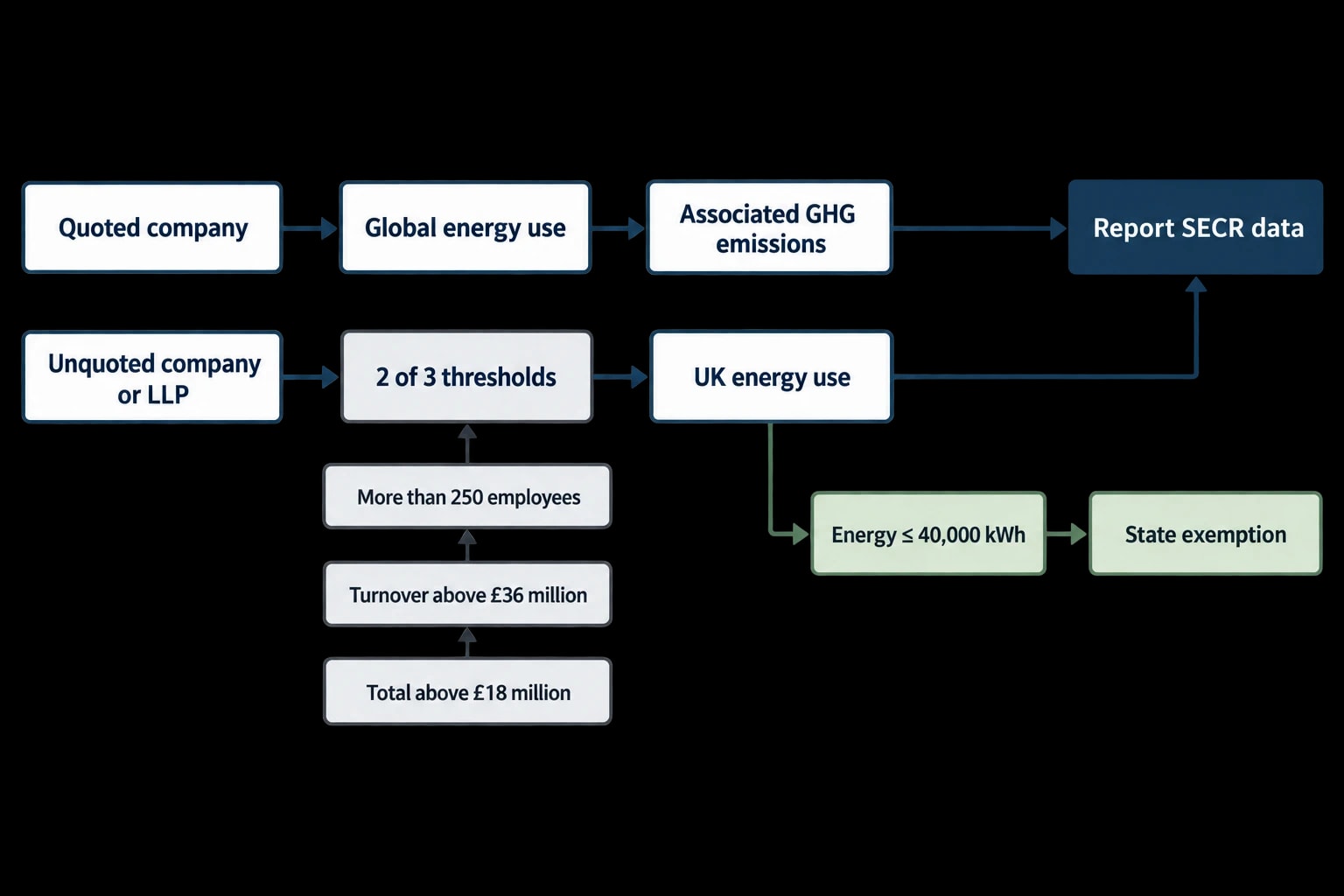
SECR applies to UK quoted companies, subject to exemptions. It also applies to unquoted companies and LLPs that meet at least two of the following thresholds:
- More than 250 employees
- Turnover above £36 million
- Balance sheet total above £18 million
The low energy use exemption applies where annual energy consumption is 40,000 kWh or less. Organisations relying on that exemption must state it in the relevant report.
Energy and carbon disclosure requirements
SECR reporting requirements differ by entity type and reporting boundary, but an industrial disclosure typically needs to address energy use, greenhouse gas emissions, an intensity metric, methodology and energy-efficiency action.
Quoted companies report global energy use and associated greenhouse gas emissions. Large unquoted companies and LLPs report UK energy use and associated emissions. Comparative information is important where readers need to understand whether an apparent reduction results from efficiency activity, changed output, site closures, acquisitions, revised boundaries or a different emissions factor.
A credible disclosure commonly includes:
- Energy consumption in kWh within the applicable reporting boundary
- Scope 1 and Scope 2 greenhouse gas emissions in tonnes of CO₂e
- An intensity ratio, such as tonnes CO₂e per tonne of product, batch, unit of output or £ million turnover
- The methodology used to calculate emissions
- At least one energy-efficiency action taken during the period
- Comparative figures where required
Why the methodology statement matters
The methodology statement should allow a reviewer to understand the route from activity data to reported emissions. That means identifying the organisational boundary, facilities included, energy sources, source records, conversion factors and treatment of estimates.
A single annual carbon total does not provide that evidence. A well-controlled reporting record can answer specific questions: which gas meter supplied the activity data, whether the reading was actual or estimated, which reporting period it covered, which conversion factor applied and whether a reviewer approved an adjustment.
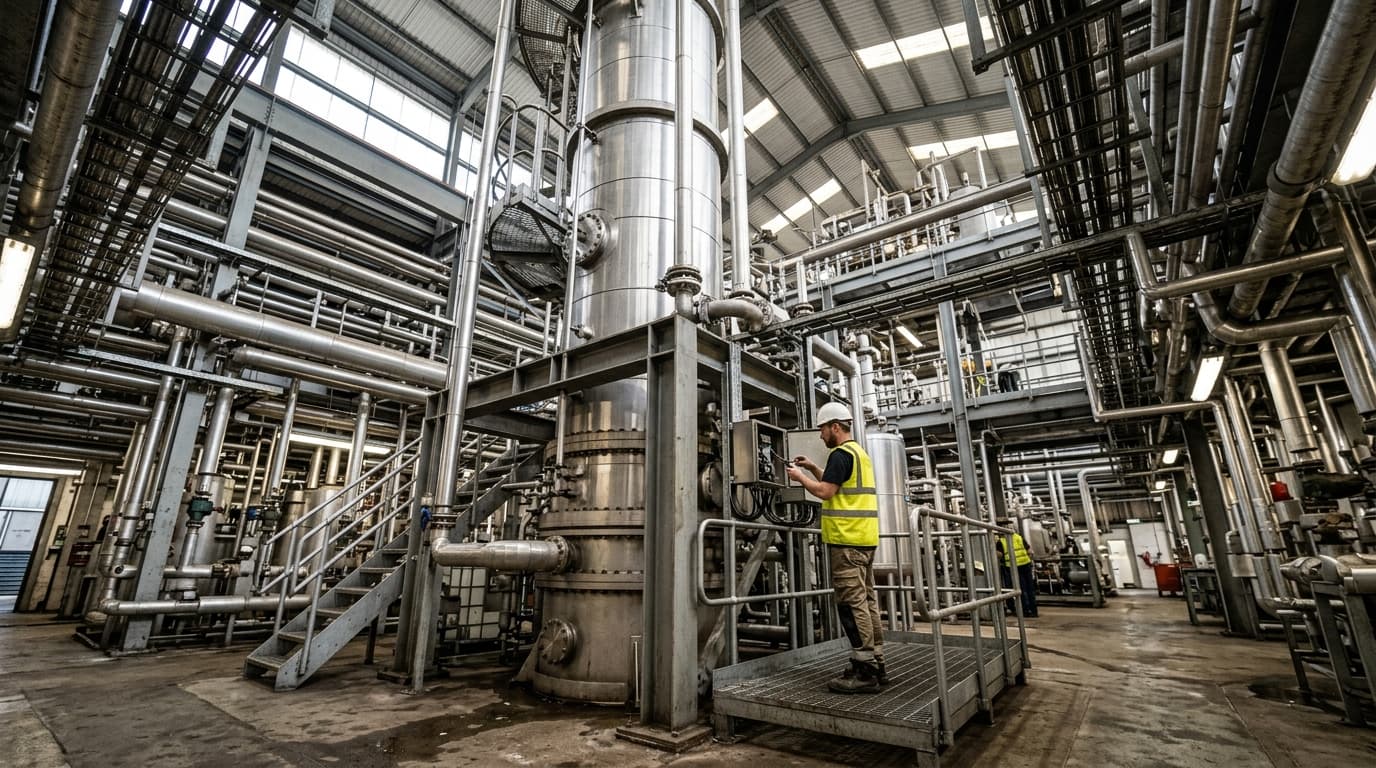
Omni Vision delivers turnkey utility metering, CO2 tracking, and AI-powered production KPI intelligence — giving you real-time dashboards and actionable insights across your entire facility.
Scope 1 and Scope 2 accounting begins with clear boundaries
The Greenhouse Gas Protocol Corporate Standard remains a widely used foundation for corporate greenhouse gas inventories. It requires separate accounting and reporting of Scope 1 and Scope 2 emissions.
The first control sits above meter level. An organisation must decide which legal entities, facilities and controlled operations belong within its inventory. The Greenhouse Gas Protocol describes equity share and control approaches for organisational consolidation. The selected policy must remain consistent, with clear explanations where a business acquisition, disposal, lease change or joint venture affects comparability.
Scope 1 includes direct emissions from controlled sources
Scope 1 emissions arise from sources owned or controlled by the reporting organisation. Industrial examples include:
- Natural gas used in boilers, furnaces and thermal oil heaters
- Diesel, gas oil or LPG used in stationary combustion equipment
- Fuel used in company-controlled vehicles
- Relevant process emissions from controlled equipment
- Fugitive refrigerant emissions from owned or controlled systems
A gas meter produces activity data. It does not produce a finished emissions result. Reporting software should retain the meter identity, site, reading period, unit, data status and conversion factor used to calculate the final CO₂e output.
Scope 2 covers purchased energy
Scope 2 covers indirect emissions associated with purchased electricity, heat, steam and cooling consumed by the reporting organisation. Electricity may arrive through fiscal meters, sub-meters, landlord statements and supplier invoices. Each source needs a defined location, time period, unit and relationship to the reporting boundary.
Steam classification requires particular attention in industrial plants. Fuel combusted in an on-site boiler generally creates Scope 1 emissions through the fuel source. Purchased steam is Scope 2. Incorrect configuration can cause double counting or place an emissions source in the wrong scope.
Keep operational inputs separate from emissions sources
Water and compressed-air readings can support operational reconciliation. A sudden water increase may indicate a process change, while compressed-air demand may help explain electricity use on a production line. Neither water consumption nor compressed air is, by itself, a Scope 1 or Scope 2 emissions activity source.
Software design should preserve that distinction. Operational data can support investigation, intensity analysis and energy-efficiency work without inflating the Scope 1 and Scope 2 inventory.
What makes SECR data audit-ready?
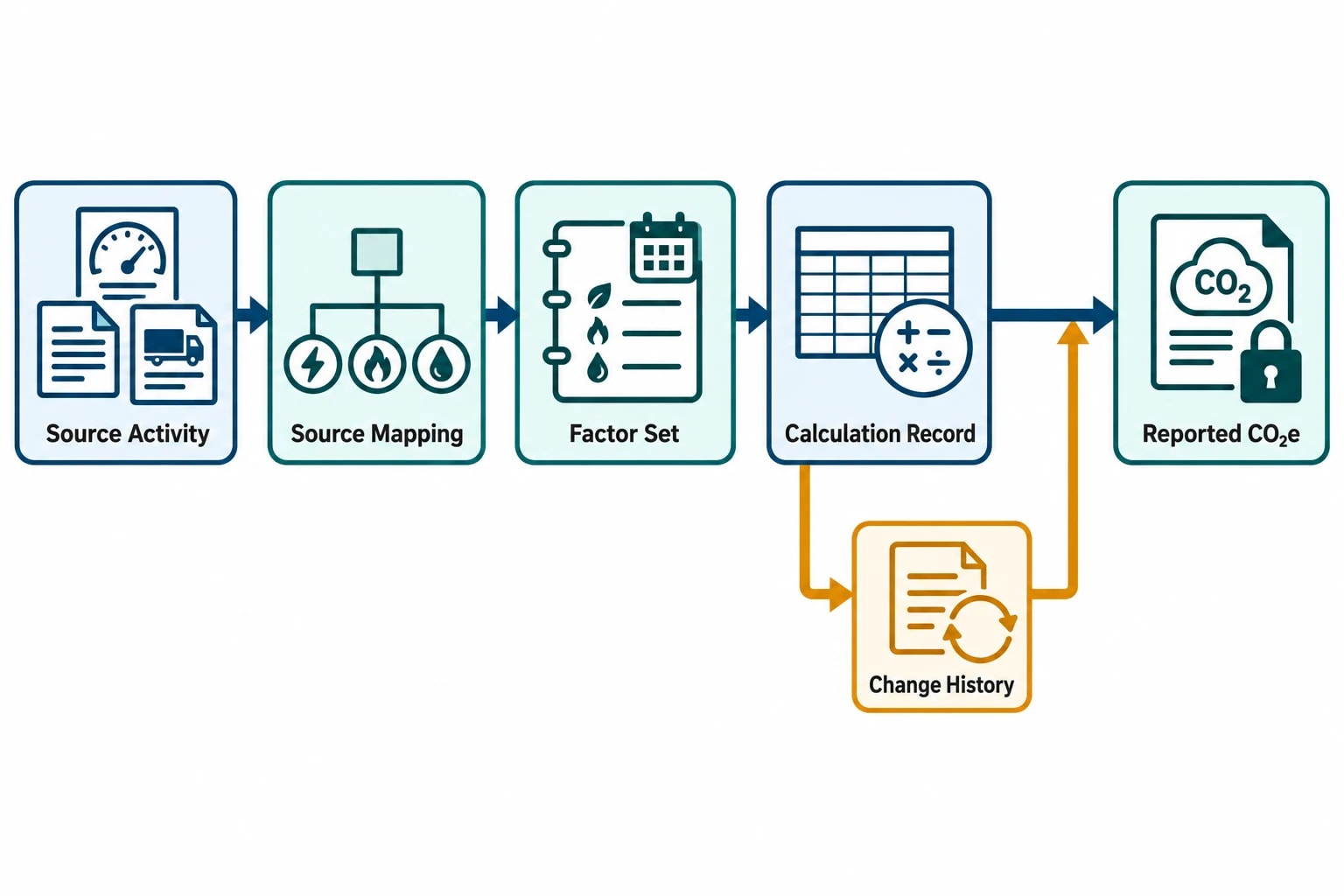
Audit-ready data allows an internal reviewer, external auditor or assurance provider to trace a reported number back to source evidence and recreate each material calculation. It also shows how the organisation dealt with late bills, failed meters, estimates and corrections.
A dashboard can present a useful summary. Audit readiness depends on the underlying evidence and control history.
| Evidence record | Required content | SECR value |
|---|---|---|
| Source activity data | Meter readings, invoices, delivery records, dates, units and site identifiers | Shows where consumption originated |
| Source mapping | Facility, legal entity, energy source, inclusion status and Scope classification | Supports complete and consistent inventory boundaries |
| Calculation record | Conversion factor, factor year, calculation method and CO₂e output | Allows reported emissions to be recreated |
| Change history | Correction, estimate, replacement data, reason and approver | Explains revisions after an initial entry or reporting close |
| Reconciliation record | Comparisons against invoices, fiscal meters, production data and prior periods | Identifies missing, duplicated or abnormal consumption |
Preserve source data and adjustments
Spreadsheet processes often overwrite prior values. An audit-ready system should retain original activity data and record later changes separately. A reviewer needs to see the initial value, replacement value, reason for the change and person who approved it.
This becomes important where a meter communications failure leads to an estimate. The system should identify the affected period, approved estimation method and data owner. When the actual reading arrives, the corrected value should remain linked to the earlier estimate. The organisation can then explain the revision without reconstructing the process from email trails.
Version-control conversion factors
The Department for Energy Security and Net Zero publishes annual greenhouse gas conversion factors for company reporting. The factors enable organisations to calculate emissions from activity data such as fuel volumes, purchased electricity and distance travelled.
A controlled system assigns the relevant factor set to the reporting period and preserves that association with the calculation. This avoids a common reporting weakness: historical totals changing after a software update with no record of which factor was replaced or why.
Factor governance matters for comparability. If an organisation recalculates a prior year using a new factor set, it should retain the original result, document the restatement and explain its effect on the comparison. A year-on-year reduction based solely on updated electricity factors has a different meaning from a reduction arising from lower consumption.
Reconcile energy before calculating carbon
An emissions calculation inherits defects in the underlying energy data. Monthly reconciliation should compare metered consumption with utility bills, fuel purchase records and known operational events such as shutdowns, altered shifts, commissioning work or changed production capacity.
Production-linked checks are particularly valuable in manufacturing and pharmaceutical sites. A material increase in kWh per tonne, per batch or per operating hour may indicate a meter fault, data gap, energy-performance issue or a genuine change in process conditions. The reporting record should capture the investigation and conclusion before annual reporting begins.
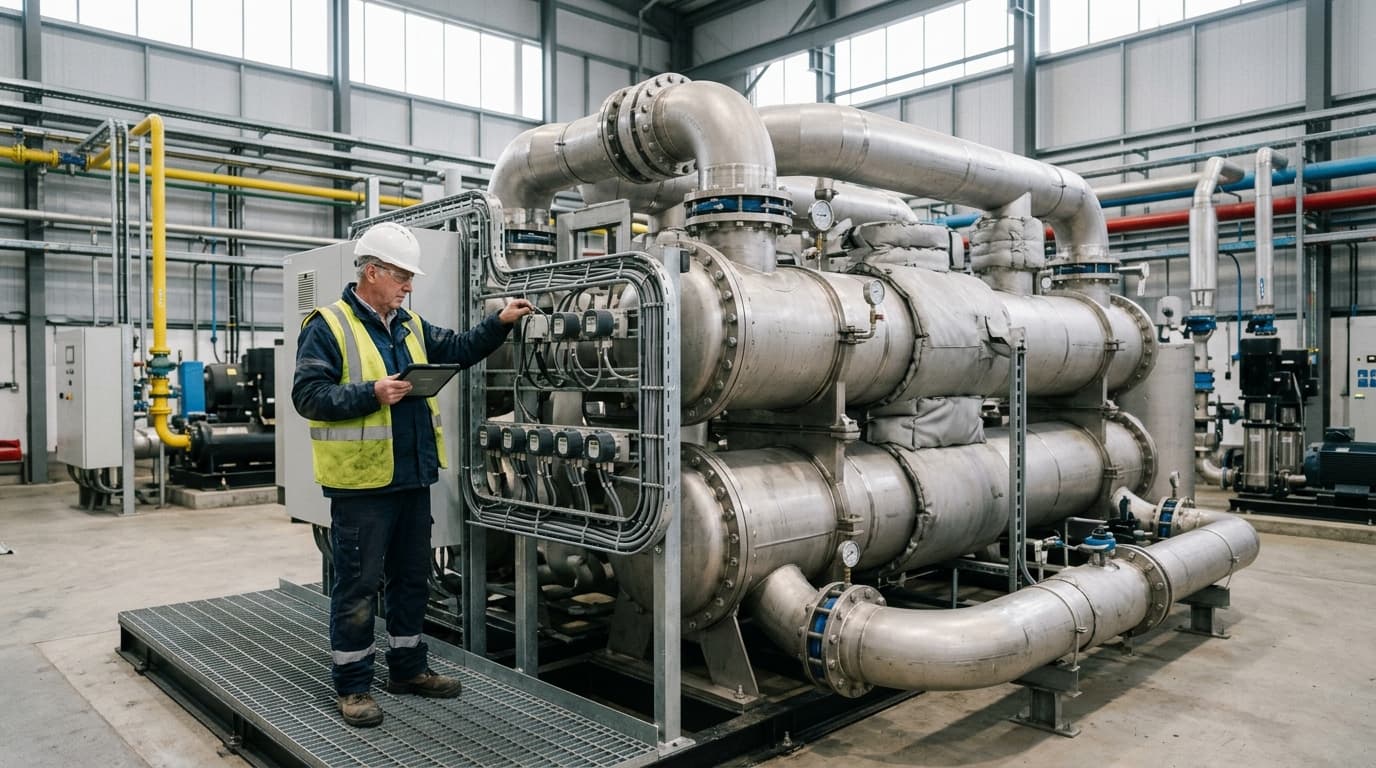
Track energy consumption, emissions, and process parameters with seamless PLC/SCADA integration via Modbus, OPC-UA, and MQTT protocols.
How automated tracking strengthens SECR reporting controls
Scope 1 and 2 emissions tracking software replaces repeated manual consolidation with a defined cycle of data collection, validation, review and approval. Sustainability teams retain responsibility for judgement. The software makes that judgement visible and repeatable.
Capture data close to the activity
Automated capture can reduce transcription between meters, invoices and reporting workbooks. For Scope 1 and Scope 2 reporting, the priority sources are electricity, natural gas, combustion fuels, purchased heat, purchased steam and purchased cooling.
Each record should carry a minimum set of attributes:
- Site and reporting entity
- Source type and Scope category
- Start and end date for the reading or bill
- Original unit and any unit conversion
- Actual, estimated, corrected or manually entered status
- Evidence attachment or source reference
- Named owner and validation status
Those fields prevent a frequent spreadsheet problem: a value appears in a reporting tab without a clear explanation of its origin or status.
Use exceptions to direct review
Good controls identify work that needs attention. They do not merely colour a dashboard red.
Useful exceptions include missing intervals, duplicate readings, meter resets, unexpected unit changes, late invoices, consumption outside defined operating ranges, incomplete source mappings and factors due for an annual update. Each exception needs an assigned owner, a documented resolution and a closure date.
A gas increase may stem from a cold-weather period, a boiler running outside normal hours, a newly commissioned line, a faulty meter or an input error. The reported number should follow the investigation. Automated anomaly detection can identify the event, but an accountable reviewer must decide whether the data requires correction, explanation or no change.
Establish a controlled reporting close
A monthly close gives organisations time to resolve issues before the annual report is due. The close can require data owners to complete reconciliations, approve estimates, resolve exceptions and sign off a period snapshot.
The snapshot should preserve the activity data, organisational boundary, calculation rules and factor versions used at that point. If later information requires a restatement, the system should retain both versions and a reason for change. This record supports audit review and stops reporting teams from relying on memory several months after the event.
Aligning Scope 1 and 2 data with ISO 14064-1 and ESOS
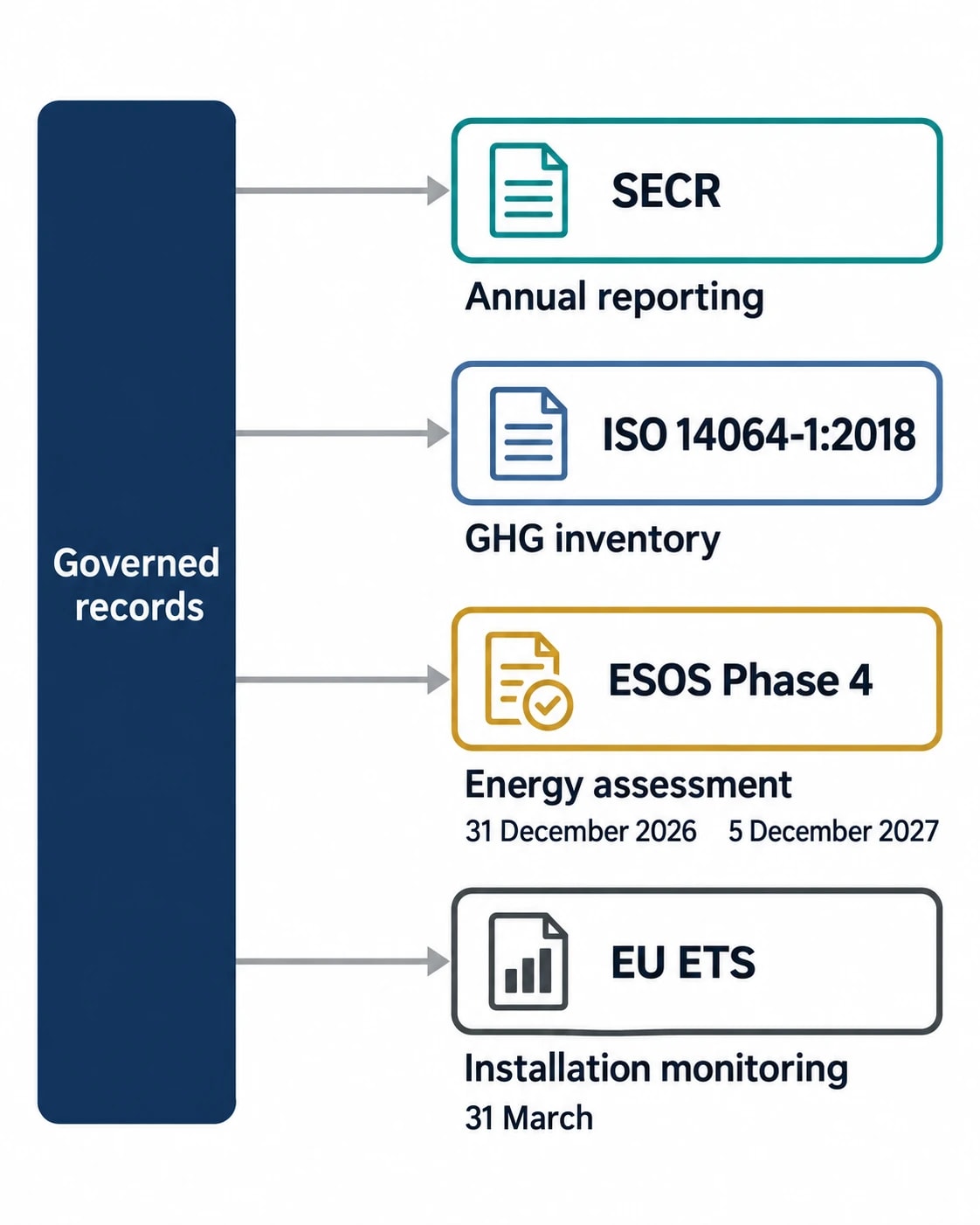
One governed data set can support several environmental reporting tasks. The obligations, boundaries and evidence requirements still differ. Organisations should avoid treating a SECR output as proof of compliance with another scheme.
ISO 14064-1:2018 supports disciplined inventories
ISO 14064-1:2018 specifies principles and requirements for quantifying and reporting greenhouse gas emissions and removals at organisation level. It addresses inventory design, development, management, reporting and verification.
For SECR reporters, the standard supports practical discipline around relevance, completeness, consistency, accuracy and transparency. Software can retain records and calculation evidence, while management remains responsible for defining the inventory, assessing material changes and approving reported information.
A clear organisational boundary, controlled source register, preserved conversion factors and documented recalculations make a Scope 1 and Scope 2 inventory easier to review under both SECR and ISO 14064-1:2018.
ESOS Phase 4 needs retained energy evidence
ESOS Phase 4 applies to qualifying large UK undertakings and corporate groups on 31 December 2026. The notification of compliance deadline is 5 December 2027.
ESOS is a periodic energy-assessment regime, while SECR is an annual corporate reporting requirement. ESOS Phase 4 requires a compliance notification through the Manage your Energy Savings Opportunity Scheme service, an evidence pack and required sign-off. Participants must also report energy-saving opportunities identified through the assessment.
Centralised energy records can make the evidence pack more efficient to prepare. They can show significant energy consumption, site boundaries, data sources and the evidence behind identified opportunities. The organisation must still complete the required assessment and meet ESOS-specific sign-off requirements.
EU ETS requires installation-specific monitoring controls
The EU Emissions Trading System applies to covered installations and aircraft operators within its jurisdiction. Industrial groups with EU operations need to keep EU ETS compliance distinct from UK corporate reporting.
Under Commission Implementing Regulation (EU) 2018/2066, operators must establish, document, implement and maintain data-flow procedures for monitoring and reporting emissions. An installation requires an approved monitoring plan before the monitoring period begins. Operators must have annual emissions reports verified by an accredited verifier and submit them to the competent authority by 31 March of the following year.
Scope 1 and Scope 2 software can provide useful controlled source records, reconciliations and change histories for EU operations. It cannot substitute for the approved monitoring plan, installation-specific procedures, accredited verification or allowance-surrender obligations.
A practical route from spreadsheets to audit-ready SECR data
The transition should start with reporting governance rather than a dashboard build. The following sequence gives industrial organisations a defensible foundation.
-
Define the organisational boundary, legal entities, facilities, consolidation approach and reporting periods.
-
Create a complete register of Scope 1 and Scope 2 sources, including boilers, furnaces, fleet fuel, electricity supplies, purchased heat, purchased steam and purchased cooling.
-
Map each source to a meter, invoice, delivery record or approved estimation method. Assign an accountable data owner.
-
Configure source units, Scope classifications, factor-year controls, calculation rules and evidence retention requirements.
-
Run monthly reconciliation, anomaly investigation and approval workflows throughout the reporting year.
-
Complete a mock SECR close before year-end. Select material reported figures and trace each to its original energy record, including source evidence, approvals, factor versions and boundary decisions.
This article reflects the independent analysis and editorial opinion of EnerTherm Engineering. Product names, trademarks, and brands mentioned belong to their respective owners. EnerTherm Engineering is not affiliated with, endorsed by, or a licensee of any third-party software or product mentioned unless explicitly stated.

Technical Manager — EnerTherm Engineering
John Naranjo is Technical Manager at EnerTherm Engineering, bringing specialist expertise in chemical and environmental engineering. He recently led the implementation of Omni Vision, EnerTherm's real-time energy and utility monitoring platform. He holds an MSc in Environmental Engineering from the University of Huelva and a BSc in Chemical Engineering, with memberships in both the Energy Institute and IChemE.
