
Streaming Modbus Energy Meter Data to Cloud Platforms
Mapping industrial RTU registers via MQTT gateways without disrupting active PLC loops.
A Modbus energy meter cloud integration is an industrial IoT architecture that extracts real-time power metrics from legacy Modbus-enabled field meters and securely streams them to a cloud-based analytics platform for energy intelligence and emissions compliance. In heavy manufacturing and process industries, electricity, steam, and thermal utilities represent a major share of operational expenses; managing these costs requires high-resolution consumption data.
Historically, tracking these utility streams meant relying on manual clipboard readings or isolated, on-premises supervisory control databases. Implementing an automated edge-to-cloud pipeline modernises these legacy systems, providing engineering and environmental teams with verified, continuous data for immediate anomaly detection and automated emissions reporting.
Overcoming the Operational Gap Between OT and IT Networks
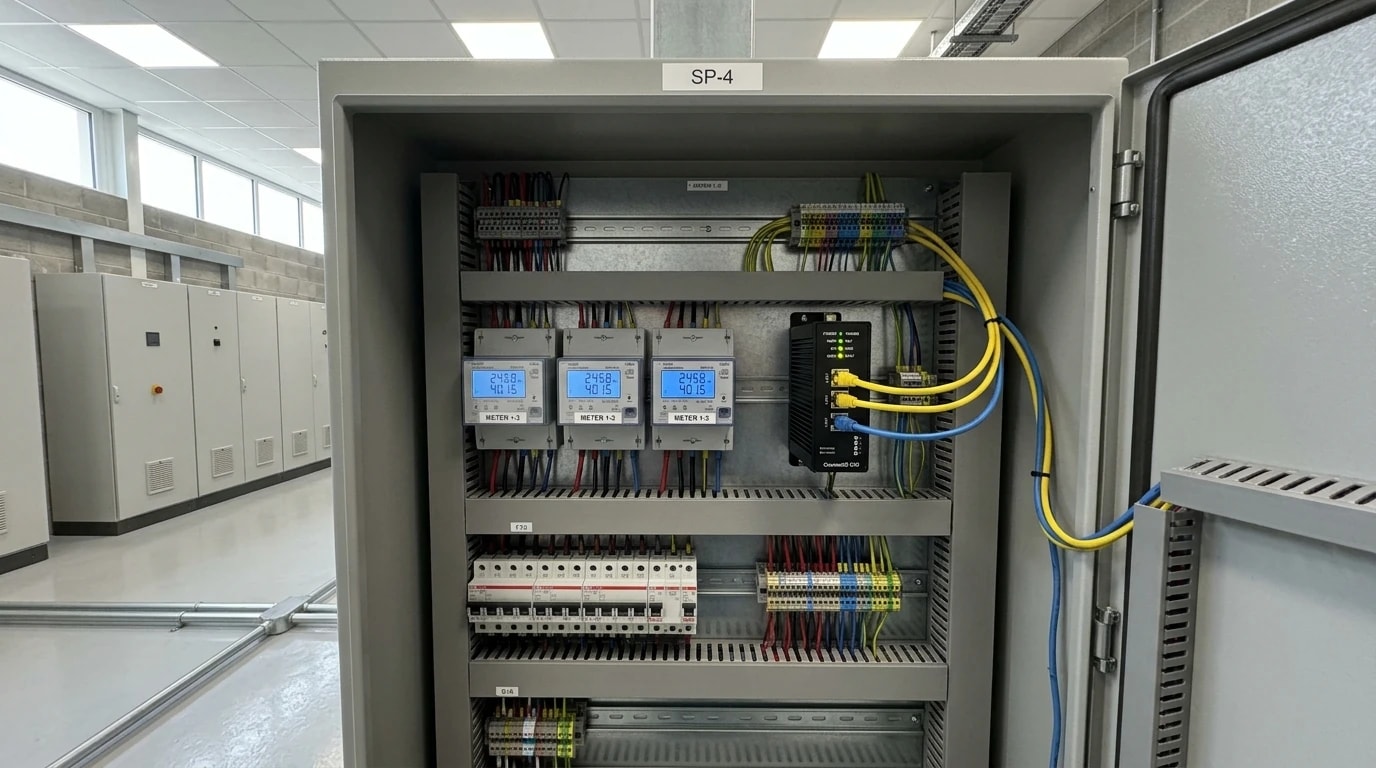
Operational Technology (OT) and Information Technology (IT) networks have historically remained strictly isolated. This division stems from contrasting design goals: OT networks prioritise high availability, deterministic execution, and safety, whereas IT networks focus on data accessibility, global scalability, and cybersecurity.
Security Isolation in Process Control
In manufacturing plants, field energy meters often sit directly on active control networks, queried by Programmable Logic Controllers (PLCs) that regulate production lines. Connecting these critical control environments to the public internet introduces severe vulnerabilities.
A compromised external network connection could allow malicious packet injection into the field network, disrupting control loops, manipulating process parameters, or causing costly equipment shutdowns. This risk remains the primary barrier to deploying Industrial Internet of Things (IIoT) analytics.
Unidirectional Read-Only Data Extraction
To eliminate these risks, industrial architectures must enforce strict physical and logical unidirectional data flow. Edge integration gateways act as a secure boundary, configured to extract register data using strictly read-only protocols.
By blocking any command transmission back to the meters or PLCs, this architecture protects the underlying control loops. Data flow remains strictly outbound, passing from the OT segment to the cloud analytics platform without permitting inbound configuration changes.

Omni Vision delivers turnkey utility metering, CO2 tracking, and AI-powered production KPI intelligence — giving you real-time dashboards and actionable insights across your entire facility.
Physical Layer Configurations for Modbus Field Networks
Developing a reliable edge-to-cloud telemetry system requires a robust physical installation. Industrial energy meters are typically installed inside motor control centres (MCCs) or main distribution switchboards using serial or Ethernet topologies.
Integrating RS-485 Serial Networks (Modbus RTU)
The Modbus RTU protocol operates over physical RS-485 serial networks, utilising differential voltage signals over a shielded twisted pair. In heavy industrial settings, these serial buses are highly vulnerable to electromagnetic noise from high-voltage motors, transformers, and variable-speed drives.
To prevent packet loss, field technicians must map the physical parameters of the RS-485 bus directly to the gateway configuration. Rather than relying on defaults, engineers systematically evaluate cable lengths and baud rates; when cables exceed 500 metres, lower transmission speeds are configured to reduce attenuation.
Technicians must install a 120-ohm termination resistor across the differential signal wires at each physical end of the daisy chain to prevent signal reflection and data corruption. Active pull-up and pull-down biasing resistors ensure the bus maintains a stable voltage during idle states, preventing the receiver from registering false start bits induced by electrical noise.
Standardising Modbus TCP over Ethernet Networks
Modbus TCP replaces serial connections with standard category-grade Ethernet cabling, encapsulating standard Modbus application frames inside TCP/IP packets routed via TCP port 502.
Unlike serial networks, which require careful parameter matching, Modbus TCP devices use static IP addresses. However, because the microprocessors inside industrial energy meters have limited processing power, their internal network stacks typically support only two or three concurrent TCP connections.
Simultaneous polling by multiple client systems can drop packets or freeze the meter. Gateways must therefore manage these connection limits, regulating polling frequency to protect the device.
Register Mapping and Normalisation of Modbus Metrics
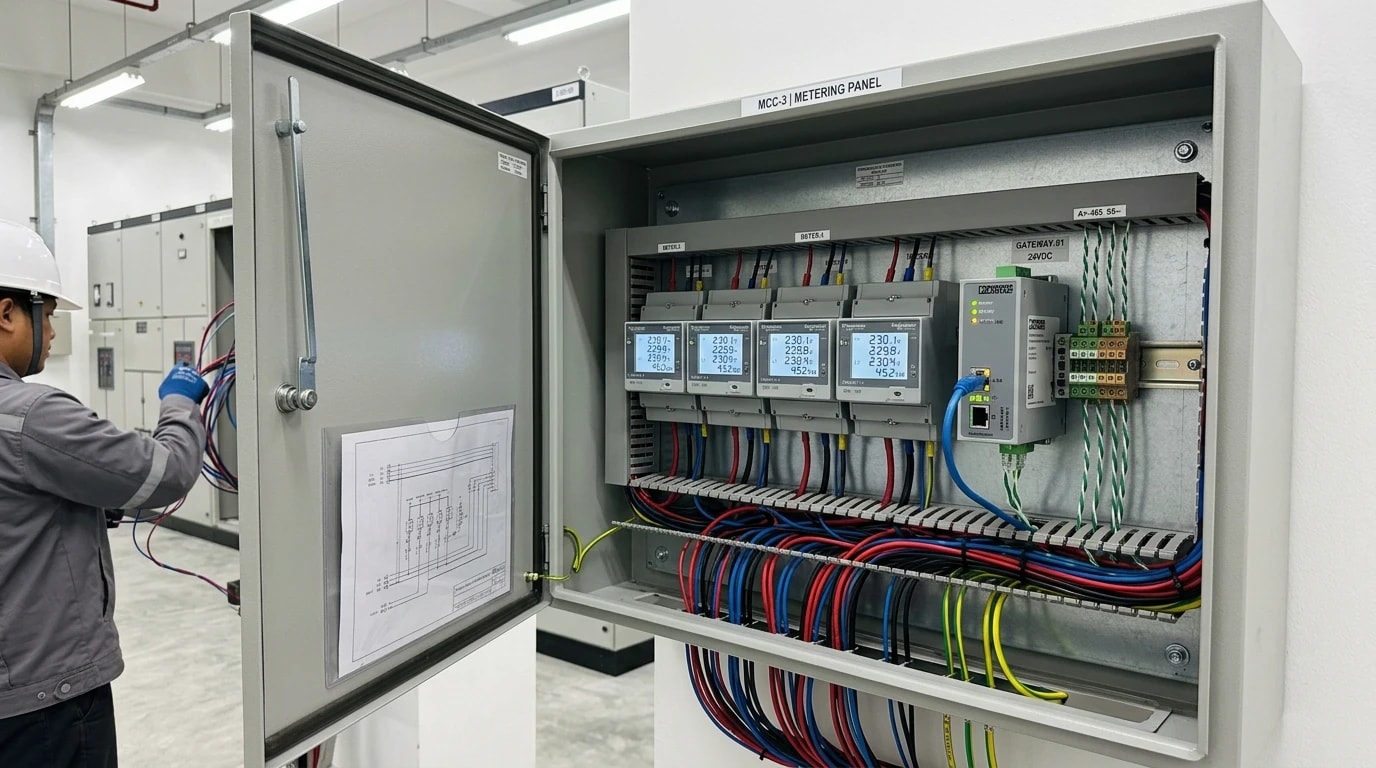
Once physical connectivity is established, the edge gateway must translate binary registers into structured engineering values. Because Modbus networks transfer only raw 16-bit binary integers without metadata, the integration platform relies on a device-specific register map to interpret these payloads.
Memory Address Structures for Industry-Standard Meters
High-precision industrial energy meters store electrical parameters in 32-bit floating-point structures. Since a Modbus register is only 16 bits wide, each value occupies two consecutive memory addresses. The gateway must poll both registers, combine the bytes, and interpret them using the correct word-order sequence (big-endian versus little-endian). Any byte-alignment mismatch will corrupt the resulting value.
The table below lists the standard Modbus holding register addresses for three widely used industrial network analysers:
| Parameter | Schneider PM8000 Address | Schneider PM8000 Type | ABB M4M 30 Address | ABB M4M 30 Type | Siemens PAC4200 Address | Siemens PAC4200 Type |
|---|---|---|---|---|---|---|
| Phase A (L1) Voltage (V) | 403020 | FLOAT32 | 23298 | FLOAT32 | 400001 | FLOAT32 |
| Phase A (L1) Current (A) | 403000 | FLOAT32 | 23314 | FLOAT32 | 400013 | FLOAT32 |
| Phase A (L1) Active Power (kW) | 403054 | FLOAT32 | 23330 | FLOAT32 | 400019 | FLOAT32 |
| Total Active Energy (kWh) | 402700 | FLOAT32 | 5000 | FLOAT32 | 400801 | FLOAT32 |
| System Frequency (Hz) | 403110 | FLOAT32 | 23326 | FLOAT32 | 400055 | FLOAT32 |
(Note: Real-world register configurations can vary based on installed firmware versions. For instance, some Siemens PAC4200 profiles can store active energy values in INT64 format rather than FLOAT32. Engineers must verify the register list with the manufacturer's official documentation before programming the gateway).
Compiling and Normalising Data into JSON Streams
The edge gateway polls these registers on a defined schedule, applying multipliers to convert raw values into final engineering units (such as Watts to kilowatts) before packaging them into a structured JavaScript Object Notation (JSON) format.
{
  "timestamp": "2026-08-03T08:00:00Z",
  "device_metadata": {
    "site_id": "UK-MIDLANDS-01",
    "facility_zone": "LINE-4-BOILER",
    "meter_brand": "Schneider",
    "meter_model": "PM8000",
    "modbus_unit_id": 12
  },
  "metrics": {
    "voltage_l1_v": 230.45,
    "current_l1_a": 45.18,
    "active_power_l1_kw": 10.41,
    "total_active_energy_kwh": 145823.7,
    "frequency_hz": 50.02
  }
}
This standardised format allows cloud platforms to ingest and query metrics directly, removing the need for post-processing or byte-shuffling at the database layer.

Track energy consumption, emissions, and process parameters with seamless PLC/SCADA integration via Modbus, OPC-UA, and MQTT protocols.
Engineering a Non-Invasive Edge Gateway Architecture
To protect active plant operations, the cloud integration must operate completely non-invasively, causing zero disruption to pre-existing control networks.
Preventing PLC Loop Interference and Communication Collisions
On serial RS-485 networks, Modbus RTU operates as a single-master protocol. If an edge gateway acts as a secondary master and polls a serial bus while a PLC is active, packet collisions will occur, triggering PLC timeout alarms that can halt manufacturing.
To bypass this issue, engineers use several methods:
- Passive RS-485 Listeners: Deploying hardware-isolated serial splitters that clone the RX differential line, allowing the gateway to read packets passively without transmitting.
- Secondary Serial Ports: Utilising dual-port meters where one port is dedicated to the PLC loop and the second port is isolated for the edge gateway.
- Intermediary Read-Only Servers: Routing queries through an OPC-UA server or a read-only Modbus TCP slave bridge configured within the PLC memory space.
The Modbus-to-MQTT Telemetry Pipeline
Once the gateway extracts the raw registers, it must transmit the structured data to the cloud. Because sending raw Modbus packets over the internet is inefficient and insecure, gateways convert the data into MQTT payloads.
MQTT uses an asynchronous, publish-subscribe model highly suited to WAN networks. The gateway establishes an outbound TCP connection on port 8883, publishing payloads encrypted via Transport Layer Security (TLS 1.3). Because this connection is initiated from within the plant, firewalls do not require inbound ports to be opened, protecting the facility from external intrusion.
Mitigating Network Vulnerabilities and Communication Dropouts
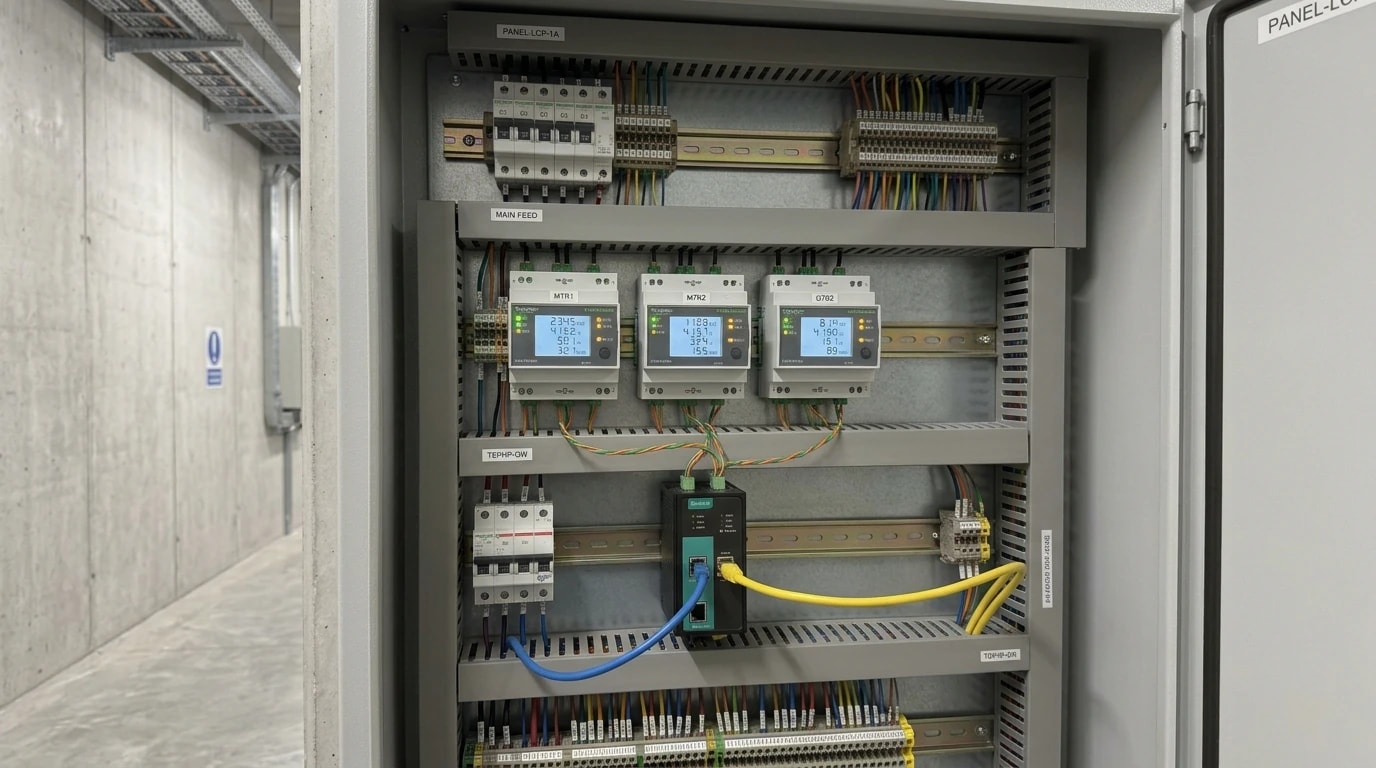
Legacy Modbus protocols transmit data in unencrypted, plain-text formats. To protect industrial environments, the architecture must enforce security and redundancy at the edge.
Dual-Homed Network Isolation and Three-Way Galvanic Barriers
Dual-homed routing prevents direct bridging between the corporate network and the manufacturing floor. The edge gateway utilises two physically separate network interfaces:
- OT Interface: Configured with a static IP on the isolated PLC/meter network, without a default gateway.
- IT/Cloud Interface: Configured for the plant IT network with outbound-only internet routing.
The gateway's operating system strictly prevents routing or bridging between these interfaces, ensuring external traffic never reaches the OT network.
Additionally, serial interfaces are isolated using three-way galvanic barriers. This separates the input, output, and power supply circuits, blocking high-voltage surges or ground potential shifts common in heavy manufacturing.
Local Buffering and QoS 1 Delivery Guarantees
Wide Area Network (WAN) connections can experience temporary packet loss or extended outages. To prevent data loss, the edge gateway uses local storage and buffering.
During a connection failure, the gateway stores JSON payloads in local solid-state memory sized to retain several weeks of high-resolution readings. The MQTT client operates with Quality of Service (QoS 1) delivery guarantees, requiring the cloud broker to return an acknowledgement packet for every received message.
If no acknowledgement is received, the gateway retains the message in its queue. Once the WAN connection is restored, a store-and-forward mechanism transmits the buffered data in chronological order, preserving original timestamps to maintain historical continuity for downstream environmental reporting.
Omni Vision: Enterprise Environmental Monitoring and Real-Time Analytics
Transitioning from manual data collection to automated utility monitoring is critical for modern industrial organisations. Developed by EnerTherm Engineering, the Omni Vision Energy Intelligence Platform provides a complete, turnkey solution. The platform combines secure on-site hardware integration with advanced, cloud-based analytics powered by EPSA's cloud intelligence.
Replacing Manual Spreadsheets with Automated Telemetry
Many facilities still rely on manual spreadsheet entry, recording utility readings weekly or monthly. This lag makes it impossible to detect anomalies, identify leaks, or correlate energy consumption with specific production batches.
The Omni Vision platform automates this process by monitoring more than six core utility streams: electricity, gas, water, steam, compressed air, and oil. The system utilises strictly read-only data extraction to connect to existing Modbus, OPC-UA, BACnet, and MQTT networks. This zero-write architecture ensures no interference with critical plant operations.
Audit-Ready Compliance for International Sustainability Frameworks
By capturing actual metered utility data, Omni Vision delivers automated, audit-ready compliance reporting. Supported frameworks include:
- Streamlined Energy and Carbon Reporting (SECR) in the UK
- Energy Savings Opportunity Scheme (ESOS) in the UK
- EU Emissions Trading System (EU ETS)
- US Environmental Protection Agency (US EPA 40 CFR Part 60)
- International standards, including ISO 50001:2018 (Energy Management) and ISO 14064:2018 (Greenhouse Gas Verification)
- The Task Force on Climate-related Financial Disclosures (TCFD) and the Carbon Disclosure Project (CDP)
EPSA's cloud-based analytics engine uses this granular data to run predictive models, perform anomaly detection, and map production-linked Key Performance Indicators (KPIs)—such as energy used per batch or cost per tonne. This level of insight allows plant managers to identify inefficiencies and consistently realise 15 to 25 per cent energy cost reductions.
EnerTherm Engineering brings a 12-year track record and experience across more than 150 customer deployments to every project. Delivered under a standardised 8 to 16-week turnkey deployment model, Omni Vision transitions organisations from fragmented, manual tracking to centralised, real-time energy intelligence, yielding a sub-12-month return on investment.
This article reflects the independent analysis and editorial opinion of EnerTherm Engineering. Product names, trademarks, and brands mentioned belong to their respective owners. EnerTherm Engineering is not affiliated with, endorsed by, or a licensee of any third-party software or product mentioned unless explicitly stated.

Technical Manager — EnerTherm Engineering
John Naranjo is Technical Manager at EnerTherm Engineering, bringing specialist expertise in chemical and environmental engineering. He recently led the implementation of Omni Vision, EnerTherm's real-time energy and utility monitoring platform. He holds an MSc in Environmental Engineering from the University of Huelva and a BSc in Chemical Engineering, with memberships in both the Energy Institute and IChemE.
