
Why ISO 50001 Compliance Software Replaces Spreadsheets
Audit-ready Clause 9.1 data replaces manual tracking for ESOS and EnMS reporting.
The Environment Agency has set 5 December 2027 as the deadline for ESOS Phase 4 compliance notifications. For industrial organisations still assembling energy records from invoices, emailed meter reads and multiple workbook versions, that date exposes a persistent problem: a spreadsheet may contain the figure, yet fail to show how it was measured, checked, approved and used.
ISO 50001 compliance software turns this annual reconstruction exercise into a maintained record of energy performance. It brings time-stamped utility data, Energy Performance Indicators, corrective actions, evidence outputs and management-review information into one controlled system.
ISO 50001:2018 requires an Energy Management System, or EnMS, to support continual improvement through the Plan-Do-Check-Act cycle. A credible EnMS needs more than a year-end consumption total. It needs evidence that the organisation monitored significant energy uses, analysed performance, investigated deviations and acted on the findings.
For manufacturing, pharmaceutical and process sites, software gives energy managers and compliance officers a stronger route to certification surveillance, ESOS evidence retention and carbon reporting.
ESOS Phase 4 makes ISO 50001 evidence more valuable
ESOS Phase 4 applies to large UK undertakings that meet the qualification criteria on 31 December 2026. Participating organisations must assess energy used in buildings, industrial processes and transport, identify significant energy consumption, calculate energy-intensity ratios and retain an evidence pack.
The Environment Agency also requires Phase 4 participants to report progress against action-plan commitments. Organisations must record energy savings achieved during the compliance period and explain why proposed measures were not implemented.
These requirements depend on historic records that can be traced to an operating site, activity, reporting period and consumption source.
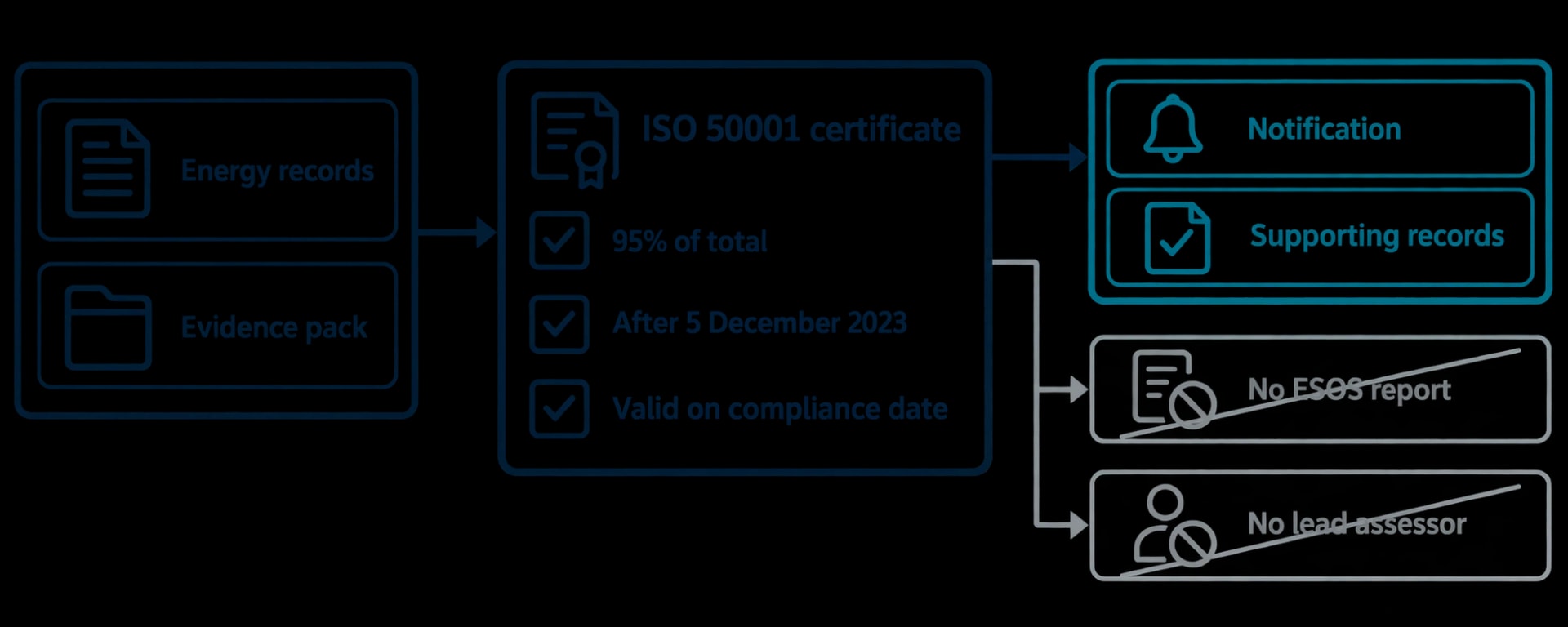
ISO 50001 can reduce ESOS Phase 4 obligations
An ISO 50001 certification can provide an ESOS compliance route where it covers total energy consumption or significant energy consumption, as applicable. Significant energy consumption must account for at least 95% of total energy consumption.
An organisation complying solely through an eligible ISO 50001 certification does not need to appoint an ESOS lead assessor or produce an ESOS report. It must still submit its notification of compliance and retain supporting records.
For Phase 4, the ISO 50001 certification must have been issued after 5 December 2023 and remain valid on the compliance date. The certificate scope therefore deserves close attention. A certificate that excludes a major manufacturing utility, transport activity or process area can leave the organisation reliant on an additional ESOS audit.
Evidence is part of the compliance route
A certificate alone does not explain how a site monitors its significant energy uses. Auditors and internal reviewers need to see the underlying EnMS records.
Useful evidence includes:
- The EnMS boundary and included sites
- Significant energy uses and associated assets
- Utility consumption data and data-source records
- Energy Performance Indicators and energy baselines
- Production or operating variables used to interpret consumption
- Energy objectives, action plans and responsible owners
- Review records for savings measures and performance deviations
- Management-review outputs and corrective actions
Spreadsheet folders can hold these documents, but become harder to govern as sites, utility streams and contributors increase.
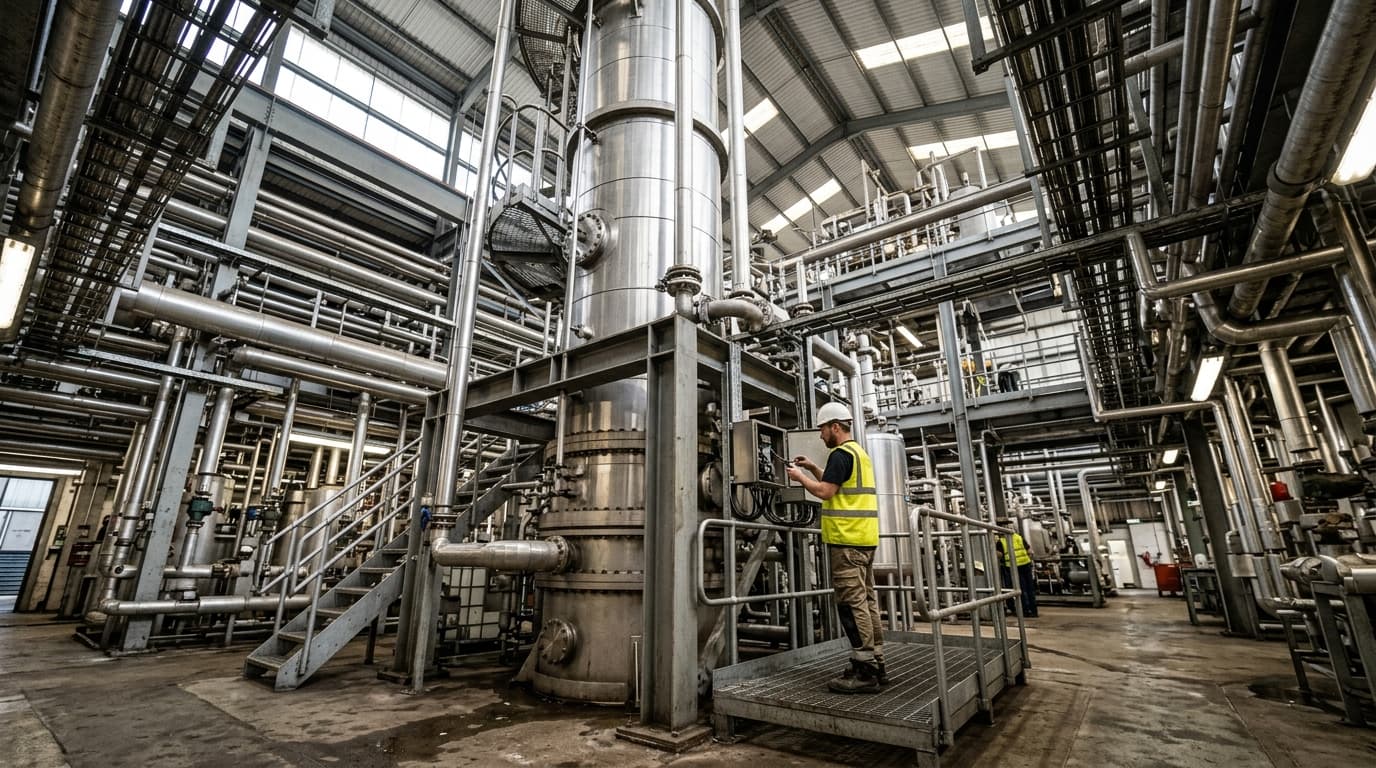
Omni Vision delivers turnkey utility metering, CO2 tracking, and AI-powered production KPI intelligence — giving you real-time dashboards and actionable insights across your entire facility.
ISO 50001 Clause 9.1 requires consistent monitoring
Clause 9.1 of ISO 50001:2018 addresses monitoring, measurement, analysis and evaluation. Organisations must determine what to monitor and measure, how and when this will happen, and when the resulting information will be analysed and evaluated.
For an industrial EnMS, this can cover electricity demand, natural gas, steam, compressed air, fuel oil, water, process consumption, production output and energy intensity.
Time-stamped energy data changes the quality of review
A monthly electricity invoice can establish billed consumption. It rarely explains why a production line’s baseload increased during a particular shift, why a boiler operated outside planned hours or why compressed-air use rose after maintenance.
Time-stamped meter data allows energy teams to examine consumption against operating hours, batches, throughput, product mix and other relevant variables. That context separates a genuine deterioration in energy performance from a rise in production.
An Energy Performance Indicator such as energy per tonne or energy per batch becomes more credible when the software retains the utility data, production value and reporting period that produced it.
Continual improvement needs a maintained record
The Plan-Do-Check-Act cycle depends on repeatable activity.
- The organisation sets an energy objective, baseline and Energy Performance Indicator.
- It implements an operational or capital measure.
- It monitors performance against the agreed measure.
- It evaluates the outcome, records deviations and decides further action.
ISO 50001 compliance software can connect a measure to its implementation date, owner, affected asset, expected outcome and observed energy result. This gives management-review meetings and certification audits a record of decisions made during the year.
A workbook may calculate the same comparison. The compliance risk arises when the site cannot establish which version was used, whether source data changed or who approved an adjustment.
Why spreadsheets create ISO 50001 compliance risks
Spreadsheets retain an important place in local engineering analysis and one-off modelling. Their limitations appear when they become the primary system of record for a multi-site Energy Management System.
Version control weakens data traceability
A workbook copied each month can create competing versions. Formula changes, overwritten cells, hidden columns and manual imports can be difficult to identify after a reporting period closes.
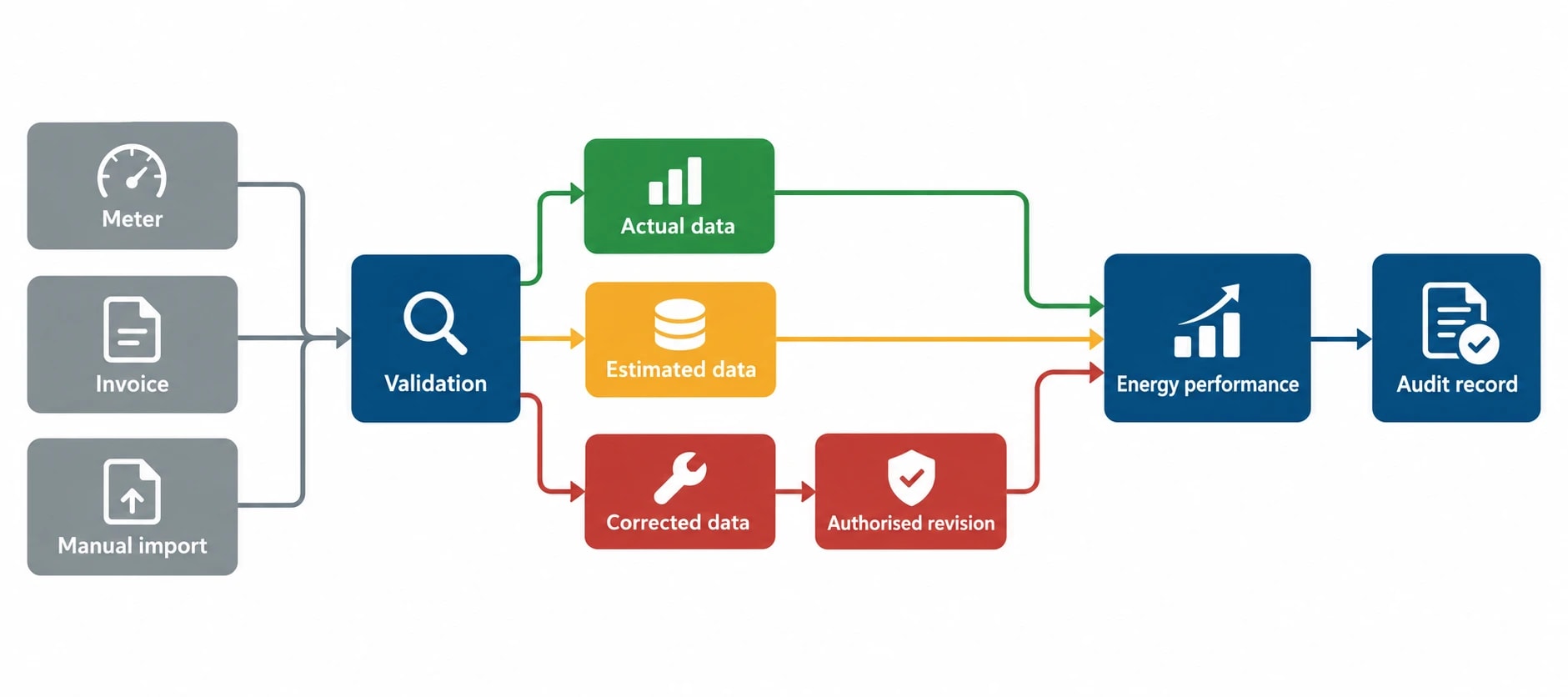
A controlled software system should retain a clear route from an energy-performance figure to its source data. Auditors should be able to identify whether the value came from a meter, invoice, manual import or approved estimate.
A site needs to know which data changed, why it changed and who authorised the revision.
Manual consolidation adds data-quality work
Energy records can arrive in kWh, litres, cubic metres, invoices, data logger exports and sub-meter files. A manual process assigns unit conversion, period alignment and aggregation to the person maintaining the workbook.
Errors commonly arise where an invoice covers an estimated period, a meter has been replaced, a data feed has failed or a production reporting method has changed. These issues may remain hidden until an auditor asks for a reconciliation.
ISO 50001 compliance software should flag missing intervals, unusual values, communication gaps and incomplete production data. Energy managers still need to investigate exceptions, but they can do so while the event remains recent and operational teams can explain it.
Annual totals do not prove performance management
A single annual consumption total does not show how the organisation monitored significant energy uses or evaluated change across the year.
An audit-ready record should distinguish actual data from estimated or corrected data. It should retain the asset hierarchy, site boundaries, validation status, calculation rules and action history alongside the reported total.
Compliance software preserves operational context before a certification audit, ESOS review or board request creates pressure to reconstruct it.
What ISO 50001 compliance software should capture
The strongest systems are configured around EnMS evidence requirements. They collect raw data, preserve its context and make it available to energy management, sustainability and compliance teams.
| Compliance need | Software requirement | Evidence output |
|---|---|---|
| Significant energy uses | Meter and asset hierarchy connected to sites and processes | Register of significant energy uses and monitored assets |
| Clause 9.1 monitoring | Time-stamped utility and process data | Trend records and monitoring reports |
| EnPIs and baselines | Period-controlled calculations with relevant variables | Energy-intensity and baseline comparison reports |
| Data-quality review | Flags for missing, estimated, corrected or unusual data | Exception log and approval record |
| Improvement actions | Measure register, owner, dates and results | Action-plan and savings evidence |
| ESOS evidence pack | Exportable records linked to reporting periods | Traceable compliance evidence |
| Carbon reporting | Controlled activity data and emissions-factor records | Scope 1 and Scope 2 reporting outputs |
Data governance deserves the same attention as data collection
Metering coverage is only one part of the design. The organisation also needs documented rules for data validation, corrections and retention.
A useful operating process identifies who investigates unusual consumption, who can approve material adjustments and how estimated readings are labelled. It also records meter maintenance, calibration information and replacements where these affect record continuity.
The software should preserve the original source value alongside an approved correction. This allows a reviewer to understand what happened without losing the measurement history.
Reporting should work from a shared dataset
Energy, carbon and compliance teams often recreate the same utility totals in separate workbooks. This creates reconciliation work and increases the likelihood of inconsistent figures.
A central dataset can support management review, ISO 50001 surveillance, ESOS evidence retention and internal energy-performance reporting from the same validated records. Each report may have a different audience, but the underlying source data should remain consistent.
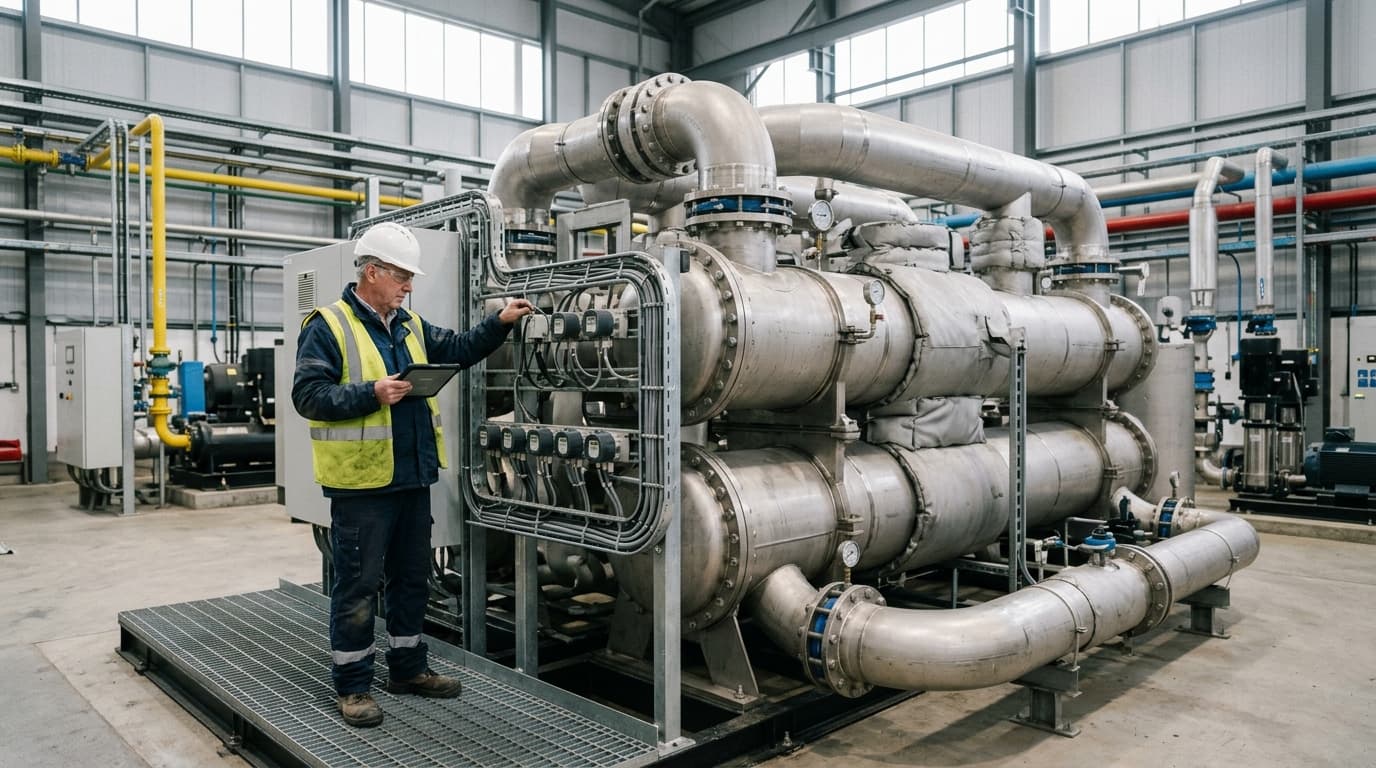
Track energy consumption, emissions, and process parameters with seamless PLC/SCADA integration via Modbus, OPC-UA, and MQTT protocols.
Metered energy data improves Scope 1 and Scope 2 reporting
Energy data gathered for an EnMS can also support wider environmental reporting.
Under the GHG Protocol Corporate Standard, Scope 1 covers direct greenhouse-gas emissions from sources owned or controlled by the reporting organisation. For industrial facilities, this commonly includes fuel combustion in boilers, furnaces and other stationary equipment.
Scope 2 covers indirect emissions from the generation of purchased or acquired electricity, steam, heating or cooling consumed by the reporting organisation.
Actual readings provide a stronger reporting trail
Invoices and estimated values may be necessary where direct readings are unavailable. Metered data provides a clearer record of how the facility operated during the reporting period.
A controlled software workflow can associate consumption with the relevant site, meter, period and emissions-factor set. This supports reconciliation when sustainability, finance and engineering teams review a reported emissions figure.
The system should also retain the factor version used for a completed reporting period. Replacing historic factors with a current set can make prior-year figures difficult to reproduce.
Energy performance and emissions reporting share core records
The utility data required for ISO 50001 monitoring overlaps substantially with the activity data used for Scope 1 and Scope 2 calculations. Gas consumption can support boiler performance analysis and stationary-combustion reporting. Purchased electricity can support load analysis and Scope 2 reporting.
The reporting purpose differs, but the underlying requirement remains the same: accurate, time-stamped and traceable consumption data.
A practical route from spreadsheet tracking to audit-ready records
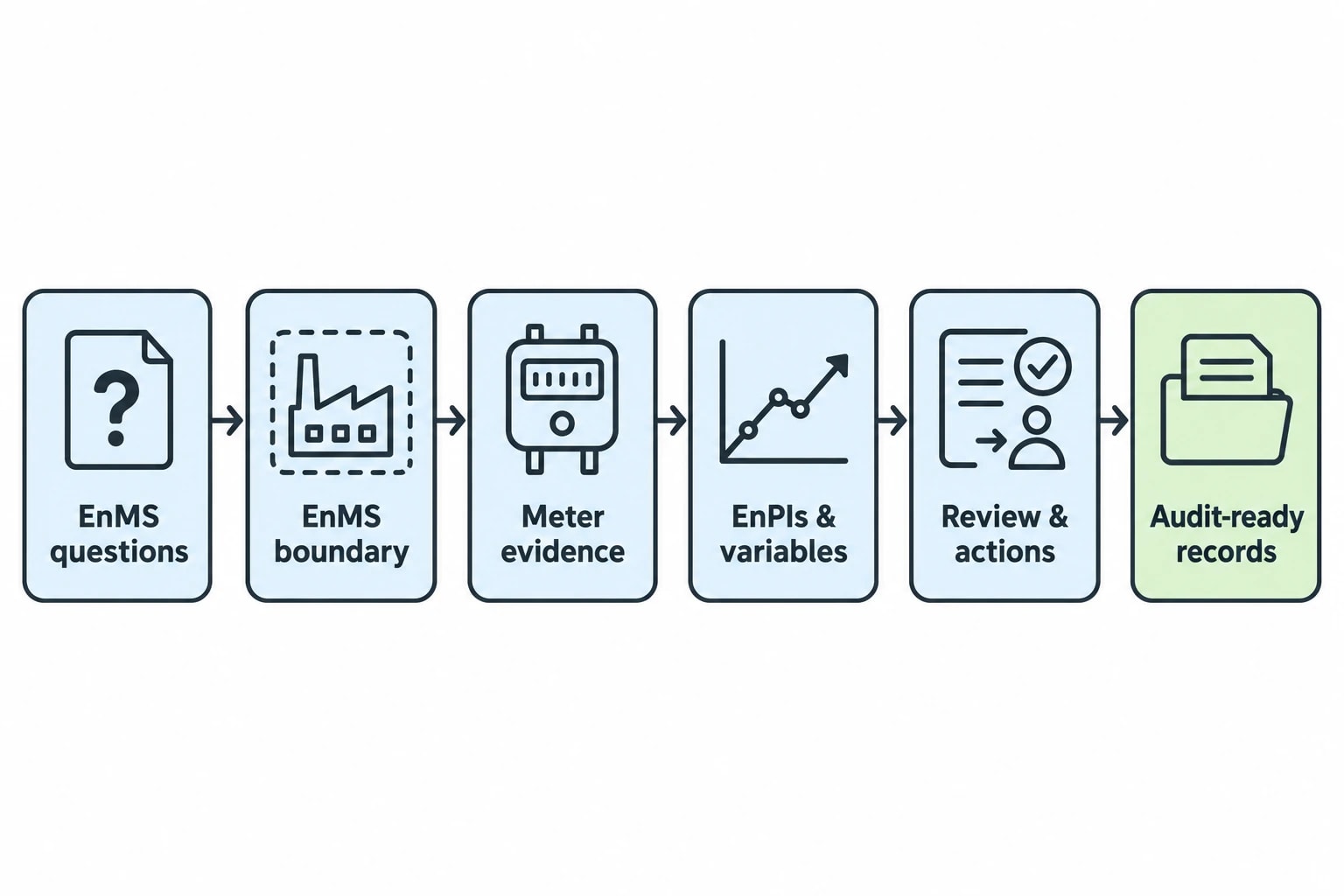
A software project should begin with the EnMS questions the facility needs to answer. Data collection follows those requirements.
Define the compliance boundary first
Energy managers should establish:
- Which sites, assets and activities sit inside the EnMS boundary.
- Which utility streams support each significant energy use.
- Which meters provide evidence for each monitored activity.
- Which production or operating variables are needed for Energy Performance Indicators.
- Who reviews exceptions, approves adjustments and owns improvement actions.
- Which reports support management review, certification and ESOS evidence retention.
This avoids collecting large volumes of data without a defined compliance purpose.
Start with the largest and least understood energy uses
A site does not need to instrument every asset before it can improve its EnMS. It should first establish reliable coverage of significant energy uses and major energy-consuming processes.
A food manufacturer may begin with refrigeration, compressed air, boilers and major production lines. A pharmaceutical facility may prioritise clean utilities, HVAC systems, process heating and batch-linked consumption. The meter hierarchy should reflect the site’s energy review, not a generic dashboard template.
Build the review routine around exceptions and actions
The organisation should agree a monthly or weekly routine for reviewing energy performance. The review should identify changes against the Energy Performance Indicator, establish whether operating conditions explain them and assign actions where required.
This turns the software record into an active part of the EnMS and ensures the facility has current evidence before a surveillance audit or ESOS reporting deadline approaches.
How Omni Vision supports ISO 50001 reporting
EnerTherm Engineering describes Omni Vision for Environmental Monitoring as a platform that calculates Scope 1 emissions from metered fuel use and Scope 2 emissions from metered purchased electricity consumption. Its published material states that reported values can be traced to individual time-stamped meter readings.
This creates a route from a reported figure back to the underlying measurement. For energy managers, useful outputs include utility trends, consumption records, production-linked indicators, emissions records and evidence for energy-saving measures.
Specify the evidence outputs before deployment
A facility evaluating Omni Vision or another compliance platform should define the required outputs in advance:
- Time-stamped utility consumption by site, asset and reporting period
- Actual, estimated and corrected data status
- Energy Performance Indicator and baseline reports
- Energy-saving measure register and implementation history
- Scope 1 and Scope 2 activity-data outputs
- Management-review reports
- Exportable records for ISO 50001 surveillance and ESOS evidence packs
A compliance officer should be able to start with a reported energy or emissions figure and trace it to the source measurement, calculation rule, reporting period and approved record.
ISO 50001 certification still depends on leadership, competent people, operational control and continual improvement. ISO 50001 compliance software provides a dependable factual record for those activities.
This article reflects the independent analysis and editorial opinion of EnerTherm Engineering. Product names, trademarks, and brands mentioned belong to their respective owners. EnerTherm Engineering is not affiliated with, endorsed by, or a licensee of any third-party software or product mentioned unless explicitly stated.

Technical Manager — EnerTherm Engineering
John Naranjo is Technical Manager at EnerTherm Engineering, bringing specialist expertise in chemical and environmental engineering. He recently led the implementation of Omni Vision, EnerTherm's real-time energy and utility monitoring platform. He holds an MSc in Environmental Engineering from the University of Huelva and a BSc in Chemical Engineering, with memberships in both the Energy Institute and IChemE.
