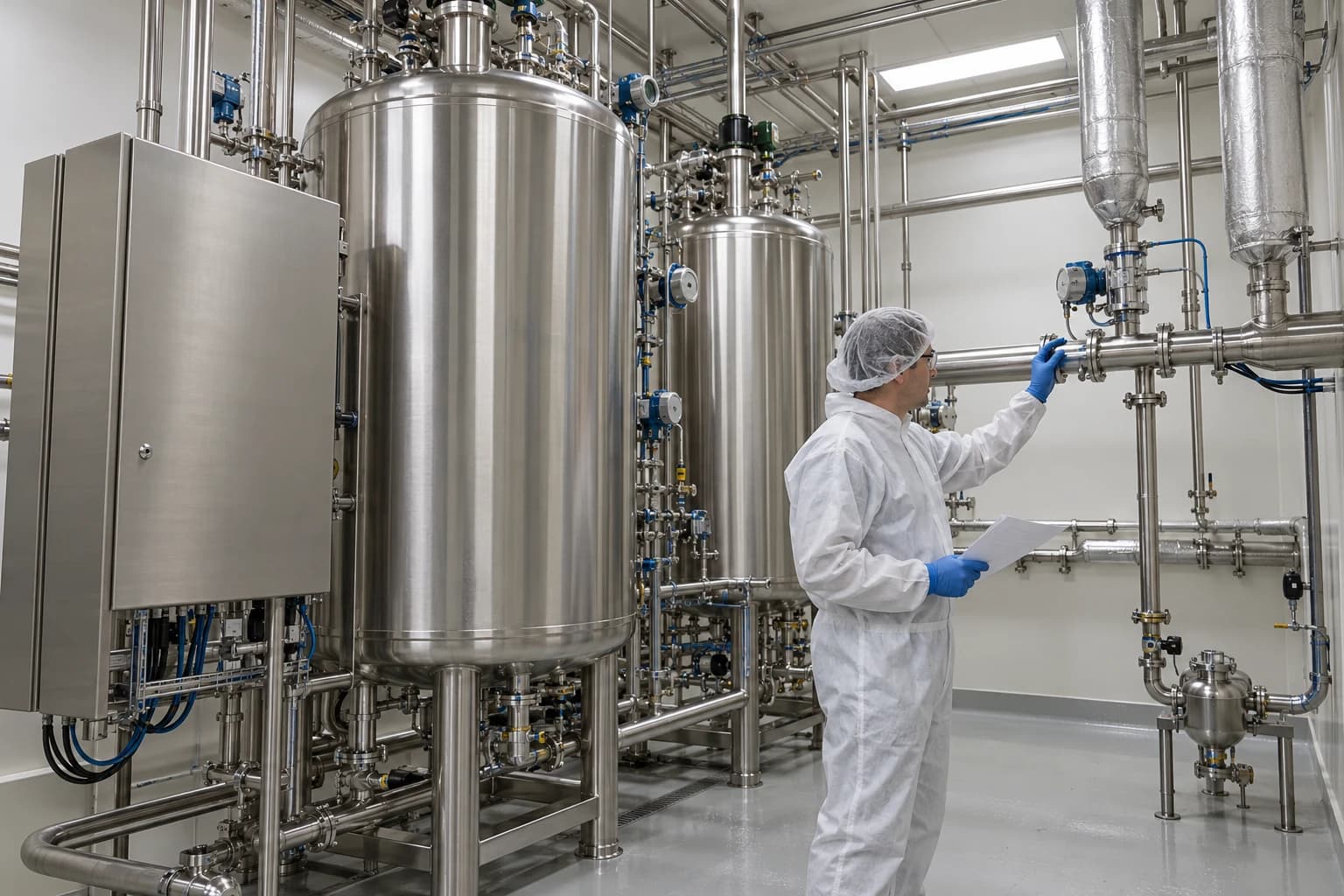
GMP Compliant Process Validation After Utility Changes
Annex 15 links heat-and-mass-balance evidence to risk-based requalification
EU GMP Annex 15 has required formal assessment of planned changes to facilities, equipment, utilities and processes that could affect product quality since 1 October 2015. A replacement clean-steam generator, altered chilled-water loop, new WFI storage vessel or revised HVAC sequence can require more than engineering commissioning. It can trigger utility requalification, process-validation activity and review of the manufacturing control strategy.
Utility projects often begin with an operational driver: capacity, reliability, energy use, obsolescence or a recurring deviation. GMP changes the decision test. The site must establish whether the changed utility can continue to support consistent product quality under intended manufacturing conditions.
That conclusion needs a clear connection between engineering and GMP evidence. Heat and mass balance work helps the change-control team identify physical changes: utility flow, temperature, pressure, duty, heat-transfer performance, phase change, hold time, water use, condensate return or cooling capacity. It does not replace GMP-compliant process validation. It provides the technical basis for defining its scope.
Why utility changes can affect validated status
Annex 15 applies directly to utilities. Manufacturers must document planned changes to utilities that may affect product quality, then assess their impact on validated status and the control strategy.
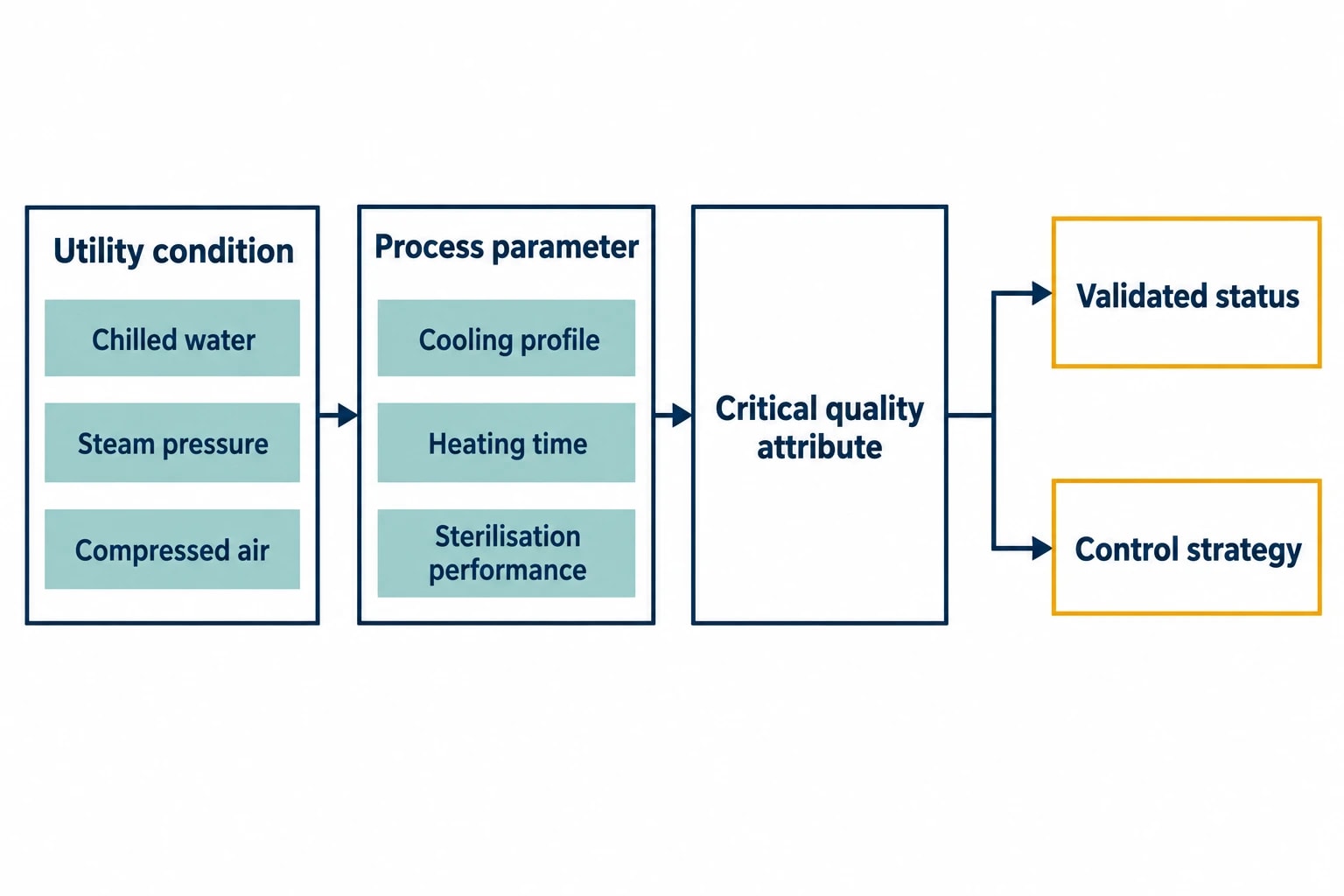
A utility need not contact product directly to influence a critical process parameter. A revised chilled-water system can change a crystallisation cooling profile. A steam-pressure change can alter vessel heating time or sterilisation performance. A modified compressed-air installation can affect pneumatic transfer or exposed-product handling. The risk assessment must follow the route from utility condition to process parameter and then to the relevant critical quality attribute.
Direct contact, indirect contact and the manufacturing environment
Direct-contact utilities require close assessment where they become part of the product or contact product-contact surfaces. Typical examples include:
- Water for Injection used as an ingredient, diluent or final rinse
- Clean steam used for sterilisation or direct injection
- Process gases used with exposed product or product-contact equipment
- Compressed air where its use creates a credible product-contact route
Indirect-contact systems require assessment of their heat-transfer boundary and failure modes. Jacket steam, chilled water, glycol, thermal fluid and refrigerant circuits can influence temperature control, reaction rate, solvent removal, crystallisation and hold conditions. A heat-exchanger leak, changed fouling performance, incorrect utility pressure or slower control response may affect the process even where the utility remains physically separated from product.
HVAC should be assessed as an environmental-control system. Its GMP relevance lies in room temperature, humidity, pressure differentials, air-change performance, filtration, airflow direction, particulate control and microbial control. An HVAC modification can affect exposed product, open handling, dispensing, drying and contamination-control measures without making HVAC a direct product-contact utility.
Requalification must account for cumulative change
Annex 15 requires facilities, equipment, utilities and systems to be evaluated at an appropriate frequency to confirm that they remain in a state of control. Where periodic requalification is used, the interval and evaluation criteria require justification. The assessment should also consider small changes over time.
This matters where a utility project combines several modest modifications. A replacement control valve, revised condensate arrangement, new control setpoint, added process user and altered batch schedule may each appear limited when reviewed alone. Together, they can alter the utility delivered at a point of use.
The change-control record should therefore assess the installed configuration and expected operating profile as a whole. Maintenance history alone does not demonstrate that the revised utility continues to support validated manufacturing conditions.

Map every energy and material flow in your process with detailed heat and mass balance calculations — the foundation for any optimisation or design project.
Start GMP compliant process validation with an impact assessment
The change-control process should define the decision before test plans are written. Possible outcomes include no impact on validated status, targeted utility requalification, additional process validation, enhanced ongoing process verification, or a combination.
A cross-functional assessment should involve process engineering, utilities engineering, manufacturing, validation, quality assurance and quality control. Regulatory affairs may be needed where the change could affect the marketing authorisation, registered process description or regulatory commitments.
Define the change at the process boundary
“Replace boiler” and “upgrade cooling plant” are poor validation descriptions. They identify assets, not the GMP-relevant change.
A suitable change definition identifies the utility boundary at the process user and records:
- Utility generation, storage and distribution systems affected
- All affected process users and points of use
- Pre-change and proposed utility conditions at relevant boundaries
- Normal, minimum and maximum demand
- Materials of construction, filters, control logic, alarms and instrumentation affected
- Start-up, shutdown, cleaning, sanitisation and recovery states
- Interfaces with batch records, recipes, procedures and electronic data
- Utility-quality attributes and applicable monitoring points
Designed capacity and demonstrated capacity are different claims. A chiller nameplate rating does not show that a reactor reaches its required cooling ramp at maximum batch mass. A clean-steam generator capacity rating does not establish steam quality at a remote steriliser during simultaneous demand.
Connect utility performance to process knowledge
Annex 15 requires process validation to demonstrate that relevant quality attributes and process parameters can be consistently met. It also requires a documented basis for classifying parameters and quality attributes as critical or non-critical.
The impact assessment should answer practical questions:
- Which critical process parameters depend on the utility?
- Which established operating ranges must remain unchanged?
- Does the project alter utility accuracy, response time, uniformity or available duty?
- Which critical quality attributes could move following a utility excursion?
- Is simultaneous demand a credible worst case?
- Do existing alarms, interlocks and operator actions remain suitable?
- Could the change affect cleaning, sterilisation, environmental control or validated hold times?
Development reports, prior validation data, batch histories and deviation investigations should underpin these answers. A risk assessment that does not identify the evidence behind its conclusions quickly becomes a register of assumptions.
Use heat and mass balance evidence to define requalification
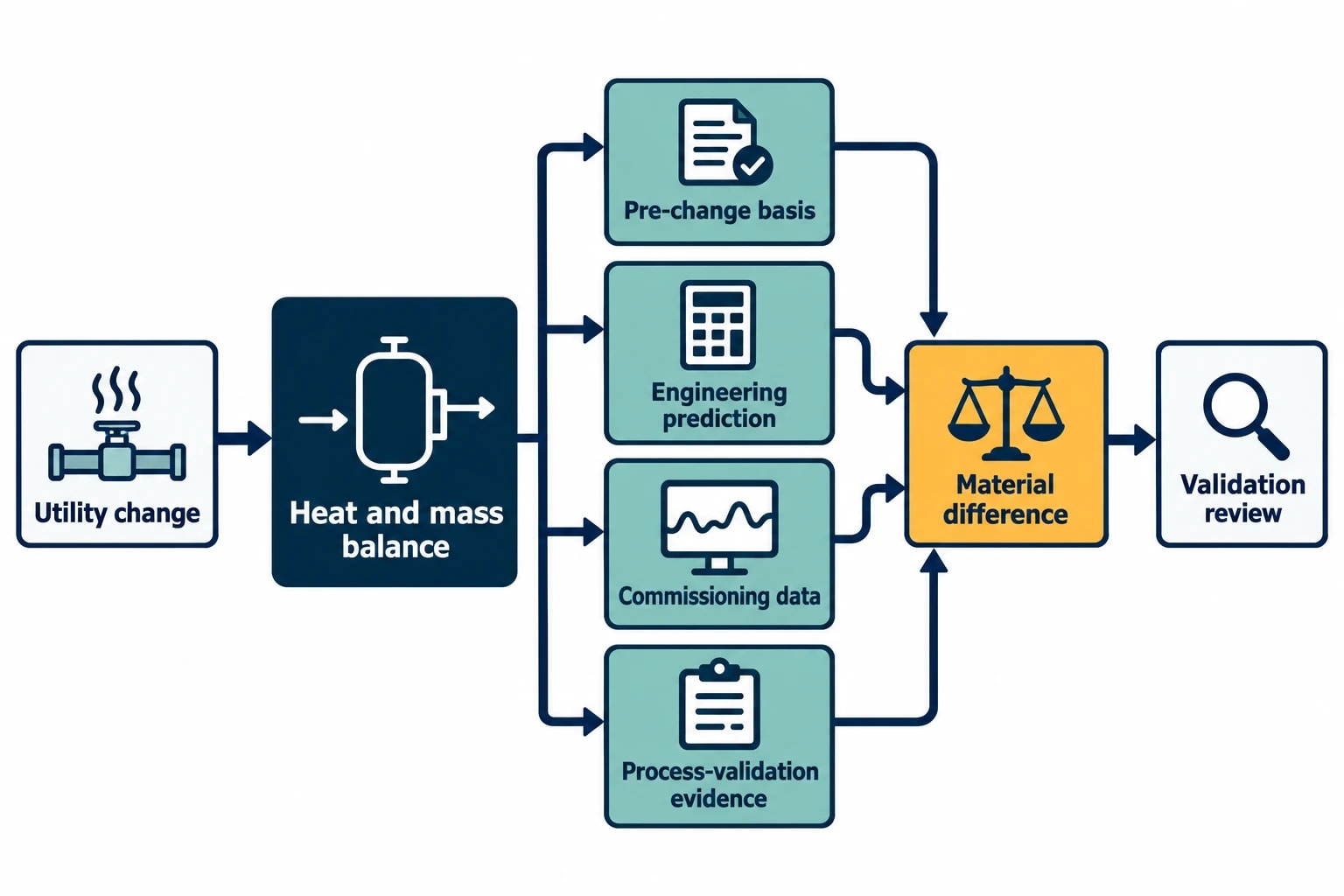
A heat and mass balance converts a utility modification into the variables that govern process performance. It should represent real manufacturing conditions rather than a generic utility-demand estimate.
For batch operations, the assessment should cover charging, heating, reaction, agitation, cooling, hold and discharge. For continuous operations, it should reflect feed-rate variation, recirculation, start-up and steady-state operation.
What engineering evidence should show
A fit-for-purpose balance records the relevant inputs, outputs and accumulation for the process step. It should state data sources, assumptions, measurement uncertainty and the operating case represented.
For a reactor heating or cooling project, this may include product mass, solvent composition, specific heat, reaction heat where applicable, jacket duty, utility flow, inlet and outlet temperature, pressure, heat-transfer area, batch duration and condenser load. For an evaporator, it may include feed solids, vapour rate, condensate rate, heating-steam demand, vacuum conditions and outlet concentration.
The key comparison is between:
- The approved pre-change process basis.
- The post-change engineering prediction.
- Commissioning and qualification measurements.
- Process-validation and commercial-batch evidence.
A material difference gives the validation team a defined reason to review process parameters, sampling plans, acceptance criteria or the validation approach.
Link the balance to qualification stages
Annex 15 describes a qualification lifecycle from user requirements through installation, operational and performance qualification. Utility evidence should support each stage.
| Qualification stage | Utility-change evidence | GMP purpose |
|---|---|---|
| Installation qualification | Approved P&IDs, line lists, materials records, calibration status, equipment tags and connection verification | Confirms that the installed system matches approved engineering documentation |
| Operational qualification | Setpoint accuracy, alarm tests, control response, flow and pressure testing, minimum and maximum load tests | Demonstrates performance across defined limits and credible upset conditions |
| Performance qualification | Representative production load, concurrent demand, process temperature profile and relevant utility-quality results | Demonstrates that the utility supports its intended manufacturing use |
| Process validation or enhanced verification | Batch data, critical process parameter performance, critical quality attribute results and batch record review | Establishes continued process consistency after the change |
The heat and mass balance should not create product acceptance criteria. Product and process knowledge must establish those limits. The balance shows whether the test range and selected operating cases represent the actual process duty.
Test simultaneous demand, not isolated performance
Peak demand can determine whether a utility change affects validated status. A clean-steam generator may support one sterilisation cycle yet lose pressure when several sterilisers, tanks and SIP circuits call simultaneously. A chilled-water system can perform well during a reactor test in isolation but slow materially when other reactors begin cooling.
The protocol should define credible normal and worst-case demand scenarios. Batch scheduling, product mix, cleaning timing, peak WFI use and production scale can all change the load profile. A qualification run that avoids the conditions most likely to challenge the revised utility provides limited assurance.
Map every energy and material flow in your process with detailed heat and mass balance calculations — the foundation for any optimisation or design project.
Write a protocol that joins utility qualification and process validation
Annex 15 requires a written process-validation protocol that defines critical quality attributes, critical process parameters and limits, equipment and calibration status, analytical methods, in-process controls, additional testing, sampling, evaluation and batch-release arrangements.
After a utility change, the protocol needs to make the engineering-to-quality connection explicit.
Essential protocol content after a utility change
The protocol should state:
- The approved change-control reference, risk assessment and affected products or process steps.
- The utility configuration, point-of-use boundaries and supporting qualified systems.
- The utility parameters to be measured, with locations, methods and calibration status.
- The manufacturing conditions, batch size, product strength and simultaneous-demand case.
- The affected critical process parameters and critical quality attributes.
- Predefined utility and process acceptance criteria.
- The sampling plan, including its scientific rationale.
- Deviation handling, out-of-limit investigation, data review and amendment controls.
- The criteria for success, required follow-up and transition to routine monitoring.
Engineering and process-validation protocols can remain separate documents, but they need a traceable interface. The process-validation report should identify the utility qualification evidence it relies on and explain why that evidence supports the batch conclusion.
Choose a proportionate validation approach
Annex 15 permits traditional process validation, continuous process verification and hybrid approaches. A hybrid approach may be appropriate for validation activity after changes or during ongoing process verification where product and process knowledge supports it.
Targeted requalification with enhanced ongoing process verification may suit a well-understood process when the changed utility has been fully qualified and the risk assessment shows limited impact on critical parameters. A more extensive programme may be justified where the project affects a critical thermal profile, sterilisation condition, product-contact utility quality, environmental conditions or an established critical process parameter.
The often-cited three-batch expectation is not an automatic response to every utility modification. Annex 15 states that three consecutive routine-condition batches could generally constitute process validation, while allowing another number where justified. The number of batches and samples should provide sufficient evidence of normal variation, trends and repeatable capability.
Preserve an inspection-ready evidence chain
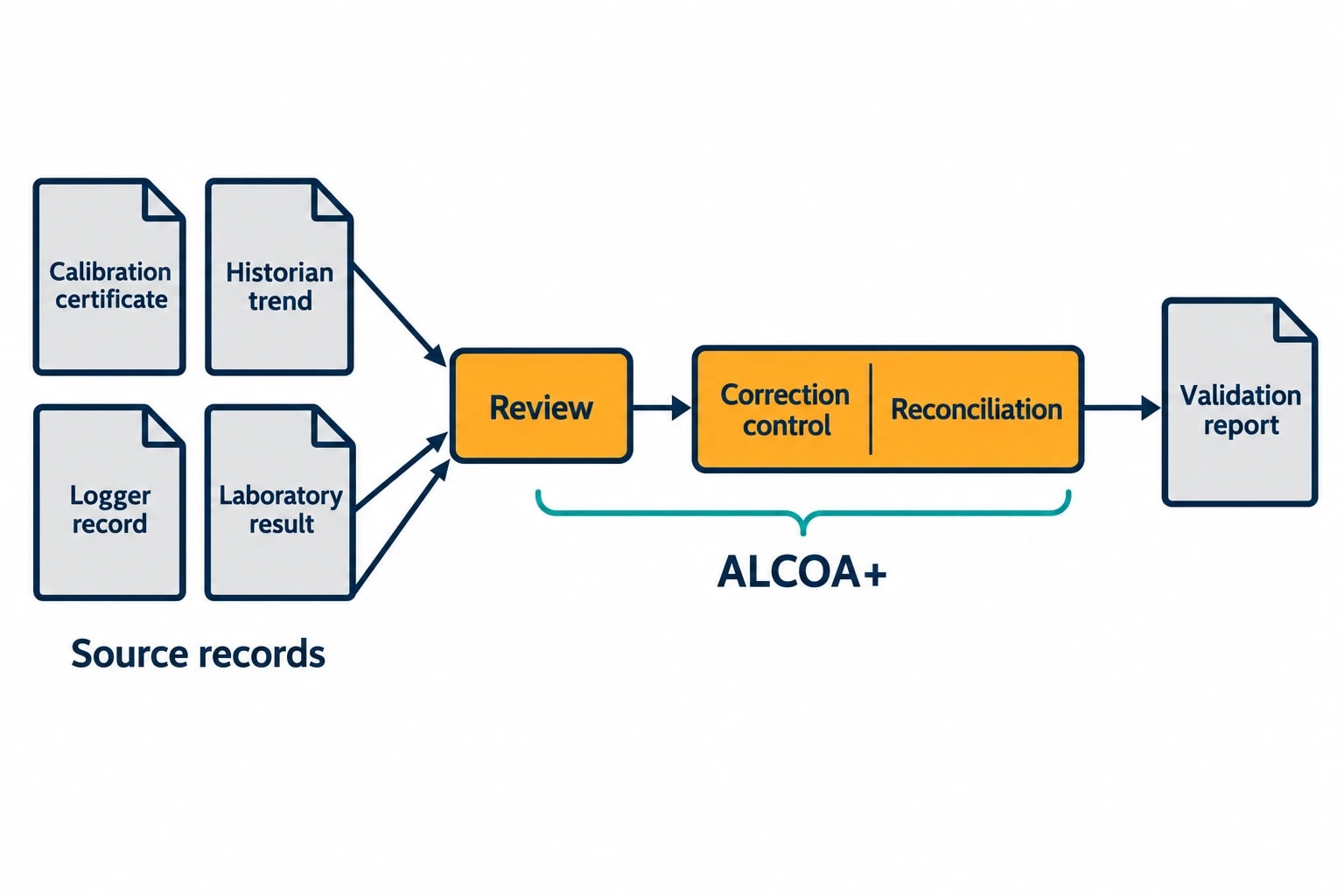
Calibration certificates, historian trends, temporary data-logger records, commissioning sheets and laboratory results can support GMP-compliant process validation. Their technical value depends on traceability, review and control.
PIC/S data-integrity guidance applies data-governance principles to paper, computerised and hybrid records. For utility projects, the validation plan should identify which source records form GMP evidence, who reviews them, how corrections are managed and how the final report reconciles raw data with its conclusions.
Records that need particular attention
Validation teams should account for:
- Instrument calibration status and as-found results
- Temporary gauges and data loggers used during commissioning
- Time alignment between utility trends and batch records
- Alarm and event-history review
- Controlled exports from historian or supervisory systems
- Changes to programmable controllers, recipes and control logic
- Deviations from approved test conditions
- Calculation files supporting heat and mass balances
- Transcription of field readings into GMP records
Where automated utility data supports release decisions or a conclusion about validated status, the system should be assessed against Annex 11 requirements for computerised systems. Measurement accuracy alone does not establish trustworthy evidence. The record must remain attributable, legible, contemporaneous, original, accurate, complete, consistent, enduring and available throughout its lifecycle.
Maintain GMP compliant process validation after handover
The engineering project ends at handover. GMP-compliant process validation continues through commercial manufacture.
Annex 15 applies ongoing process verification to traditional, continuous and hybrid approaches. Manufacturers should monitor product quality and evaluate relevant process trends throughout the lifecycle. The verification activity requires an approved protocol or equivalent document and a corresponding report. Statistical tools should support conclusions about variability and capability where appropriate.
Build a focused post-change monitoring plan
A defined post-change monitoring period should link utility performance to process and product results. The selected indicators must reflect the risk assessment.
Relevant measures may include utility temperature, pressure, flow, conductivity, microbial quality, air conditions, cooling duty, process ramp time, batch hold performance and product-quality results. A generic list of engineering tags produces noise. Useful metrics have a credible connection to the affected process parameters and quality attributes.
The Product Quality Review should evaluate whether the utility and process remain in control. It should consider incremental drift, recurring alarms, deviations, maintenance findings and product-quality trends. Annex 15 requires assessment of incremental change and consideration of further action, including enhanced sampling.
Annex 15 revision status
The current EU Annex 15 remains the operative text. The European Commission continues to list it as in operation since 1 October 2015.
The EMA GMP/GDP Inspectors Working Group and PIC/S agreed a concept paper for a targeted Annex 15 revision in January 2026. The joint public consultation ran from 9 February to 9 April 2026. The corrigendum issued in July 2026 revised the proposed timetable while retaining the concept paper’s focus on extending Annex 15 to chemical and biological active-substance manufacturers and reflecting ICH Q9(R1) quality risk management.
The proposal also identifies qualification and validation policy, change control, outsourced activities, investigation of failures against predefined acceptance criteria, qualification stages, process recovery of materials and solvents, ongoing process verification and periodic review as areas for targeted revision. These are proposals, not current enforceable additions to Annex 15.
This article reflects the independent analysis and editorial opinion of EnerTherm Engineering. Product names, trademarks, and brands mentioned belong to their respective owners. EnerTherm Engineering is not affiliated with, endorsed by, or a licensee of any third-party software or product mentioned unless explicitly stated.

Technical Manager — EnerTherm Engineering
John Naranjo is Technical Manager at EnerTherm Engineering, bringing specialist expertise in chemical and environmental engineering. He recently led the implementation of Omni Vision, EnerTherm's real-time energy and utility monitoring platform. He holds an MSc in Environmental Engineering from the University of Huelva and a BSc in Chemical Engineering, with memberships in both the Energy Institute and IChemE.
