How a Food Plant Used Pinch Analysis to Cut Utility Demand
A dairy case study reported 48.5% lower hot-utility demand and 44.9% less cooling.
Pinch analysis is a process-integration method that identifies the minimum external heating and cooling a plant requires by matching hot and cold process streams.
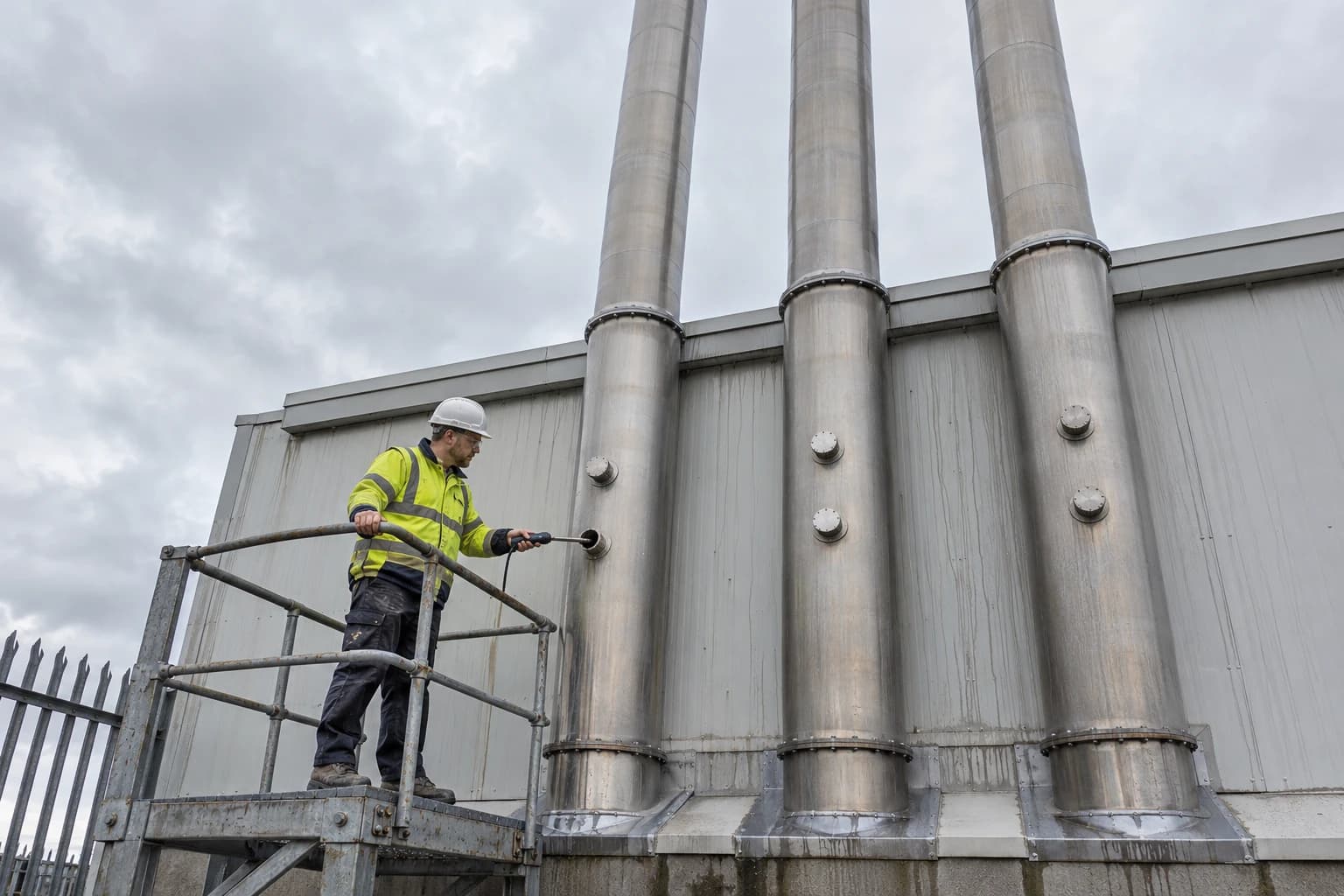
At a northern England food-production site, the first verified outcome was 26 new measurement access points across boiler and travel-oven ductwork. The plant had baking lines, steam generation and tin-washing operations, but lacked the flow, temperature and exhaust-property data needed to calculate a credible heat-recovery target.
Heat-recovery projects often begin with an assumption: a hot oven stack, boiler flue or warm washing-water discharge must contain useful energy. Pinch analysis must establish how much heat is available, at what temperature, for how long, and whether a receiving duty needs heat at the same time.
EnerTherm Engineering’s April 2026 site study was a data-integrity project before it became an equipment project. It covered boilers, travel ovens, rack ovens and washers, identifying the monitoring infrastructure needed to build a defensible thermal model, assess heat-recovery options and prepare a business case without risking production or hygiene controls.
The public case study does not publish stream temperatures, flow rates, operating overlap, pinch temperature, utility targets, installed equipment or utility savings. These results could not be calculated reliably before measurement. The case documents the engineering work needed before a food plant can claim a utility reduction.

Pinch analysis identifies the thermodynamic minimum energy requirement of your process — then designs the heat exchanger network to achieve it.
The northern England pinch analysis case study for food processing
The plant operates several high-temperature baking lines and steam-generation systems. Its initial pinch-analysis scope focused on three potential thermal links:
- Boiler flues and boiler feedwater demand
- Travel-oven exhaust streams
- Hot-water demand associated with tin washing
The project team surveyed ducts, exhaust stacks and access routes. Existing infrastructure did not provide enough representative measurement locations to characterise the streams.
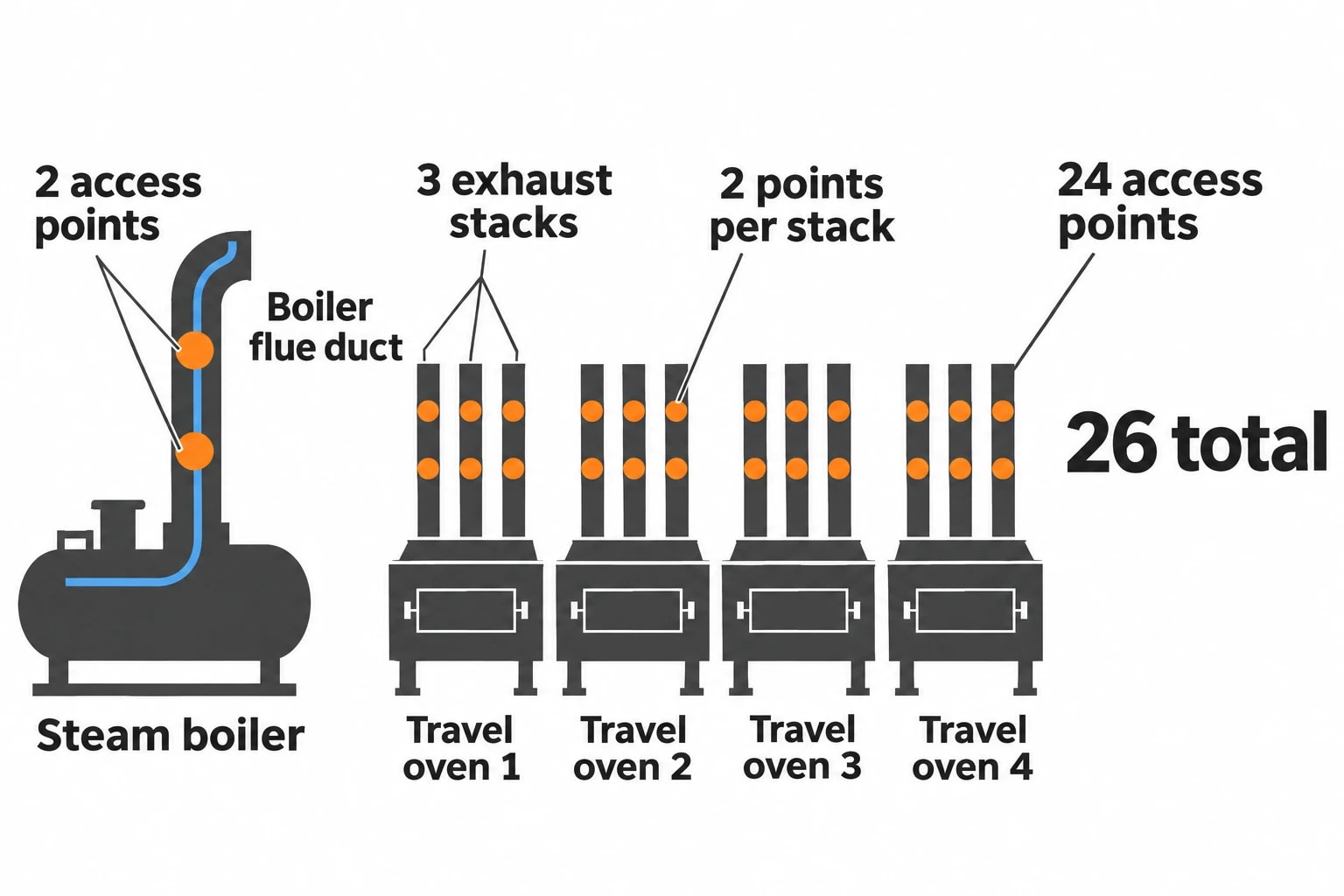
The quantified outcome: 26 new access points
The audit specified two new access points on Steam Boiler B and 24 across four travel ovens. Each travel oven had three exhaust stacks, with two monitoring points required on each stack.
| Asset area | Monitoring requirement | New access points |
|---|---|---|
| Steam Boiler B | Two points per duct | 2 |
| Travel ovens, four units | Two points per stack across 12 stacks | 24 |
| Total | 26 |
The study also assessed rack-oven access and tin-washer hot-water use, but does not publish their measured values.
The 26-point programme is a completed monitoring-infrastructure outcome, not a published utility-saving result.
What the case study does and does not establish
The study establishes that the plant needed additional physical access before technicians could measure exhaust-gas flow, temperature and composition. It also identifies potential uses for recovered energy, including boiler-feedwater and combustion-air preheating.
It does not publish:
| Required pinch-analysis input or output | Publicly available from the case study |
|---|---|
| Oven exhaust temperatures | No |
| Exhaust flow rates | No |
| Exhaust moisture or gas composition | No |
| Tin-washer water flow and temperature profile | No |
| Boiler feedwater temperature and flow rate | No |
| Operating overlap between sources and sinks | No |
| Selected minimum temperature difference | No |
| Minimum hot-utility target | No |
| Minimum cold-utility target | No |
| Installed heat-recovery duty or annual saving | No |
Publishing any of these values would require evidence not present in the case study. Assigning a pinch target, annual gas saving or payback period before measurement would turn an engineering assessment into speculation.
Why stream data determines the utility target
A pinch study starts with process streams rather than equipment names. A hot stream requires cooling and releases heat; a cold stream requires heating and absorbs it.
At the northern England plant, the likely hot streams included boiler flue gas, travel-oven exhaust and potentially hot discharge from washing operations. Potential cold demands included boiler feedwater, combustion air and tin-washing water.
Each stream needs a complete description before it enters a thermal model.
The data required for each hot and cold stream
A usable stream table should record:
- Supply and target temperatures
- Flow rate or heat-capacity flow rate
- Fluid identity and relevant physical properties
- Operating hours and production state
- Whether the duty is continuous, batch-based or intermittent
- Fouling, contamination and cleanability constraints
- Pressure limitations and allowable pressure drop
- The proposed minimum temperature difference
For exhaust streams, temperature alone is insufficient. Two oven stacks can show similar temperature readings but deliver very different recoverable duties because of gas flow rate, humidity, excess air, production loading or operating duration.
For washing duties, a nominal water temperature also gives an incomplete picture. Engineers need the volume heated, required temperature rise, heating schedule, cleaning-cycle timing and whether a final heating stage must meet a validated temperature.
Why operating overlap matters
A hot source has value only while a compatible cold sink needs heat. A bakery may operate ovens for long production runs while washer demand occurs around shift changes, planned cleaning or product changeovers. Pinch analysis must test that timing.
Annual gas and electricity bills identify the scale of utility use. They cannot establish whether a source and sink overlap during a production day.
The northern England study followed the required sequence:
- Identify thermal assets and likely hot and cold streams.
- Create safe, representative access for measurement.
- Measure temperatures, flows and exhaust characteristics across operating conditions.
- Build the stream table and select a justified minimum temperature difference.
- Calculate hot- and cold-utility targets.
- Develop heat-recovery matches and test them against hygiene, maintenance and production requirements.

Pinch analysis identifies the thermodynamic minimum energy requirement of your process — then designs the heat exchanger network to achieve it.
How pinch analysis sets a credible heat-recovery target
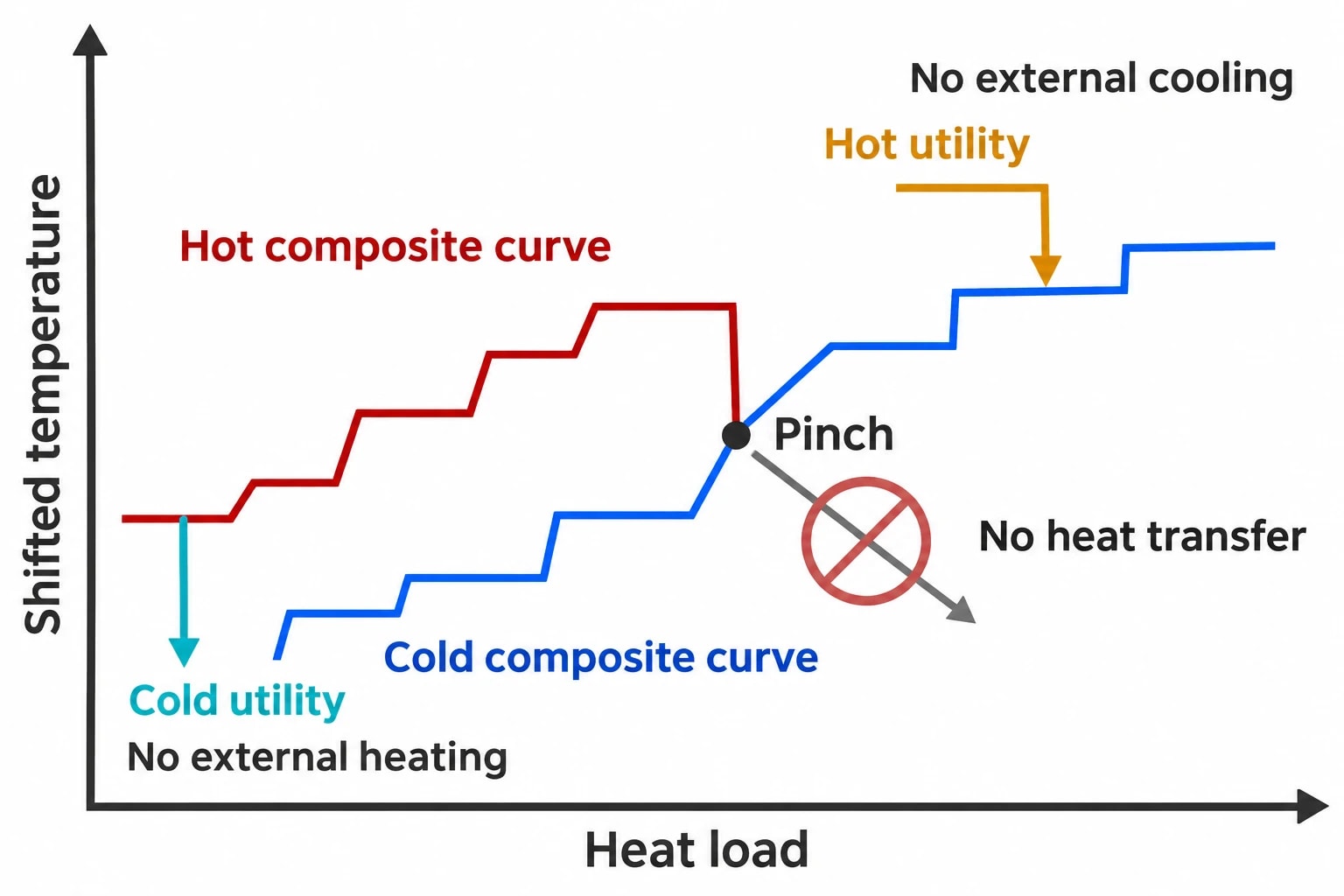
Once measurement data is available, engineers can shift hot and cold stream temperatures by the selected minimum temperature difference and construct composite curves or apply the problem-table algorithm. These methods identify the lowest possible hot-utility and cold-utility demand consistent with the design assumptions.
The pinch is the temperature region where the shifted hot and cold composite curves are closest. It sets the thermodynamic constraint governing network design.
Selecting the minimum temperature difference
The northern England case study does not state a selected minimum temperature difference. The value should not be assumed from a generic bakery example.
Its selection affects recovery and capital cost. A smaller temperature difference can increase theoretical recovery but generally requires more heat-transfer area. In a food plant, it can also increase sensitivity to fouling, constrain cleaning arrangements and make temperature control harder during changing production conditions.
A wider temperature difference can reduce exchanger area and simplify operation while retaining more demand for steam, gas-fired hot water, refrigeration or other utilities.
The engineering team should select the value after considering:
- The fluids on both sides of the proposed exchanger
- Exchanger type and material selection
- Fouling tendency and cleaning regime
- Required water or process temperatures
- Available pressure drop
- Control response during changing oven load or washing cycles
- Space and maintenance access
The three pinch design rules
After setting the target, designers normally apply three rules:
- Do not use external heating below the pinch unless the utility penalty is understood.
- Do not use external cooling above the pinch unless the utility penalty is understood.
- Avoid heat transfer across the pinch unless the loss of recovery has been accepted.
These rules prevent a locally attractive heat-recovery connection from reducing the wider site opportunity. An oven-exhaust source may be capable of preheating one water loop, but a full site model may show that the same temperature range has greater value in boiler-feedwater preheating.
Food-plant heat recovery must protect hygiene and product quality
Regulation (EC) No 852/2004, as assimilated in Great Britain and amended, requires food businesses to put in place, implement and maintain procedures based on HACCP principles. Food temperatures must also be maintained and monitored appropriately.
A heat-recovery retrofit must preserve hygienic separation, validated cleaning conditions and temperature-control arrangements.
Tin washing is a potential heat sink, not an automatic heat-recovery project
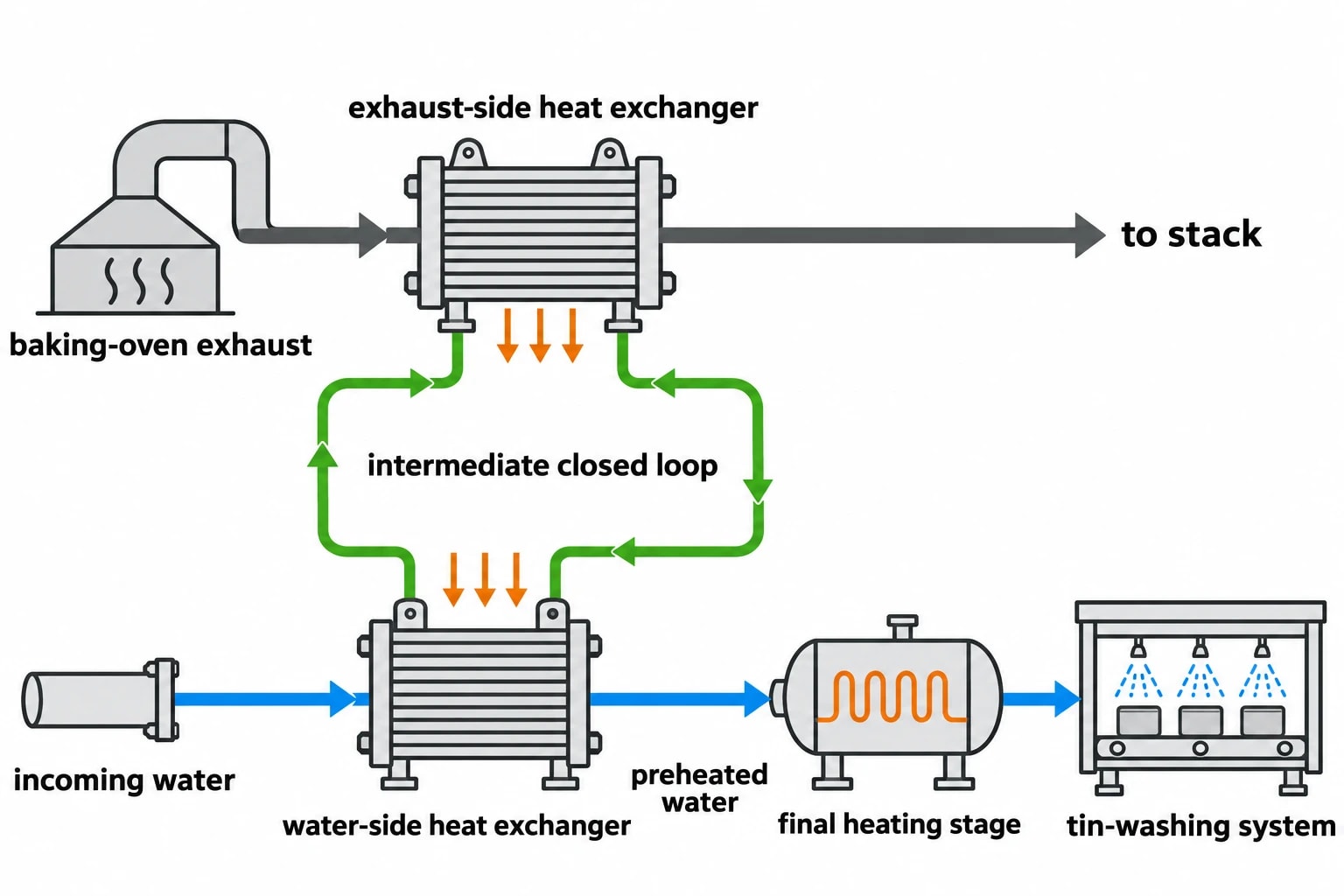
Tin-washing systems can create repeated hot-water demand, making them worth measuring during a pinch analysis. Recovered heat could preheat incoming water before a final heating stage brings it to the temperature specified by the cleaning programme.
This may avoid introducing exhaust-derived heat directly into a food-contact or cleaning circuit. Depending on the risk assessment, an intermediate closed loop can separate the exhaust-side exchanger from water used in the washing process.
The final design must still demonstrate that it does not compromise:
- Cleaning temperature, time and chemical concentration
- Allergen-control procedures
- Inspection and maintenance access
- Drainage and cleanability
- Monitoring and corrective actions within the HACCP plan
- Production availability where a heat-recovery unit needs bypass or isolation
Oven and boiler exhaust need measured evidence
Baking-oven exhaust can carry heat suitable for water preheating or, in some cases, combustion-air preheating. Boiler flue gas can also support boiler-feedwater preheating through an economiser.
The recovery route depends on measured temperature profile, flow rate, moisture content, contaminants, corrosion risk and cold-side demand. The northern England study identifies these as information gaps to close through monitoring.
A single stack-temperature reading does not size an economiser or establish whether cooling the exhaust could create condensation, corrosion, fouling or maintenance difficulties. The 26 access points enable the measurements needed for that decision.
BAT 6 supports site-wide energy planning
Commission Implementing Decision (EU) 2019/2031 establishes Best Available Techniques conclusions for food, drink and milk industries within its scope. BAT 5 requires an energy-efficiency plan, while BAT 6 requires an appropriate combination of common techniques.
The listed techniques include:
- Heat recovery with heat exchangers or heat pumps
- Boiler-blowdown minimisation
- Steam-distribution optimisation
- Boiler-feedwater preheating
- Burner regulation and control
- Insulation to reduce heat losses
- Process-control systems
For a UK food plant, the decision remains a useful technical reference for energy planning alongside applicable environmental-permitting and food-safety obligations. Pinch analysis ranks these options against measured thermal duties.
From survey to investable heat-recovery scheme
The practical deliverable from the northern England study is not a claimed percentage saving, but a route to an investable scheme.
| Project stage | Decision enabled |
|---|---|
| Install access points | Whether representative monitoring can be completed safely |
| Measure hot and cold streams | Whether a useful heat match exists |
| Build the pinch model | Minimum external heating and cooling targets |
| Develop network options | Which heat-recovery match should be prioritised |
| Complete hygiene review | Whether the configuration supports HACCP controls |
| Prepare business case | Capital cost, maintenance scope, shutdown requirement and expected utility reduction |
| Verify after installation | Actual utility reduction, normalised for production output |
The next stage is to use the 26 access points to establish duty, temperature level, operating overlap and hygiene constraints before selecting a heat-recovery scheme.
This article reflects the independent analysis and editorial opinion of EnerTherm Engineering. Product names, trademarks, and brands mentioned belong to their respective owners. EnerTherm Engineering is not affiliated with, endorsed by, or a licensee of any third-party software or product mentioned unless explicitly stated.

Technical Manager — EnerTherm Engineering
John Naranjo is Technical Manager at EnerTherm Engineering, bringing specialist expertise in chemical and environmental engineering. He recently led the implementation of Omni Vision, EnerTherm's real-time energy and utility monitoring platform. He holds an MSc in Environmental Engineering from the University of Huelva and a BSc in Chemical Engineering, with memberships in both the Energy Institute and IChemE.
