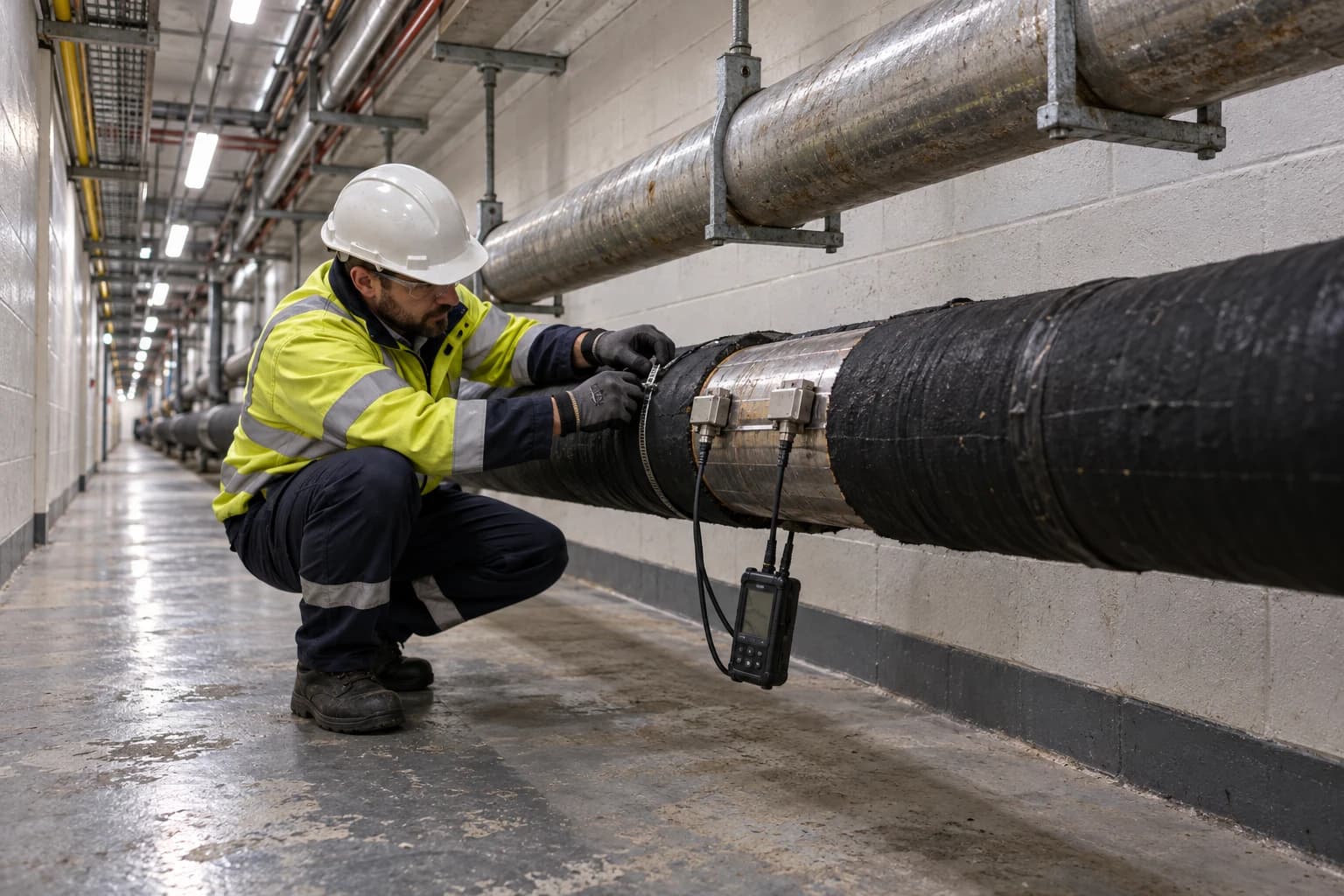
Industrial Energy Audit Services: What ESOS Requires
UK ESOS Phase 3 links audit findings to expected savings and implementation plans.
The final Phase 3 ESOS progress update is due by 5 December 2026. For manufacturers that submitted a Phase 3 action plan, the deadline is a prompt to turn previous audit findings into evidence of work delivered, savings achieved and projects still awaiting investment.
Industrial energy audit services matter because ESOS examines more than office energy use. It covers buildings, transport and industrial processes, placing boiler houses, steam systems, dryers, ovens, refrigeration plant, compressed-air systems and process heating within the assessment boundary.
The commercial value lies in the recommendations. A useful audit identifies heat losses and avoidable consumption, then frames each measure with credible savings, capital cost, operating constraints and a route to delivery.
What organisations must comply with ESOS?
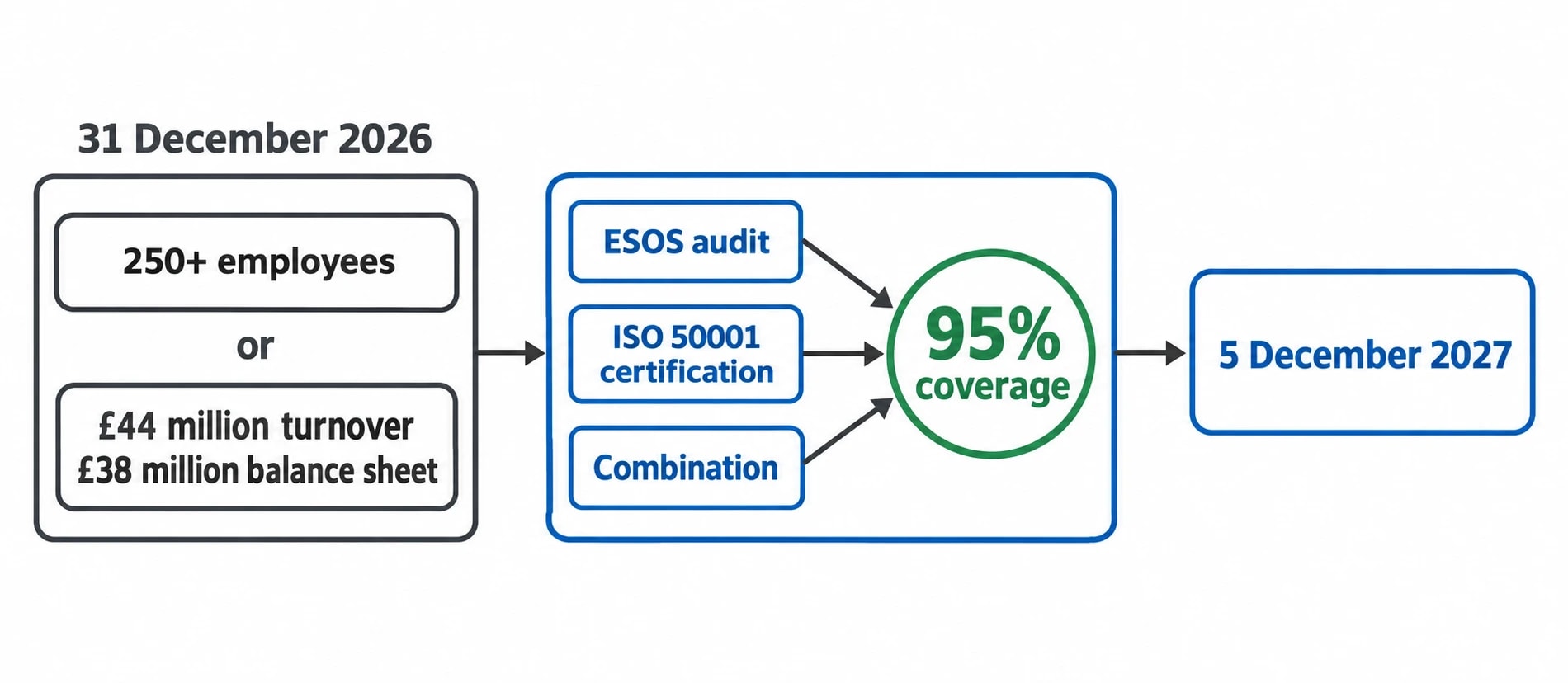
The Energy Savings Opportunity Scheme applies to large UK undertakings and qualifying corporate groups. An undertaking qualifies for Phase 4 if, on the qualification date, it has 250 or more employees, or both annual turnover above £44 million and an annual balance-sheet total above £38 million.
The qualification test can affect a single manufacturing business, a UK parent company or a group with qualifying UK operations. Corporate structures need careful review, particularly where energy procurement, site ownership and operational control sit across several legal entities.
Phase 4 qualification and compliance dates
For Phase 4, the qualification date is 31 December 2026 and the deadline for a notification of compliance is 5 December 2027.
The Environment Agency’s Phase 4 guidance removes Display Energy Certificates and Green Deal Assessments as alternative routes to compliance. Industrial organisations will generally comply through ESOS energy audits, ISO 50001 certification, or a combination where the management system does not cover all required energy use.
The 95% significant energy consumption rule
Participants must calculate total energy consumption across UK assets and activities, then ensure that at least 95% is covered by an ESOS-compliant route. This is significant energy consumption.
For industrial sites, the exercise should begin with an energy map rather than a finance-led review of utility invoices. The map should account for electricity, natural gas, fuel oil, LPG, purchased heat and transport fuels where relevant to the organisation’s activities.
A paper mill, chemical-processing plant or food factory may find that its largest energy uses sit outside building services. Process steam, direct-fired dryers, refrigeration, compressed air and thermal-fluid systems can dominate the profile. The remaining 5% may be treated as de minimis consumption, although a small load can still justify attention where it creates a straightforward saving.

Identify where your plant is losing energy and quantify the savings potential — our audits map every heat source, sink, and waste stream in your facility.
What does an ESOS-compliant industrial energy audit require?
An ESOS energy audit must analyse energy consumption and energy efficiency, identify energy-saving opportunities and include site visits. It must use verifiable energy-consumption data over a 12-month period where reasonably practicable.
For Phase 4, the data period must begin no earlier than 6 December 2022 and end no more than 24 months before the compliance notification date. These rules give production data, sub-metering and fuel allocation a direct bearing on both compliance and project confidence.
Build the evidence before the site visit
An audit team needs enough evidence to distinguish a genuine efficiency opportunity from a production-driven variation. Relevant records can include:
- Half-hourly electricity data and fuel invoices
- Steam, gas, compressed-air and water meter readings
- Production volumes, batch schedules and shift patterns
- Boiler, furnace, dryer and refrigeration operating records
- Maintenance history and shutdown plans
- Condensate-return data and steam-trap surveys
- Existing thermal-imaging reports and insulation registers
An incomplete baseline creates weak savings estimates. For example, a fall in gas use after an insulation repair may reflect reduced production, warmer weather or an altered operating schedule. Metered evidence and production-normalised data give the measure a stronger commercial basis.
The lead assessor and specialist process work
An approved ESOS lead assessor must review and sign off the assessment unless the organisation qualifies for an ISO 50001-only exception. The lead assessor provides the formal ESOS review. Specialist thermal and process engineers can carry out the detailed examination of industrial equipment and operating conditions.
That division is useful on complex plants. A compliance review may establish the energy boundary and reporting route, while an industrial energy audit service investigates the physical reasons behind consumption.
Typical areas include:
- Boiler combustion performance, sequencing and blowdown
- Steam distribution, condensate return and flash-steam losses
- Insulation condition on pipework, vessels, valves and fittings
- Furnace, oven, kiln and dryer exhaust losses
- Heat recovery from exhaust gases, product cooling or effluent
- Refrigeration loading and condensing pressure
- Compressed-air leakage and inappropriate end uses
- Pump and fan duty compared with process demand
Recommendations must be costed and practical
ESOS requires auditors, so far as reasonably practicable, to estimate the financial costs and benefits of each energy-saving opportunity. Reports should also identify non-financial benefits, annual energy-spend reduction, annual energy-consumption reduction, payback period and implementation considerations.
Life-cycle cost analysis should inform the cost assessment where practicable. This matters for plant equipment with long operating lives, ongoing maintenance requirements or difficult access arrangements.
A recommendation to improve boiler efficiency is too broad for capital approval. A useful recommendation names the cause, scope and operating conditions. It may identify excess oxygen at low firing rates, poor boiler sequencing, degraded insulation, a failed condensate-return arrangement or a specific heat-recovery opportunity.
Cost-benefit analysis for industrial energy audit services
Energy managers need audit findings that can withstand engineering, production, maintenance and finance review. The strongest recommendations show their assumptions and separate measured facts from estimates.
The information a project sponsor needs
| Audit output | Value to an industrial site |
|---|---|
| Energy baseline | Establishes current consumption and operating conditions |
| Annual energy saving | Allows opportunities to be ranked on a common basis |
| Capital cost | Helps place the measure within maintenance, site-improvement or strategic capital budgets |
| Annual financial benefit | Connects technical savings to an investable business case |
| Payback period | Provides an initial screen for investment decisions |
| Operational impact | Identifies shutdowns, quality risks, maintenance demands and operator changes |
| Measurement plan | Supports verification after installation and credible ESOS reporting |
| Delivery timetable | Links work to planned outages and production windows |
Simple payback is useful for screening measures such as insulation repairs, steam-trap replacement, compressed-air leak repairs and controls adjustments. It should sit alongside operating risk and life-cycle cost.
A longer-payback project can still be a strong investment where it reduces unplanned downtime, improves product consistency, removes a maintenance burden or enables later decarbonisation work. Heat recovery illustrates the point: the project only works where a coincident, reliable heat demand exists for enough operating hours.
Account for process constraints
Savings calculations should reflect actual duty, not nameplate capacity. For thermal systems, the audit should consider operating hours, fuel type, production rate, batch timing, standby periods, process temperatures, seasonal variation and post-installation performance.
Site constraints often determine whether a project proceeds:
- Food and beverage plants may need hygienic design, washdown resistance and short shutdown windows.
- Pharmaceutical sites may require change control, validation and documented impact on product quality.
- Chemical-processing facilities may need hazardous-area assessment, materials compatibility checks and process-safety review.
- Automotive plants may need installation work coordinated around model changeovers and planned maintenance periods.
- Paper and pulp sites may need to balance energy work against continuous-process availability and moisture-control requirements.
An audit report should state these limitations plainly. A deferred project can then be scheduled around an outage rather than disappearing after the report is issued.
Avoid false precision in savings claims
Metered fuel and electricity data provide the strongest baseline. Temporary measurements of temperature, flow, pressure and electrical load can improve confidence where permanent instrumentation is absent. Production teams should document changes in throughput, product mix, cleaning cycles and shift patterns before attributing energy savings to a project.
The measurement approach should be proportionate to the opportunity. A repair to damaged valve insulation may need a recorded condition survey, operating temperature and conservative heat-loss estimate. A large heat-recovery installation may justify temporary metering before capital approval, followed by permanent measurement after commissioning.
Where industrial sites lose thermal energy
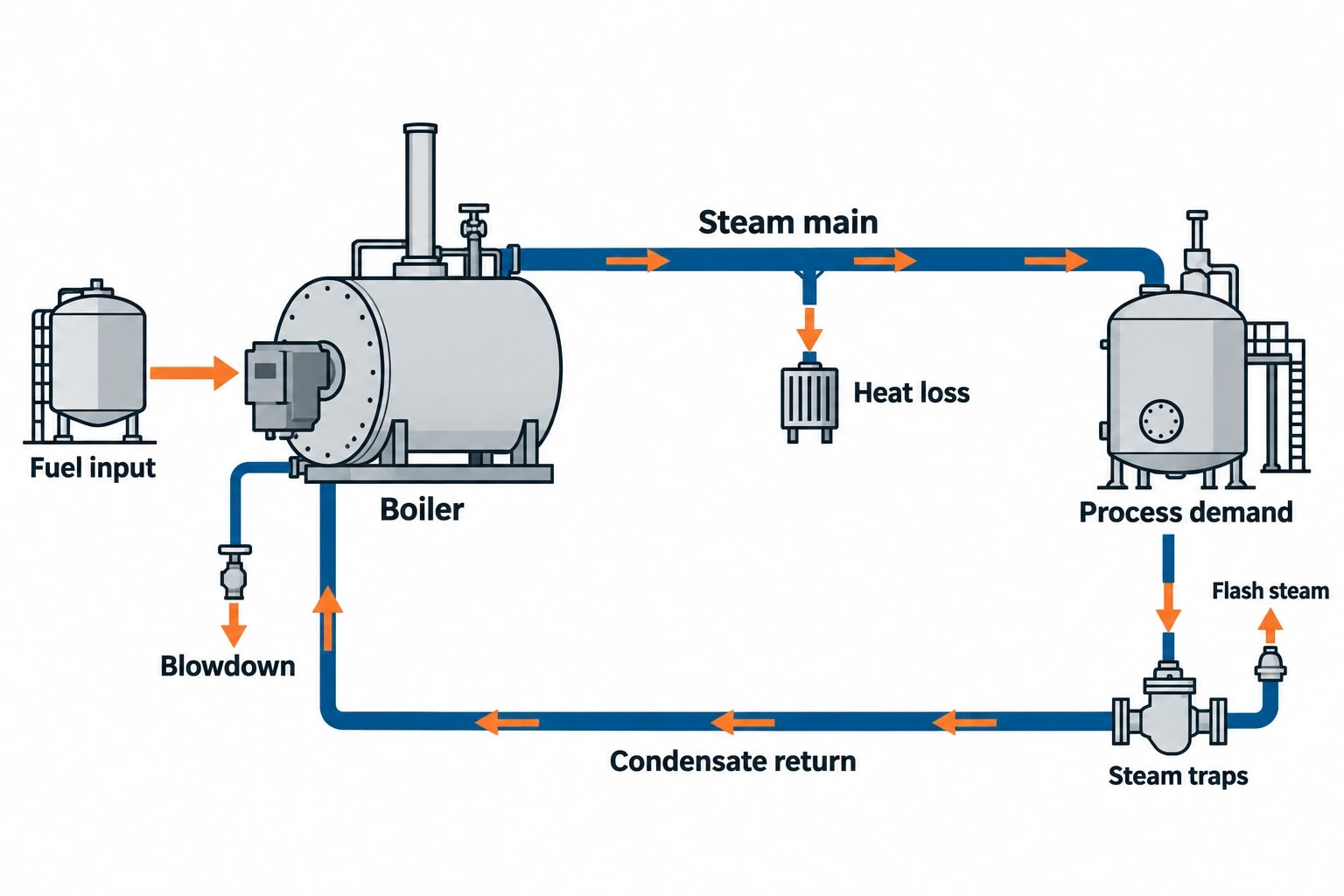
Thermal waste rarely sits in one asset. It often arises from the interaction of utility generation, distribution, control settings and process demand. Industrial energy audit services bring those elements into one assessment.
Steam systems and boiler houses
Steam remains central to many chemical, food, paper and pharmaceutical processes. Audits often examine fuel input, boiler efficiency, blowdown, steam pressure, distribution losses, flash steam, condensate return and end-use demand together.
A boiler-house project can be undermined if downstream conditions remain poor. Raising condensate return, correcting steam pressure, repairing leaks and restoring insulation can reduce demand before capital equipment is sized or replaced.
Steam-trap surveys are valuable, but they should form part of a wider steam balance. A site may have numerous failed traps with modest individual losses while a dryer exhaust or poorly controlled process-heating profile represents the larger opportunity.
Insulation and surface heat loss
Thermal imaging and surface-temperature surveys can identify damaged lagging, uninsulated valves, flanges, vessels and pipework. Follow-up work should assess heat loss, accessibility, exposure temperature, operating hours and the practical route for repair.
Removable insulation covers can be appropriate for maintainable valves and fittings. Fixed insulation may suit stable pipe runs and vessels. The choice depends on maintenance access, washdown requirements, fire precautions and the risk of insulation being removed and not reinstated.
Insulation measures can also improve working conditions. Lower external surface temperatures can reduce local heat exposure and protect nearby instruments or materials.
Drying, ovens and direct-fired processes
Dryers, ovens, kilns and direct-fired heaters often lose energy through exhaust gases, infiltration and poorly matched operating profiles. The audit should compare fuel input with useful process duty, product moisture removal, exhaust temperature and available heat sinks.
A heat-recovery proposal needs more than a high exhaust temperature. Engineers need to establish fouling risk, corrosion risk, heat-demand coincidence, process contamination controls and the effect on exhaust-system performance.
Refrigeration, compressed air and motors
Thermal efficiency work also extends into supporting utilities. Refrigeration plant can consume excessive electricity where condensing pressure, suction pressure, defrost cycles or loading do not match the actual process need. Compressed-air systems can waste energy through leakage, artificial demand and inappropriate applications.
Pumps and fans should be assessed against the required process duty. A throttled pump or dampered fan may indicate an opportunity for control adjustment, system redesign or variable-speed operation, provided the process remains stable.

Identify where your plant is losing energy and quantify the savings potential — our audits map every heat source, sink, and waste stream in your facility.
ESOS action plans and the current Phase 3 reporting requirement
Phase 3 introduced mandatory action plans. The action plan due by 5 December 2024 required participants to state intended energy-efficiency measures, whether they arose from an ESOS audit, expected savings across the relevant four-year period, a breakdown by organisational purpose and the method used to estimate savings.
The second progress update covers the reporting period from 6 December 2025 to 5 December 2026.
What the 2026 progress update must include
The Phase 3 progress update must identify:
- Energy-saving measures implemented since the first progress update, including measures outside the original action plan.
- Whether each action-plan measure was completed by its proposed implementation date.
- Measures not completed by their stated date.
- Estimated energy savings achieved or expected during the relevant 12-month reporting period.
- The method used to estimate savings for each reported measure.
A board-level director, or equivalent, must sign off the progress update before submission through the Manage your Energy Savings Opportunity Scheme Reporting system. The Environment Agency publishes action plans and progress updates.
Prepare the evidence pack now
Sites should assemble audit recommendations, action-plan commitments, project approvals, commissioning records, invoices and before-and-after energy evidence. The evidence pack should also record the calculation method and assumptions used for each savings estimate.
Reported savings should exclude consumption reductions caused by selling assets or lower output. Where production or operating hours changed materially, teams should explain how they accounted for those changes.
A credible update can use several methods, including comparison of energy use across comparable periods, validated feasibility-study estimates, or a prior ESOS estimate checked against operational evidence. The method should fit the measure and be stated clearly.
Standards that improve industrial audit quality
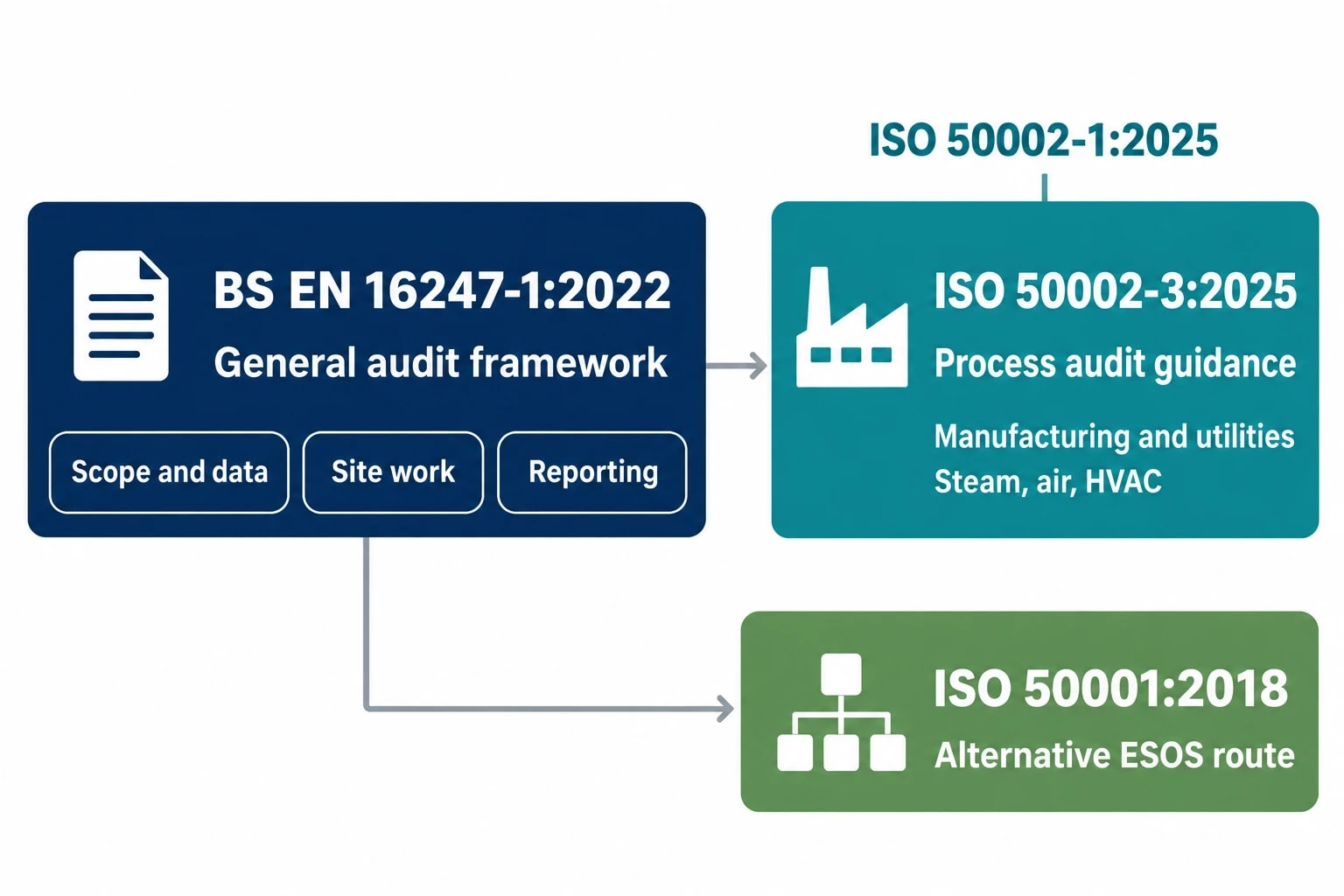
BS EN 16247-1:2022 sets out general requirements, methodology and deliverables for energy audits. It provides a framework for scope definition, data collection, site work and reporting.
For process-intensive sites, ISO 50002-3:2025 provides guidance for conducting process energy audits using ISO 50002-1:2025. It applies to manufacturing and utility systems, including steam, compressed air and HVAC. Its process focus is relevant where batch schedules, product mix and variable thermal duty influence energy use.
ISO 50001:2018 is an alternative ESOS route where certification covers the required total or significant energy consumption. It establishes a management-system framework for energy performance. A detailed process audit supplies the engineering evidence needed to prioritise specific projects.
Phase 4 reduces obligations for organisations that comply solely through ISO 50001 certification covering their total or significant energy consumption, as applicable. In those circumstances, the participant does not need an ESOS report or a lead assessor.
EU-linked manufacturers face separate energy-audit duties
Directive (EU) 2023/1791 on energy efficiency creates separate requirements for enterprises operating in EU Member States. It requires enterprises with average annual energy consumption above 10 TJ across the preceding three years, and without an energy management system, to undergo an energy audit.
The Directive sets 11 October 2026 as the deadline for the first audit, followed by audits at least every four years. Enterprises above 85 TJ of average annual energy consumption across the preceding three years must implement a certified energy management system by 11 October 2027.
The Directive requires a concrete, feasible action plan based on audit recommendations where measures are technically or economically feasible. EU Member States implement the Directive through national law. A UK site does not fall into scope solely because it sells products into Europe, but groups with EU operations should assess the applicable national requirements alongside ESOS.
Making an industrial energy audit deliver results
An external industrial energy audit service should produce a ranked programme of work, not a general list of opportunities. Each measure needs a defensible baseline, a transparent saving estimate, a cost range, a delivery route and a plan for verifying the result.
EnerTherm Engineering’s industrial energy audit services combine thermal-efficiency and heat-loss assessments with Ecolog consumption monitoring and process-optimisation work. Continuous consumption data can establish a stronger baseline, reveal abnormal operating patterns and provide evidence after measures are installed.
For energy managers, the immediate priority is to complete outstanding Phase 3 reporting with evidence that supports each claimed saving. The longer-term opportunity is to use the same audit work to build a practical programme for boilers, steam, heat recovery, drying, refrigeration and process control.
This article reflects the independent analysis and editorial opinion of EnerTherm Engineering. Product names, trademarks, and brands mentioned belong to their respective owners. EnerTherm Engineering is not affiliated with, endorsed by, or a licensee of any third-party software or product mentioned unless explicitly stated.

Managing Director — EnerTherm Engineering
Dr. François Pierrel is Managing Director of EnerTherm Engineering with over two decades of expertise in thermal design, heat transfer, and industrial energy optimisation. He holds a PhD in Heat Transfer from Cranfield University and a Post-Doctorate from Heriot-Watt University.
