UK Food Plants Cut Fuel Costs by Boosting Boiler Efficiency
A cost-benefit assessment covers burner upgrades, audits and compliant boiler replacement.
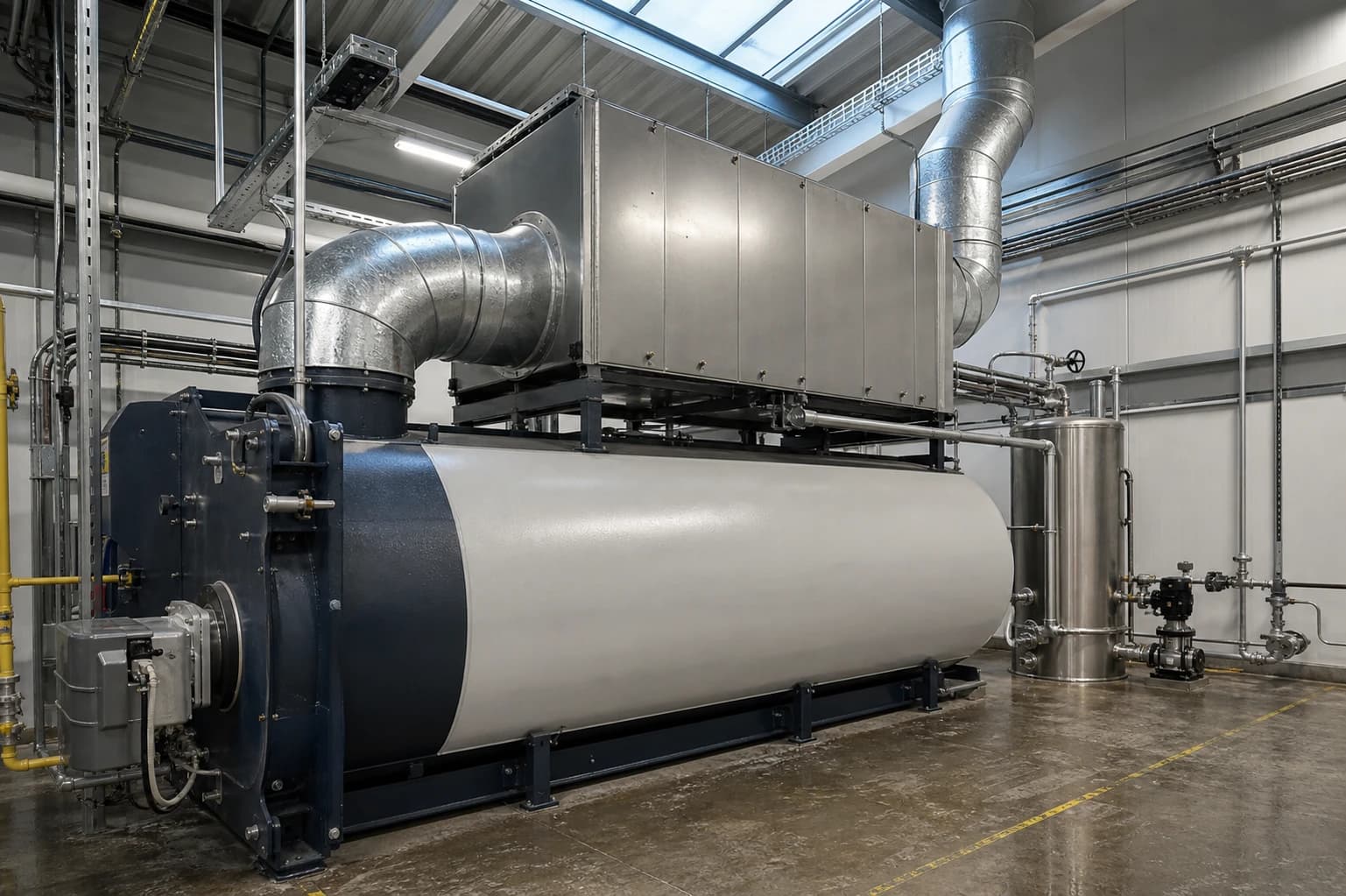
The current UK Energy Technology List requires qualifying gas and dual-fuel steam boilers to achieve at least 92.0% net thermal efficiency at both 30% and 100% maximum continuous rating, alongside a minimum 4:1 turndown ratio. It is a useful starting point for food and beverage sites considering an industrial boiler efficiency improvement project.
Steam and hot water remain central to cooking, pasteurisation, evaporation, washdown, clean-in-place operations and space heating. Fuel use rises quickly when boiler controls drift, condensate return falls, excess air increases or a boiler spends too much time at an inefficient part-load condition.
For an energy manager, the immediate question is financial: where can fuel costs fall without creating production, hygiene or compliance risks? The strongest projects begin with measured losses, match heat recovery to a genuine heat sink, and treat boiler-house changes as part of the site utility system rather than a stand-alone equipment purchase.
Why industrial boiler efficiency improvement matters in food manufacturing
Food plants have heat loads that move with production schedules, product changeovers and cleaning cycles. A boiler sized for peak cooking or sterilisation duty may then run lightly loaded for long periods. Parallel boilers can also cycle unnecessarily if sequencing does not reflect the real steam-demand profile.
This creates a gap between nameplate efficiency and delivered site performance. Procurement data may show a high-performing boiler; the fuel invoice reflects the whole system:
- Combustion and flue losses
- Blowdown losses
- Feedwater and condensate temperature
- Steam leaks and failed traps
- Distribution insulation
- Pressure settings
- Standby operation
- Demand changes during CIP and production cleaning
A new boiler can be appropriate where age, reliability, emissions compliance and capacity constraints align. Many sites can develop a worthwhile investment case from controls, heat recovery and water management before replacement becomes necessary.
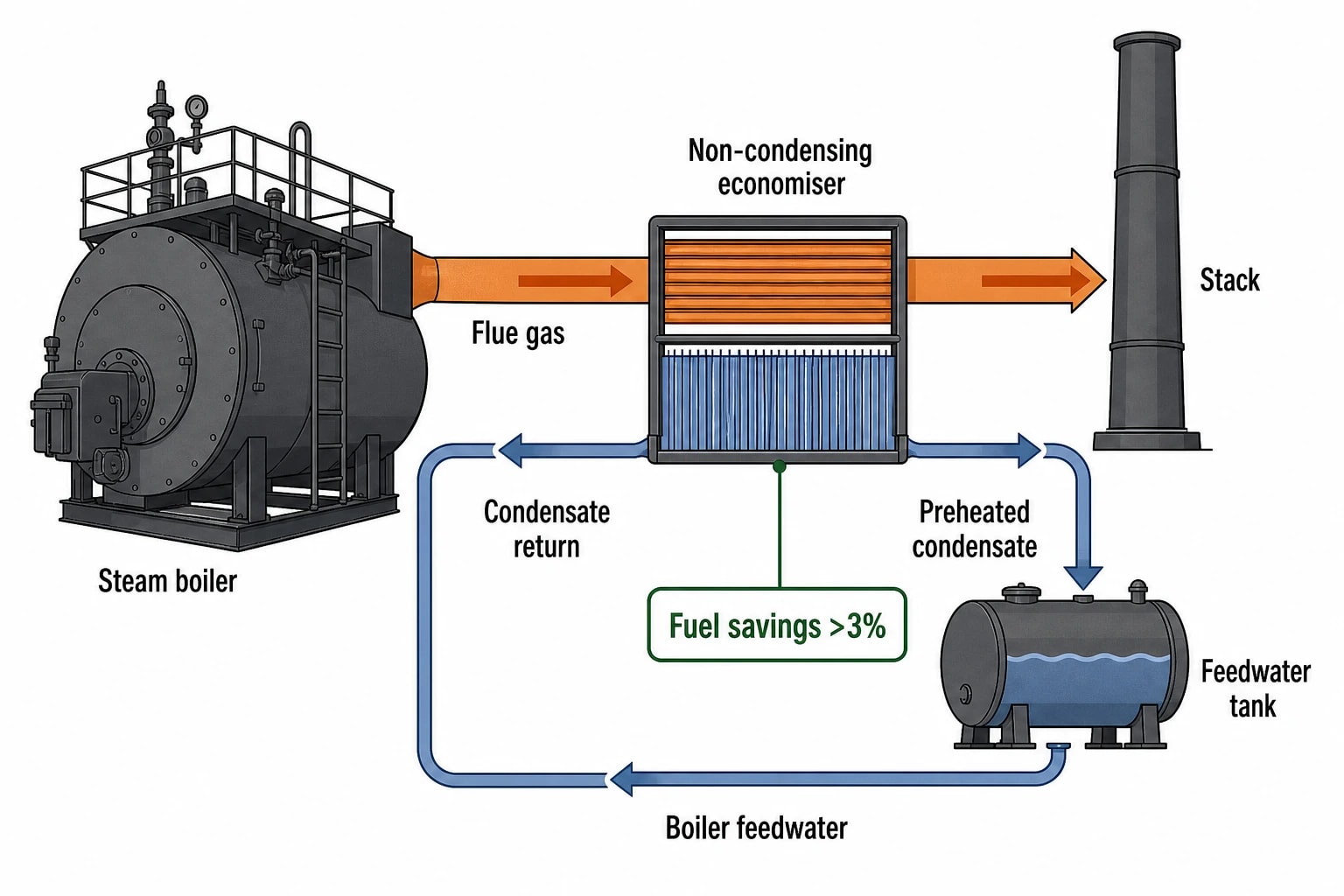
The Energy Technology List identifies non-condensing economisers as particularly relevant to steam boilers and condensate preheat in food manufacturing. It states that specified non-condensing flue-gas economisers can deliver fuel savings of more than 3%. The result on a particular site depends on flue-gas temperature, feedwater flow, operating hours, return-condensate temperature and the available heat sink.
Identify where your plant is losing energy and quantify the savings potential — our audits map every heat source, sink, and waste stream in your facility.
Build the baseline before selecting equipment
Measure boiler-house performance across production conditions
An industrial boiler efficiency improvement programme needs more than a single flue-gas reading. Audit work should cover full production, reduced throughput, start-up, standby and CIP periods. These states often have very different firing patterns and condensate-return rates.
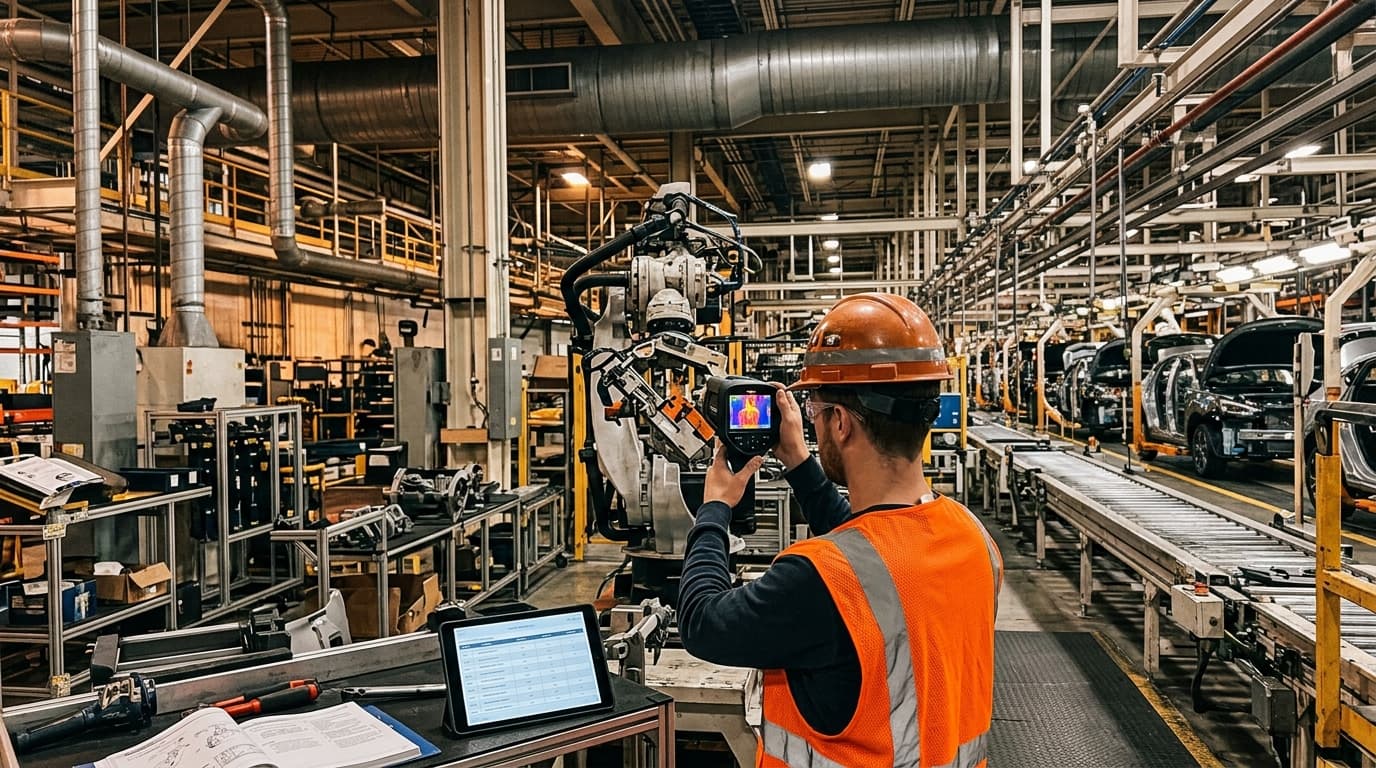
EnerTherm Engineering’s seven-step audit methodology starts with consultation and an on-site assessment, then uses portable instrumentation such as power analysers, ultrasonic leak detectors and thermal imaging. The resulting data should connect fuel consumption with steam output, boiler pressure, feedwater temperature, blowdown events, oxygen-trim performance and production activity.
Useful baseline measurements include:
| Measure | Why it matters to the investment case |
|---|---|
| Gas consumption and boiler firing rate | Establishes fuel use by production state |
| Steam flow and pressure | Shows actual load and pressure stability |
| Feedwater and condensate temperature | Quantifies the value of recovered heat |
| Condensate return rate | Identifies lost water, heat and treatment chemicals |
| Flue-gas oxygen and temperature | Indicates excess-air and stack-loss opportunities |
| Blowdown volume and conductivity | Tests whether water treatment and blowdown control are aligned |
| Steam-trap and leak survey | Finds losses outside the boiler shell |
| Production and CIP schedule | Locates practical installation windows and usable heat sinks |
The baseline should distinguish boiler thermal efficiency from overall steam-system efficiency. A burner tune can improve combustion while unrepaired leaks, failed traps or low condensate return continue to consume fuel.
Identify the load profile
Load profiling often changes the preferred option. A large single boiler may operate acceptably at peak demand but cycle at low load between shifts. A modular arrangement can match output more closely to demand, though capital cost, controls, footprint, flue arrangement and permit implications require full assessment.
For replacement projects, the ETL benchmark tests gas and dual-fuel steam boilers at both 30% and 100% maximum continuous rating. A boiler that performs only at full output offers limited value to a site with fluctuating batches and regular cleaning duty.
The minimum 4:1 turndown requirement is also a useful screening test for whether a boiler can remain in stable, efficient modulation across a wider operating range. It does not replace a site-specific review of minimum steam demand, standby arrangements and required resilience.
Low-disruption measures that reduce boiler fuel use
Tune combustion and sequence boilers properly
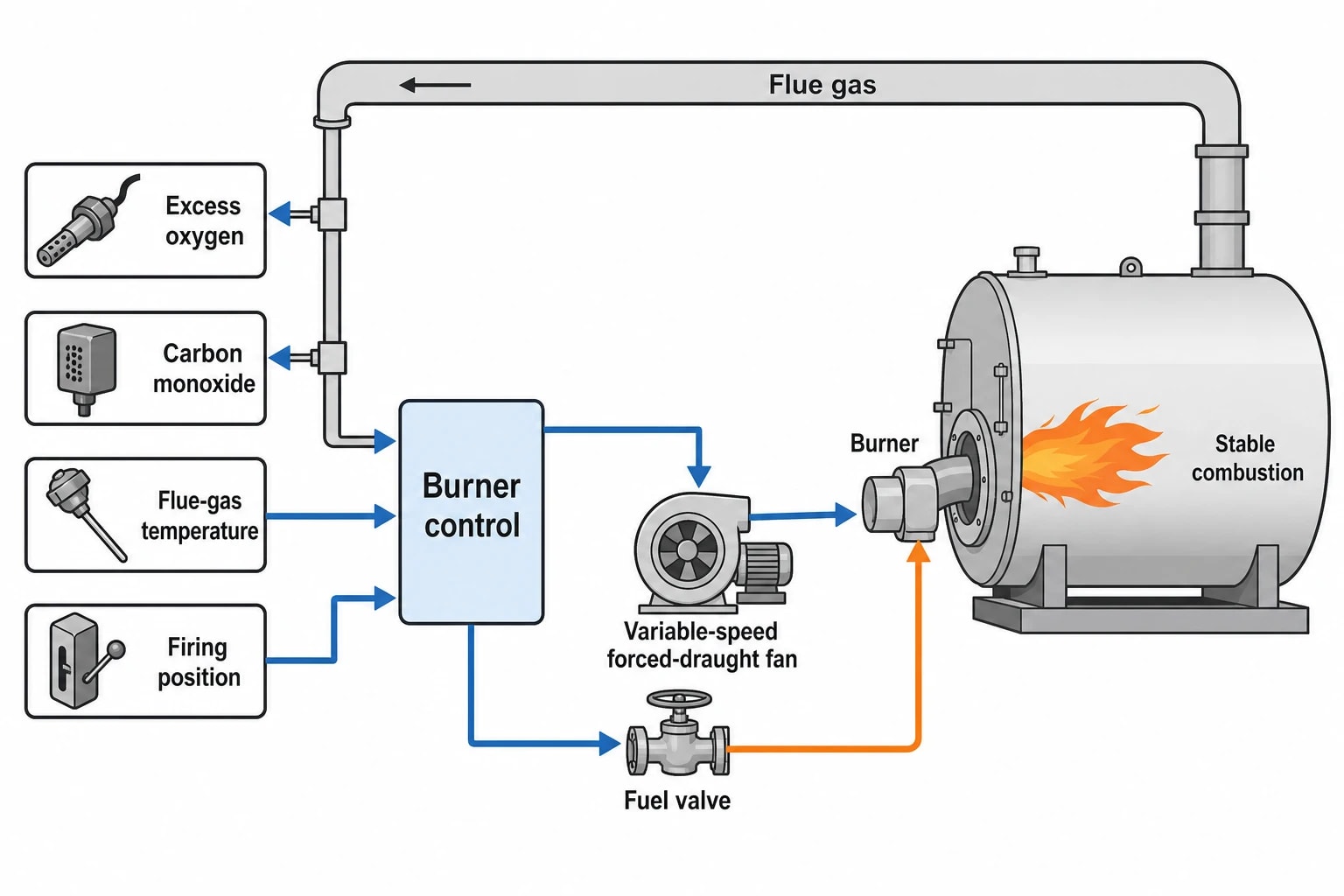
Burner tuning should follow measured excess oxygen, carbon monoxide, flue-gas temperature and firing position, and be performed by competent personnel within the burner manufacturer’s limits. The aim is stable, complete combustion with no unnecessary excess air.
Control improvements can make a strong financial case where demand varies through the day. The Energy Technology List covers burners with controls and retrofit burner-control systems intended to match heat generation with demand. Variable-speed forced-draught fans and accurate fuel-air control can reduce fan power and improve part-load combustion.
For multi-boiler sites, the control strategy should answer practical questions:
- Which boiler should lead at low demand?
- At what demand should a second boiler start?
- Can one boiler meet overnight or weekend loads?
- Does the sequence minimise cycling?
- Are boilers operating within their preferred modulation range?
- Does the control philosophy preserve the pressure and capacity needed by critical process users?
A control change needs commissioning during representative production conditions. A sequence that looks efficient on a trend chart can be unsuitable if it causes pressure dips at a pasteuriser or lengthens a cleaning cycle.
Recover heat from flue gas and blowdown
A non-condensing economiser transfers sensible heat from flue gas into boiler feedwater or another suitable water stream. It is often a good fit where the site needs to preheat feedwater and has sufficient condensate or make-up water flow.
A condensing economiser can recover sensible and latent heat by cooling flue gas below its dew point. The ETL states that condensing economisers can raise net efficiency by up to 9%, depending on boiler output rating. Their application needs closer scrutiny because the recovered heat is lower grade and acidic condensate requires appropriate materials, drainage and treatment.
Food sites should identify the heat user before progressing either option. Potential uses include feedwater preheat, wash-water preheat and other low-temperature duties. The heat sink must be available when the boiler fires; otherwise, the recovery system may bypass frequently and the projected saving will not materialise.
Blowdown and flash-steam recovery deserve the same attention. The ETL includes equipment that recovers heat from boiler blowdown condensate and flash steam through heat exchangers or flash-steam recovery vessels. The opportunity depends on boiler pressure, blowdown rate, water chemistry, available heat use and safe routing of the recovered energy.
Improve water treatment and condensate return
Scale, deposition and corrosion reduce heat transfer and can increase blowdown demand. Water treatment therefore has an energy, reliability and safety case. The treatment programme should reflect feedwater quality, condensate quality, boiler design and the boiler-water specification.
Condensate return improves the economics twice. It returns hot water, reducing the fuel needed to raise feedwater temperature, and reduces fresh-water and treatment-chemical demand. A survey should locate condensate drains, flash losses, contaminated returns, faulty pumping arrangements and process areas where return may have been isolated after a historical quality incident.
Food-safety teams should define which condensate streams are suitable for return. The answer may differ between direct and indirect process contact, cleaning systems and product areas. Engineering decisions should sit within the site’s documented hygiene controls.
Repair steam losses and protect distribution
Steam leaks and failed traps often sit outside boiler-house budgets, yet they directly increase boiler firing. Ultrasonic inspection can identify leaks and trap failures while the system remains in operation. Thermal imaging can reveal missing or damaged insulation, uninsulated valves and hot spots on distribution equipment.
This work is usually easier to phase than boiler replacement. Repairs can be prioritised by steam loss, accessibility, product-area constraints and planned maintenance windows. A post-repair survey verifies that the saving remains in place.

Identify where your plant is losing energy and quantify the savings potential — our audits map every heat source, sink, and waste stream in your facility.
How to produce a credible cost-benefit case
Separate quick-return projects from replacement decisions
A board-ready case should not group every measure into a single assumed saving. Each opportunity needs a defined baseline, capital cost, outage requirement, operational risk and measurement plan.
| Measure | Primary financial benefit | Main technical check |
|---|---|---|
| Burner tune and combustion controls | Lower fuel use at varying loads | Emissions, safe combustion and stable steam pressure |
| Boiler sequencing | Reduced cycling and standby losses | Minimum demand, resilience and control commissioning |
| Non-condensing economiser | Feedwater preheat and lower gas use | Flue temperature, water flow and corrosion margin |
| Condensing economiser | Higher heat recovery | Low-temperature heat sink, acidic condensate management |
| Blowdown recovery | Recovered heat and reduced water loss | Water chemistry, drainage and duty profile |
| Condensate return improvements | Lower fuel, water and chemical cost | Condensate quality and pumping reliability |
| Boiler replacement or modularisation | Efficiency, reliability and capacity fit | Demand profile, capital cost, permits and installation outage |
Finance teams should model fuel savings using the site’s contracted fuel price and measured annual consumption. They should separately include avoided water, sewerage and chemical costs where condensate or blowdown changes affect them. Maintenance costs, permit work, design, temporary steam provision, commissioning and production downtime must be visible rather than absorbed into a broad contingency.
Net present value, internal rate of return and simple payback can then compare options with different lifetimes. A sensitivity range should test fuel price, annual operating hours, production volume, expected efficiency gain and the proportion of recovered heat the site can use.
EnerTherm’s ongoing measurement and verification stage can apply IPMVP principles to compare performance against the agreed baseline. The plan should state meters, adjustment factors, data frequency, reporting period and who signs off changes in production or operating conditions.
Regulation, safety and hygiene shape the economics
Medium Combustion Plant Directive requirements
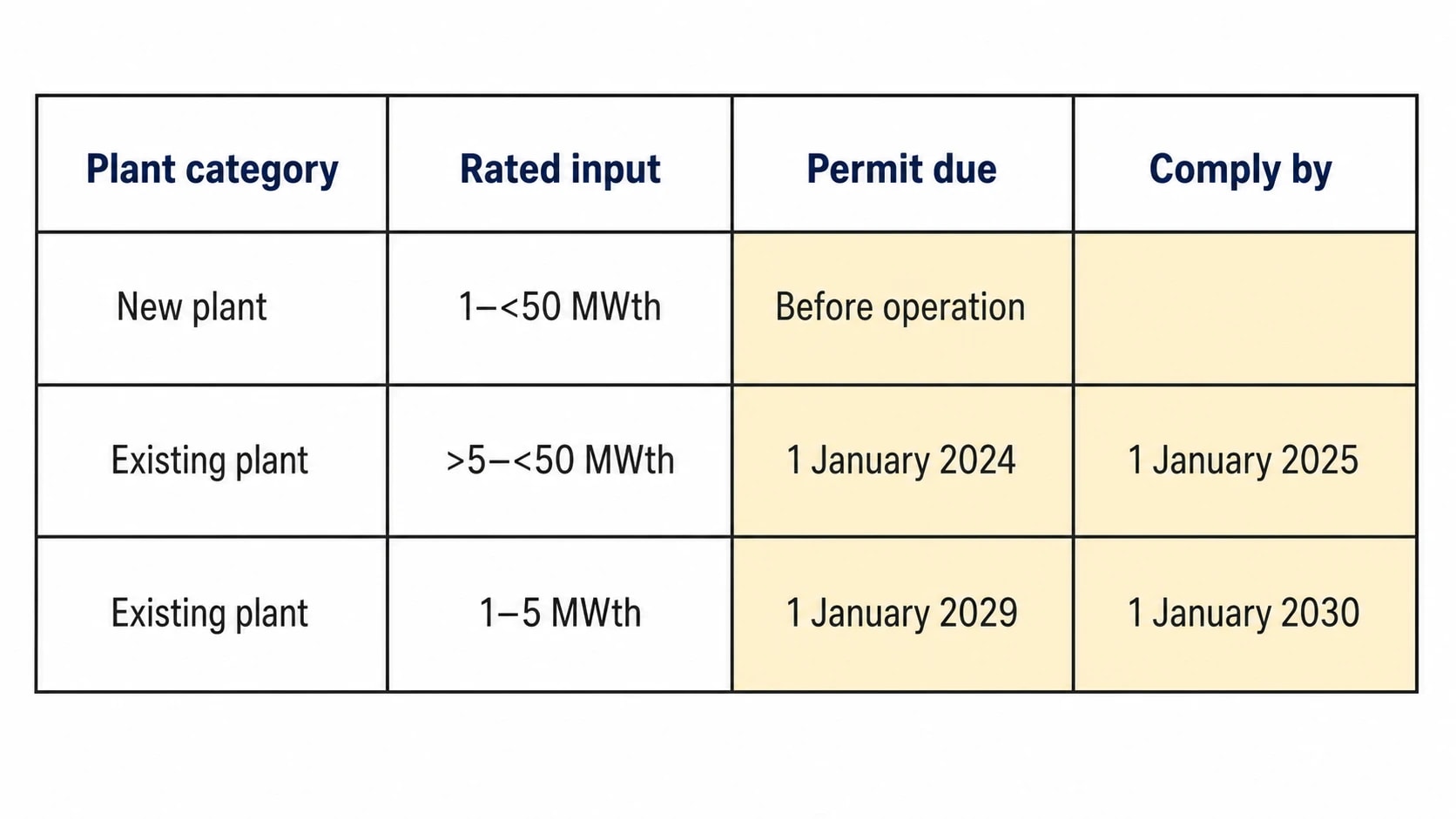
The UK’s medium-combustion-plant permitting regime, derived from Directive (EU) 2015/2193 and commonly called the Medium Combustion Plant Directive, covers boilers with a rated thermal input of 1 MWth or more and less than 50 MWth. In England and Wales, Environment Agency and Natural Resources Wales guidance sets permit requirements, emission-limit values and monitoring obligations according to plant age, size and fuel.
Existing plants above 5 MWth and below 50 MWth had to have a permit in place by 1 January 2024 and comply by 1 January 2025. Existing units from 1 MWth to 5 MWth are scheduled to require a permit by 1 January 2029 and compliance by 1 January 2030. New plant requires a permit before it operates.
A burner upgrade or replacement case should therefore assess emissions compliance before equipment selection. Rated thermal input uses net calorific value, and units may be aggregated where their waste gases are discharged, or could be discharged, through a common stack. Splitting a replacement into smaller units does not automatically remove regulatory exposure.
Food plants in Scotland and Northern Ireland should confirm the applicable national permitting route with the relevant regulator. Regulatory costs, stack assessment, monitoring and permit timescales belong in the financial model.
Pressure systems safety and planned outages
The Pressure Systems Safety Regulations 2000 apply to steam at any pressure. HSE states that an installed steam boiler needs a written scheme of examination before use, with examination requirements based on the system and its operating conditions.
HSE INDG436 explains that the written scheme should cover pipework, vessels, safety devices and other components that could give rise to danger. A major boiler or control-system alteration may require review of the scheme, operating procedures, competence arrangements and records.
This is a practical reason to align efficiency work with planned shutdowns. A food site can combine inspection access, maintenance, instrumentation installation and tie-in work into an approved outage plan, subject to site safety controls and competent-person requirements.
Hygiene controls during boiler and steam-system work
BS EN 1672-2:2020 covers hygiene and cleanability requirements for food-processing machinery. Boiler-house equipment may sit outside direct product contact, but alterations to steam lines, condensate returns and heat exchangers can affect hygiene zoning, drainage, access and cleanability around process equipment.
The project team should agree isolation, reinstatement, line identification, cleaning and release arrangements with engineering, production, quality and hygiene personnel. Temporary hoses, tools and scaffolding need controlled routes in food areas. Steam-quality requirements for process duties must remain defined by the site’s food-safety system.
HSE identifies clean-in-place systems as a safer option for internal disinfection when plant is maintained and operated under safe systems of work. CIP periods are valuable audit windows, but only where monitoring and temporary connections do not compromise the validated cleaning programme.
A practical investment sequence for UK food plants
Start with the measured steam and fuel balance. Then select the least disruptive measures that address the largest verified losses.
- Establish fuel, steam, condensate, flue-gas and production baselines.
- Complete combustion, leak, steam-trap, insulation and water-treatment surveys.
- Correct control, sequencing and maintenance deficiencies.
- Match economiser, blowdown or flash-steam recovery to a stable heat sink.
- Test boiler replacement or modularisation against the ETL efficiency and turndown benchmark.
- Review MCPD permitting, PSSR duties, hygiene controls and outage requirements before approval.
- Verify savings after commissioning and carry the results into routine utility management.
This article reflects the independent analysis and editorial opinion of EnerTherm Engineering. Product names, trademarks, and brands mentioned belong to their respective owners. EnerTherm Engineering is not affiliated with, endorsed by, or a licensee of any third-party software or product mentioned unless explicitly stated.

Managing Director — EnerTherm Engineering
Dr. François Pierrel is Managing Director of EnerTherm Engineering with over two decades of expertise in thermal design, heat transfer, and industrial energy optimisation. He holds a PhD in Heat Transfer from Cranfield University and a Post-Doctorate from Heriot-Watt University.
