
Peak Tariff Avoidance Software for UK Chemical Plants
A cost-benefit analysis of Triad forecasting, load shifting and EII audit data.
Eastern Power Networks’ 2026/27 tariff for high-voltage sites applies a much higher DUoS charge in the red band between 16:00 and 19:00 on weekdays than in the green band. For a chemical plant able to move an approved electrical duty outside that window, the difference creates a measurable cost-avoidance opportunity.
Peak tariff avoidance software for manufacturing helps plant teams identify opportunities before an expensive settlement period closes. It combines interval electricity data with production plans, asset status and tariff information to forecast demand, identify contributing loads and calculate whether an intervention is likely to produce a net saving.
The financial case has changed since the traditional UK Triad-response model. Ofgem’s Targeted Charging Review moved residual network charges for final-demand customers to fixed charging arrangements from April 2023. Chemical plants should not treat every winter demand reduction as a Triad saving. Software must instead model the charges that remain sensitive to timing and consumption under the site’s supply contract and network tariff.
Why peak tariff avoidance remains relevant after Triad reform
Electricity invoices at a UK chemical site contain more than a commodity rate. Depending on the supply arrangement, the bill may include energy, balancing costs, distribution charges, transmission charges, supplier costs, taxes and capacity-related charges.
Some elements change when a plant changes its half-hourly consumption. Others do not.
Ofgem’s Targeted Charging Review removed the previous ability for final-demand customers to avoid residual network charges by reducing demand during the three highest system-demand half-hours. The Transmission Demand Residual charge is now fixed for the relevant customer segment or site basis.
Triad periods still matter in the wider GB charging framework. NESO defines them as the three half-hour settlement periods with the highest system demand, separated by at least ten clear days between November and February. They remain relevant to certain charging and embedded-generation arrangements. A distribution-connected chemical plant should not assign a financial benefit to an avoided Triad event unless its supplier contract and charging basis support that calculation.
The cost signals software must separate
A tariff model should distinguish between fixed and variable exposure.
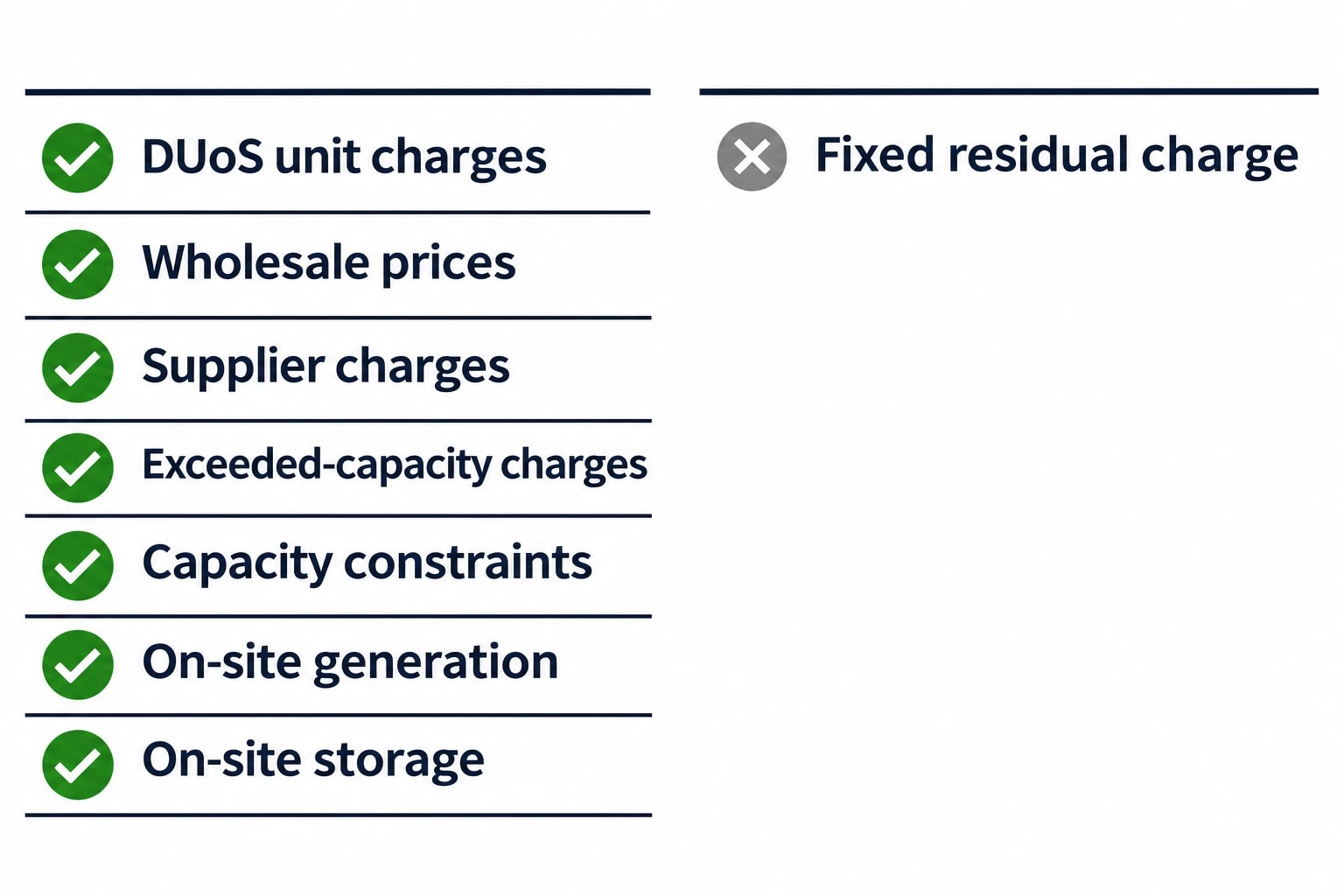
Variable or potentially variable exposure can include:
- Time-of-use DUoS unit charges.
- Half-hourly wholesale electricity prices under a pass-through or flexible supply contract.
- Supplier charges indexed to particular settlement periods.
- Exceeded-capacity charges.
- Site-specific capacity constraints.
- The cost or value of operating on-site generation or storage.
Fixed residual network charges should remain visible in reporting but be excluded from avoided-cost calculations for the near term. This prevents finance teams approving a business case based on savings that production scheduling cannot deliver.

Omni Vision delivers turnkey utility metering, CO2 tracking, and AI-powered production KPI intelligence — giving you real-time dashboards and actionable insights across your entire facility.
Chemical plants need flexibility within safe operating limits
Chemical manufacturing cannot treat electrical demand as a simple switch-off exercise. Distillation, reaction, refrigeration, compressed air, effluent treatment and thermal control support product quality, process stability and safe operation.
Peak tariff avoidance software for manufacturing therefore needs an operational model as well as a tariff model.
Identify loads that have a genuine flexibility window
Suitable actions vary by site, product and batch programme. Possible areas for investigation include chilled-water production, selected pumping duties, air-compressor sequencing, non-critical water treatment, thermal-oil preheating and energy-storage charging.
Each proposed action requires a clear operating boundary. A chiller may have thermal storage available for 30 minutes. A compressor may tolerate a revised sequence if pressure remains within an approved range. A batch start may move if raw materials, operators, reactors and downstream packing capacity are available.
The software should record these constraints against the relevant asset or process area. It should also distinguish between a load that can be deferred and one that can only be reduced.
Rebound demand determines the real value
A short reduction in electricity demand can create higher consumption later. Refrigeration is a common example. Deferring compressor activity can increase the work required to return a process or store to its required temperature.
The financial calculation must include:
- The electricity removed from the high-cost period.
- The electricity consumed later to recover the process condition.
- The tariff applicable to that recovery period.
- Any additional fuel, steam or compressed-air consumption.
- Any production, quality or maintenance consequence.
A dashboard that reports only peak kW reduction can overstate value. The relevant measure is net avoided cost after recovery energy and operational effects.
What peak tariff avoidance software must measure
A site import meter shows the financial boundary, but it does not identify why demand increased. Chemical plants need enough process-level visibility to connect interval demand with the duty that created it.
Meter the electrical loads that drive peaks
The priority is electricity metering at the incomer, main distribution boards and major demand centres. Supporting utility data explains whether an electrical response shifts cost elsewhere on site.
A practical monitoring scope may include:
- Incoming electrical supply and major sub-distribution boards.
- Chillers, refrigeration compressors and cooling towers.
- Distillation columns and reactor heating or cooling systems.
- Boiler-house electrical auxiliaries and steam-related loads.
- Compressed-air generation and ring-main demand.
- Pumps, water treatment and effluent-treatment assets.
- Batch starts, operating states, product grades and tonnes produced.
This data lets an energy manager separate a predictable batch overlap from a fault, such as unnecessary compressor operation or several large pumps starting together.
Preserve process-control boundaries
Read-only collection of operational signals gives the software plant context without giving it control of process equipment. Operators and established control systems retain responsibility for every intervention.
This separation matters where a peak alert concerns equipment with safety, environmental or product-quality implications. The software can forecast exposure and present approved options; the site’s operating procedure determines whether operators or building-management systems act during a validated change window.
Establish a data-quality plan before forecasting savings
Poor timestamps, incorrect meter multipliers and incomplete production records quickly undermine a forecast. A data-quality plan should set out meter ownership, calibration records, interval resolution, time synchronisation, missing-data treatment and retention of original readings.
Half-hour data is essential for billing analysis. Data at finer resolution can reveal the mechanism behind the half-hour result. A five-minute overlap between compressor loading, a reactor heat-up and a chiller ramp may otherwise appear as one unexplained settlement period in invoice data.
A tariff-specific calculation using published DUoS rates
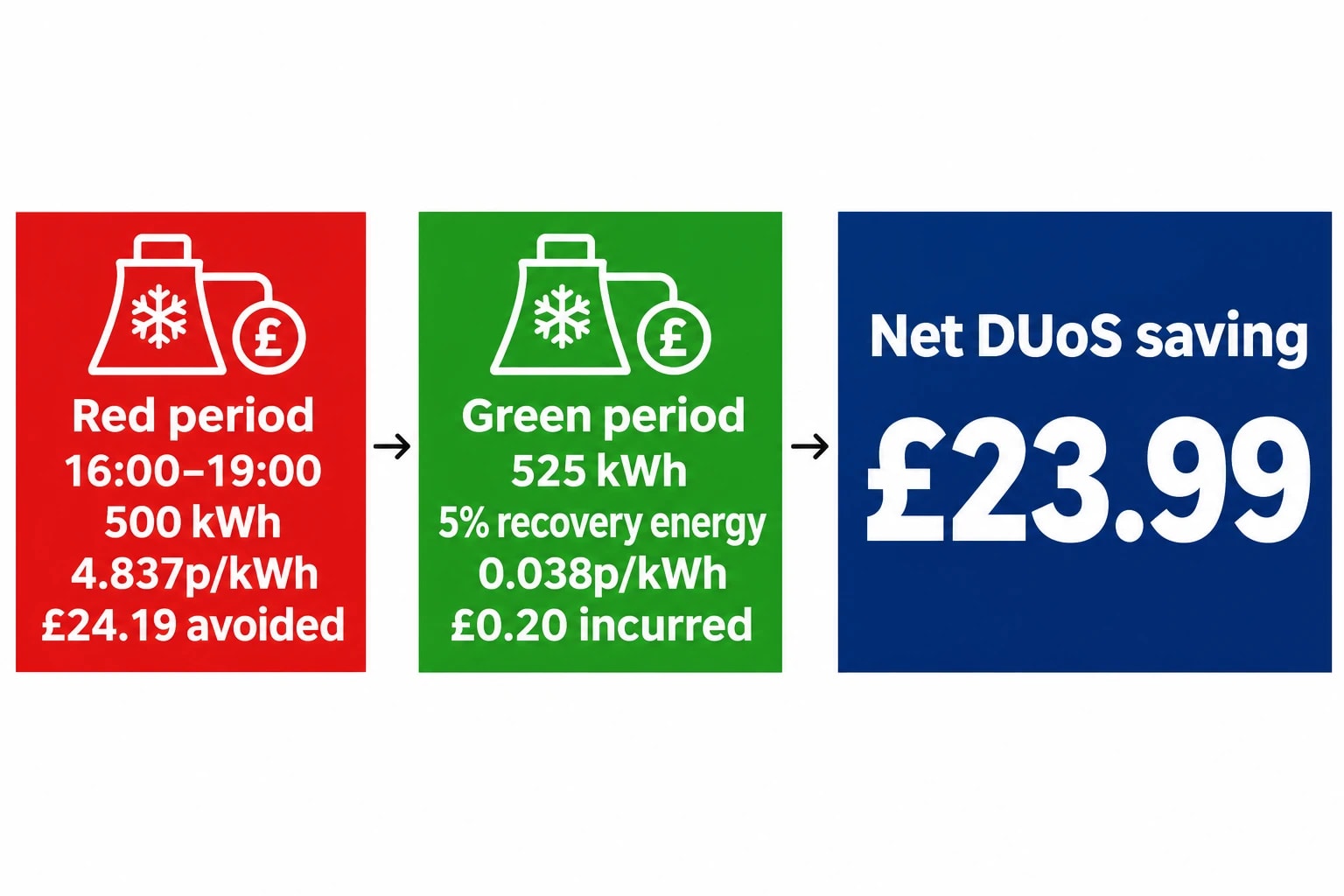
The following example isolates the DUoS unit-charge effect. It uses the Eastern Power Networks 2026/27 schedule for an HV Site Specific Band 1 customer, with a red period from 16:00 to 19:00 on weekdays.
Assume a chemical plant defers 1 MW of chilled-water production for one half-hour. The avoided red-band energy is therefore 500 kWh. The plant later consumes 525 kWh during a green period to restore the chilled-water condition, including a 5% recovery-energy increase.
| Calculation item | Interval energy | Relevant DUoS rate | Cost effect |
|---|---|---|---|
| Chilled-water duty removed from red period | 500 kWh | 4.837p/kWh | £24.19 avoided |
| Recovery duty in green period | 525 kWh | 0.038p/kWh | £0.20 incurred |
| Net DUoS saving from the action | £23.99 |
The calculation does not claim a commodity-energy saving. The site consumes 25 kWh more electricity because of recovery losses. It identifies a £23.99 avoided DUoS cost from moving the duty between tariff periods.
A plant on a flexible supply contract could add the verified commodity-price difference between the two settlement periods. A plant on a fully fixed tariff might receive no direct pass-through benefit from that movement. The contract determines whether that additional value exists.
Scale only after operational validation
If operators take the same approved action on 150 eligible weekdays, the annual DUoS saving would be approximately £3,599 before allowing for missed events, changed tariffs, maintenance constraints or reduced production flexibility.
That figure is not a forecast for every chemical site. It demonstrates why tariff-specific modelling matters. The actual opportunity depends on the plant’s network area, voltage level, LLFC or tariff identifier, supply contract, available load and recovery profile.

Track energy consumption, emissions, and process parameters with seamless PLC/SCADA integration via Modbus, OPC-UA, and MQTT protocols.
Turning a forecast into an operating decision
Forecasting has value when it arrives early enough for operations to act within a defined procedure.
A useful peak-alert workflow should answer four questions:
- What demand is expected in the next settlement period?
- Which processes are expected to create the increase?
- Which pre-approved actions remain available under current plant conditions?
- What net cost is likely to be avoided after rebound demand?
Forecast against production reality
For chemical sites, a credible forecast should account for batch schedules, product grade, reactor condition, planned cleaning, ambient temperature, refrigeration duty, compressor loading, maintenance work and available utility capacity.
An alert that only predicts a high import figure leaves operators with little to assess. An alert that identifies a projected increase from a refrigeration ramp and scheduled reactor heat-up gives them a practical starting point.
The system should state forecast confidence and the data inputs used. Plant teams need to know whether an alert rests on a confirmed batch schedule, current equipment state or a historical pattern.
Use approval rules rather than automatic curtailment
A chemical plant should define its response hierarchy before a tariff event. The energy manager may own the forecast. Operations may confirm whether equipment can move. Finance may validate the avoided-cost calculation. Plant management should approve the operating procedure and limits.
The record should capture the alert, decision, action, metered outcome and any production effect. Over time, this provides evidence of which interventions consistently work and which only appear attractive in theory.
Building the investment case for peak tariff avoidance software
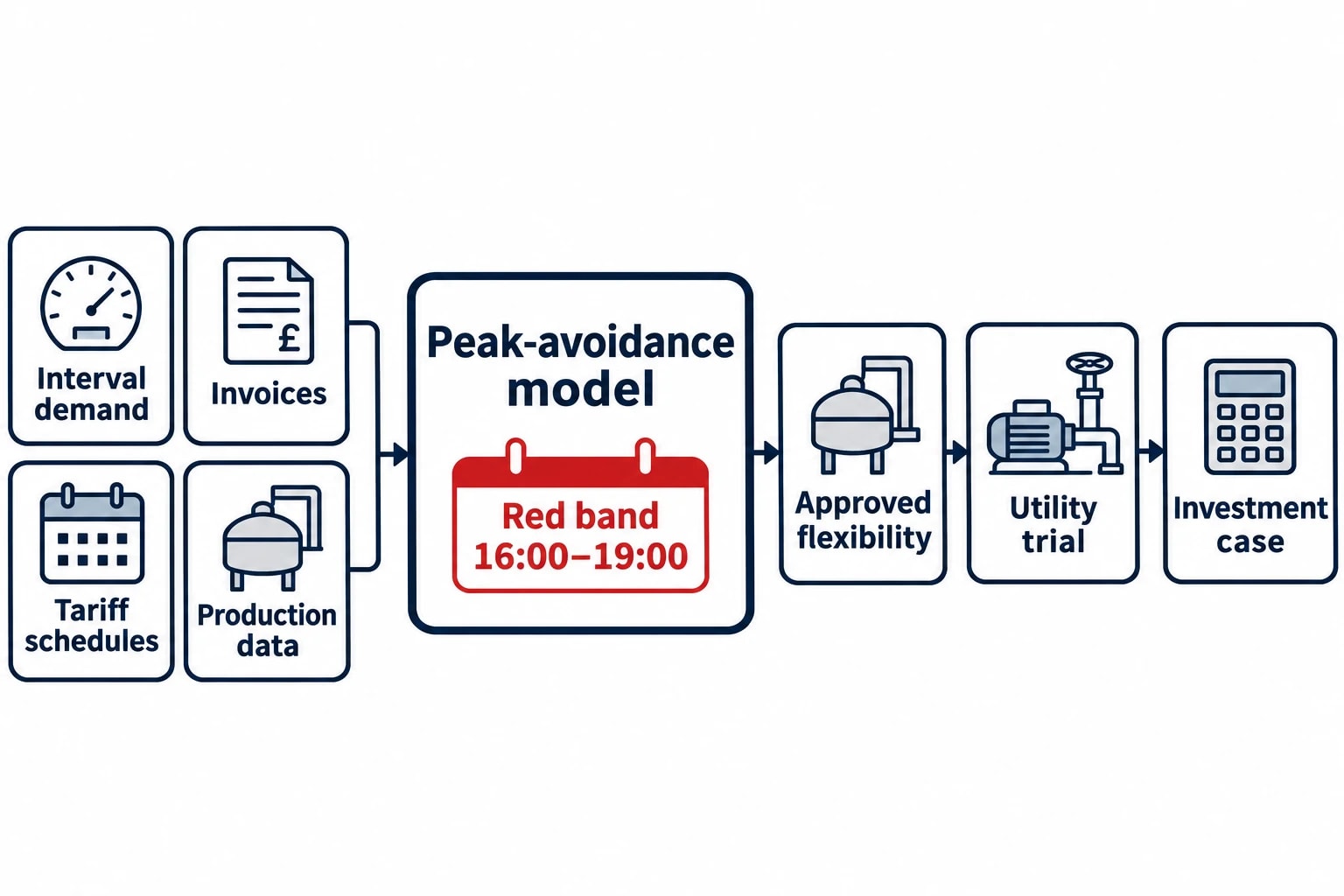
The strongest business case separates tariff savings from wider energy-management benefits.
Set a baseline that finance can audit
Use interval demand data, invoices, tariff schedules and production information to identify the highest-cost periods. The baseline should show how often flexible loads coincide with expensive tariff windows and whether the actions are repeatable.
Useful production-linked indicators include:
- Electricity per batch.
- Energy per tonne.
- Cost per tonne.
- Compressor kWh per unit of production.
- Refrigeration kWh per batch or storage requirement.
These measures prevent a low-demand day being reported as an energy success when reduced output caused it.
Include the full cost of implementation
The investment appraisal should include metering, installation, engineering surveys, software, training, support, process trials and internal labour. Hazardous-area requirements, electrical access and validation requirements can materially affect programme cost at chemical facilities.
Omni Vision can centralise utility, process and production data to support this assessment. In a peak-avoidance project, it connects interval electricity demand with production context, approved flexibility options and tariff calculations. A phased deployment focused on refrigeration, compressed air or another major utility area can establish the financial case before wider expansion.
ISO 50001:2018 and sustained peak-cost control
ISO 50001:2018, as amended by ISO 50001:2018/Amd 1:2024, remains current. Its requirements support a disciplined approach to managing energy performance rather than a campaign to reduce visible peaks.
Operational planning and control
Clause 8.1, operational planning and control, aligns with the need for documented conditions around peak-response actions. A chemical plant should specify which assets can participate, who approves the action, what conditions prevent intervention and how operators return equipment to normal operation.
Those criteria should include process safety, product quality, emissions obligations, thermal stability, maintenance condition and utility resilience.
Performance evaluation
Clause 9.1, monitoring, measurement, analysis and evaluation, supports the evidence needed to test whether an intervention delivered a benefit. Granular metering, tariff versions, production records and intervention logs allow the energy team to compare forecast against outcome.
The review should retain source readings and calculation logic. It should identify when a result is unsuitable for comparison, such as after a failed meter, abnormal batch, altered production output or changed tariff.
The practical commercial test
Peak tariff avoidance software for manufacturing earns its place when it produces safe, repeatable and financially verified decisions.
For UK chemical plants, the starting point is not a generic Triad warning. It is a precise assessment of the tariff currently paid, the electrical loads that can move without harming production, and the recovery energy that follows. Once these elements are visible in the same operational view, energy managers can quantify the cost of a projected peak before the settlement period closes and decide whether the available response is worth taking.
This article reflects the independent analysis and editorial opinion of EnerTherm Engineering. Product names, trademarks, and brands mentioned belong to their respective owners. EnerTherm Engineering is not affiliated with, endorsed by, or a licensee of any third-party software or product mentioned unless explicitly stated.

Technical Manager — EnerTherm Engineering
John Naranjo is Technical Manager at EnerTherm Engineering, bringing specialist expertise in chemical and environmental engineering. He recently led the implementation of Omni Vision, EnerTherm's real-time energy and utility monitoring platform. He holds an MSc in Environmental Engineering from the University of Huelva and a BSc in Chemical Engineering, with memberships in both the Energy Institute and IChemE.
