Where UK Automotive Plants Find Energy Saving Opportunities
Average 19% energy cost reduction, with an average 1.9-year payback in automotive audits.
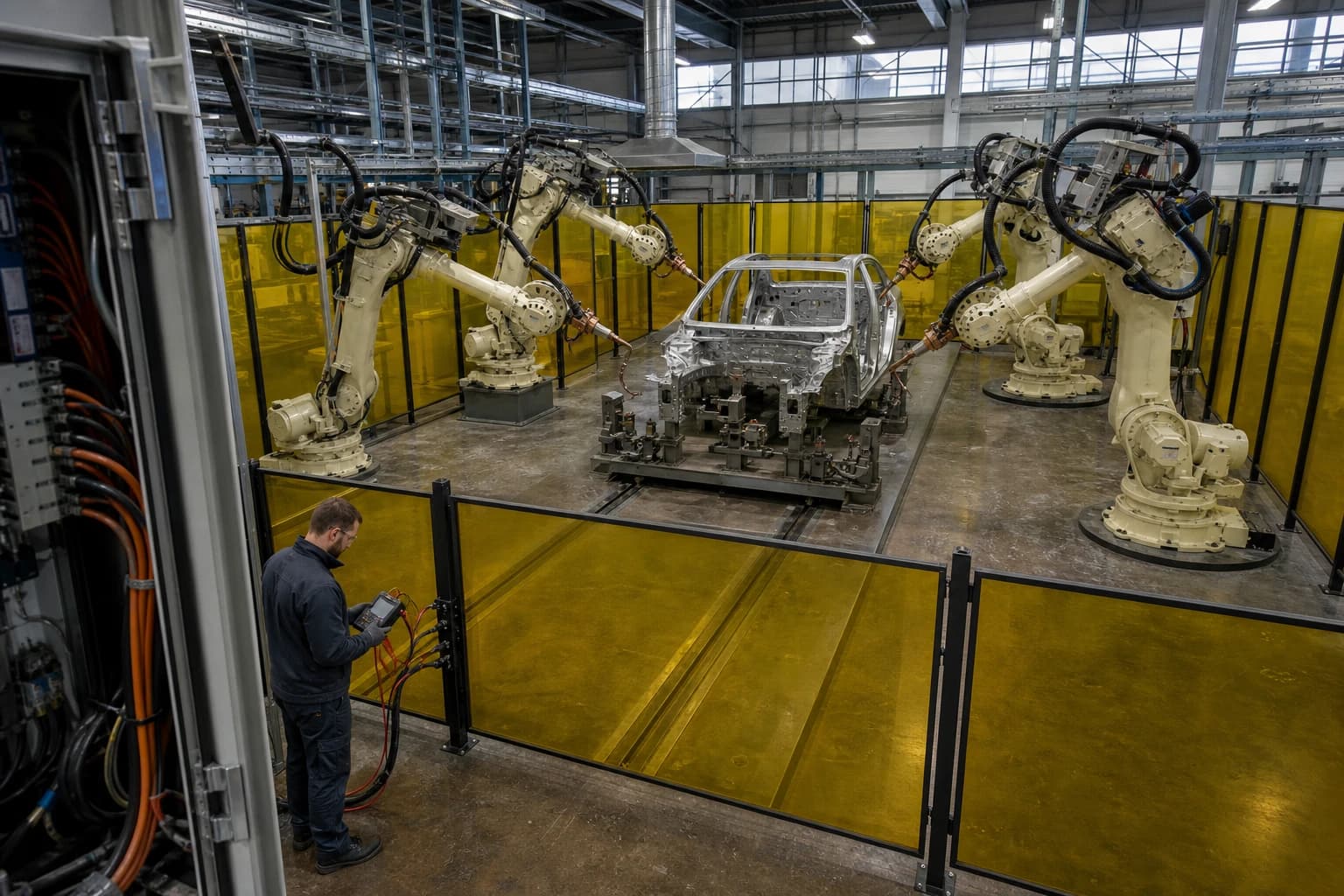
A Škoda Auto robotic-cell case study cut energy use by about 20% by optimising robot speeds and applying power-saving modes while maintaining the required production rate. That finding captures a wider reality for UK automotive plants: energy-saving opportunities in automotive manufacturing often sit within established production assets, control settings and idle periods rather than requiring dramatic equipment replacement.
For OEM and Tier 1 facilities, the financial case must link each measure to output, quality and plant availability. Electricity and gas costs must fall without weakening weld integrity, coating quality, ventilation performance or takt time. A useful audit starts with the energy profile of the vehicle, component or production line, then tests where process demand differs from what the plant pays to supply.
Why energy saving opportunities in automotive manufacturing need production context
Automotive sites contain energy systems with different operating constraints. Paint shops consume gas and electricity for curing ovens, spray booths, air handling and make-up air. Body-in-white operations draw electricity through welding transformers, robots, extraction and conveyors. Compressed air supports tools, actuators and equipment across the site. HVAC adds a variable load around occupied and conditioned spaces.
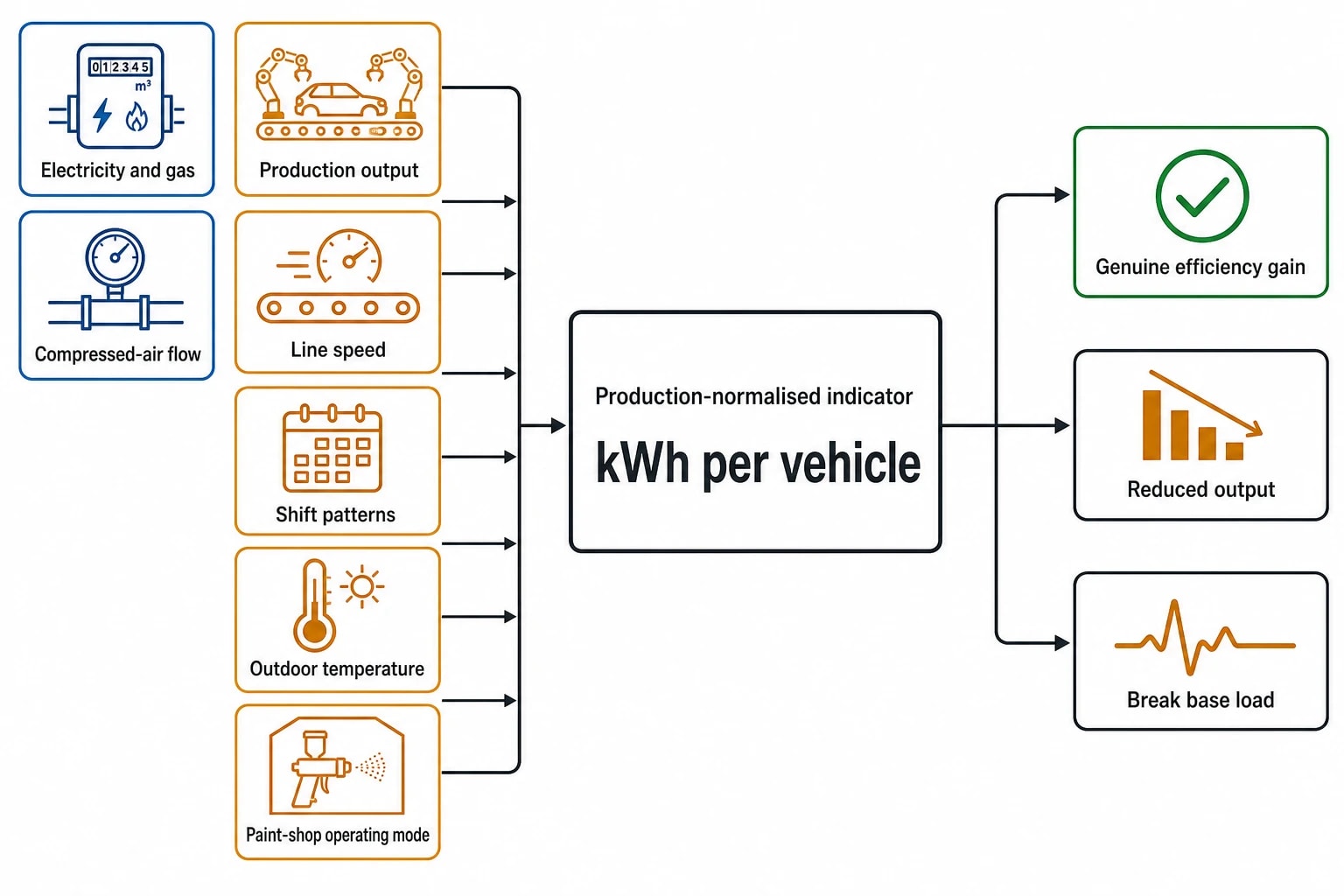
A site-wide utility bill cannot show whether an improvement has reduced energy waste or merely coincided with lower output. Energy managers need production-normalised indicators such as kWh per vehicle, kWh per body, kWh per painted unit or kWh per thousand components.
Establish the production baseline before selecting projects
The baseline should separate at least:
- Electricity and gas consumption
- Shift patterns, shutdowns and model changeovers
- Production output and line speed
- Scrap, rework and quality events
- Outdoor temperature where it affects heating or cooling demand
- Paint-shop operating mode, including booth and oven schedules
- Compressed-air flow, pressure and compressor load state
This separates genuine efficiency gains from reduced production. It also reveals costly operating periods that annual consumption figures can conceal. A body-in-white line may be efficient during production but retain a high electrical base load during breaks. A paint shop may use full ventilation and make-up-air capacity before or after spraying activity.
Rank opportunities by cost, risk and verification route
A useful register identifies the expected capital requirement, outage requirement, affected production area, owner, energy metric and measurement method. This distinguishes low-capital control changes from projects needing a planned shutdown or a longer capital case.
| Opportunity area | Typical investment profile | Financial value to test | Production safeguard |
|---|---|---|---|
| Compressed-air leaks and pressure control | Low to medium capital | Avoided electricity use and reduced compressor running hours | Confirm pressure at critical end uses |
| Robot standby and speed optimisation | Low capital to engineering-led change | Reduced cell electricity use during operation and idle periods | Maintain cycle time, collision protection and weld quality |
| Booth air handling controls | Medium capital | Fan electricity and heating or cooling energy | Protect capture performance, pressure and air quality |
| Oven heat-loss reduction and heat recovery | Medium to high capital | Lower gas use and possible useful heat recovery | Maintain cure profile and product quality |
| Welding transformer and cooling-system review | Low to medium capital | Reduced electrical losses and auxiliary demand | Validate weld parameters and equipment reliability |
Identify where your plant is losing energy and quantify the savings potential — our audits map every heat source, sink, and waste stream in your facility.
Paint shop energy savings: focus on air, heat and operating hours
Paint shops demand careful engineering because they combine thermal processes, high airflow, volatile organic compound controls and strict quality requirements. The opportunity is to match the energy supplied to the active process, not to reduce ventilation below safety or permit requirements.
Audit spray booths and air handling by operating state
The audit should log fan power, air volume, pressure, temperature, humidity, make-up-air energy and spray activity over representative shifts. It should identify whether booth fans run at a fixed rate through breaks, maintenance periods and periods with no spraying.
Demand-based fan control can reduce unnecessary fan energy where the process and safety case permit reduced operation. Variable speed drives are particularly relevant to fans because their duty varies with airflow demand. Production, paint engineering and health and safety teams should review the control sequence closely.
HSE guidance requires appropriate risk controls for spray booths and potentially explosive atmospheres. Any alteration to extraction, recirculation, airflow, interlocks or electrical equipment must be assessed under the Dangerous Substances and Explosive Atmospheres Regulations 2002. Energy savings cannot come at the expense of contaminant control, negative pressure, safe clearance procedures or permit compliance.
Reduce gas use in ovens before considering fuel substitution
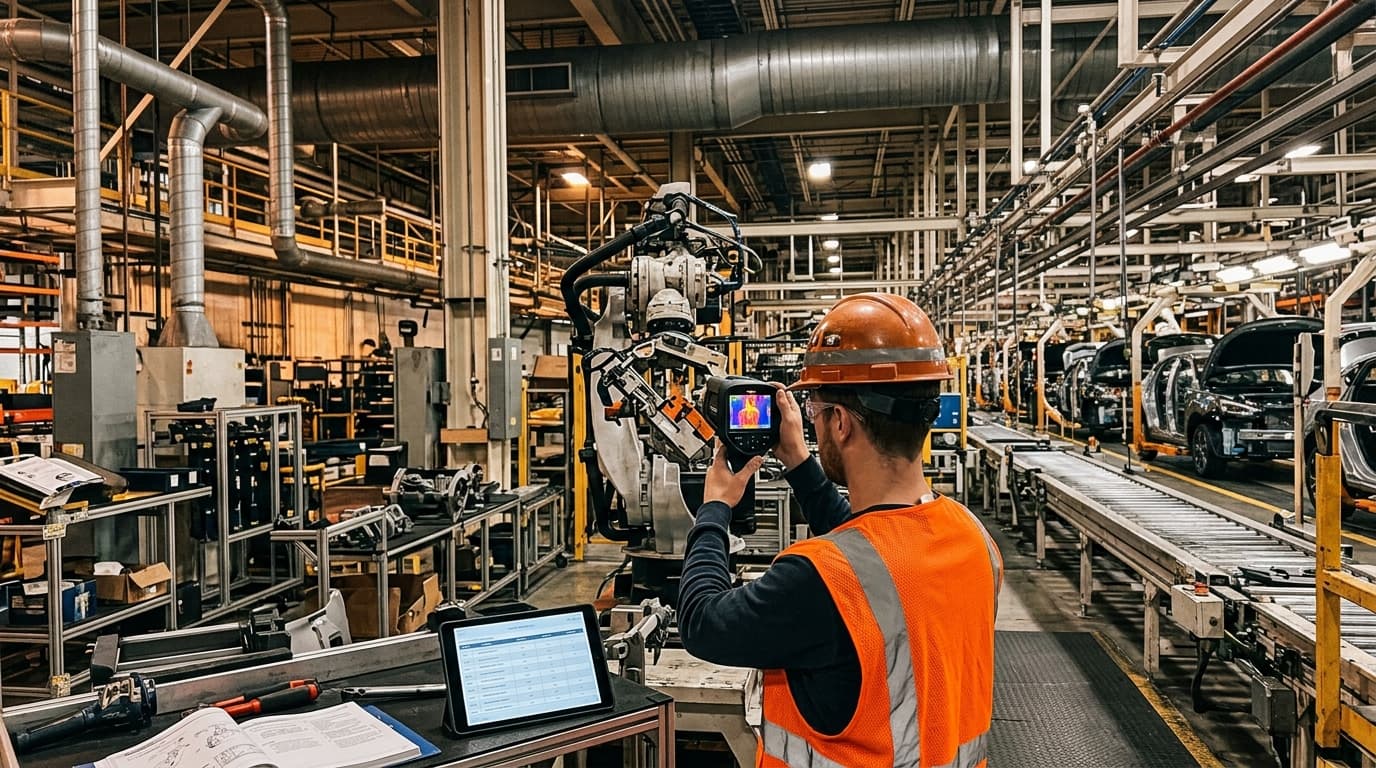
Curing ovens offer a direct gas-saving opportunity where the audit identifies excess exhaust, poor insulation, combustion settings that drift from specification, leakage around doors or unnecessary heat loss during idle periods. Thermal imaging can locate hot surfaces, damaged insulation and poor seals. Flue-gas measurement can establish whether combustion control merits investigation.
Waste heat recovery becomes viable only where there is a stable heat source and a nearby demand with a suitable temperature requirement. Potential users include incoming make-up air, process water and building heating. The business case must account for seasonal demand, contamination risk, duct routes, maintenance access, heat exchanger fouling and production shutdown requirements.
Strong cases quantify avoided gas use from measured heat demand, then confirm that recovered heat will displace existing consumption for sufficient operating hours. A large theoretical heat source offers little value if the receiving load is absent for most of the year.
Compressed-air savings: measure demand before buying compressor capacity
Compressed air is a clear energy-saving opportunity in automotive manufacturing because losses occur in generation, distribution and end use. The Department for Energy Security and Net Zero’s 2026 industrial efficiency evidence assesses a package of leak reduction, improved system layout, variable speed compressor drives, improved controls and lower inlet-air temperature at 6% electricity savings for an average site in the relevant assessment. It gives £350,000 in 2024 prices as its indicative average-site capital figure.
That figure is an evidence input, not an automotive project quotation. The business case depends on the compressor configuration, air-quality requirement, production demand profile and condition of the distribution network.
Find the system curve, not only the leaks
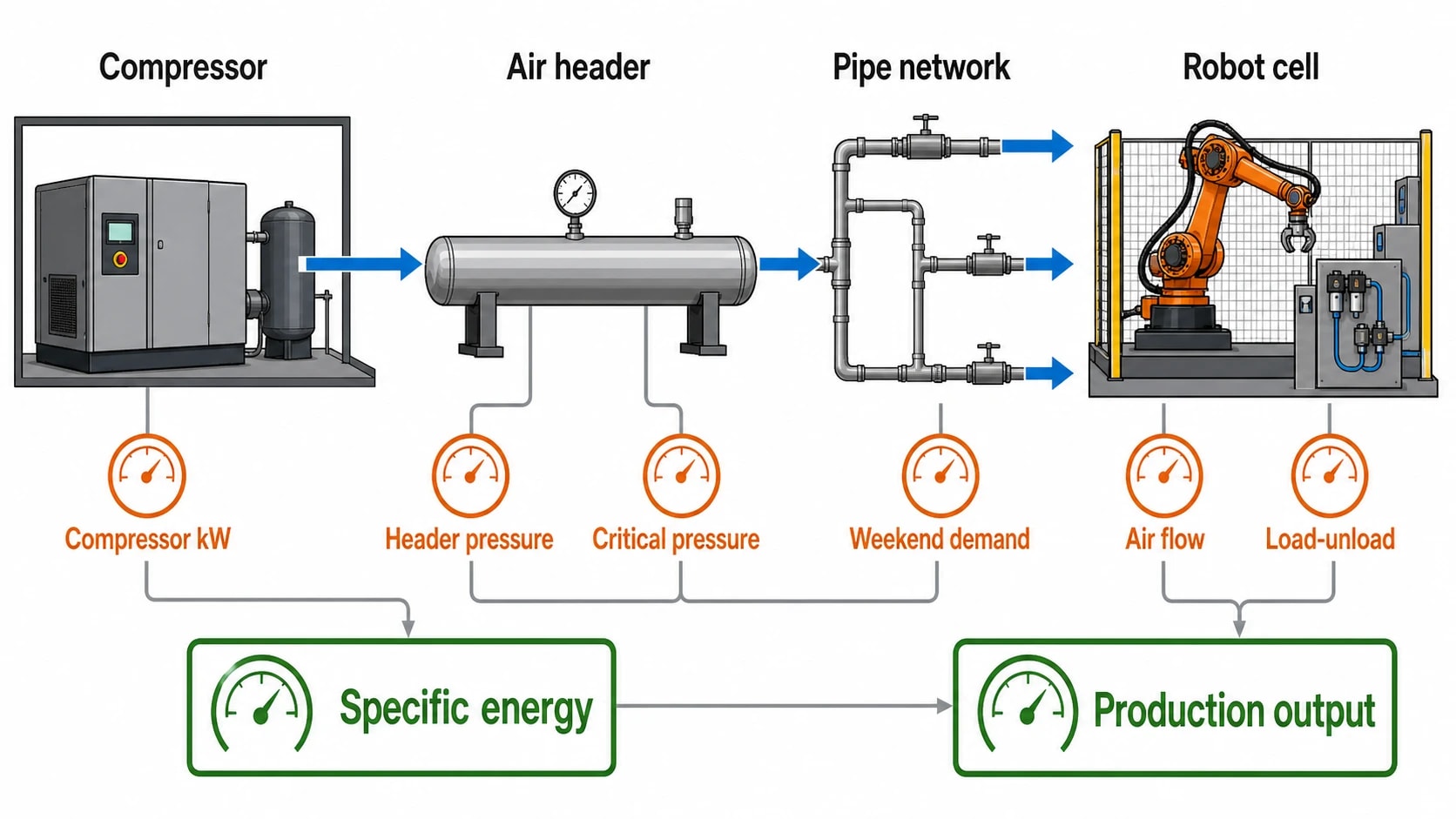
Ultrasonic leak detection should form part of the site walkdown, but a leak survey alone can understate the opportunity. The assessment should also record:
- Compressor kW, flow and load-unload behaviour
- Header pressure and pressure at critical users
- Overnight and weekend demand
- Artificial demand created by excessive pressure
- Inappropriate open blowing or venturi use
- Dryer and condensate-management energy
- Compressor-room inlet temperature and ventilation
A plant that raises header pressure to compensate for a few weak points pays for that decision through every operating hour. Local pressure loss, restrictive filters, undersized pipework or poor compressor sequencing may cost less to correct than adding generation capacity.
Treat compressed air as a production utility
Repair priorities should reflect both energy loss and operational consequence. A small leak close to a robot cell may be insignificant in energy terms but affect available pressure during peak production. Conversely, a large weekend base load may indicate leakage, equipment left energised or a process demand that needs its own operating schedule.
Verification should compare kWh, flow and output before and after intervention. Compressor energy per unit of delivered air can reveal whether sequencing has improved. Production-normalised plant electricity then confirms whether the saving survives changes in output.
Body-in-white robotics and welding lines offer controllable electrical savings
Body-in-white teams often protect maximum robot speed as a proxy for throughput. The cited robotic-cell study shows why that assumption deserves testing. Researchers modelled and measured a six-robot Škoda Auto cell, retaining welding, gluing and assembly work while changing robot movement speeds and power-saving modes. They estimated a reduction from 500 kJ to 391 kJ per cycle, about 20%, with most of the reduction attributed to speed optimisation.
Measure cells through the whole cycle
The audit should use temporary power analysers or installed sub-metering to record cell load across active welding, robot motion, waits, breaks and longer idle periods. The resulting profile identifies:
- Peak demand during concurrent robot motion and welding
- Standby consumption between operations
- Break and shift-change loads
- Periods long enough for an approved energy-saving mode
- Transformer, cooling and control loads that persist while production stops
The optimisation problem is operational. Engineers should identify movements with time margin, assess whether the cell contains long waits, and test whether alternative sequencing maintains takt time. Any amended programmes need normal production controls, including collision review, cycle-time validation, weld-quality approval and restore procedures.
Review welding transformer and cooling demand
Spot-welding energy is process-specific, but auxiliary losses merit attention. The audit can compare transformer input demand, cooling-water pump operation, filter condition, setpoints and idle-state consumption across comparable cells. Ageing transformers, poor power quality, unnecessary cooling circulation and controls that retain full demand during downtime may justify improvement.
The savings model should not assume that reducing instantaneous kW automatically reduces total kWh. The line must complete the same work at the same output rate, so cycle-level metering and post-change verification are more credible than nameplate estimates.

Identify where your plant is losing energy and quantify the savings potential — our audits map every heat source, sink, and waste stream in your facility.
HVAC and make-up air should follow actual automotive production demand
Automotive plants often treat HVAC as a building service, yet process areas connect it directly to energy use, quality and worker conditions. Make-up air for booths, conditioned manufacturing areas and local extraction can drive electricity and gas demand.
Use measured schedules to challenge fixed operation
The audit should compare air-handling run times with shifts, spray activity, production holidays and occupancy. Fan speed, supply temperature, return temperature, damper position and heating-valve demand can expose equipment running at full duty without a matching requirement.
Changes may include revised schedules, variable speed fan control, setpoint discipline, damper and sensor repairs, or better zoning. Each measure must preserve the process conditions required for coating quality and worker protection.
HSE states that employers must provide adequate ventilation in enclosed workplaces. In paint and welding environments, local exhaust ventilation and process-specific controls require separate attention. Energy managers should define a minimum approved operating envelope with health and safety, production and quality teams before altering control logic.
Connect heat-loss audits to capital planning
Thermal imaging works best when paired with operating data. A hot duct, uninsulated valve, damaged oven seal or leaking door can be photographed, measured and costed against operating hours. This turns a maintenance issue into a capital-planning decision.
The same approach applies to pipework, heat exchangers and hot-water circuits. Repair priorities should consider energy loss, personnel protection, access difficulty and the outage window. Small repairs often provide a faster return than a major thermal project, particularly where production access is limited.
Build the investment case around verified savings, not estimates alone
Energy projects compete with quality, capacity and maintenance programmes. The investment case needs to show annual energy savings, avoided cost, capital cost, outage requirement, maintenance implications and emissions reduction. It should define how the site will prove that savings occurred.
For ESOS Phase 3 participants, this discipline supports compliance. Organisations must ensure that assets and activities representing at least 95% of total energy consumption are covered by an audit or alternative compliance route. The second Phase 3 action-plan progress update is due on 5 December 2026 and must report implemented measures, energy-saving estimates and the method used to estimate them.
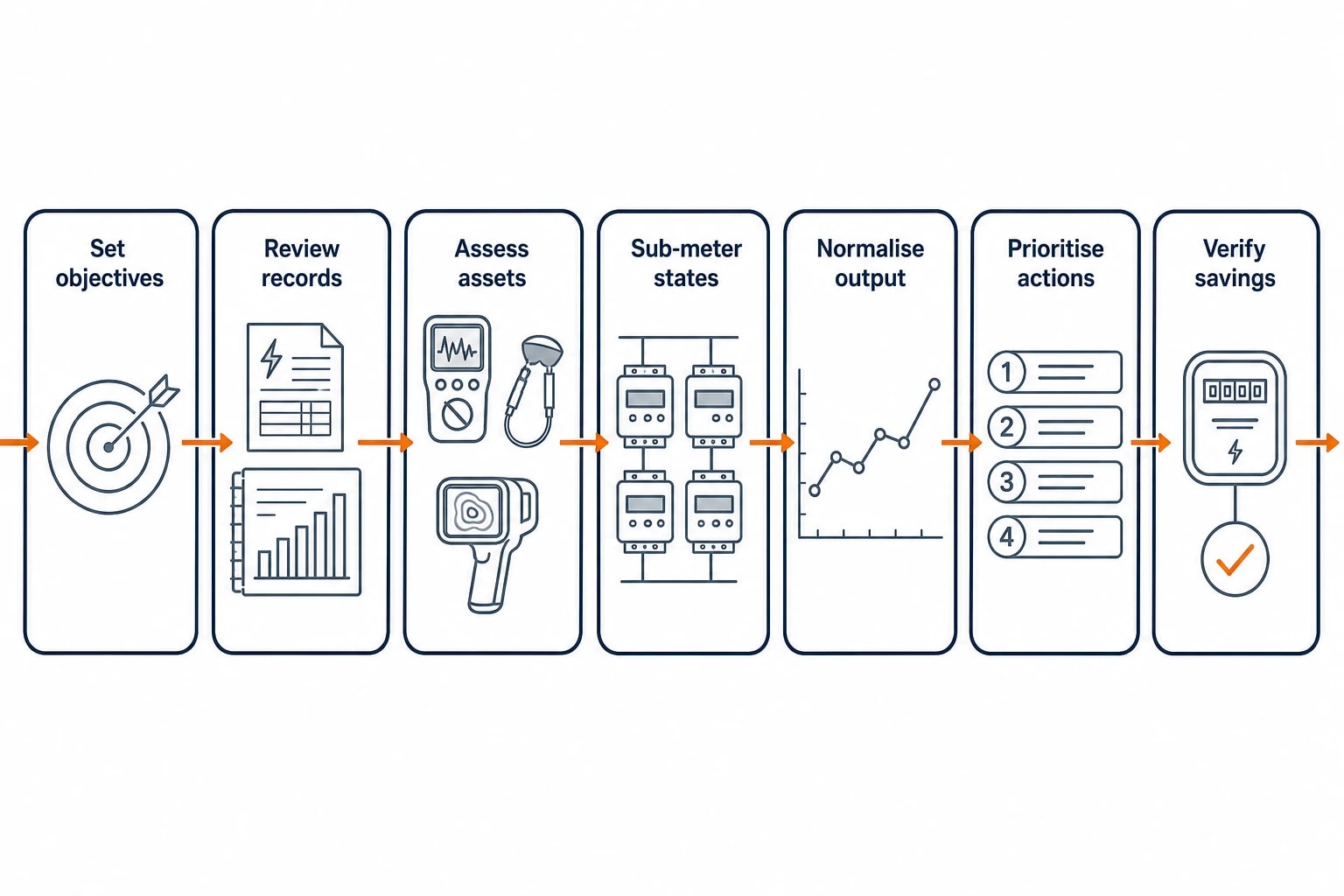
Apply a seven-step automotive energy audit
EnerTherm Engineering’s automotive audit method can structure the work around production reality:
- Initial consultation to establish business, output and carbon objectives.
- Review of utility data, production records and existing energy information.
- On-site assessment using power analysers, ultrasonic leak detection and thermal imaging.
- Sub-metering and observation of paint, welding, robotics, compressed air and HVAC operating states.
- Data analysis using production-normalised performance indicators.
- Prioritised implementation plan with financial return, risk and outage requirements.
- Implementation support and ongoing measurement and verification.
ISO 50001:2018 provides a useful framework for maintaining this discipline through energy baselines, performance indicators and continual improvement. Measurement and verification plans can follow IPMVP Core Concepts 2022, with the selected boundary and adjustment factors agreed before installation.
EnerTherm Engineering reports average outcomes of 19% energy-cost reduction, a 1.9-year payback period and an average annual reduction of 1,400 tonnes of CO₂ across its audit work. Individual automotive projects require site-specific validation, particularly where output mix, operating hours or contracted energy prices differ.
The practical priority for UK automotive energy managers
The best starting point is a ranked audit of systems that consume energy while production is idle, constrained or operating below design demand. Compressed-air base load, booth fan schedules, robot standby power, oven heat loss and uncontrolled make-up air all merit measurement before capital is committed.
This article reflects the independent analysis and editorial opinion of EnerTherm Engineering. Product names, trademarks, and brands mentioned belong to their respective owners. EnerTherm Engineering is not affiliated with, endorsed by, or a licensee of any third-party software or product mentioned unless explicitly stated.

Managing Director — EnerTherm Engineering
Dr. François Pierrel is Managing Director of EnerTherm Engineering with over two decades of expertise in thermal design, heat transfer, and industrial energy optimisation. He holds a PhD in Heat Transfer from Cranfield University and a Post-Doctorate from Heriot-Watt University.
