
Why Chemical Plants Need Energy Audits Under ESOS Phase 4
ESOS Phase 4 requires industrial-process assessments every four years
An energy audit for a chemical plant is a structured assessment of how a site uses fuel, electricity, steam and recovered heat to identify technically viable energy-saving measures without compromising production, process safety or emissions compliance.
For qualifying UK organisations, ESOS Phase 4 makes that assessment a formal compliance requirement. The scheme covers energy used by buildings, transport and, critically for chemical manufacturers, industrial processes. A plant’s energy demand is concentrated in fired heaters, boilers, reactors, distillation trains, steam networks, refrigeration, compressed air and heat exchanger networks. These operational systems directly affect unit cost, throughput, product quality and emissions.
The Environment Agency published Phase 4 guidance on 30 July 2026. Organisations that qualify on 31 December 2026 must submit their compliance notification by 5 December 2027. Chemical sites therefore need to gather reliable data, complete fieldwork, test opportunities with operations teams and present decisions for board-level sign-off.
Which chemical plants fall within ESOS Phase 4?
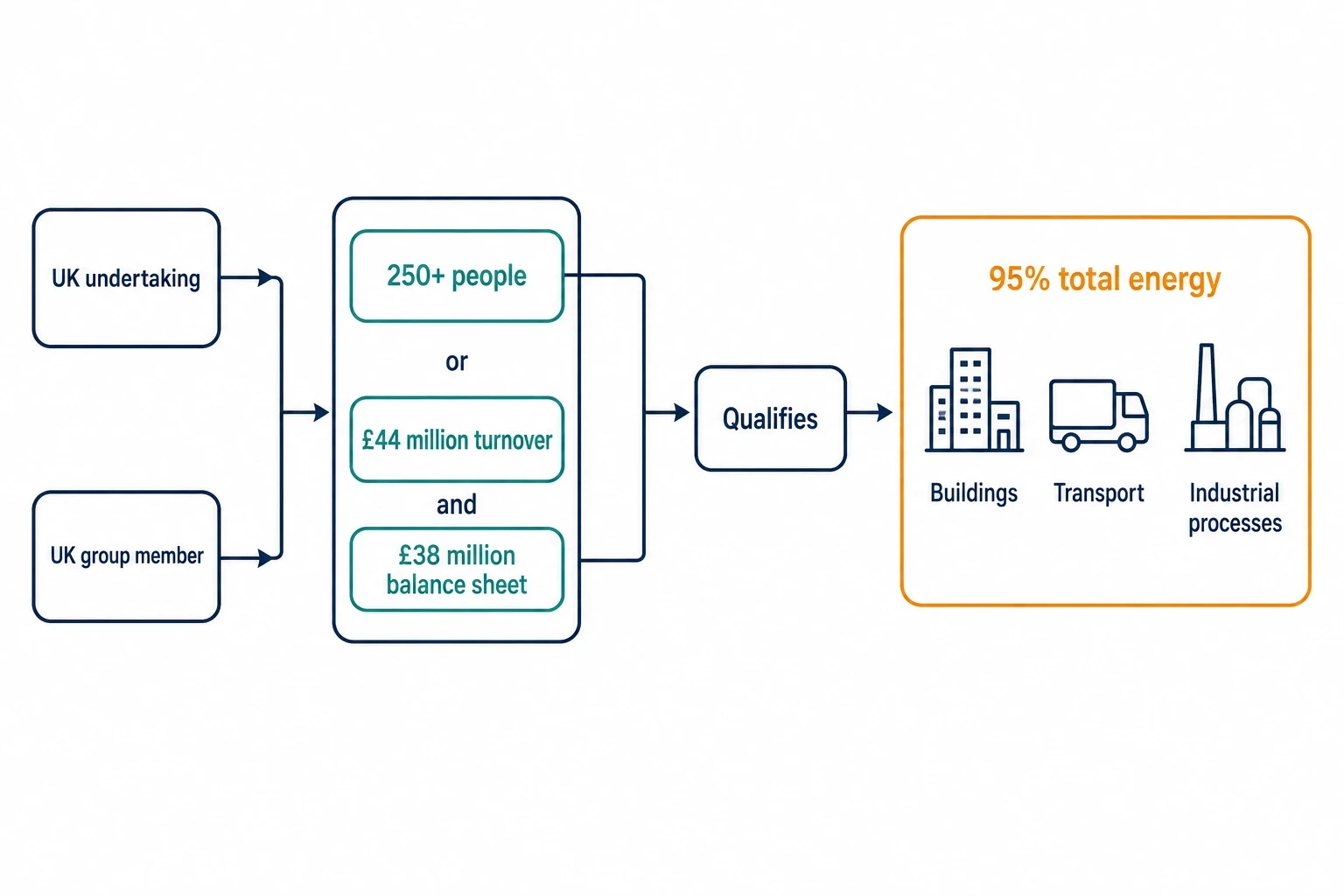
ESOS applies to large UK undertakings and corporate groups. A business qualifies if it employs 250 or more people, or has annual turnover above £44 million and an annual balance sheet total above £38 million.
A chemical site does not need to meet those thresholds as a standalone operation. A group qualifies if at least one UK group member meets the definition of a large undertaking. This matters to specialty chemicals businesses with smaller plants, as well as polymer and bulk chemical operations owned by larger groups.
Industrial-process energy is part of the assessment
The scheme requires qualifying organisations to calculate total energy consumption across buildings, transport and industrial processes. Areas of significant energy consumption must represent at least 95% of total consumption.
For a chemical manufacturer, industrial processes normally contain the material energy issues. The audit must distinguish between energy that supports production and energy that is lost, oversupplied or used at a higher temperature or pressure than the duty requires.
That distinction needs process knowledge. A monthly gas bill may establish annual spend, but it cannot show whether a furnace excess-air setting has drifted, whether a steam pressure-reducing valve is dissipating useful pressure, or whether a fouled heat exchanger is forcing a reactor train to consume extra steam.
Compliance routes have narrowed
From Phase 4, Display Energy Certificates and Green Deal Assessments are no longer alternative routes to compliance. Participants must use ESOS-compliant energy audits, ISO 50001 certification, or a combination of the two.
An organisation using ISO 50001:2018 must ensure its certification covers the required energy consumption and remains valid on the compliance date. Where ISO 50001 certification covers significant or total energy consumption, Phase 4 reduces certain reporting and lead-assessor obligations. Certification does not remove the value of plant-level investigation. Production changes, feedstock variation and maintenance conditions can materially alter energy performance between certification cycles.

Identify where your plant is losing energy and quantify the savings potential — our audits map every heat source, sink, and waste stream in your facility.
What ESOS Phase 4 changes for chemical plant energy audits
Phase 4 puts more weight on implementation and evidence. The assessment is no longer limited to identifying opportunities for a future list.
Action-plan delivery must be reported
Phase 4 reports and compliance notifications must include energy savings achieved during the compliance period. They must describe measures implemented, the energy savings achieved by each measure and the measure’s energy-saving category.
Participants must also review their action plan. Where proposed measures have not been implemented, the organisation must identify them and explain why. Common reasons at chemical sites may include a deferred shutdown, an unacceptable process safety risk, unresolved product-quality implications, insufficient plot space, a changed production forecast or a capital project failing an internal investment test.
Those reasons should be documented with the same discipline as the proposed measure. A decision to defer a heat-recovery project, for example, should state the required process study, shutdown window, mechanical-integrity work and operating conditions needed before reconsideration.
Energy intensity must be meaningful
Phase 4 requires energy intensity ratios for buildings, transport, industrial processes and other energy uses. The selected indicator must be quantifiable, linked to the relevant activity and based on verifiable data where reasonably practicable.
For chemical processing, a site-wide kWh-per-tonne figure can obscure more than it reveals. It may change because of product mix, batch size, grade transitions, feedstock composition, reaction yield or operating rate. Better audit practice develops indicators that reflect the process boundary:
- Fuel per tonne of on-spec product for a fired process.
- Steam per tonne of product or per batch for a separation train.
- Electricity per tonne for extrusion, pumping, milling or refrigeration.
- Energy per tonne of solvent recovered for a recovery unit.
- Boiler fuel relative to measured steam exported to defined users.
The metric should be stable enough to compare periods, yet specific enough to guide action. It should expose abnormal operation rather than normalising it away.
Site visits and measured data remain central
An ESOS-compliant audit must use, so far as reasonably practicable, verifiable energy data measured over a 12-month period. The period must begin no earlier than 6 December 2022 and no more than 24 months before the audit starts. The audit must analyse energy consumption and efficiency, identify opportunities and include site visits.
That fieldwork is indispensable in chemical plants. Audit teams need to walk steam headers, inspect insulation condition, examine condensate return arrangements, observe furnace and boiler operation, review heat-exchanger approach temperatures, and compare logged utility demand with actual plant operating states.
Where an energy audit for chemical plants finds value
Chemical sites contain interdependent thermal loads. A measure that appears attractive in isolation can shift pressure, temperature, cooling duty, emissions or control behaviour elsewhere. The audit should therefore build a process energy map before ranking projects.
Fired heaters, furnaces and boilers
Combustion systems deserve early attention because they convert purchased fuel into process heat and steam. Auditors typically review flue-gas oxygen, stack temperature, burner condition, combustion control, heat-transfer surfaces, boiler blowdown, feedwater temperature and operating load.
High stack temperature may indicate fouling, refractory deterioration, excess air, poor heat transfer or a damaged economiser. Each cause demands a different response. Reducing excess air without confirming burner condition, flame stability and emissions performance would be poor engineering.
Audits should link efficiency work to the site’s regulated emissions obligations. Burner tuning, combustion control and heat recovery can affect NOₓ performance. Any project affecting vent systems, thermal oxidisers or process conditions needs review against the environmental permit and the operating envelope of the abatement equipment.
Steam and condensate systems
Steam systems often distribute energy well beyond the boiler house. Losses arise through leaking traps, failed isolation valves, uninsulated fittings, flash steam left unmanaged, excessive pressure reduction, condensate losses and low boiler feedwater temperature.
A useful audit separates generation, distribution and end-use demand. A boiler may operate efficiently while the plant still wastes steam through inappropriate pressure levels or poor condensate recovery. Equally, a local steam-saving project may reduce a load that supports a viable combined heat and power operating profile. The site energy balance needs to test those interactions.
Heat exchanger networks and pinch analysis
Heat exchanger performance is central to many chemical energy cases. Fouling raises pressure drop and can force extra steam or cooling demand. Bypass leakage, incorrect valve positions and poor control strategy can have similar effects.
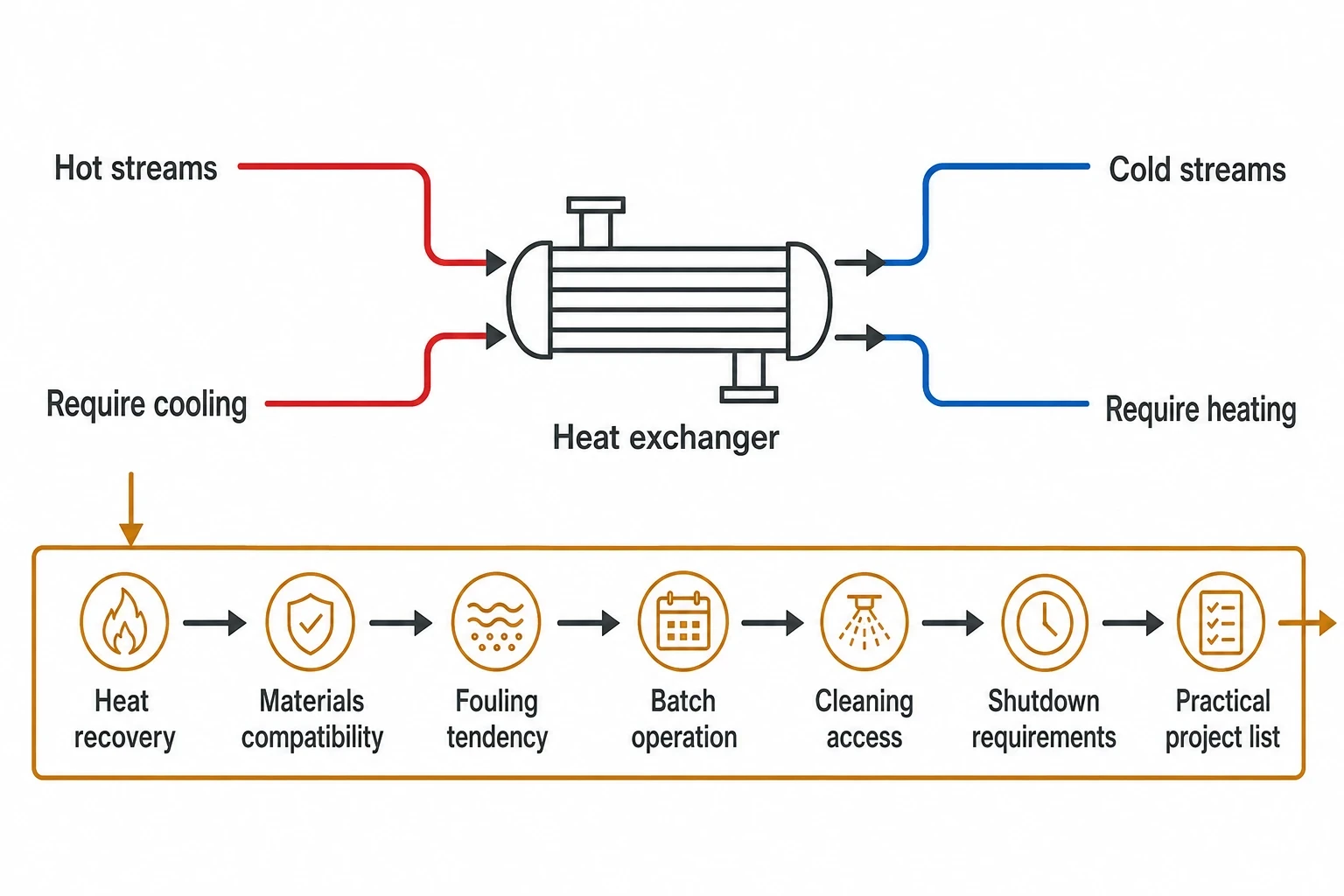
Pinch analysis provides a disciplined way to examine heat recovery across process streams. It compares hot streams that require cooling with cold streams that require heating, then identifies the practical limits of internal heat recovery. The result is not a guarantee that every theoretical heat exchanger is buildable. Materials compatibility, fouling tendency, batch operation, controllability, cleaning access, plot space and shutdown requirements determine the practical project list.
For batch and specialty chemical sites, the audit should use production schedules as well as design temperatures. Heat is often available at a useful temperature but at the wrong time. Storage, scheduling changes or a different utility arrangement may be more suitable than a permanent heat exchanger.
Motors, pumping, refrigeration and compressed air
Electricity opportunities commonly emerge in pumps, fans, agitators, vacuum systems, refrigeration compressors and compressed-air supply. Variable-speed drives can reduce throttling or recirculation losses where process duty genuinely varies. They require a review of minimum-flow protection, pump curves, control philosophy and hazardous-area suitability.
Compressed air should be treated as a defined utility with measured generation and demand. Leak repairs matter, but audit work should also challenge inappropriate uses, excessive header pressure and artificial demand. Air used for conveying, cooling, sparging or inerting may have process alternatives, each requiring a safety and quality assessment.

Identify where your plant is losing energy and quantify the savings potential — our audits map every heat source, sink, and waste stream in your facility.
How safety shapes chemical plant audit work
Energy audits must operate within the site’s process safety management system. The objective is to identify opportunities, not to alter equipment or operating conditions during fieldwork.
DSEAR and hazardous-area controls
The Dangerous Substances and Explosive Atmospheres Regulations 2002 require employers to assess risks from dangerous substances before work takes place. This is directly relevant when auditors install temporary power analysers, thermal-imaging equipment, flow meters or pressure instruments near flammable solvents, gases, dusts or vapours.
The assessment should establish the hazardous-area classification, permit requirements, ignition-source controls, isolation boundaries and equipment suitability before field measurements begin. The audit plan should involve the site’s responsible engineer and permit office, particularly where measurements need access to live electrical panels, hot surfaces or elevated pipework.
In Great Britain, the Equipment and Protective Systems Intended for Use in Potentially Explosive Atmospheres Regulations 2016 regulate equipment and protective systems placed on the GB market for explosive atmospheres. The former 1996 regulations are not the current GB product framework. Equipment selection for new or temporary audit instrumentation must align with the applicable zone and the site risk assessment.
Preserve safeguards and SIL functions
An energy project can touch equipment protected by safety instrumented functions. Changes to trip settings, control valves, burner management, pressure control or interlocks require management of change and review by the responsible functional-safety team.
Audit recommendations should identify these dependencies early. A variable-speed drive on a critical pump, a change to furnace air control or a revised steam pressure regime may be technically promising, yet need a hazard review, cause-and-effect check, proof-test consideration or formal SIL assessment before implementation.
Turning audit findings into investable energy conservation measures
A credible Energy Conservation Measure, or ECM, needs more than an estimated energy saving. Chemical plants need enough engineering definition to determine whether the change is safe, operable and financially sound.
EnerTherm Engineering’s seven-step methodology
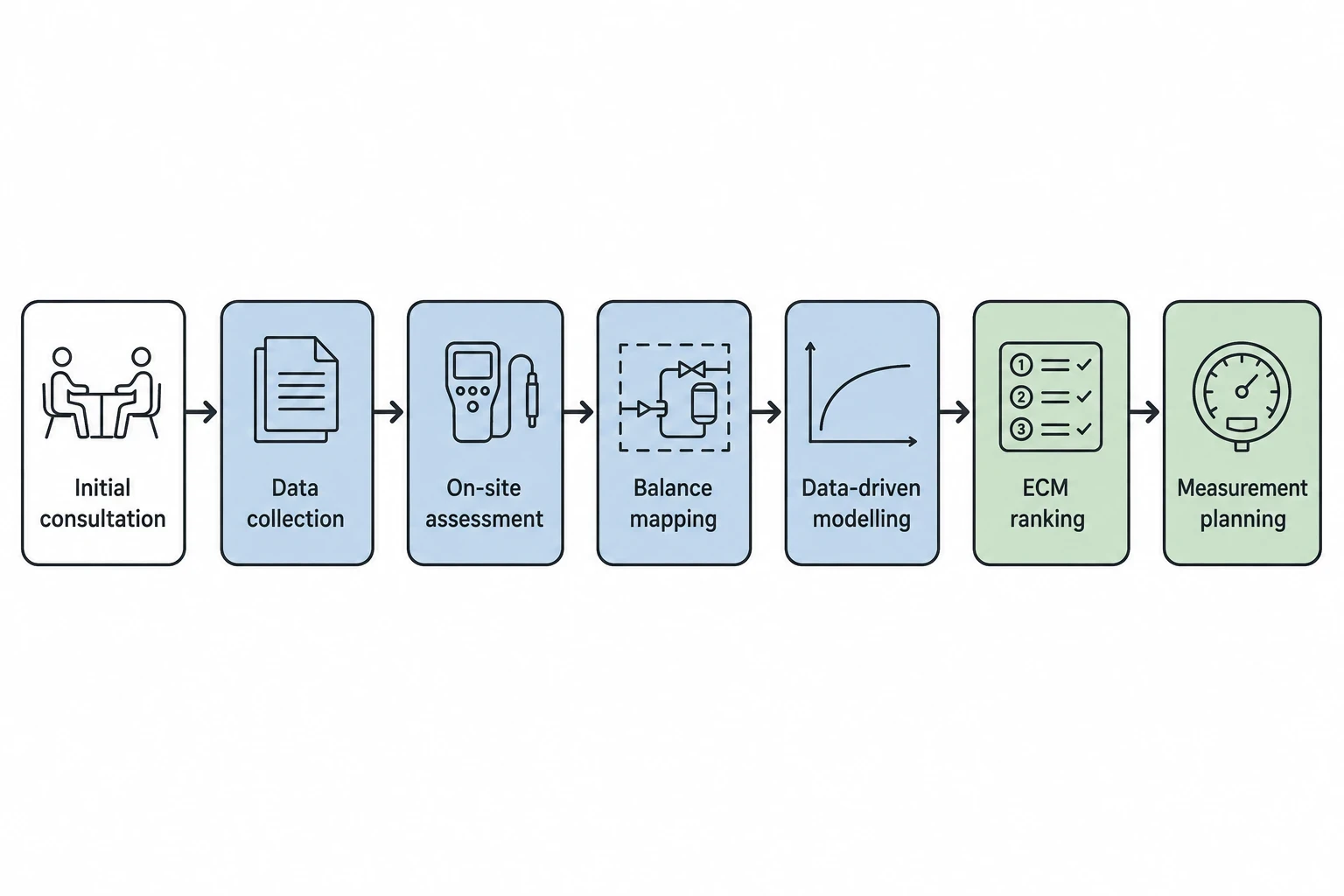
EnerTherm Engineering’s methodology provides a practical structure for an energy audit for chemical plants:
- Initial consultation to establish production priorities, operating constraints and ESOS scope.
- Data collection covering utility bills, production records, process data and maintenance history.
- On-site assessment using appropriate tools such as power analysers and thermal imaging.
- Energy and mass-balance mapping to locate major losses and establish process boundaries.
- Data-driven modelling to test opportunities under representative operating conditions.
- Development and ranking of ECMs by energy impact, capital requirement, practicality, risk and expected payback.
- Implementation support and measurement planning to confirm results after project delivery.
This sequence protects against a familiar failure: selecting measures from generic checklists before understanding the plant’s thermodynamics and operating constraints.
Rank projects by value and deliverability
A capital list should separate no-capital operating changes, maintenance actions, minor modifications and major projects. It should also identify enabling work such as metering, process studies, hazardous-area design, control upgrades or shutdown access.
Financial evaluation should use the investment method required by the organisation. Simple payback can screen small projects, while Net Present Value provides a stronger basis for multi-year capital decisions. The calculation should include production effects, maintenance savings, installation costs, outage costs, utility-price assumptions and any impact on emissions compliance.
A project that reduces fuel consumption but constrains throughput, worsens product quality or raises maintenance exposure has not created a sound outcome. The audit must bring those trade-offs into the business case.
Measurement and verification closes the ESOS loop
Phase 4’s focus on achieved savings makes measurement and verification part of project delivery. The International Performance Measurement and Verification Protocol, IPMVP Core Concepts 2022, offers an established framework for defining boundaries, baselines, adjustments and reporting.
For chemical plants, the measurement plan should be agreed before implementation. It should state the meter or calculation method, baseline period, reporting period, relevant production variables, expected routine adjustments and treatment of non-routine events such as outages, grade changes or capacity expansions.
Ongoing consumption monitoring can turn the ESOS audit into a management tool. Monthly reviews of fuel, steam, electricity and process-specific intensity indicators make deterioration visible before the next four-year assessment. They also create an evidence trail for action-plan progress and the Phase 4 report.
This article reflects the independent analysis and editorial opinion of EnerTherm Engineering. Product names, trademarks, and brands mentioned belong to their respective owners. EnerTherm Engineering is not affiliated with, endorsed by, or a licensee of any third-party software or product mentioned unless explicitly stated.

Senior Process Engineer — EnerTherm Engineering
Masab Javed is a Senior Process Engineer at EnerTherm Engineering with extensive expertise in chemical process design, decarbonisation, and sustainable industrial solutions. He holds an MSc from TUM School of Management and a BEng in Chemical Engineering from NUST, with experience spanning ammonia production, CO2 capture, and semiconductor manufacturing optimisation.
