
Why ISO 50001 Energy Baseline Calculation Fails Audits
How ISO 50006:2023, regression analysis and re-baselining support audit-ready EnBs.
ISO 50006:2023 defines how organisations should establish, use and maintain energy performance indicators, known as EnPIs, and energy baselines, known as EnBs, to evaluate energy performance improvement.
That work determines whether an ISO 50001 audit can verify improvement or merely confirm that a site has recorded utility consumption. A plant may report lower gas use after a mild winter, lower electricity use after reduced production, or improved kWh per tonne after shifting to less energy-intensive products. None proves improved energy performance without a baseline that accounts for operating conditions.
This is where many ISO 50001 energy baseline calculations fail. A spreadsheet may contain correct meter readings, yet its method does not establish a fair comparison. It may use a short baseline period, omit relevant variables, combine incompatible product groups or continue unchanged after a major expansion. Certification auditors can trace those weaknesses through the energy review, monitoring records and management-review evidence.
For industrial sites in pharmaceuticals, food and beverage, chemicals and heavy manufacturing, an EnB must be controlled compliance evidence. It needs an explicit boundary, reliable inputs, a repeatable calculation method and a documented response to permanent operational change.
What an ISO 50001 energy baseline calculation must demonstrate
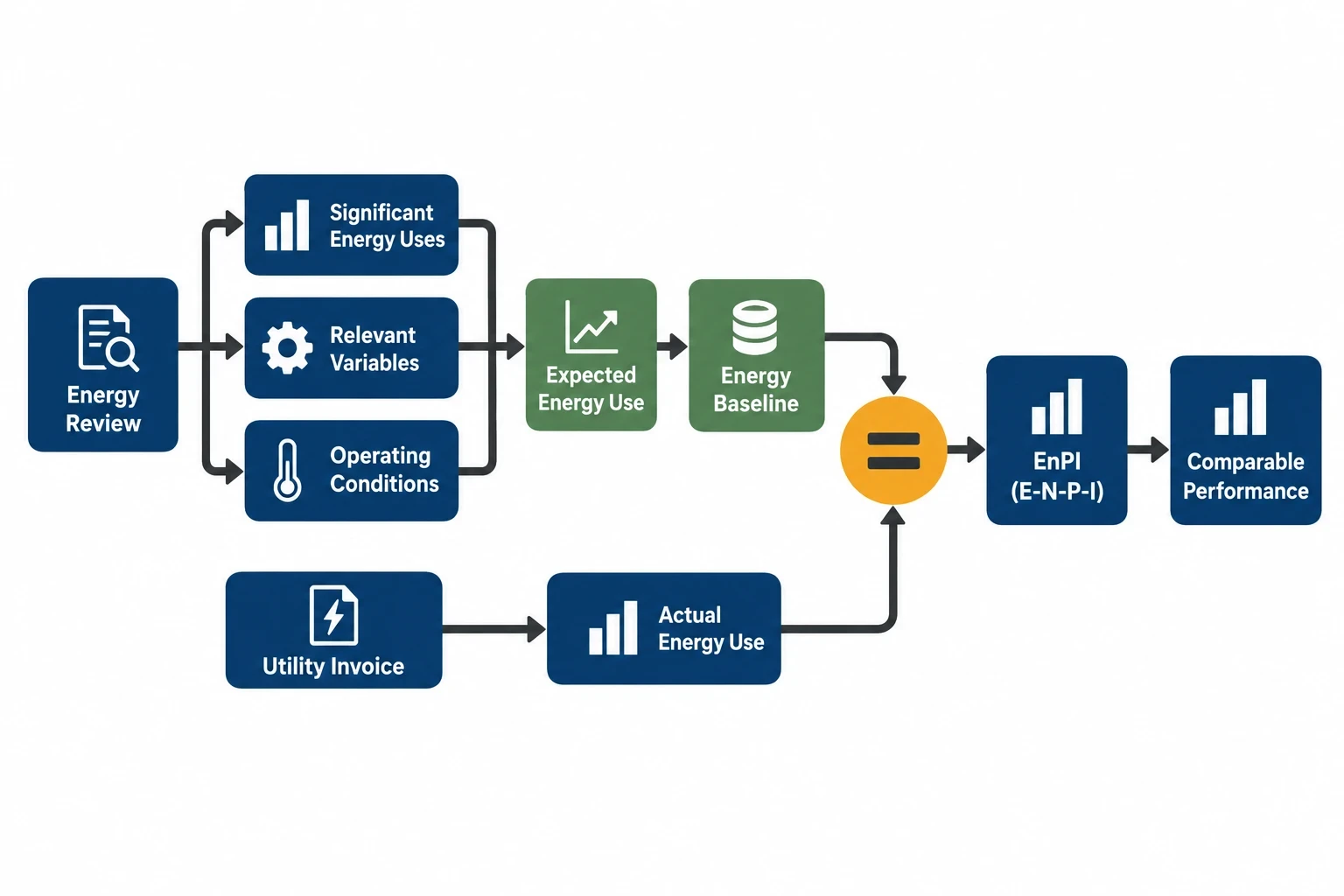
An energy baseline is a quantified reference against which an organisation compares energy performance over time. It should describe expected energy use under defined operating conditions, rather than be a historic consumption total.
A credible calculation starts with the energy review. The organisation identifies significant energy uses, determines the factors that influence them and chooses EnPIs that represent performance. ISO 50001:2018 places the baseline requirement in Clause 6.5, while Clause 6.6 requires planning for the collection of energy data. Clause 9.1 requires monitoring, measurement, analysis and evaluation of energy performance.
Consumption is not energy performance
Absolute consumption is an important management measure, but it cannot explain operational context on its own. A food manufacturer may use less natural gas because fewer batches ran. A pharmaceutical plant may use more electricity after a cleanroom extension while reducing fan energy per air change. A furnace process may consume more electricity while producing substantially more saleable output.
An audit-ready EnB separates these operational facts from performance improvement. It answers a specific question: what energy use would reasonably have occurred under the reporting period's conditions without the improvement?
ISO 50001 focuses on energy performance, including energy efficiency, energy use and energy consumption. A utility invoice records consumption. An EnB translates that record into a comparable performance result.
EnBs and EnPIs have distinct purposes
The EnB provides the reference condition. The EnPI measures performance against it. An organisation may use a ratio, a regression model or another suitable method, provided the measure reflects the relevant energy use.
A simple ratio such as kWh per tonne may suit a stable, high-volume process with limited product variation. It becomes unreliable when grades, batch durations, process temperatures or packaging formats materially affect energy demand.
A plant with different product families may need separate throughput variables. Tonnes of low-temperature liquid product, frozen food and spray-dried powder do not necessarily create comparable utility loads. Combining them into one production figure can conceal waste and genuine efficiency gains.
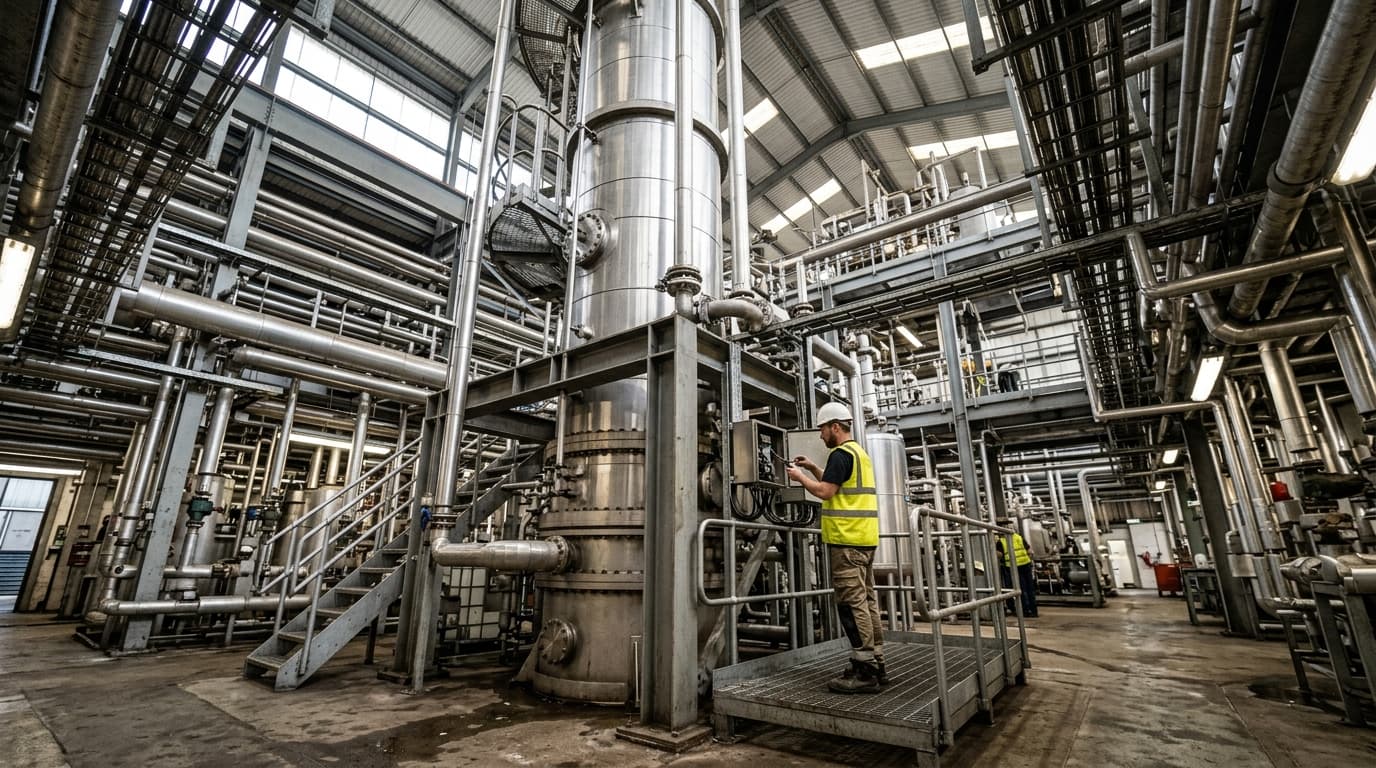
Omni Vision delivers turnkey utility metering, CO2 tracking, and AI-powered production KPI intelligence — giving you real-time dashboards and actionable insights across your entire facility.
Why baseline periods fail certification audits
Baseline selection is an engineering decision, not an administrative choice. The period must represent the conditions against which the organisation intends to measure performance.
The chosen period does not represent normal operation
A baseline affected by a prolonged shutdown, supply constraint, abnormal product mix or temporary plant outage will distort future comparisons. The calculation may show apparent savings because the reporting period looks more typical than the selected reference year.
A 12-month baseline often provides a useful starting point because it can capture seasonal weather and ordinary production cycles. It is not automatically valid. The team must identify abnormal events, check meter continuity and assess whether the period includes representative operating modes.
For example, a site that selected a baseline year during reduced demand may report apparent deterioration after production returns to normal. A team that selected a year with unusually high refrigeration demand may overstate later savings. Both cases weaken the claim because the reference condition lacks context.
Energy and activity data use different time boundaries
Energy data and relevant-variable data must cover the same intervals. This control often fails where teams combine utility invoices, monthly production reports and independently downloaded weather data.
An electricity invoice that closes on the 18th of each month cannot be directly matched with production totals recorded from the first to the last calendar day. A half-hourly energy dataset cannot support a weekly batch figure without a clear allocation method. A report that mixes local weather data with a distant weather station needs a documented justification.
Auditors will test whether a reported baseline result can be reproduced from source records. The evidence should identify:
- The utility meter or sub-meter used.
- The measurement boundary and utility stream covered.
- Data units and conversion factors.
- Timestamp conventions and reporting cut-off dates.
- Data owners and review responsibilities.
- Corrections for meter resets, missing values or communications failures.
A calculation can be statistically sophisticated and still fail if its input data cannot be reconciled.
The boundary does not match the improvement claim
The measurement boundary must align with the energy performance claim. A whole-site electricity EnB can support a site-level improvement result, but it cannot isolate savings from one compressed-air project unless the organisation has suitable sub-metering or a documented allocation approach.
The opposite problem also occurs. A boiler-house EnPI may demonstrate combustion or steam-generation improvement, yet it does not establish whole-site ISO 50001 performance by itself. The site needs evidence showing how the significant energy use relates to incoming fuel supplies, process demand and the wider EnMS scope.
Meter mapping is part of baseline governance. Teams should retain a current hierarchy showing supply meters, distribution meters, process meters and estimated data points. Changes to a meter, pulse factor, communication path or unit conversion should trigger reconciliation before revised data enters the EnB.
Relevant variables and normalisation determine whether the comparison is fair
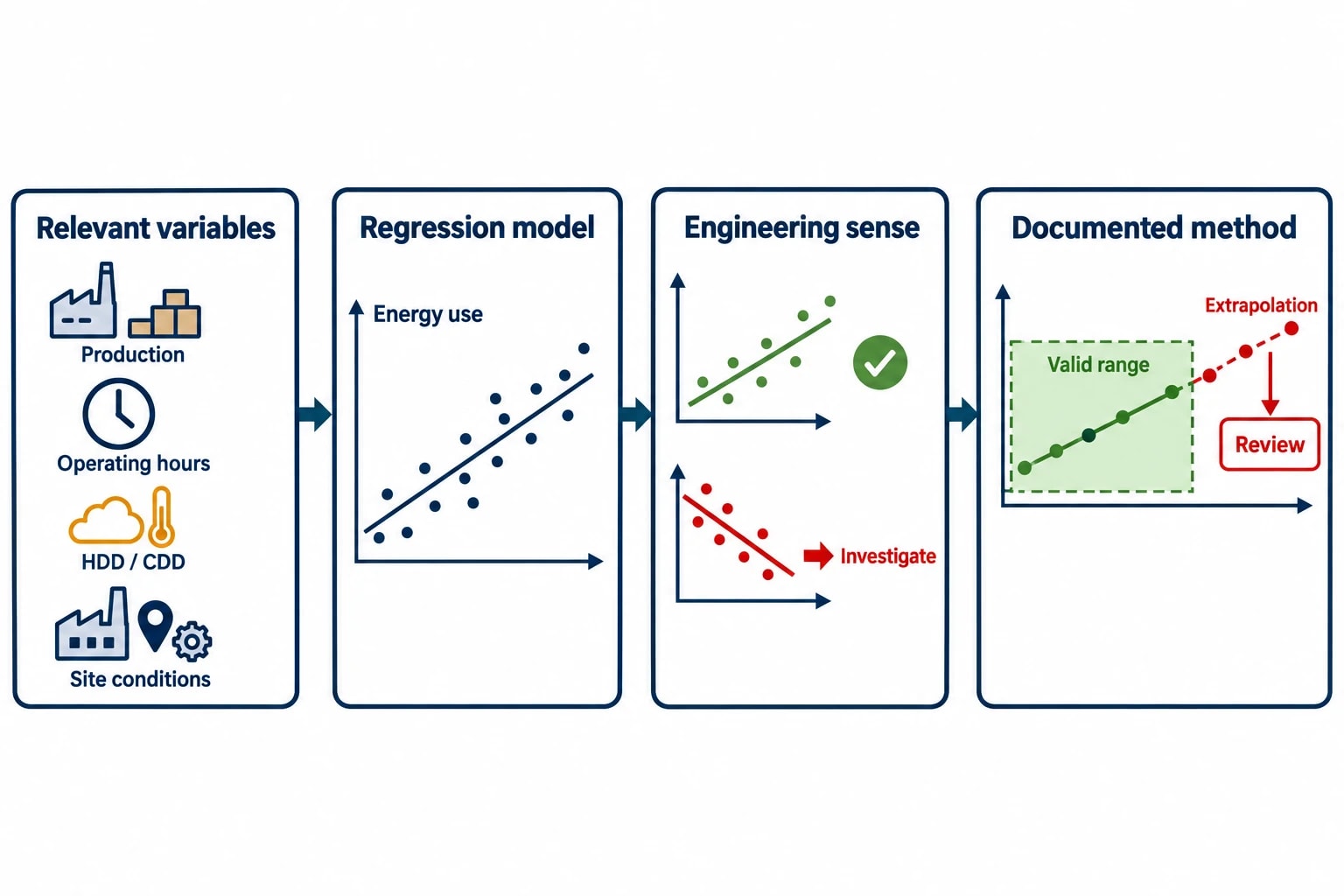
ISO 50001 requires organisations to normalise EnPI values and corresponding EnBs where relevant variables significantly affect energy performance. ISO 50006:2023 gives updated guidance for establishing and maintaining this work.
The International Performance Measurement and Verification Protocol, IPMVP Core Concepts 2022, describes routine adjustments as mathematical or statistical adjustments for expected changes in independent variables. In industrial applications, these variables may include production, operating hours, outdoor temperature, heating degree days and cooling degree days.
Regression analysis must follow process reality
Regression analysis can model the relationship between energy consumption and one or more relevant variables. It can support site-wide and major-area assessments where meter data captures the combined effect of multiple measures.
The model should first make engineering sense. If a production coefficient suggests that energy falls as output rises, the team should investigate data alignment, product mix, missing fixed load or incorrect variable selection. A high R² alone does not prove that a model is suitable.
Consider a chilled-food facility. Refrigeration electricity may relate to product throughput, cold-store occupancy, outside temperature and operating hours. A model based only on tonnes produced may understate the influence of storage conditions. A pharmaceutical facility with substantial cleanroom ventilation may require separate consideration of operating mode, air-change requirements and occupancy patterns.
Relevant variables should be selected because they materially affect energy use within the chosen boundary, not because the data is easy to obtain.
Degree days require a demonstrated link
Heating degree days, HDD, and cooling degree days, CDD, can improve normalisation for weather-sensitive loads. They are not universal inputs.
HDD may suit gas use in space heating or process areas influenced by outside conditions. CDD may suit cooling loads where ambient temperature affects refrigeration or air-conditioning demand. A facility with predominantly internal process heat gains, tightly controlled cleanrooms or a large continuous thermal process may show a different relationship.
The organisation should document why weather data is relevant, its source, the selected base temperature where applicable and its alignment with energy data. This turns an assumed relationship into an auditable modelling choice.
Model validity must be recorded
IPMVP advises recording the range of independent-variable values used to develop a baseline model. This prevents a team from applying a model beyond the conditions under which it was developed.
A model based on ordinary production volumes may become unsuitable after a capacity expansion. A temperature model built only from mild seasons cannot reliably estimate winter heating demand. A baseline applied outside its valid range is extrapolation and should trigger review rather than automatic performance reporting.
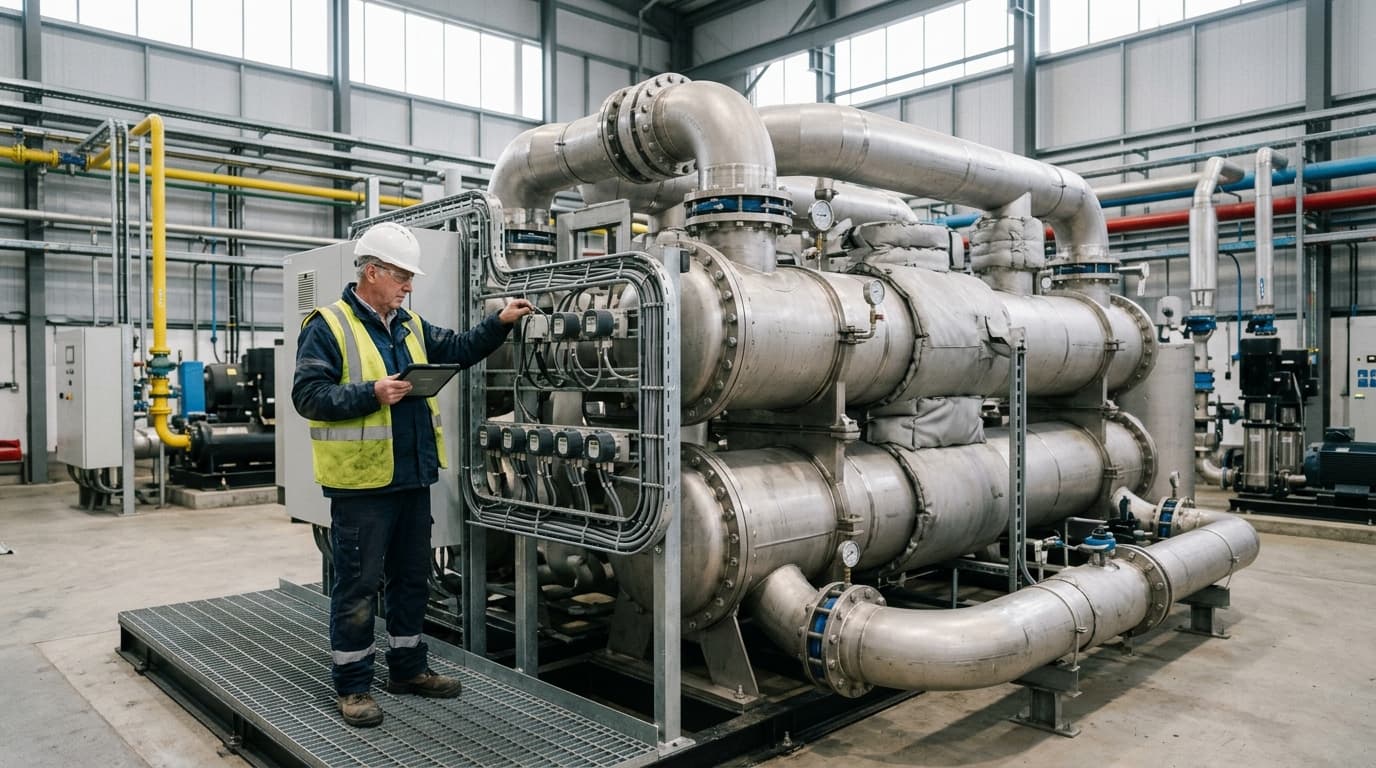
Track energy consumption, emissions, and process parameters with seamless PLC/SCADA integration via Modbus, OPC-UA, and MQTT protocols.
Static factors require controlled baseline revision
Routine adjustments address expected changes. Static factors describe characteristics that normally remain stable, such as facility size, installed equipment, process configuration, measurement boundary or permanent operating arrangements.
When a significant static factor changes, the organisation must review whether the EnPI and EnB remain representative. ISO 50001 Clause 6.5 requires revision of EnBs when EnPIs no longer reflect energy performance, when major changes to static factors occur, or according to a predetermined method.
Common triggers for re-baselining
The following changes should enter a formal EnB review process:
- Installation of a new production line or process furnace.
- Cleanroom, warehouse or cold-store expansion.
- A material change in installed refrigeration, compressed-air or steam-generation equipment.
- Permanent additional shifts or sustained operating-hours changes.
- A revised product portfolio with different thermal or utility demands.
- Alteration of the organisational, site or metering boundary.
- Major refurbishment that changes ventilation, heating or process controls.
A facility extension may add a permanent electrical baseload. A new compression train may alter compressed-air capacity and specific energy use. A recipe change may increase steam demand per batch. Treating these events as ordinary variation produces a comparison that no longer represents the same operating system.
Record the decision, not only the revised number
An auditor needs more than a revised baseline file. The evidence should show the engineering change, its expected effect, the assessment method, the decision-maker and the date on which the new approach took effect.
Where a non-routine adjustment is appropriate, the organisation should document its basis and apply it consistently. Where the change permanently alters the energy system, revision of the EnB may be more appropriate. The decision should connect to engineering change control, capital-project records and the baseline register.
This governance matters in regulated factories. Quality, maintenance and production teams may already operate formal change-control procedures. Energy-management responsibilities should connect to that process so a permanent alteration cannot bypass EnB review.
What auditors expect behind a baseline result
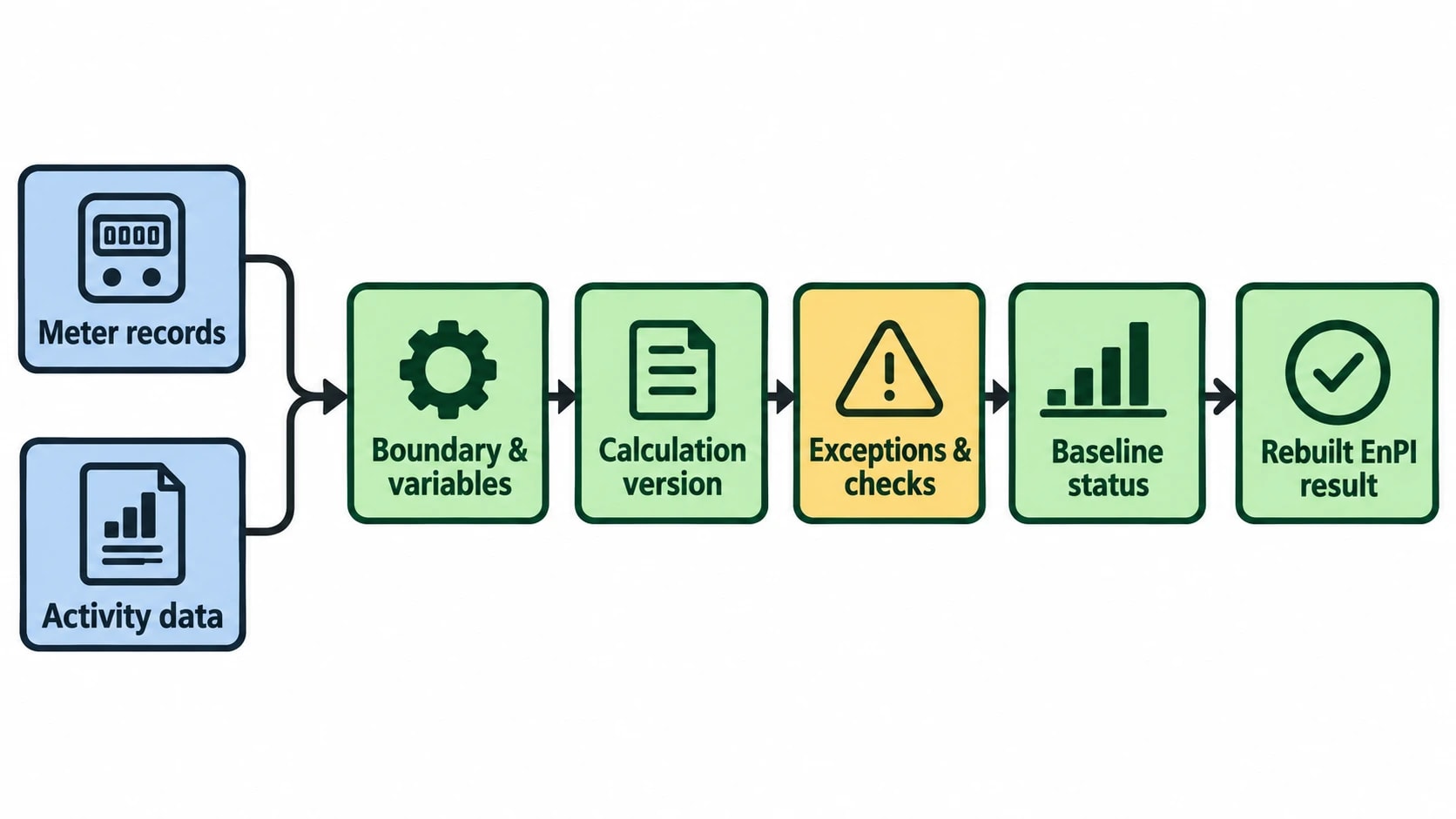
ISO 50003:2021 sets requirements for bodies providing ISO 50001 audit and certification. Auditors therefore examine whether the organisation's evidence supports a consistent assessment of energy performance improvement.
A graph in a management-review presentation will not establish that evidence chain. The calculation needs supporting records that explain how it was created, maintained and used.
| Audit question | Evidence expected |
|---|---|
| What does the EnB cover? | Defined site, process, utility streams, meters and organisational boundary |
| Why was the period selected? | Baseline rationale, operating history and record of abnormal events |
| What influences energy use? | Energy review, variable assessment and process explanation |
| How was normalisation performed? | Controlled method, model version, assumptions and source datasets |
| Can the result be reproduced? | Meter records, production data, timestamps, calculations and checks |
| What changed since the baseline? | Static-factor register, change-control records and revision decisions |
| How is improvement evaluated? | EnPI results, investigations, actions and management-review records |
Missing data needs a formal rule
No industrial energy dataset is perfect. Meter maintenance, network failures and late production records create gaps. The compliance risk comes from undocumented estimates.
The organisation should define how it will identify, investigate and treat missing data. A short gap during stable operation may permit a transparent interpolation method. A long outage during peak production may require exclusion, an independently checked substitute source or further investigation. The method must be proportionate to the significance of the data and applied consistently.
Internal audit should reproduce the calculation
A useful internal audit samples a reported EnPI result and rebuilds it from raw meter and activity data. The auditor should check the boundary, variables, calculation version, exceptions and baseline status.
This exercise identifies weaknesses before the certification audit. It also tests whether knowledge sits with one spreadsheet owner or has been embedded in controlled procedures.
A practical ISO 50001 baseline-control sequence
A durable baseline is maintained as an operational control, rather than rebuilt shortly before an external audit.
-
Define measurement boundaries for each significant energy use and reconcile them with incoming energy supplies.
-
Select EnPIs that reflect the process. Separate incompatible product groups or operating modes where one ratio obscures material differences.
-
Choose a representative baseline period, identify abnormal events and retain the rationale for exclusions.
-
Test relevant variables using process knowledge and suitable statistical analysis. Record their sources, time basis and valid range.
-
Document the normalisation method, calculation frequency, responsibilities and model review criteria.
-
Establish a static-factor register connected to capital projects, engineering change control, product changes and metering alterations.
-
Investigate material EnPI deviations, record the outcome and revise the EnB when the existing reference no longer represents performance.
-
Present performance results, action effectiveness and required decisions to management review.
For UK organisations intending to use ISO 50001 certification as an ESOS Phase 4 compliance route, the compliance date is 5 December 2027, and the notification deadline is 5 December 2027. The ISO 50001 certification must cover the relevant significant energy consumption and be valid on the compliance date.
This article reflects the independent analysis and editorial opinion of EnerTherm Engineering. Product names, trademarks, and brands mentioned belong to their respective owners. EnerTherm Engineering is not affiliated with, endorsed by, or a licensee of any third-party software or product mentioned unless explicitly stated.

Technical Manager — EnerTherm Engineering
John Naranjo is Technical Manager at EnerTherm Engineering, bringing specialist expertise in chemical and environmental engineering. He recently led the implementation of Omni Vision, EnerTherm's real-time energy and utility monitoring platform. He holds an MSc in Environmental Engineering from the University of Huelva and a BSc in Chemical Engineering, with memberships in both the Energy Institute and IChemE.
