Why UK Chemical Plants Need an ATEX DSEAR Compliance Audit
Checks hazardous-area zones, Ex equipment selection and process changes before upgrades.
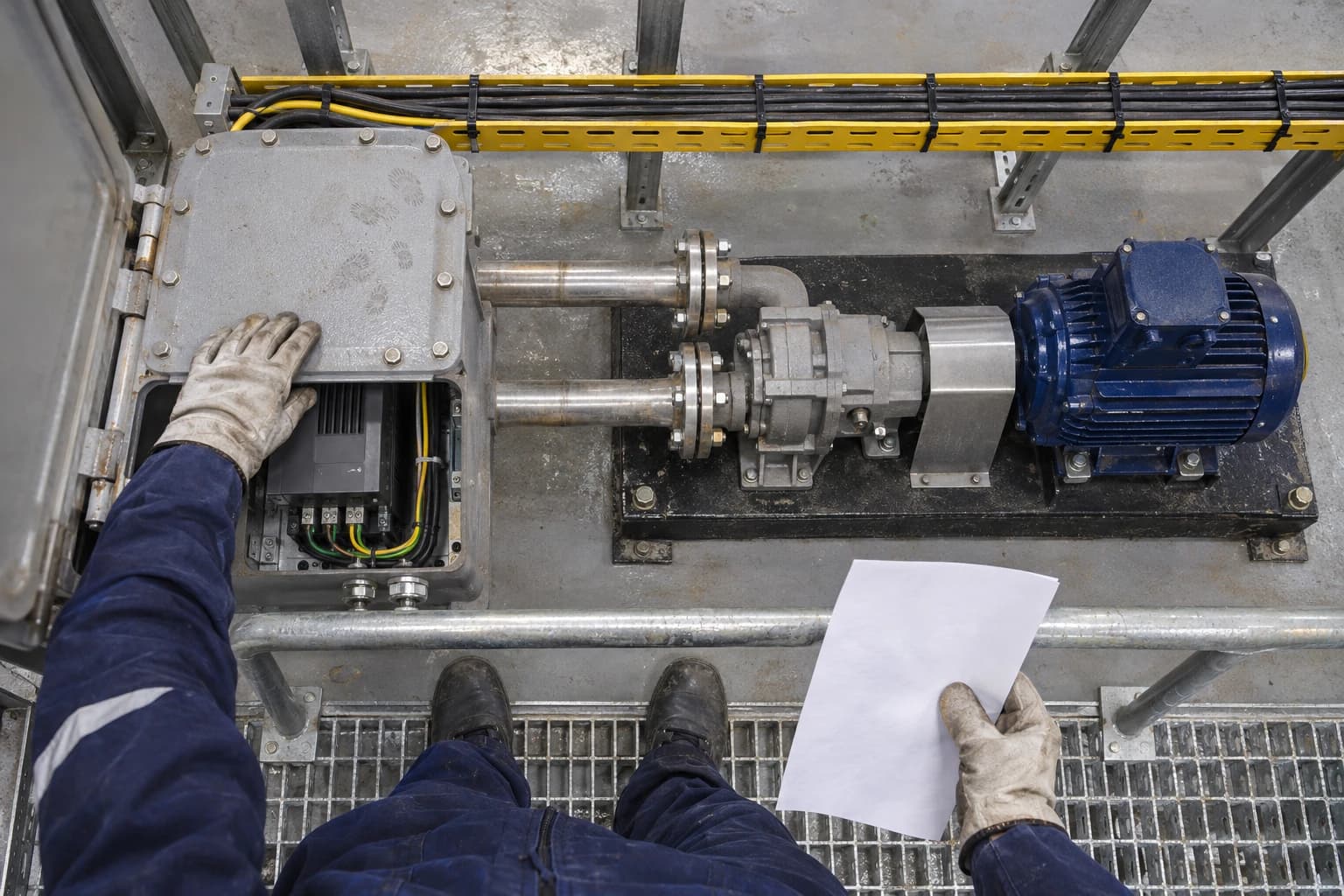
A variable-speed drive installed beside a solvent-transfer pump can reduce electricity consumption while introducing an ignition source into a Zone 1 area. An ATEX DSEAR hazardous-area compliance audit should therefore precede energy upgrades in UK chemical plants.
Chemical sites are under pressure to reduce fuel use, electricity demand and emissions. Projects involving motor control, heat recovery, instrumentation, ventilation or fired-heater improvements can deliver operating benefits. They can also alter the assumptions behind hazardous-area classification, equipment selection and ignition-source control.
For workplaces in Great Britain, the Dangerous Substances and Explosive Atmospheres Regulations 2002 (DSEAR) require employers to assess and control risks from dangerous substances. Regulation 7 requires employers to classify places where explosive atmospheres may occur and apply the criteria for selecting equipment and protective systems.
An audit provides evidence that plant drawings, zoning decisions, Ex equipment registers and work controls still match site operations.
Why an ATEX DSEAR hazardous area compliance audit matters
Chemical plants change continually. Production campaigns change, raw materials are substituted, throughput rises, vessels are repurposed and ventilation arrangements are modified. A pump may be replaced during a breakdown, while a temporary local control panel may become permanent. Each alteration can affect the basis on which a hazardous area was classified.
An ATEX DSEAR hazardous-area compliance audit tests the connection between documented controls and field conditions. It should establish whether the site can demonstrate that hazardous areas have been identified, classified and managed against current operating conditions.
DSEAR treats hazardous-area classification as an operational duty
DSEAR Regulation 7 requires employers to classify locations where an explosive atmosphere may occur as hazardous or non-hazardous. Hazardous locations must then be assigned a zone under Schedule 2.
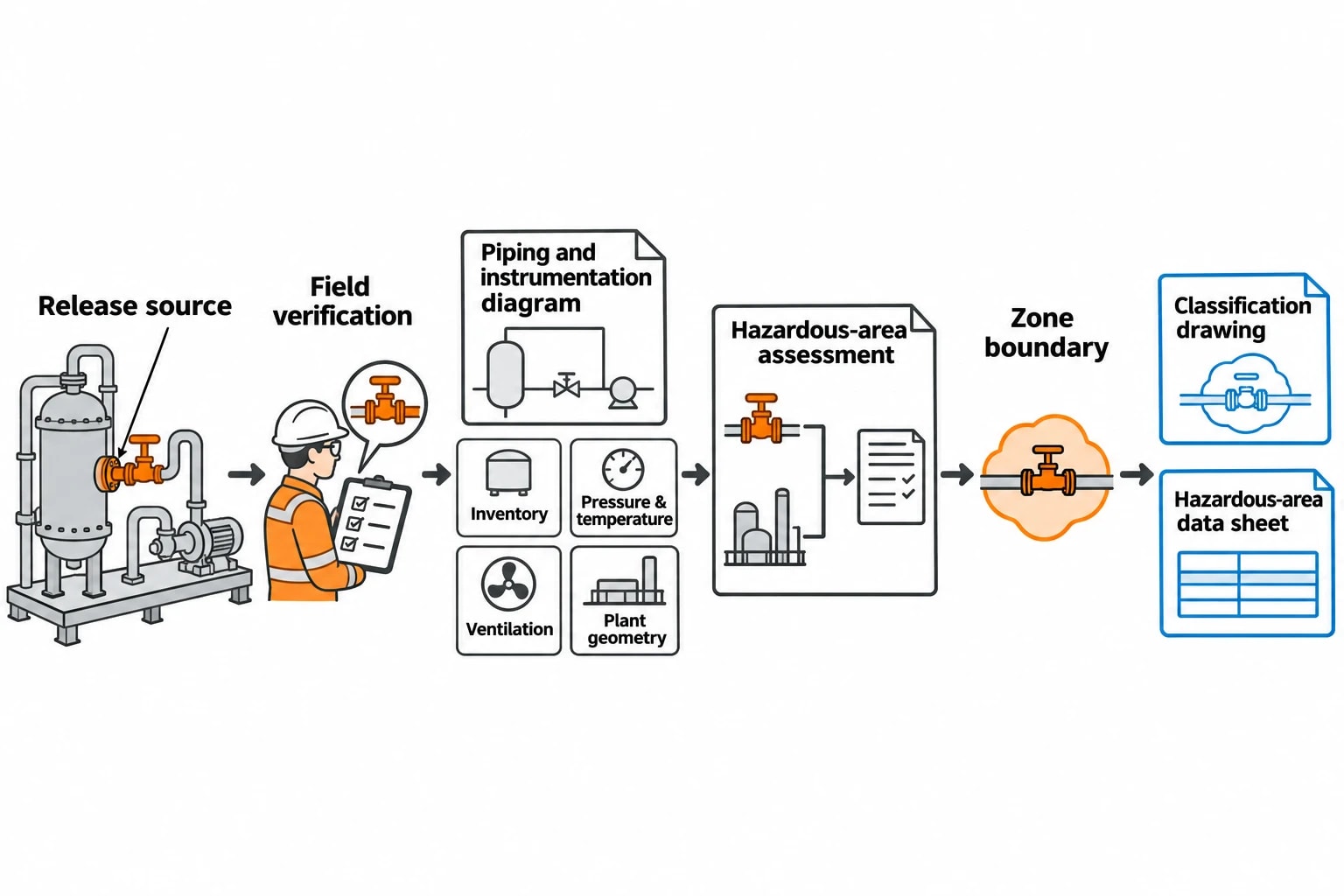
The assessment is based on the frequency and duration of an explosive atmosphere, not a broad label applied to an entire process building. Auditors need to examine the release source, material properties, operating pressure and temperature, ventilation, surrounding geometry, and plant operation and maintenance.
HSE guidance identifies release sources as the starting point for hazardous-area classification. These can include routine process releases, primary releases during normal operation and secondary releases arising from foreseeable faults or operator error.
An audit should ask:
- Do current solvent, monomer, gas, dust or intermediate inventories match those considered in the original assessment?
- Have operating temperatures or pressures changed the potential for vapour formation?
- Are vents, sampling points, drains, seals, flanges and hose connections included in the classification basis?
- Does ventilation still achieve the performance assumed in the zoning study?
- Have new walls, enclosures, ducts or equipment obstructed natural ventilation?
- Are tanker transfer, drum charging and maintenance controlled within the documented hazardous-area arrangements?
The audit closes the gap between drawings and plant reality
A zoning drawing can remain visually plausible for years while the plant it represents has changed materially. This is common where engineering modifications have been approved through separate capital projects, reliability work or production changes.
Auditors should compare hazardous-area drawings with process flow diagrams, piping and instrumentation diagrams, line lists, chemical inventories, relief and vent routes, plant-layout drawings and management-of-change records. Field verification should then confirm that the documents reflect actual equipment, access routes, ventilation arrangements and operating practice.
The result should be a controlled set of classification drawings supported by hazardous-area data sheets. Zone boundaries need to be clear above and below equipment where relevant, particularly around elevated vents, pits, bunds, enclosed skids and basement spaces.

Identify where your plant is losing energy and quantify the savings potential — our audits map every heat source, sink, and waste stream in your facility.
DSEAR zoning provides the basis for equipment selection
DSEAR Schedule 2 distinguishes zones for gases, vapours and mists from those for combustible dusts. Schedule 3 links those zones to equipment categories.
| Hazardous area | Explosive atmosphere description | Minimum permitted equipment category |
|---|---|---|
| Zone 0 | Gas, vapour or mist present continuously, for long periods or frequently | Category 1 |
| Zone 1 | Gas, vapour or mist likely in normal operation | Category 1 or 2 |
| Zone 2 | Gas, vapour or mist not likely in normal operation and present briefly if it occurs | Category 1, 2 or 3 |
| Zone 20 | Combustible dust cloud present continuously, for long periods or frequently | Category 1 |
| Zone 21 | Combustible dust cloud likely in normal operation | Category 1 or 2 |
| Zone 22 | Combustible dust cloud not likely in normal operation and present briefly if it occurs | Category 1, 2 or 3 |
Gas, vapour and mist zones require a release-based assessment
Zone 0, Zone 1 and Zone 2 apply where dangerous substances can form an explosive atmosphere with air as a gas, vapour or mist. Reactor vapour spaces, solvent-vessel vents, pump seals, loading arms and sample points can each have different classification requirements.
The assessment should identify normal operating releases separately from abnormal releases. Catastrophic vessel or pipe failures sit outside the narrow purpose of area classification and require assessment through wider process-hazard methods, such as HAZOP or site risk studies.
HSE guidance also makes clear that classification is not a consequence ranking. A large Zone 1 area does not automatically mean better protection. Excessive zoning can make equipment selection harder and obscure the source-control, ventilation and operational measures requiring attention.
Combustible dust zones demand evidence beyond a clean walkdown
Zones 20, 21 and 22 apply to clouds of combustible dust in air. Chemical plants may encounter dust hazards in drying, milling, sieving, blending, bagging, filtration, pneumatic conveying and dust-collection systems.
An audit should examine where dust can escape, settle and be disturbed. Dust layers, deposits and accumulations matter because they can become airborne or create hot-surface ignition concerns. Audit evidence should include material safety data, process dust characterisation where available, housekeeping records, extraction performance and inspection findings from dryers, filter units and transfer points.
An Ex label does not prove installed equipment is suitable
DSEAR Schedule 3 sets the minimum equipment category for a zone. That is only the first selection test. The audit must establish whether the complete installation is suitable for the specific atmosphere and service conditions.
The equipment register needs more than product certificates
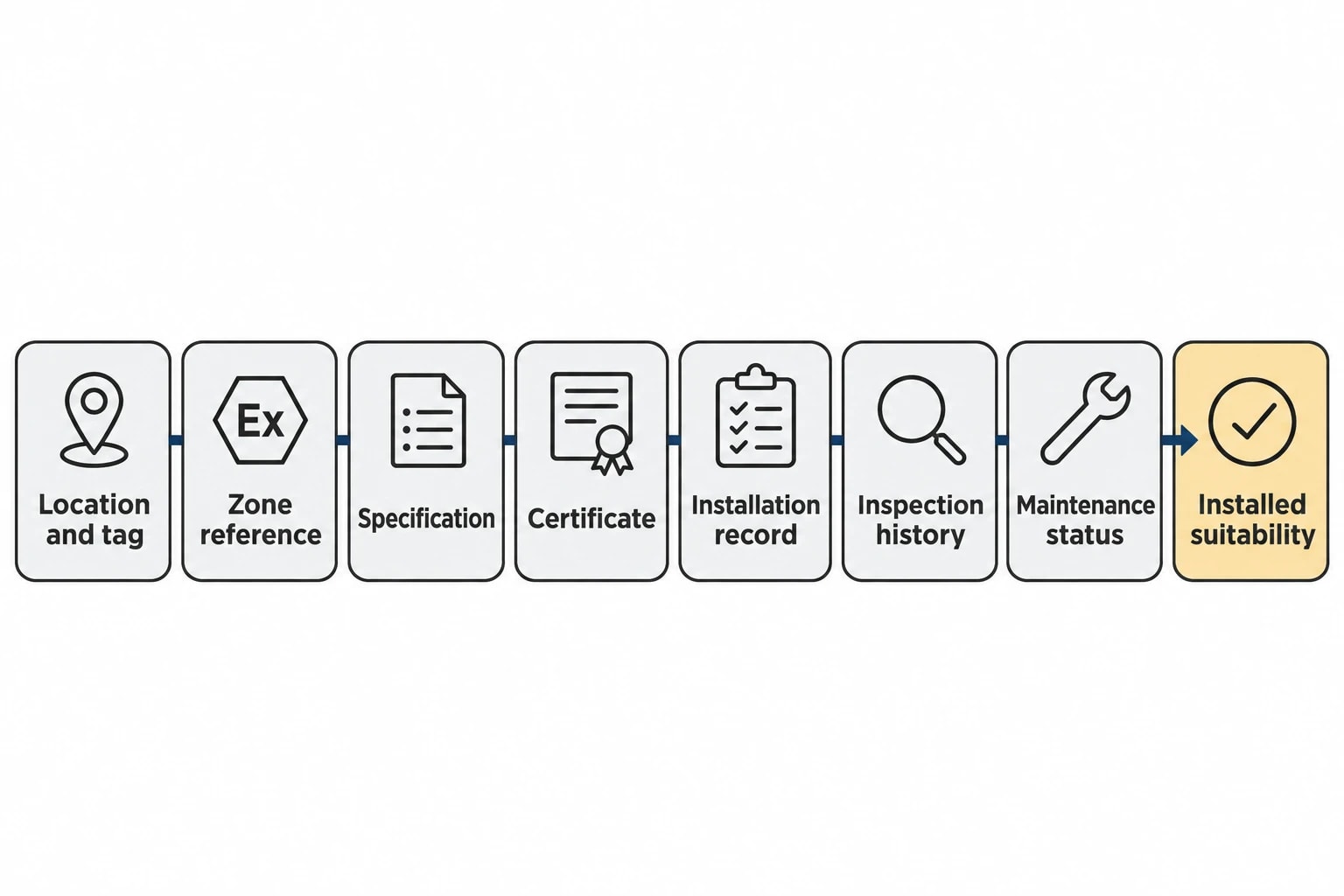
For equipment in hazardous areas, the audit should trace an item from its location and tag number to its specification, certificate, installation record, inspection history and maintenance status.
Useful register fields include:
- Equipment tag and physical location.
- Zone and hazardous-area drawing reference.
- Equipment group and category.
- Gas or dust group where applicable.
- Temperature classification or maximum surface temperature.
- Ambient temperature limits.
- Equipment protection concept.
- Certificate and declaration reference.
- Cable gland, stopping plug and enclosure-entry details.
- Inspection grade, interval, defects and repair status.
The review should assess motors, luminaires, junction boxes, isolators, heat tracing, local control stations, portable-equipment connection points and instrumentation. It should also cover non-electrical ignition sources, including hot bearings, belt friction, mechanical impact, static discharge and hot process surfaces.
Product conformity and site suitability are separate tests
The Equipment and Protective Systems Intended for Use in Potentially Explosive Atmospheres Regulations 2016 apply to relevant equipment, protective systems and certain safety, control and regulating devices placed on the Great Britain market. HSE states that new equipment for potentially explosive atmospheres should carry Ex marking and the relevant conformity marking, with declarations of conformity and English instructions.
For EU markets, ATEX Directive 2014/34/EU governs equipment and protective systems placed on the market.
Neither framework proves that an item is suitable after installation. A correctly certified device can become unsuitable when placed in the wrong zone, exposed to an excessive ambient temperature, fitted with an incorrect cable gland or modified in the field. A flameproof enclosure with a damaged joint, missing stopping plug or unauthorised entry is an audit finding even when its original certificate is valid.

Identify where your plant is losing energy and quantify the savings potential — our audits map every heat source, sink, and waste stream in your facility.
Energy upgrades need hazardous-area review before design freeze
Energy projects should enter the DSEAR review process before procurement and installation. HSE states that potentially explosive areas must be risk assessed before new work is undertaken and that controls must be applied.
The review identifies whether proposed equipment belongs within the classified area, requires a suitable Ex specification, or can be located outside the zone.
Variable-speed drives and motor projects
Variable-speed drives can reduce throttling losses from pumps and fans. The compliance review should determine the location of the drive, motor, isolator, local controls, cabling and diagnostic connections.
The audit should also check whether lower-speed motor operation affects cooling, surface temperature or maintenance instructions. A project specification should state the applicable zone, required equipment category, protection type, ambient conditions and acceptance records before the purchase order is released.
Heat recovery, ventilation and instrumentation changes
Waste-heat recovery can add fans, pumps, dampers, heat exchangers, hot surfaces and control equipment. Ventilation upgrades can change airflow patterns that support an existing hazardous-area classification. A new enclosure, duct or extraction point can also restrict ventilation around a release source.
Instrumentation projects require the same attention. New temperature, pressure, flow and level devices must be suitable for the location, correctly installed and entered into the inspection regime. Where a modification changes a release source, ventilation condition or zone extent, the site should revise classification documentation before commissioning.
Field verification tests the condition of Ex installations
A desktop study cannot establish whether equipment remains safely installed. Field inspection should sample representative equipment across each process area and focus on locations most likely to accumulate defects.
What auditors should inspect in the field
Auditors should verify the condition and installation of:
- Cable glands, stopping plugs and unused entries.
- Enclosure covers, fasteners, seals and flamepaths.
- Damaged cables, unsupported runs and unauthorised modifications.
- Earthing and bonding arrangements for plant, drums, containers and transfer equipment.
- Motors, luminaires, local isolators and junction boxes.
- Heat tracing systems and hot surfaces.
- Portable electrical equipment controls.
- Ventilation equipment associated with hazardous-area assumptions.
- Dust deposits around dryers, bagging equipment, extraction points and electrical apparatus.
BS EN IEC 60079-17:2024 is the current standard for inspection and maintenance of electrical installations in hazardous areas. The audit should compare the site inspection strategy with the installed equipment, operating environment and recorded defect history.
Competence and defect management are auditable controls
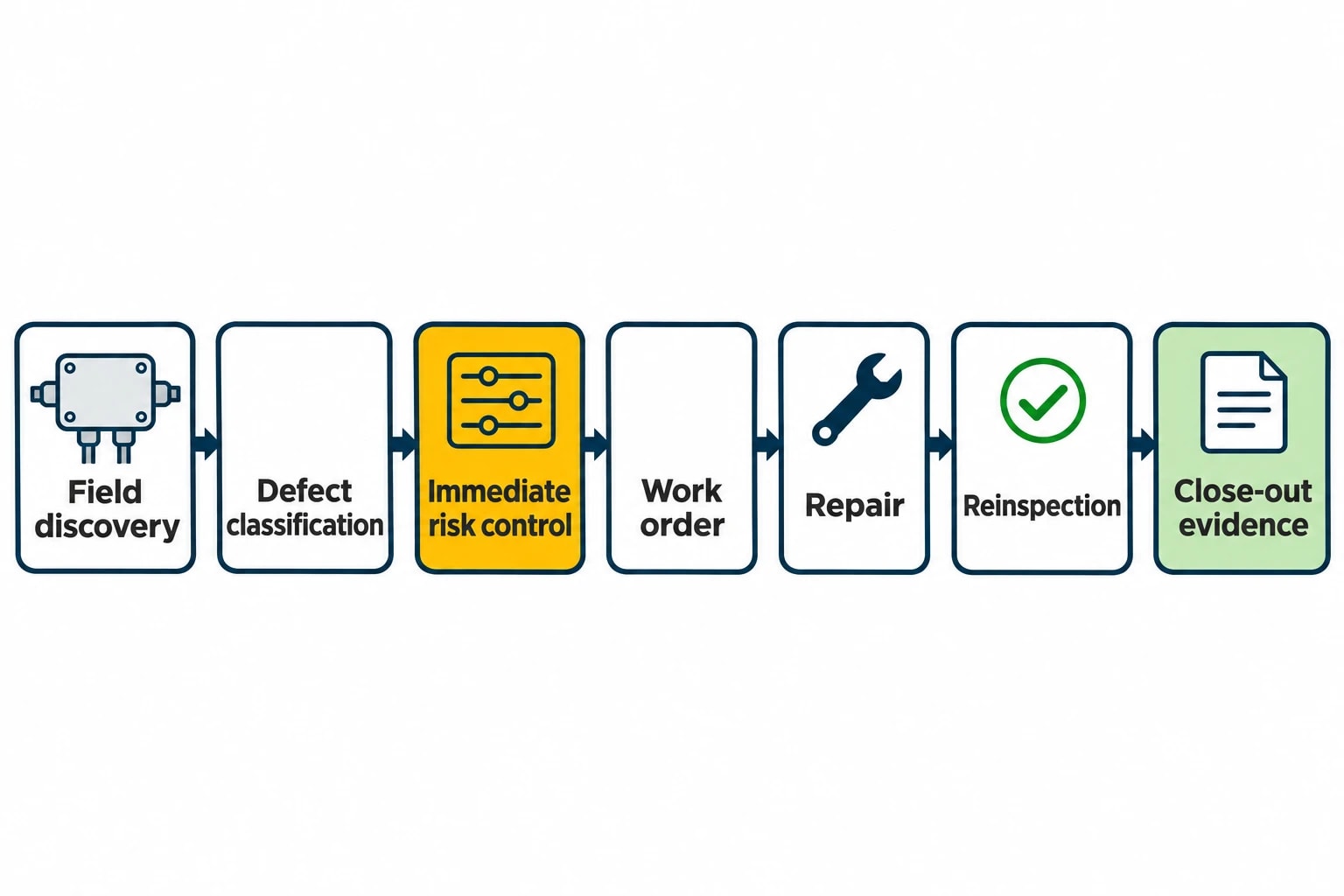
The audit should establish who performs Ex inspections, maintenance and repairs, and what evidence demonstrates competence for the tasks assigned. It should then trace defects from discovery through classification, temporary controls, work order, repair, reinspection and close-out.
A defect register without accountable actions does not provide assurance. Each finding should identify the asset, location, zone, defect mechanism, immediate risk control, corrective-action owner and closure evidence.
Closure evidence can include photographs of completed repairs, updated equipment-register fields, inspection certificates, revised drawings, manufacturer instructions, work packs and a competent-person verification record.
Turn audit findings into accountable corrective actions
An effective ATEX DSEAR hazardous-area compliance audit produces decisions that engineering, maintenance and EHS managers can act on.
Rank actions by the evidence required for safe operation
High-priority findings include equipment that cannot be shown to suit its zone, damaged Ex protection features, missing enclosure entries, uncontrolled ignition sources and zoning drawings that no longer reflect process conditions. The plant should establish temporary controls while corrective work is planned, including isolation, restricted access, removal from service or restrictions on specific tasks.
Medium-priority actions can include incomplete certification records, missing inspection history, inconsistent equipment tags or outdated drawing revisions. The accountable owner should obtain and validate the missing evidence rather than mark the action complete after a document search.
Use project gates to prevent repeat findings
Modification procedures should require a hazardous-area review at defined stages:
- Concept selection, to identify zoning and ignition-control constraints.
- Detailed design, to confirm location, equipment specification and installation requirements.
- Pre-start-up review, to verify drawings, certificates, installation records and inspection requirements.
- Post-commissioning close-out, to update the DSEAR assessment, equipment register and maintenance regime.
A plant should accept a hazardous-area-related project only when the final evidence package shows that the equipment is appropriate for the installed zone, correctly fitted, entered into the inspection system and reflected in controlled drawings.
This article reflects the independent analysis and editorial opinion of EnerTherm Engineering. Product names, trademarks, and brands mentioned belong to their respective owners. EnerTherm Engineering is not affiliated with, endorsed by, or a licensee of any third-party software or product mentioned unless explicitly stated.

Technical Manager — EnerTherm Engineering
John Naranjo is Technical Manager at EnerTherm Engineering, bringing specialist expertise in chemical and environmental engineering. He recently led the implementation of Omni Vision, EnerTherm's real-time energy and utility monitoring platform. He holds an MSc in Environmental Engineering from the University of Huelva and a BSc in Chemical Engineering, with memberships in both the Energy Institute and IChemE.
