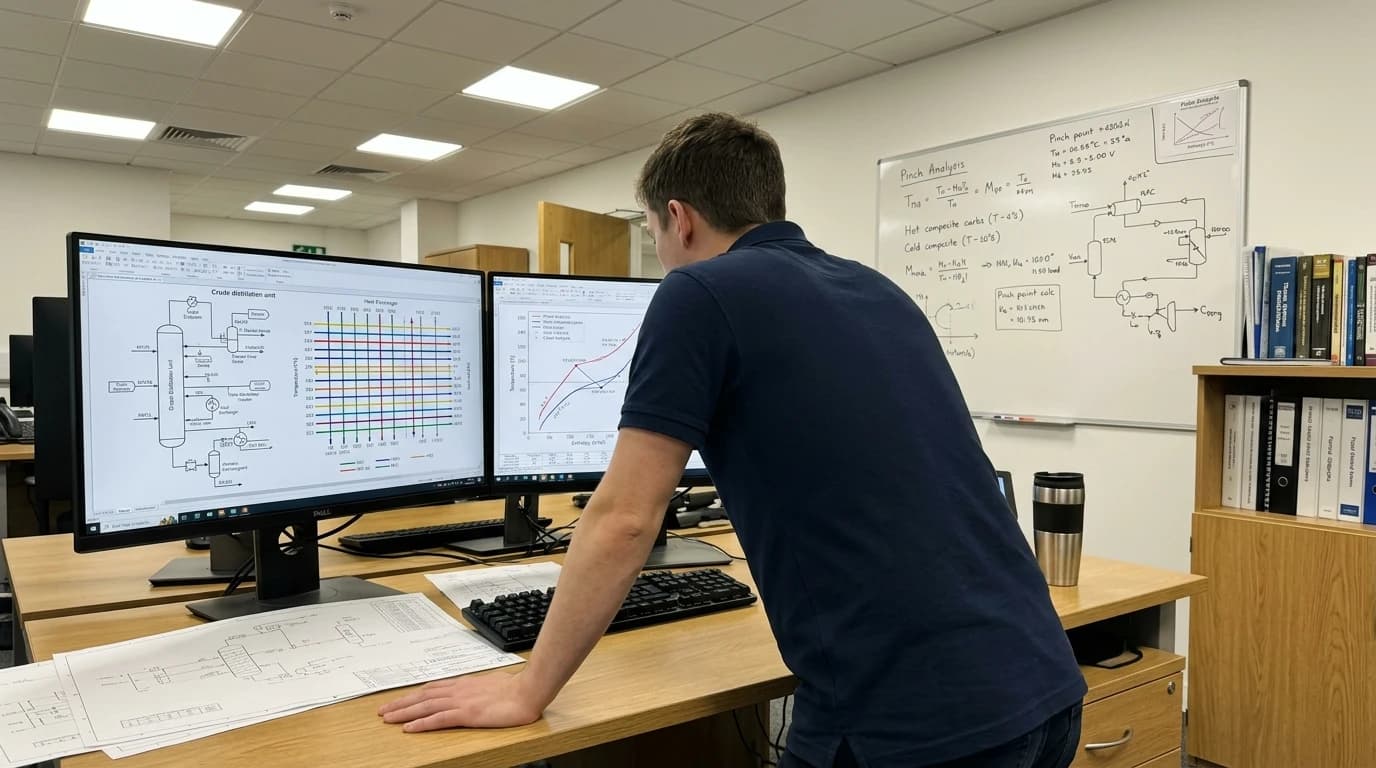
Comparing Aspen and HTRI Heat Integration Software
Comparing MINLP optimisation tools to identify retrofits with payback under 0.75 years.
Refinery heat integration software applies thermodynamic principles and mathematical programming to design, analyse, and optimise heat exchanger networks (HENs) within crude oil refineries and petrochemical facilities. Operating companies use these platforms to recover thermal energy, lower external utility demands, and reduce fuel combustion in fired heaters. In the context of stringent environmental regulations and carbon taxation, selecting the correct software suite directly influences a refinery’s ability to achieve Scope 1 emissions targets and lower operational expenditures.
While Aspen Technology and Heat Transfer Research, Inc. (HTRI) both offer industry-standard solutions, their software packages approach heat integration from distinct technical philosophies. Understanding the core mathematical methodologies, physical models, and operational capabilities of these tools is vital for engineering teams tasked with optimising refinery preheat trains.
Thermodynamic and Mathematical Principles of Refinery Heat Integration

To evaluate commercial software packages, process engineers must understand the underlying mathematical formulations that govern heat exchanger network synthesis (HENS). Refinery heat integration software packages utilise two primary methodologies to optimise thermal networks: sequential synthesis based on classical Pinch Analysis and simultaneous synthesis based on mathematical programming.
Classical Pinch Analysis and Thermodynamic Energy Targeting
Pinch Analysis operates on thermodynamic targeting principles. Before any physical heat exchanger is designed, the software extracts stream data, specifically source temperatures, target temperatures, heat capacity flow rates, and specific enthalpies. The software then constructs Composite Curves (CC) representing the total hot and cold thermal profiles of the process.
By shifting these curves vertically by the minimum approach temperature (ΔTmin), the software identifies the pinch point, which is the thermodynamic bottleneck of the process. This analysis generates the Grand Composite Curve (GCC), which defines the absolute minimum hot utility and cold utility requirements for a chosen ΔTmin. A central objective of the software is to identify and eliminate any cross-pinch heat exchangers. Transferring heat from a hot stream above the pinch to a cold stream below the pinch incurs a double utility penalty, increasing both the external heating and cooling demands.
Stage-Wise Superstructure and Mixed-Integer Non-Linear Programming
Modern refinery heat integration software has evolved beyond manual, graphical pinch techniques to incorporate automated mathematical optimisation. This is achieved through the formulation of mixed-integer non-linear programming (MINLP) problems.
The most prominent mathematical model used for this purpose is the Stage-Wise Superstructure (SWS) formulation. In an SWS model, the heat exchange process is divided into a predefined number of stages. Within each stage, potential heat exchanger matches are modelled between every hot stream and every cold stream.
The optimisation algorithm seeks to minimise the objective function, which is typically the Total Annual Cost (TAC):
TAC=Ccapi∑j∑k∑(a+b⋅Ai,j,kc)⋅yi,j,k+m∑Cu,m⋅Qu,mWhere:
- TAC is the Total Annual Cost.
- Ccap is the annualisation factor for capital design.
- a, b, and c are cost coefficients for heat exchanger surface area.
- Ai,j,k is the heat transfer area of the exchanger matching hot stream i and cold stream j in stage k (expressed in m²).
- yi,j,k is the binary variable indicating the presence (1) or absence (0) of a physical match.
- Cu,m is the unit cost of utility m.
- Qu,m is the heat load of utility m (expressed in MW).
Because the heat transfer equations involve non-linear relationships, such as the calculation of log-mean temperature differences (LMTD) and non-isothermal mixing, the resulting model is a highly complex, non-convex MINLP problem. Refinery heat integration software uses advanced solvers to navigate this non-convex space, providing engineers with optimised network topologies that balance energy recovery against capital expenditure constraints.

Pinch analysis identifies the thermodynamic minimum energy requirement of your process — then designs the heat exchanger network to achieve it.
Aspen Energy Analyser: Technical Scope for Conceptual Design
Aspen Energy Analyser (AEA) is widely regarded as an industry standard for the conceptual design, targeting, and synthesis of heat exchanger networks. It functions primarily as a desktop simulation tool, integrating with the broader AspenTech suite to enable a continuous workflow from process simulation to thermal network optimisation.
Direct Flowsheet Connection with HYSYS and Aspen Plus
One of the primary advantages of Aspen Energy Analyser is its direct connection to process simulators. Thermal design teams do not need to manually compile stream data tables. Instead, the software extracts stream parameters, such as temperatures, pressures, mass flows, and physical properties, directly from an active Aspen Plus or Aspen HYSYS flowsheet. This automated data extraction reduces human error and accelerates the initial phases of a pinch study, which historically consumed the majority of project hours.
Supertargeting and Automated Synthesis Engines
Once stream data is imported, Aspen Energy Analyser calculates thermodynamic targets using the Problem Table Algorithm. It displays Composite Curves and Grand Composite Curves to help engineers define the optimum ΔTmin through supertargeting, which plots TAC against varying approach temperatures.
For network synthesis, the software provides both sequential and simultaneous optimisation engines. Engineers can utilise the automatic design generator, which uses the SWS formulation and MINLP solvers to propose alternative network topologies. These options are ranked by capital cost, utility cost, and total area, allowing process engineers to quickly evaluate structural revamps or grassroots configurations.
Grid Diagram Analysis and Retrofit Design
For existing refineries, AEA includes a dedicated retrofit environment. The software maps the existing heat exchanger network on a classical Grid Diagram. Engineers can manually manipulate matches, introduce stream splits, or relocate exchangers to eliminate cross-pinch heat transfer. The tool instantly updates utility demands and calculates the payback period of each modification, allowing engineers to quickly filter out impractical retrofit configurations.
HTRI SmartPM: Operations-Driven Performance Monitoring and Dynamic Pinch
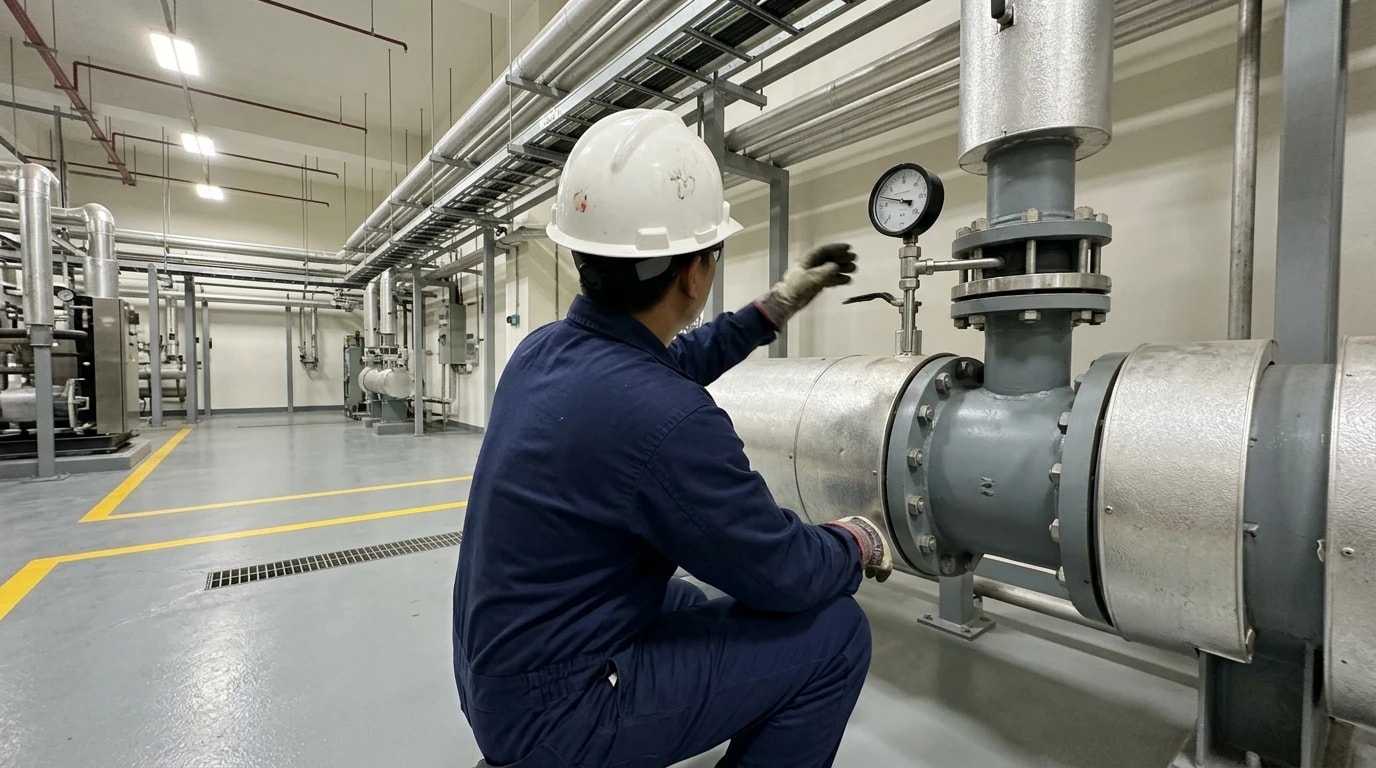
While Aspen Energy Analyser is designed primarily for the conceptual and design phases of a project, HTRI approaches heat integration from an operational and physical perspective. HTRI SmartPM is digital twin software designed specifically for the continuous performance monitoring, predictive maintenance, and operational pinch analysis of active heat exchanger networks.
Dynamic Hydrocarbon Fouling in Crude Preheat Trains
In petroleum refining, crude distillation unit (CDU) preheat trains operate under severe fouling conditions. Hydrocarbon fouling, particularly asphaltene deposition and chemical coking, acts as a thermal insulator on tube walls. This deposit continuously increases thermal resistance, degrading the heat transfer coefficient of individual exchangers.
As a result, the crude oil reaches the fired heater at a lower temperature than designed, requiring the furnace to burn more fuel to reach the distillation temperature. Traditional pinch software, which relies on static, steady-state fouling factors, cannot model this dynamic decline in network thermal efficiency.
Real-Time Data Reconciliation and Digital Twins
SmartPM addresses this limitation by connecting directly to the refinery's real-time data historian, such as the OSIsoft PI System. It reconciles noisy or incomplete plant measurements using HTRI’s physical heat transfer and fluid flow correlations.
The software builds a detailed digital twin of every exchanger in the network, utilising actual tube geometry, shell passes, and baffle configurations from HTRI Xist files. By continuously solving the mass and energy balances across the network, SmartPM calculates the actual, time-dependent fouling resistance for every individual heat exchanger shell.
Dynamic Pinch Targeting and Driving Force Analysis
Developments in HTRI SmartPM integrate comprehensive Pinch Analysis capabilities directly into the monitoring environment. This allows refinery operations teams to perform pinch targeting on an active, fouled network using real-time operational data. The software generates:
- Dynamic Composite Curves that reflect the actual, fouled thermal state of the refinery.
- Fouled Grand Composite Curves that display how fouling shifts the pinch point and increases external utility demands over time.
- Temperature Driving Force (TDF) Plots with Pinch that visually highlight which specific exchangers are operating under degraded thermal driving forces or are crossing the pinch line due to poor flow distribution or fouling.
By analysing these driving forces, refinery engineers can identify if a cross-pinch transfer is occurring due to operational changes or bypass leaks, rather than structural design flaws. This real-time visibility enables operators to make informed adjustments to control valves, stream splits, or pump-around flow rates to restore heat recovery.
HTRI Exchanger Optimiser: Detailed Mechanical and Financial Sizing
Once a process engineer identifies a beneficial network retrofit using Pinch Analysis, the proposed exchangers must be designed and costed. This is where HTRI Exchanger Optimiser bridges the gap between high-level thermodynamic targeting and detailed mechanical fabrication.
Mechanical Verification and Material-Specific Costing
Standard refinery heat integration software packages typically estimate capital costs using simplified, area-dependent power-law equations. These equations ignore critical mechanical parameters such as tube-pass configurations, shell materials, design pressures, nozzle sizes, and local manufacturing labour rates.
HTRI Exchanger Optimiser performs detailed thermal-mechanical designs to determine realistic fabrication, installation, and maintenance costs. It accounts for the actual cost of materials, including carbon steel, stainless steel, and duplex alloys, and evaluates the labour hours required for welding, drilling tube sheets, and assembling shell components.
Physical Layout Constraints and CAD Setting Plans
Exchanger Optimiser includes a built-in CAD engine that automatically generates true-to-scale setting plan drawings for shell-and-tube exchangers. These drawings can be exported directly as .dxf or .svg files for integration into plant CAD models.
This physical design rigour is vital for refinery retrofits, where plot space is highly constrained. If a pinch study proposes adding several shells in series to recover energy, the design team must immediately verify whether those shells can physically fit within the existing plot limits, clear overhead piping, or require expensive foundations. Exchanger Optimiser allows engineers to evaluate these physical and financial constraints simultaneously, preventing the design of unbuildable networks.

Pinch analysis identifies the thermodynamic minimum energy requirement of your process — then designs the heat exchanger network to achieve it.
Functional Comparison: AEA vs. HTRI
The selection between Aspen Energy Analyser and the HTRI suite, consisting of SmartPM and Exchanger Optimiser, depends on the project lifecycle phase. The table below outlines the core technical and functional differences between these software packages.
| Comparison Parameter | Aspen Energy Analyser (AEA) | HTRI SmartPM & Exchanger Optimiser |
|---|---|---|
| Primary Engineering Stage | Conceptual design, grassroots HEN synthesis, and utility supertargeting. | Operational performance monitoring, fouled-network pinch, and detailed costing. |
| Primary Data Source | Steady-state process simulators such as Aspen HYSYS or Aspen Plus. | Plant historians like OSIsoft PI and detailed mechanical geometry files. |
| Thermodynamic Targeting Focus | Theoretical targeting and structural MINLP synthesis. | Operational pinch analysis under dynamic fouling conditions. |
| Treatment of Dynamic Fouling | Static fouling factors or simple empirical margins. | Dynamic, time-dependent fouling rate prediction using physical research. |
| Capital Cost Methodology | Area-based exponential cost equations. | Detailed material, fabrication, and labour spreadsheets with CAD layouts. |
| Mechanical Layout Detail | Simplified thermal design with generalised shells and tube passes. | Full mechanical design, tube layout, vibration analysis, and setting drawings. |
| Software Integration | Direct connection with Aspen HYSYS, Aspen Plus, and Aspen EDR. | Direct connection with Xist, Xace, and other HTRI thermal rating modules. |
Financial Returns and Regulatory Compliance in Preheat Train Design
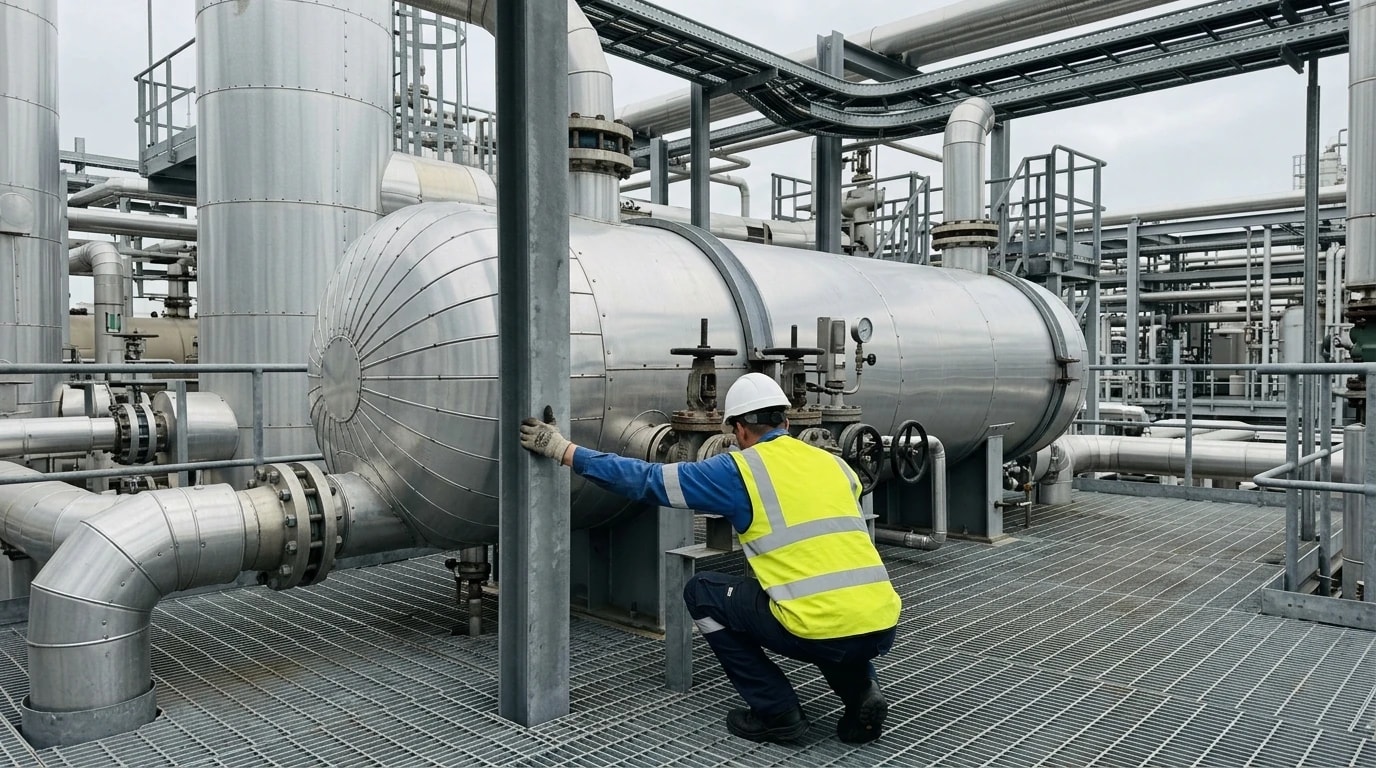
The deployment of refinery heat integration software is driven by both economic necessity and environmental compliance. Refineries are highly energy-intensive, and crude preheat trains represent the single largest opportunity for thermal energy recovery.
Quantifying Energy Savings and Capital Payback
In a typical oil refinery, the crude distillation preheat train is the most energy-intensive heat exchanger network. Operational deviations from the design target, caused by stream-composition shifts or sub-optimal bypasses, often result in significant energy waste.
Applying refinery heat integration software to systematically identify and eliminate cross-pinch heat transfer can reduce furnace heating demands by 15 to 30 per cent. For a mid-sized refinery processing 150,000 barrels per day, this translates to a reduction of 4 to 10 MW in fired heater duty.
The capital expenditure required for such retrofits, such as re-sequencing existing exchangers, adding new shells, or installing high-efficiency tube inserts, typically yields a payback period of six months to two years, depending on utility price volatility. This calculation requires careful optimisation of the capital-energy trade-off, where ΔTmin acts as the primary design constraint. A smaller ΔTmin increases heat recovery but exponentially increases the required heat transfer area, and consequently, the capital cost.
Environmental Permitting and Carbon Accounting
In England and Wales, industrial installations must comply with the Environmental Permitting (England and Wales) Regulations 2016 (as amended), which transposed the requirements of the original European Union Industrial Emissions Directive (Directive 2010/75/EU). Under these regulations, operators must implement Best Available Techniques (BAT) to minimise energy consumption and greenhouse gas emissions. The UK Environment Agency and other devolved regulators track BAT-Associated Environmental Performance Levels (BAT-AEPLs) closely.
Because every megawatt of heat recovered in the preheat train directly reduces the fuel gas burnt in the crude furnace, systematic heat integration directly lowers carbon dioxide (CO₂) emissions. This helps operators stay within their allowances under the UK Emissions Trading Scheme (UK ETS) and comply with Energy Savings Opportunity Scheme (ESOS) Phase 4 mandates.
Selecting the Appropriate Software Suite for Refinery Workflows
Selecting between Aspen and HTRI heat integration tools is not a binary decision. Instead, process engineers should align their software choice with the specific engineering objectives of the project.
Selecting Aspen Energy Analyser
Aspen Energy Analyser remains the preferred selection for:
- Grassroots Design Projects: When designing a completely new process unit or refinery from scratch, where stream files are already defined in Aspen HYSYS or Aspen Plus.
- High-Level Utility Optimisation: When evaluating the introduction of new utility headers, such as a new medium-pressure steam level or a hot oil loop, using the Grand Composite Curve.
- Structural HEN Synthesis: When utilising SWS and MINLP mathematical programming to explore a vast array of alternative network topologies that manual design cannot identify.
Selecting HTRI SmartPM and Exchanger Optimiser
The HTRI suite is the superior choice for:
- Operational Troubleshooting: When analysing an active, operating refinery preheat train that suffers from severe, time-dependent hydrocarbon fouling.
- Maintenance and Cleaning Optimisation: When seeking to identify and recommend the optimal cleaning schedule for individual heat exchanger shells to maximise cumulative thermal efficiency.
- Detailed Retrofit Costing: When evaluating the physical and financial feasibility of a proposed retrofit, requiring detailed material, labour, and CAD layout analysis.
In modern refinery engineering, the most robust workflow often involves a hybrid approach. Process engineers extract stream data from HYSYS, perform initial thermodynamic targeting and structural synthesis in Aspen Energy Analyser, design the individual shell-and-tube geometries in HTRI Xist, monitor operational fouling and dynamic pinch performance in SmartPM, and cost the finalised mechanical modifications in Exchanger Optimiser. This combined strategy ensures that heat integration designs are thermodynamically optimal, operationally resilient, and mechanically buildable.
This article reflects the independent analysis and editorial opinion of EnerTherm Engineering. Product names, trademarks, and brands mentioned belong to their respective owners. EnerTherm Engineering is not affiliated with, endorsed by, or a licensee of any third-party software or product mentioned unless explicitly stated.

Simulation Engineer — EnerTherm Engineering
Rajesh Sekar is a Simulation Engineer at EnerTherm Engineering, specialising in computational fluid dynamics (CFD), finite element analysis (FEA), and thermal process simulation. He holds a degree from Cranfield University and brings extensive experience in simulation-based product development from the automotive, aerospace, and energy sectors.
