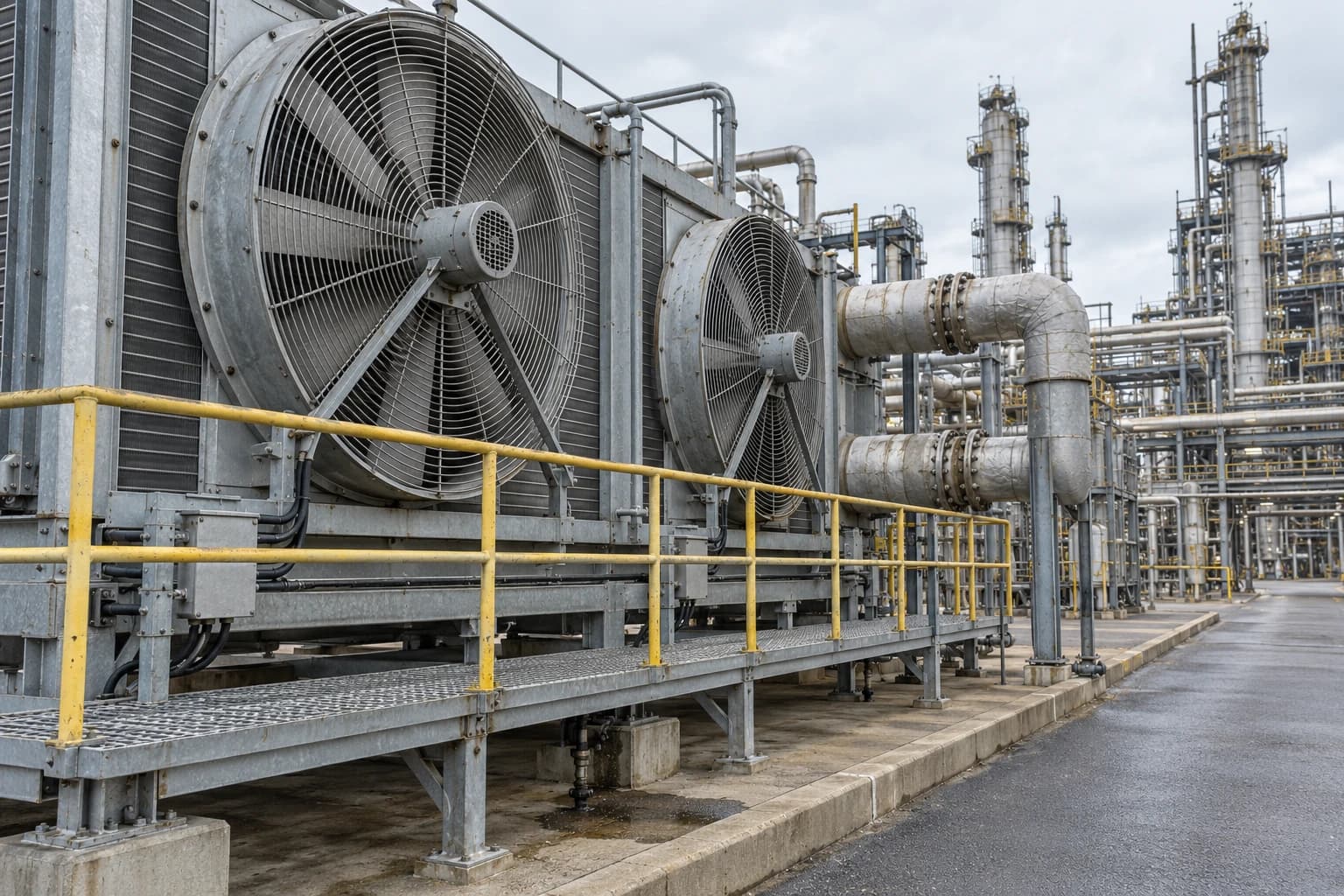
How Pinch Analysis Cuts Refinery Steam and Cooling Demand
ΔTmin balances refinery utility savings against retrofit cost and heat recovery.
Pinch analysis is a thermodynamic targeting method that identifies the minimum hot and cold utility demand needed to operate a refinery process at a selected minimum temperature approach.
For refinery energy teams, the method turns a complex set of exchangers, furnaces, reboilers, steam headers and coolers into a structured heat balance. It identifies where process heat can displace fuel firing or steam, and where avoidable cooling duty rejects heat that another process stream could use.
The prize can be substantial. Ipieca’s 2022 pinch-analysis compendium cites guideline reductions of 8% to 25% of purchased heating fuel for oil-refining applications, although the achievable result depends on existing heat recovery, operating flexibility, equipment condition and the scope of brownfield modifications.
Refinery utility optimisation pinch analysis must extend beyond an individual exchanger. A change that reduces steam to one reboiler can alter multi-pressure steam balances, turbine throughput, electricity imports and fuel-gas consumption. The best projects set thermodynamic targets first, then test practical retrofit options against the whole utility system.
Why refinery steam and cooling demand are connected
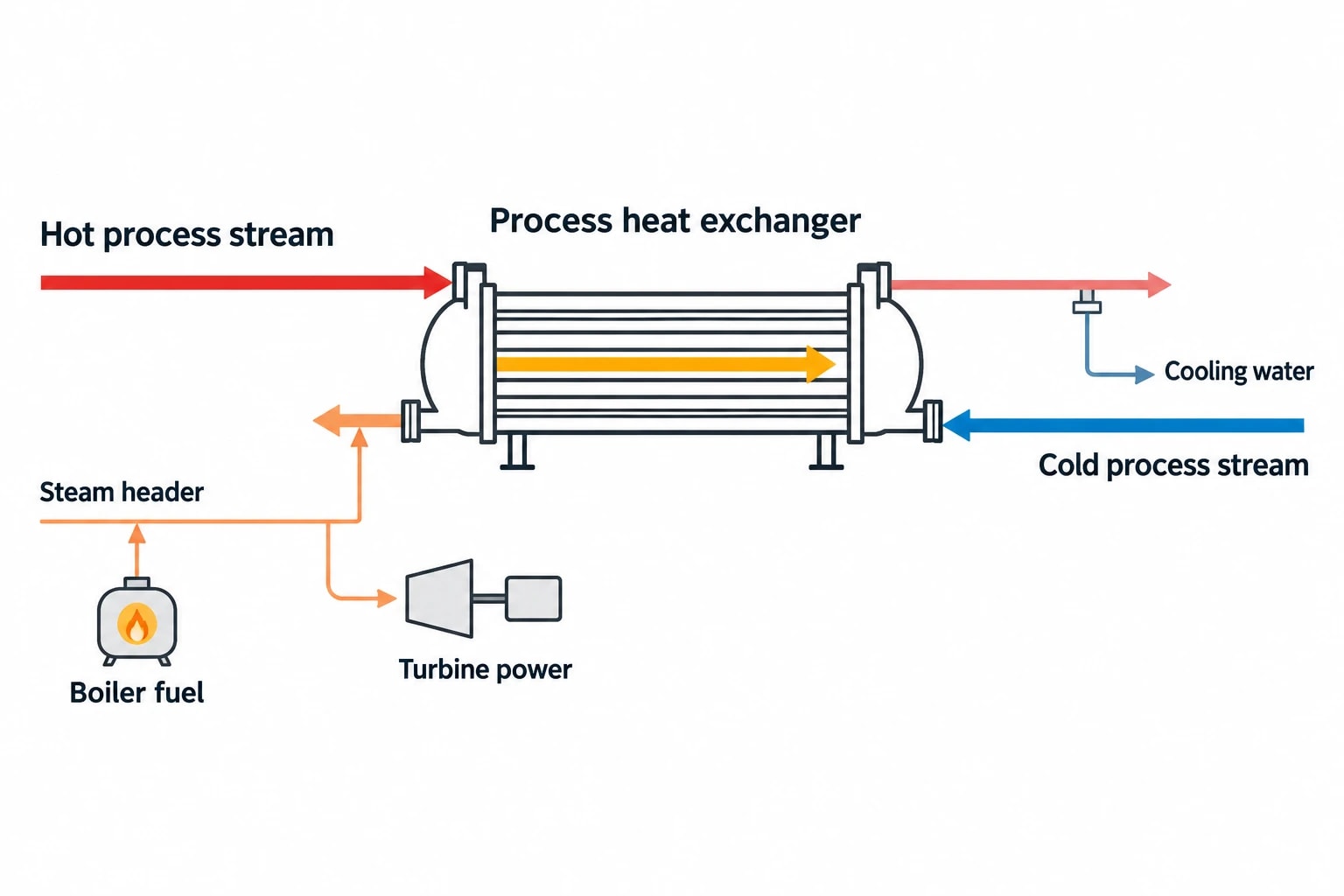
A refinery moves heat continuously between process streams. Crude feed requires preheating before atmospheric distillation. Hot products, column pumparounds, reactor effluent, bottoms streams and condensing vapours all reject heat. Fired heaters, boilers, waste-heat systems and steam headers cover the heat shortfall that process recovery cannot meet.
Cooling systems handle the other side of the balance. Cooling water, air coolers and refrigeration remove heat that cannot be reused at an appropriate temperature.
When a hot stream is cooled while a compatible cold stream receives steam or furnace heat, the refinery pays twice. It consumes hot utility to heat the cold stream and cold utility to reject useful heat from the hot stream.
Steam is a utility network, not a single cost line
Steam has different value at different pressure levels. A refinery may have high-pressure, medium-pressure and low-pressure headers, supported by boilers, waste-heat boilers, let-down stations, steam turbines and cogeneration equipment.
A local reduction in medium-pressure steam demand may reduce boiler firing. It may also lower flow through a back-pressure turbine, reducing shaft power or electricity generation. The net financial and fuel effect depends on the operating configuration.
The 2017 refinery case study A Steam Utility Network Model for the Evaluation of Heat Integration Retrofits demonstrated this point. Its authors validated a refinery steam-network model against three steady-state operating scenarios and used it to assess pressure-level steam balances, turbine shaft power and fuel-gas consumption after heat-integration changes.
A refinery pinch project therefore needs two connected models:
- A process heat-integration model to identify the minimum heating and cooling targets.
- A site utility model to assess steam generation, turbine operation, fuel use and electricity consequences.
Cooling demand carries an energy penalty
Cooling-water and air-cooling systems require electricity, water treatment, maintenance and plot space. Their main purpose is process control and safe operation, but avoidable cooling duty adds an operating burden.
Reducing high-temperature cooling duty can cut cooling-system load while reducing furnace or steam demand elsewhere. The heat must be available at a useful temperature. A large low-temperature cooling duty may offer little value for process heating because it cannot provide the required outlet temperature with an acceptable driving force.

Pinch analysis identifies the thermodynamic minimum energy requirement of your process — then designs the heat exchanger network to achieve it.
How refinery utility optimisation pinch analysis works
Pinch analysis starts with stream data rather than a heat-exchanger network drawing. Engineers define representative operating cases, identify process streams that require heating or cooling, and record temperatures, duties, phase changes and constraints.
The study should represent normal plant operation, not only design intent. An exchanger that meets its duty on a clean basis may perform differently after fouling. A bypass that operators routinely use changes the available heat recovery. Crude slate, throughput, product specifications and ambient conditions also alter the energy balance.
Build a credible stream data set
Each hot stream needs a supply temperature, target temperature and heat-capacity flowrate or duty. Each cold stream needs equivalent heating data. Latent heat from condensing or vaporising streams needs explicit treatment.
Process teams should also identify restrictions that affect feasible matches:
- Maximum furnace inlet temperatures and exchanger outlet limits.
- Fouling behaviour and the expected run length between cleaning.
- Pressure differences and the consequence of exchanger leakage.
- Control requirements during start-up, shutdown and turndown.
- Product temperature, viscosity and storage constraints.
- Stream availability across operating modes.
- Plot space, pipe routing and turnaround access.
Plant measurements, reconciled process simulations and operating records can each improve the input data. The resulting targets are only as useful as the operating case behind them.
Select ΔTmin as an economic design decision
The minimum temperature difference, ΔTmin, sets how closely hot and cold streams may approach in the analysis. It represents the trade-off between exchanger capital cost and utility cost.
A smaller ΔTmin permits more theoretical heat recovery. It usually demands more heat-transfer area, lower temperature driving forces and closer attention to fouling and controllability. A larger ΔTmin reduces area and capital expenditure but leaves a higher steam, fuel and cooling target.
A single refinery-wide approach temperature is rarely appropriate. A clean liquid-liquid exchanger, a condensing-vapour service, an air cooler and a crude-oil exchanger may justify different practical assumptions. Engineers should select ΔTmin values that reflect the service, materials, pressure drop, fouling risk, available area and maintenance strategy.
Set hot and cold utility targets
Composite curves combine all hot streams and all cold streams into temperature-enthalpy profiles. Their closest permitted approach identifies the pinch. A grand composite curve then shows the temperature levels at which the process needs external heat or rejects surplus heat.
The pinch establishes three critical targets:
- Minimum net hot utility, including fired-heater duty, boiler fuel or imported steam.
- Minimum net cold utility, including cooling water, air cooling or refrigeration.
- The temperature levels where each utility should be applied.
Above the pinch, the process has a net heat deficit. Below it, the process has a net heat surplus. These results support the established pinch design rules: avoid external cooling above the pinch, avoid external heating below it, and avoid transferring heat across the pinch unless an operational requirement justifies it.
Where pinch analysis cuts refinery steam demand
Crude and vacuum distillation units are frequent starting points because their preheat trains, furnaces and pumparound systems carry large duties. The method also applies to hydroprocessing, catalytic reforming, fractionation, stripping and utility systems.
Increase crude preheat before furnace firing
A crude preheat train transfers heat from hot refinery streams to incoming crude before it enters the crude furnace. Lost recovery raises furnace firing and fuel-gas consumption.
Pinch analysis can distinguish between several causes of poor recovery:
- Insufficient exchanger area.
- Unfavourable exchanger sequencing.
- Bypassed exchangers.
- A temperature bottleneck created by an inappropriate match.
- Fouling that prevents the intended temperature approach.
- Steam or cooling duty applied at the wrong temperature level.
Potential remedies include new exchanger surface, reconfigured exchanger sequencing, rerouted streams, revised utility-exchanger duties or changes to cleaning strategy. Each option needs a brownfield assessment covering layout, piping, tie-ins, structural loads and turnaround duration.
Reduce indirect reboiler steam consumption
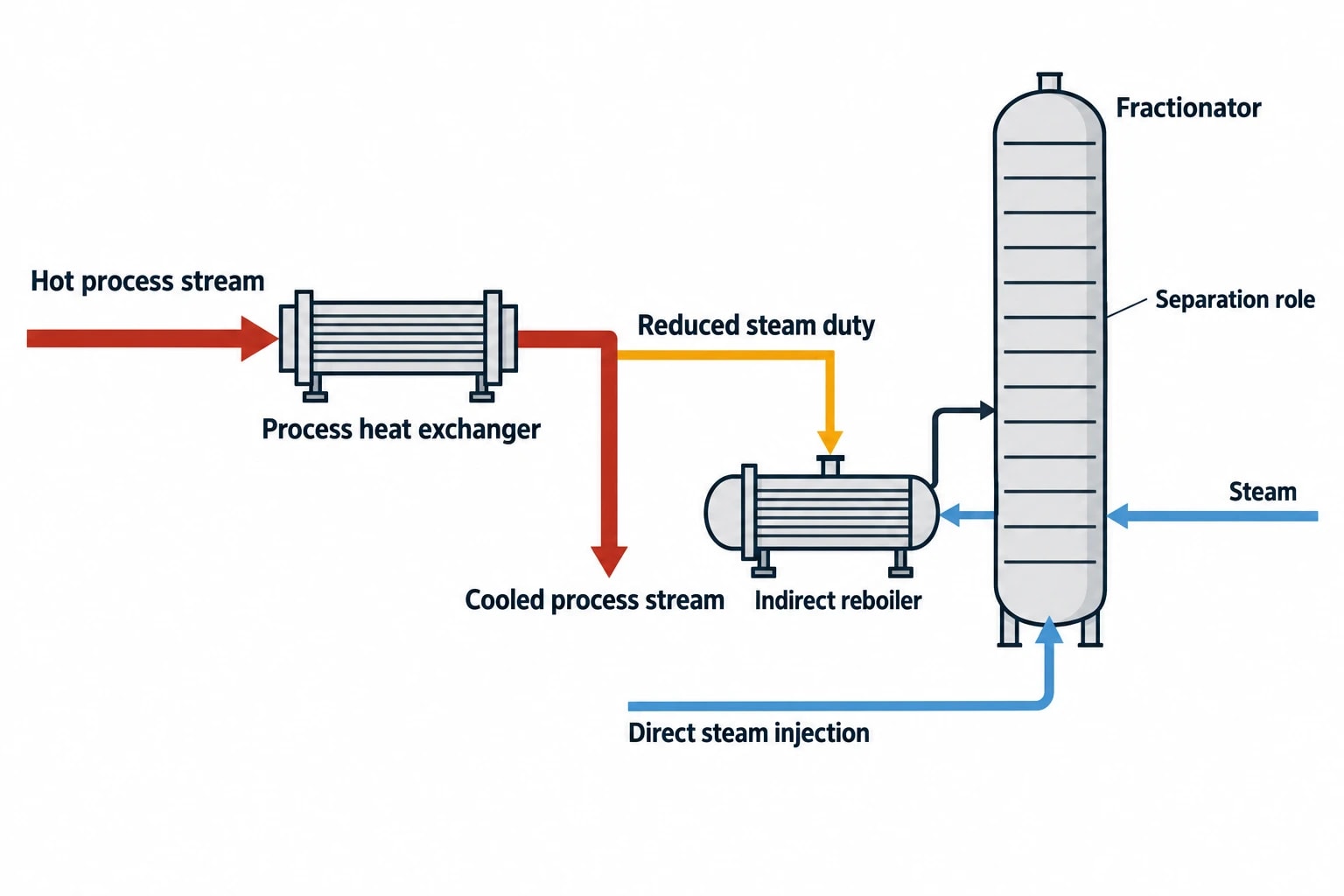
Columns, strippers and fractionators commonly use steam in indirect reboilers. Pinch analysis can identify process streams at a suitable temperature to supply part of that duty, reducing steam consumption.
The distinction between indirect heating and direct steam injection matters. Direct injection can influence stripping performance, vapour traffic, column pressure, product quality and sour-water handling. A heat-integration target identifies an opportunity, but process design must establish whether the steam has a separation role that heat recovery cannot replace.
Assess steam displacement across all pressure levels
A process match that displaces high-pressure steam has a different system value from one that displaces low-pressure steam. The steam may otherwise pass through a turbine, supply a critical process service or be produced from a waste-heat source with limited flexibility.
The refinery steam model should test each retrofit under representative configurations. It should include boiler firing limits, turbine minimum-flow constraints, let-down operation, imported electricity and any venting or surplus-steam conditions. This prevents a local duty reduction from being presented as a site-wide fuel saving without checking the utility consequences.

Pinch analysis identifies the thermodynamic minimum energy requirement of your process — then designs the heat exchanger network to achieve it.
How pinch analysis reduces cooling-water and air-cooling load
Heat recovery reduces cooling demand when it prevents useful high-temperature heat from reaching a cooler. The benefit can include lower cooling-water circulation requirements, reduced cooling-tower heat rejection, lower air-cooler fan power and released cooling capacity.
Recover high-temperature heat before it reaches a cooler
A common opportunity involves a hot product or pumparound stream that is cooled before storage or downstream processing while another stream receives steam or furnace duty. A new process-to-process exchanger can move part of that duty into the cold stream.
The final product temperature remains a real constraint. Some coolers must retain trim duty to protect storage limits, blending specifications or downstream operating conditions. Pinch analysis shows the target; detailed design identifies the cooling duty that must remain.
Evaluate cooling at the right temperature level
Duty alone does not determine heat-recovery value. A hot stream must be sufficiently hotter than the cold stream throughout the exchanger while maintaining the selected ΔTmin.
This is why large low-temperature cooling loads cannot be assumed to displace steam. A refinery may achieve a major reduction in high-temperature cooling while retaining low-temperature trim cooling. The relevant result is the minimum cold-utility target for the defined process and operating case.
Include cooling-system operating limits
Cooling-water systems face seasonal wet-bulb conditions, cooling-tower approach limits, fouling, corrosion-control requirements and allowable return temperatures. Air coolers face ambient temperature variation, fan electricity use, noise limits and plot-space constraints.
A practical project should report cooling results in engineering terms:
- Heat duty removed from cooling service.
- Expected effect on cooling-water supply and return temperatures.
- Circulating-water flow reduction where site data supports the estimate.
- Air-cooler fan-power implications.
- Cooling capacity released for other units.
Heat-duty savings should not be converted into water-use savings without site-specific cooling-tower data.
Turning pinch targets into operable refinery retrofits
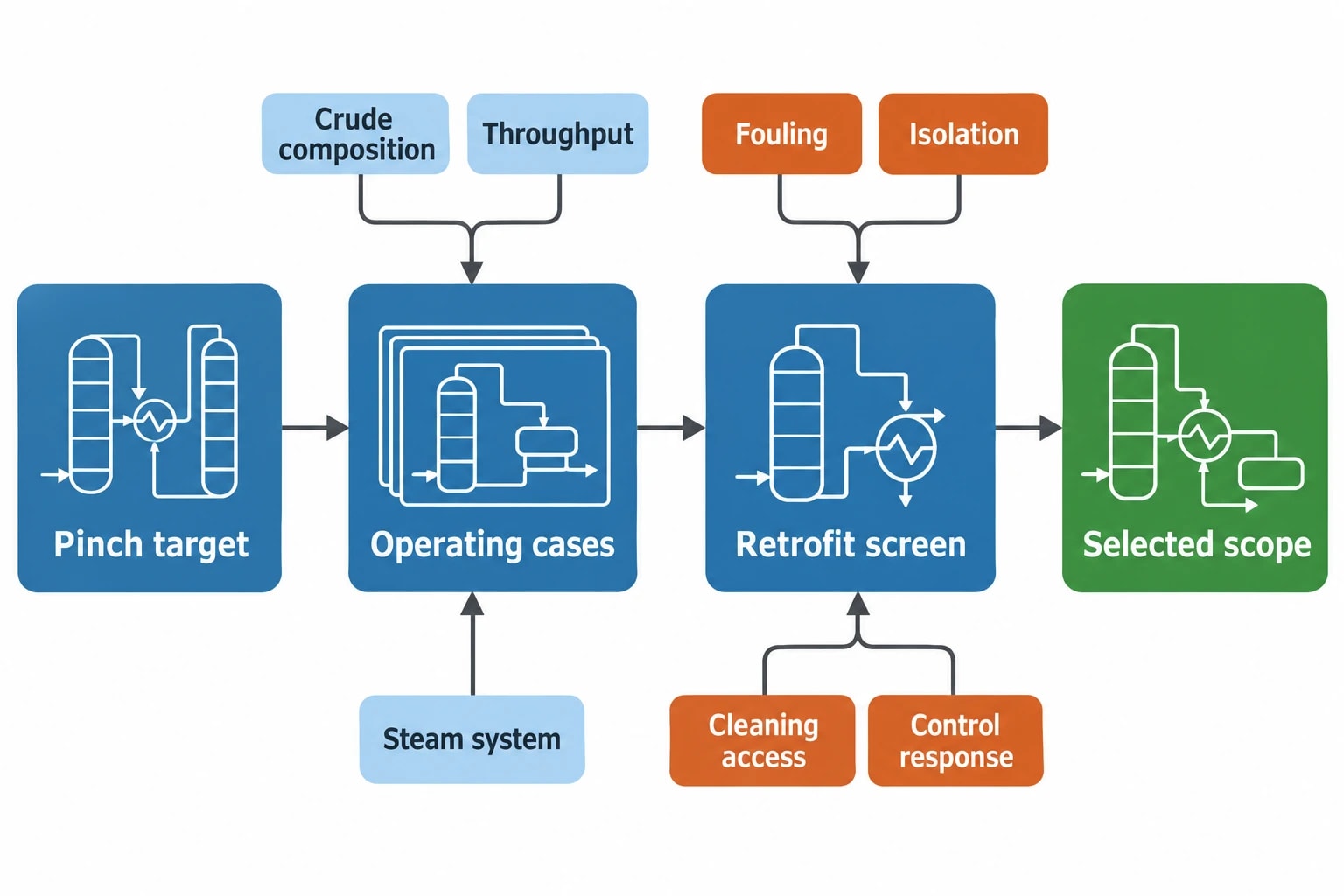
Pinch targets show the thermodynamic limit. Retrofit development determines which opportunities can operate safely, reliably and economically in an existing refinery.
Screen each match against process reality
A technically attractive match can fail if it adds unacceptable fouling, complicates control or creates a high-consequence leakage path. The project team should review exchanger type, mechanical design, pressure differential, isolation, cleaning access and control response before selecting an option.
Crude preheat projects require particular attention because fouling changes exchanger performance over a run. A design that reaches an attractive target shortly after cleaning may deliver less value before the next turnaround. The economic case should include expected fouling performance and any changes in cleaning frequency.
Use several representative operating cases
A single steady-state model can overstate annual savings. Crude composition, throughput, product slate, ambient conditions, hydrogen demand, maintenance states and steam-system configuration vary during the year.
Engineers should target and test several representative cases, then weight the results by expected operating time. This approach shows whether a retrofit delivers value through most of the year or only under a narrow set of conditions.
It also exposes constraints early. A boiler may have a minimum stable firing rate. A turbine may require minimum steam flow. A cooler may retain a temperature-control role even after process heat recovery increases. These conditions shape the final scope and expected savings.
Regulatory and energy-management context for EU refineries
Commission Implementing Decision 2014/738/EU sets the best available technique conclusions for mineral-oil and gas refining under the Industrial Emissions Directive 2010/75/EU. Under BAT 2, refineries should use an appropriate combination of energy-efficiency techniques.
The listed design techniques include pinch analysis, heat integration and heat-and-power recovery. The decision describes pinch analysis as a systematic calculation of thermodynamic targets for minimising process energy consumption and evaluating total system designs. It also identifies management and reduction of steam consumption as a process-control and maintenance technique.
This does not prescribe a universal exchanger arrangement or a fixed steam target. It makes documented engineering assessment valuable. Refinery teams should be able to show how they identified energy losses, evaluated feasible heat-integration options, considered utility-system effects and measured performance after implementation.
ISO 50001:2018 provides a compatible framework for energy objectives, energy performance indicators and continual improvement. For a refinery utility optimisation pinch analysis project, useful indicators may include furnace fuel per tonne of crude processed, steam generation by pressure level, net electricity import, cooling duty and cooling-water return temperature.
This article reflects the independent analysis and editorial opinion of EnerTherm Engineering. Product names, trademarks, and brands mentioned belong to their respective owners. EnerTherm Engineering is not affiliated with, endorsed by, or a licensee of any third-party software or product mentioned unless explicitly stated.

Technical Manager — EnerTherm Engineering
John Naranjo is Technical Manager at EnerTherm Engineering, bringing specialist expertise in chemical and environmental engineering. He recently led the implementation of Omni Vision, EnerTherm's real-time energy and utility monitoring platform. He holds an MSc in Environmental Engineering from the University of Huelva and a BSc in Chemical Engineering, with memberships in both the Energy Institute and IChemE.
