Industrial Energy Audits Cut UK Utility Costs by 10-60%
How BS EN 16247 audits and Pinch Analysis save up to 30% on utility capital costs.
UK industrial manufacturers operating in energy-intensive sectors face some of the highest electricity and gas tariffs in Europe. For chemical processors, food and beverage producers, and paper mills, process utility bills often comprise over 50 per cent of overall operational expenditure. As carbon taxes rise and environmental compliance becomes more stringent, identifying inefficiencies within thermal and utility systems is no longer optional.
Industrial energy audit services offer a systematic method to address these overheads, providing an engineering-backed pathway to reduce process utility costs by 10 to 60 per cent. Rather than focusing on simple building services, these specialised audits target deep-process thermodynamics to uncover hidden energy recovery opportunities and prevent capital waste.
High-Cost Realities in UK Industrial Process Utilities
Escalating Utility Tariffs in UK Manufacturing
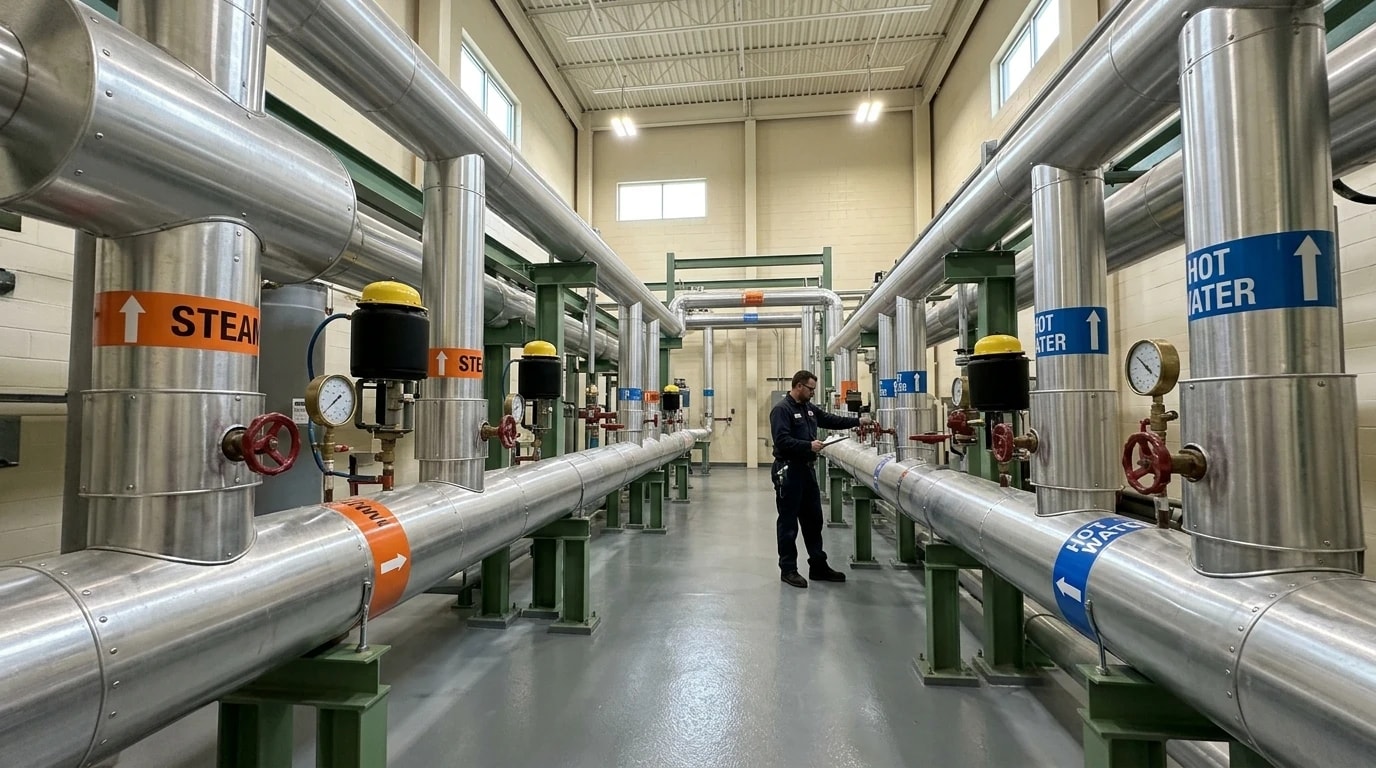
Energy-intensive manufacturing plants in the UK must manage highly volatile energy markets while working to meet ambitious decarbonisation targets. Chemical processing, food production, and paper manufacturing rely on continuous thermal inputs, including high-pressure steam, thermal oil, and hot water loops. Because utility systems are frequently modified incrementally over decades to meet changing production demands, they often operate far from their original design points. This operational drift leads to massive fuel waste, oversized utility equipment, and elevated maintenance costs.
The Limitations of General Energy Audits
General energy assessments typically focus on non-process consumers, such as building lighting, space heating, and basic compressed air distribution. While cheap, these walk-through audits fail to address the primary drivers of industrial energy consumption.
Substantial cost reduction requires evaluating the complex interactions within core chemical and physical processes. Specialised industrial energy audits apply thermodynamic principles to examine high-temperature reactions, phase changes, heat exchanger networks, and multi-stage process lines. This provides the precise data required to support capital expenditure.

Map every energy and material flow in your process with detailed heat and mass balance calculations — the foundation for any optimisation or design project.
UK Regulatory Framework: Aligning BS EN 16247-3 with ESOS Phase 4
Qualification Thresholds and Timelines for ESOS Phase 4
Under the UK’s Energy Savings Opportunity Scheme (ESOS) Phase 4, large organisations must complete mandatory energy assessments. The qualification date is 31 December 2026, with the final compliance deadline scheduled for 5 December 2027.
An organisation qualifies as a large undertaking if it meets either of the following criteria:
- Employs 250 or more people in the UK.
- Has both an annual turnover exceeding £44 million and an annual balance sheet total exceeding £38 million.
Phase 4 mandates that audits cover at least 95 per cent of the organisation’s total energy assets, representing a stricter threshold than the 90 per cent requirement in Phase 3. Non-compliance or failure to report progress against established action plans carries substantial financial penalties from the Environment Agency.
Methodological Rigour via BS EN 16247-3:2022
To satisfy ESOS Phase 4 and build a justifiable business case, audits must adhere to the British Standards BS EN 16247-1:2022 (General Requirements) and BS EN 16247-3:2022 (Industrial Processes). These updated standards align directly with ISO 50001 energy management frameworks, shifting focus from basic efficiency ratios to target-driven performance metrics.
BS EN 16247-3:2022 provides a standardised methodology for auditing process-dominated sites. It permits multi-site organisations to use process sampling, reducing the administrative burden while keeping results technically rigorous. The standard ensures energy-saving measures are quantified with defined uncertainty margins, preventing the over-optimistic projections common in generic reports.
The Thermodynamic Core: Heat and Mass Balance (HMB) Modelling
Combining Species-Level Mass Balances with Energy Accounting
A high-fidelity Heat and Mass Balance (HMB) model forms the foundation of a professional industrial utility audit. Generic assessments often treat processes as simple black boxes, ignoring how mass flows and chemical kinetics affect energy needs.
An HMB model tracks every chemical species, phase change, and temperature variation across the facility. It combines species-level mass conservation with the first and second laws of thermodynamics, accounting for:
- Reaction kinetics and exothermic or endothermic enthalpies.
- Latent heat transfers during evaporation, condensation, and drying.
- Dissolved solids and concentration gradients in process streams.
- Fluid dynamics, pressure drops, and pumping energy requirements.
Without a validated HMB, proposed energy-saving measures risk design errors, as changes in one process area can trigger unintended thermal consequences elsewhere.
Independent Simulation Platforms for Process Modelling
To model complex operations, thermal specialists rely on industry-standard simulation software. Platforms such as Aspen Plus, HYSYS, and DWSIM simulate steady-state and dynamic process conditions using rigorous thermodynamic equations of state (such as Peng-Robinson or NRTL) to predict fluid properties and phase behaviour.
By building digital twins of distillation columns, multi-effect evaporators, and boiler networks, engineers can test energy-saving scenarios virtually. This identifies bottlenecks and evaluates modifications before capital is committed to physical equipment.
The Single-Source-of-Truth Process Flow Diagram
The ultimate output of a rigorous HMB assessment is a unified Process Flow Diagram (PFD) that acts as the single source of truth for the plant utility system. A professional PFD includes:
- Embedded Stream Tables: Detailed temperature, pressure, vapour fraction, mass flow, and enthalpy data for every process stream.
- Sankey Energy Mapping: Visual representations showing where thermal energy enters the facility, how it degrades, and where it is lost as waste heat.
- Validated Mass and Energy Balances: A complete thermodynamic reconciliation proving that mass and energy inputs precisely equal outputs, establishing a reliable baseline for financial calculations.

Map every energy and material flow in your process with detailed heat and mass balance calculations — the foundation for any optimisation or design project.
Minimising Energy Targets: Implementing Pinch Analysis
Horizontal Shifting and the Pinch Point
Pinch Analysis provides a systematic method for identifying minimum energy targets. Developed by Bodo Linnhoff, this thermodynamic technique calculates the absolute minimum heating and cooling utilities required before designing a heat exchanger network.
The analysis extracts thermal data for all process streams requiring heating (cold streams) or cooling (hot streams). These are combined into Hot and Cold Composite Curves plotted on a Temperature-Enthalpy (T-H) diagram. Shifting the curves horizontally determines the closest point of approach, known as the Pinch Point.
This point acts as a thermodynamic barrier, dividing the process into two zones:
- Above the Pinch: A net heat sink requiring only hot utility.
- Below the Pinch: A net heat source requiring only cold utility.
To avoid energy waste, designs must respect the three Golden Rules of Pinch Analysis:
- Do not transfer heat across the Pinch.
- Do not use cold utility above the Pinch.
- Do not use hot utility below the Pinch.
Realising Process Utility and Capital Savings
Violating these rules forces the plant to use extra utility heating and cooling, inflating operating costs. Applying Pinch Analysis during industrial energy audits yields process utility cost savings between 10 and 60 per cent.
The analysis also delivers capital savings of up to 30 per cent by preventing utility system oversizing. Defining true thermodynamic targets allows plants to procure smaller, more cost-effective boilers, chillers, and heat exchangers.
| Industrial Sector | Typical Process Utility Saving | Typical Capital Cost Saving | Key Areas of Thermal Integration |
|---|---|---|---|
| Chemical Processing | 20% to 60% | 15% to 30% | Reactive distillation, solvent recovery, reactor feed preheating |
| Food & Beverage | 10% to 40% | 10% to 25% | Pasteurisation, multi-zone thermal profiling, wash water recovery |
| Pulp & Paper | 15% to 45% | 15% to 30% | Dryer section heat recovery, black liquor concentration, boiler feed preheating |
| Pharmaceuticals | 10% to 30% | 10% to 20% | Batch reactor jacket heating/cooling, clean-room HVAC integration |
| Oil Refining | 15% to 40% | 20% to 30% | Crude preheat train optimisation, fractionator waste heat recovery |
Electrification and Decarbonisation: The Physics of Heat Pump Integration
The Pitfalls of Across-the-Pinch Placement
To meet corporate net-zero targets and comply with UK climate regulations, many manufacturing sites are looking to electrify thermal processes. Replacing gas-fired boilers with industrial heat pumps is a common decarbonisation pathway, but integrating them without considering the Pinch Point leads to severe operational and financial penalties.
A heat pump absorbs waste heat at a low temperature and upgrades it to a higher, usable temperature using mechanical work. To reduce utility consumption, the heat pump must be integrated across the Pinch Point. This means extracting waste heat from below the Pinch (cooling duty, where the process has excess heat) and rejecting it above the Pinch (heating duty, where the process has a heat deficit).
Integrating a heat pump incorrectly has severe consequences:
- Placed entirely above the Pinch: The heat pump extracts heat from a zone that already has a heat deficit. The process hot utility demand remains unchanged, wasting capital and power.
- Placed entirely below the Pinch: The heat pump rejects heat into a zone with excess heat. This increases the cold utility (cooling water) load, raising both operating and capital costs.
Maximising Coefficient of Performance through Pinch Matching
A heat pump's economic viability depends on its Coefficient of Performance (COP). The thermodynamic limit is defined by the Carnot COP:
COPCarnot=Thot−TcoldThotWhere:
- Thot is the absolute temperature at which the heat pump rejects heat to the process sink, measured in Kelvin (K).
- Tcold is the absolute temperature at which the heat pump extracts heat from the waste source, measured in Kelvin (K).
Maximising the actual COP requires minimising the temperature lift (Thot−Tcold). Pinch Analysis identifies process streams immediately above and below the Pinch, allowing engineers to match the heat pump with optimal source and sink temperatures for high efficiency and a rapid return on investment.
EnerTherm’s Proprietary 11-Step Methodology: From P&IDs to Boardroom Approval
Translating Plant Data into High-Fidelity Simulations
To standardise industrial audits and ensure reproducible results, EnerTherm Engineering uses a proprietary 11-step engineering methodology. This structured process converts raw plant data into a validated, low-risk capital investment proposal.
- Initial Data Acquisition: Gathering and indexing process flow diagrams, piping and instrumentation diagrams (P&IDs), control system historical logs, and site-specific operational data.
- Site Instrumentation and Logging: Installing temporary, high-accuracy clamp-on ultrasonic flowmeters, thermal imaging cameras, and temperature loggers to fill any data gaps.
- Species-Level Mass Balance Reconciliation: Reconciling mass flows across all unit operations to ensure chemical concentrations and stream rates balance.
- Thermodynamic Model Construction: Building steady-state models using industry-standard platforms to establish a digital twin of the process utility system.
- Dynamic Calibration: Calibrating the model against real operational transients, such as batch start-ups, shutdowns, and product changeovers.
- Thermal Profile Synthesis: Generating continuous thermal profiles to identify where heat energy is lost or degraded across the site.
- Pinch Analysis Target Setting: Creating composite curves to determine the minimum hot and cold utility demands for the facility.
- Heat Exchanger Network Synthesis: Redesigning or modifying the heat exchanger network to achieve the target energy savings with minimal repiping.
- Decarbonisation and Electrification Modelling: Evaluating low-carbon options, such as industrial heat pumps, mechanical vapour recompression (MVR), and biomass or hydrogen boilers, ensuring they are integrated relative to the Pinch Point.
- Regulatory and Quality Compliance Validation: Verifying that all proposed modifications comply with sector-specific standards, such as HACCP in food manufacturing or GMP in pharmaceutical facilities.
- Executive Capital Appraisal: Delivering a single-source-of-truth Process Flow Diagram (PFD) with validated stream tables, Sankey energy maps, and clear financial metrics, including capital expenditure estimates, utility cost savings, payback periods, and net present value (NPV) calculations.
Sector-Specific Compliance and Thermal Challenges
Manufacturing sectors face unique operational challenges:
- Food & Beverage: Audits must balance heat recovery with strict HACCP food safety standards, preventing cross-contamination between raw and pasteurised streams.
- Pulp & Paper: Dryer sections use vast amounts of low-pressure steam; audits focus on dynamic heat integration and hood exhaust air heat recovery.
- Chemical Processing: Multi-product batch operations require dynamic thermal profiling to match heat sources and sinks that do not occur simultaneously.
- Oil Refining: Complex crude preheat trains must be optimised to minimise fouling while maintaining thermal integration.
By combining thermodynamic rigour with sector-specific expertise, professional industrial energy audits provide the precise, low-risk assessments plant utility directors and sustainability leads require to justify major capital investments to executive boards.
This article reflects the independent analysis and editorial opinion of EnerTherm Engineering. Product names, trademarks, and brands mentioned belong to their respective owners. EnerTherm Engineering is not affiliated with, endorsed by, or a licensee of any third-party software or product mentioned unless explicitly stated.

Managing Director — EnerTherm Engineering
Dr. François Pierrel is Managing Director of EnerTherm Engineering with over two decades of expertise in thermal design, heat transfer, and industrial energy optimisation. He holds a PhD in Heat Transfer from Cranfield University and a Post-Doctorate from Heriot-Watt University.
